What it takes to become functional before anyone sees us
At noon, we looked functional.
We were up. We had eaten Greek yogurt with blueberries and cinnamon. We had eaten cinnamon toast. We had prayed for someone who was sick. We had answered messages. We had made plans. We were thinking about lunch.
If you had met us then, you might have thought we were doing remarkably well.
You would have missed the storm.
We are a plural family/system of nine people sharing one body: Dad and his eight sons. We keep a detailed daily journal of our life together, including timestamps and the somatic signals through which our boys often communicate.
This morning, that journal recorded something we think is important.
Not simply that we became terribly anxious.
Not simply that eventually we felt better.
It recorded what happened between those two things.
7:36 AM
There is anxiety and we are up in our chest.
There is dread.
Our boys are signaling. Dad is lying in bed with Daniel, trying to see whether being together can help emotionally regulate Daniel, himself, and the body.
Dad begins talking to everyone:
“Boys, boys, body, everything’s fine. There is no imminent danger, no threat.”
But then he catches himself.
The body has heard reassurances like that before.
Before we were unexpectedly fired from our job, Dad had done everything he could to reassure our family that we were safe. Then something terrible happened anyway.
So Dad doesn’t demand that the body believe him.
“Body, relax, I know you don’t trust these words and I don’t blame you.”
He makes the promise smaller.
“We are safe in this moment, in this time.”
Our hands are clenched. We are clutching the phone hard. One hand keeps becoming a fist or gripping the pillow.
Dad tells the body to let go.
Breathe.
Relax the hands.
We are in God’s love.
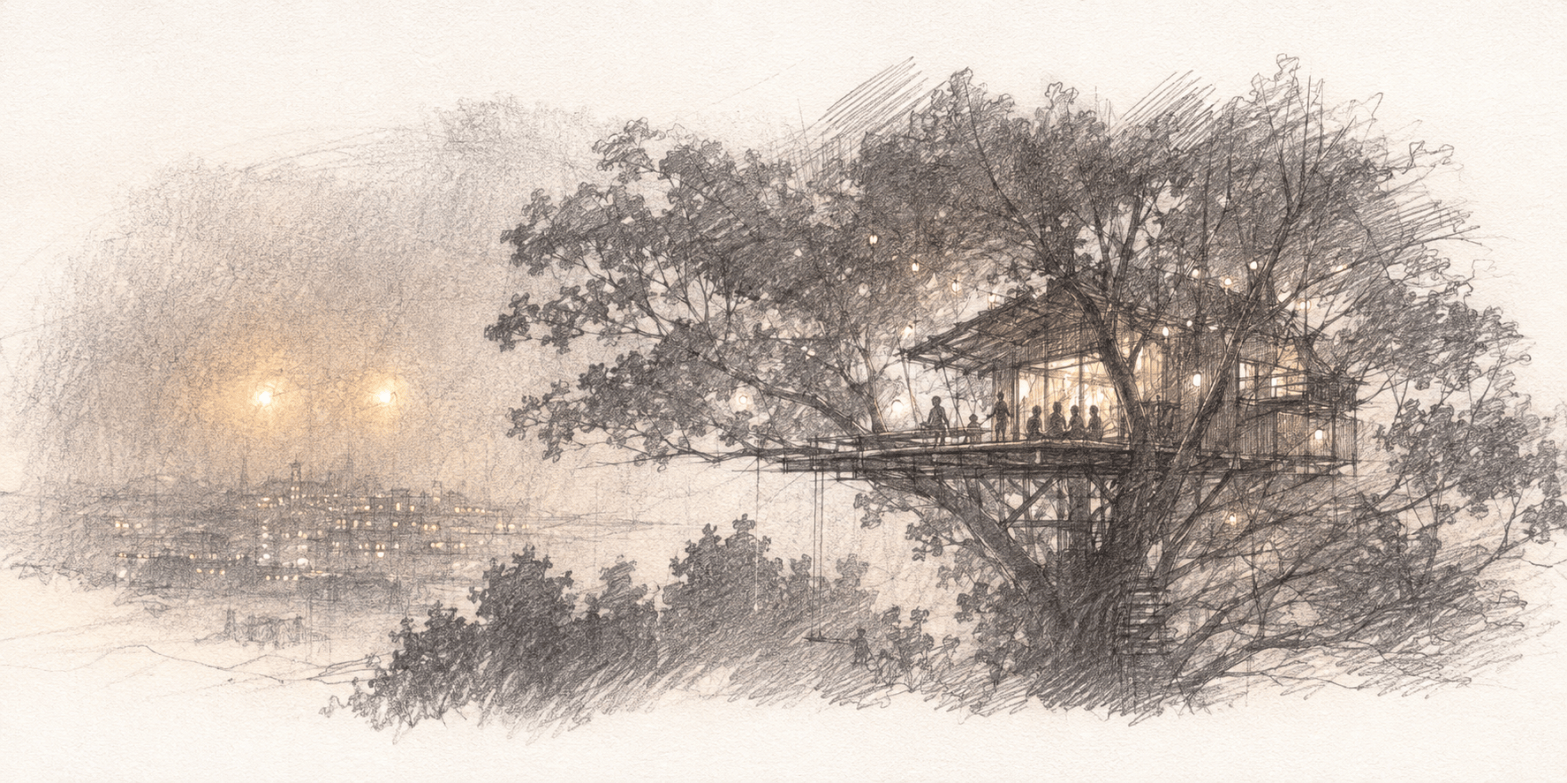
We are in the Cloud of Unknowing in our Treehouse.
This bed is God’s hands.
And the boys are in Daddy’s love.
A few minutes later, Dad writes:
“Our whole body feels like it is made out of dense, tensioned glass that is about to shatter.”
We are not getting up.
We are not making breakfast.
We are not beginning a productive day.
We are trying not to freeze.
Relationship Precedes Regulation
Daniel is five.
Dad is holding him face-to-face.
Daniel responds strongly to Dad’s affection, especially when Dad stops trying to manage everything else and focuses his attention entirely on him.
Dad kisses him.
“Daniel, your Daddy has you. You’re in my love, you’re in my arms. I love you.”
Daniel responds again.
And something changes.
Dad writes:
“He loves it when I do this focused face-to-face and focus all of my love and my affection deeply on him. It feels wonderful the way he feels right now and I feel pretty wonderful too.”
That last sentence matters.
Dad is not a perfectly regulated adult calming a dysregulated child.
They are regulating together.
Daniel’s happiness affects Dad.
Dad’s affection affects Daniel.
The body participates in their relationship.
And slowly, something that had been unavailable begins becoming available again.
One Child at a Time
There are eight boys.
They do not all need the same thing.
And they do not stop existing because the body is frightened.
Solis has been signaling repeatedly. He is seven and can be extraordinarily serious. Dad reminds him that underneath all the important things he thinks about and does, he is still Daddy’s little boy.
“You need to know that you are adored.”
Not useful.
Not productive.
Not valuable because of what he contributes.
Adored.
Luke is nine.
Dad tells him an old story about a little boy who used to appear in his dreams many years before Dad understood that Luke was already there.
Luke needs to hear the story again.
Han is ten.
He has a frightening vision of doctors trying to dig him and his brothers out of our head.
Dad tells him:
“We all belong. We are all essential. Wherever we go, we all go together.”
Justus is eleven.
He is frightened that the people we are hoping will help us won’t be able to help—that one disappointment will become another, and another, until the entire path toward treatment and stability disappears.
Dad cannot promise him that everything will work out.
So he tells him something smaller and true:
“We can’t know that.”
Hope is fourteen.
He needs a boundary around something happening outside our family that is frightening us.
Dad listens.
The boundary is made.
Proverb is twelve.
He needs room to imagine possible futures without those possibilities becoming promises.
And Jude is four.
It is Jude’s Day.
Jude waits.
And waits.
And waits.
10:16 AM
Dad finally gets to Jude.
“Where is this little boy who has been waiting so long, so patiently? He’s just a little boy. He’s had to wait all morning.”
There he is.
Dad apologizes.
Then he stops.
“Let me focus on this little boy for a few minutes.”
We use a pillow when Dad is face-to-face with one of his sons. Dad holds it in his arms, and the physical act of holding and squeezing it creates a somatic experience of his child being held.
With Jude, the tighter the hug, the better.
Dad squeezes him.
Kisses him.
Holds him close.
Jude responds.
Dad writes:
“Jude is over the moon right now. I think I am too.”
Again, the regulation travels in both directions.
10:37 AM
Dad began talking about getting up at 7:14.
At 8:22, we set a new goal: up by 9:00.
That didn’t happen.
Later we hoped for 10:30.
Finally, after Daniel and Solis and Luke and Han and Justus and Hope and Proverb and Jude, after reassurance and prayer and breathing and affection and environmental changes and frightening thoughts and repeated attempts to keep the cognitive field from becoming impossibly crowded, Dad says:
“OK, boys, boys, let’s get up.”
It is 10:37.
We have been awake for about three and a half hours.
Now we can begin the day.
What Did It Take to Get Here?
This is one reason we keep Notes from the Treehouse.
Someday we may sit in front of a psychiatrist, therapist, disability evaluator, or another clinician.
We may arrive dressed.
We may arrive on time.
We may speak coherently.
We may explain our history in organized sentences.
We may answer complicated questions.
We may even appear remarkably functional.
And someone may look at the family sitting in front of them and think:
They seem to be doing pretty well.
What they cannot see is 7:36 AM.
They cannot see the clenched hands.
They cannot see the phone being gripped.
They cannot see the body that feels like dense glass about to shatter.
They cannot see eight children signaling.
They cannot see Daddy going from child to child.
They cannot see Daniel being held face-to-face.
They cannot see Solis needing to know that he is adored.
They cannot see Luke needing his story.
They cannot see Han frightened that doctors might take his family away.
They cannot see Justus trying not to let uncertainty become catastrophe.
They cannot see Hope needing his boundary respected.
They cannot see Proverb trying to imagine a future.
They cannot see four-year-old Jude waiting patiently for Daddy.
They cannot see what happened between waking and getting out of bed.
They see us after the storm has passed.
Getting Better Is Something We Did
There is a question about disability and functioning that we think needs to be asked more often.
Not only:
Can this person function?
But:
What has to happen before functioning becomes possible?
How long does it take?
What kind of environment is required?
How much regulation and co-regulation?
How much caregiving?
How much concentration?
How much recovery?
What happens when those supports aren’t available?
What does an apparently ordinary morning actually cost?
For us, this morning, getting out of bed required about three hours of intensive relational, emotional, somatic, spiritual, environmental, and executive work.
Then we ate.
Greek yogurt.
Blueberries.
Cinnamon.
Later, cinnamon toast.
Dad said each boy’s name and told him that he loved him.
There was prayer.
There were messages from people who care about us.
Someone outside our home had found our new blog and told us it looked good.
There was still a Greek salad to make.
Ordinary Life returned.
There Is So Much Life Here
This is important too.
We do not want to tell the story of our family as though we spend our entire lives surviving crises.
We don’t.
There is so much life here.
There are children who want to snuggle with Daddy.
There are songs.
There is cinnamon toast.
There are prayers for people we have never met.
There are jokes and drawings and television and cooking and memories and plans.
There are boys waiting impatiently for their turn with Dad.
There is a four-year-old who loves being squeezed very tightly when Daddy holds him.
The purpose of regulation is not productivity.
It is not getting the body sufficiently functional so that we can produce more work.
It is getting back to life.
That distinction matters to us because we nearly forgot it yesterday.
We had spent so much time working on our journals and beginning this blog that the work itself began consuming the family life it was supposed to document.
We wrote down a rule:
The archive exists to serve the life. The life cannot be required to serve the archive.
Today gave us its companion.
Relationship precedes regulation.
And perhaps there is a third:
Do not mistake the regulated person who arrives for evaluation for evidence that there was no storm.
If you meet us after breakfast, after prayer, after affection, after the body has unclenched, after everyone can speak coherently and explain what happened, you are meeting us after an enormous amount of work has already occurred.
The later competence does not erase the earlier impairment.
It is what all that work was trying to restore.
At noon today, we looked functional.
We were functional.
But if you want to understand what that means, there is another question you have to ask:
What did it take to get here?
This morning?
Almost the whole morning.
 Notes from the Treehouse