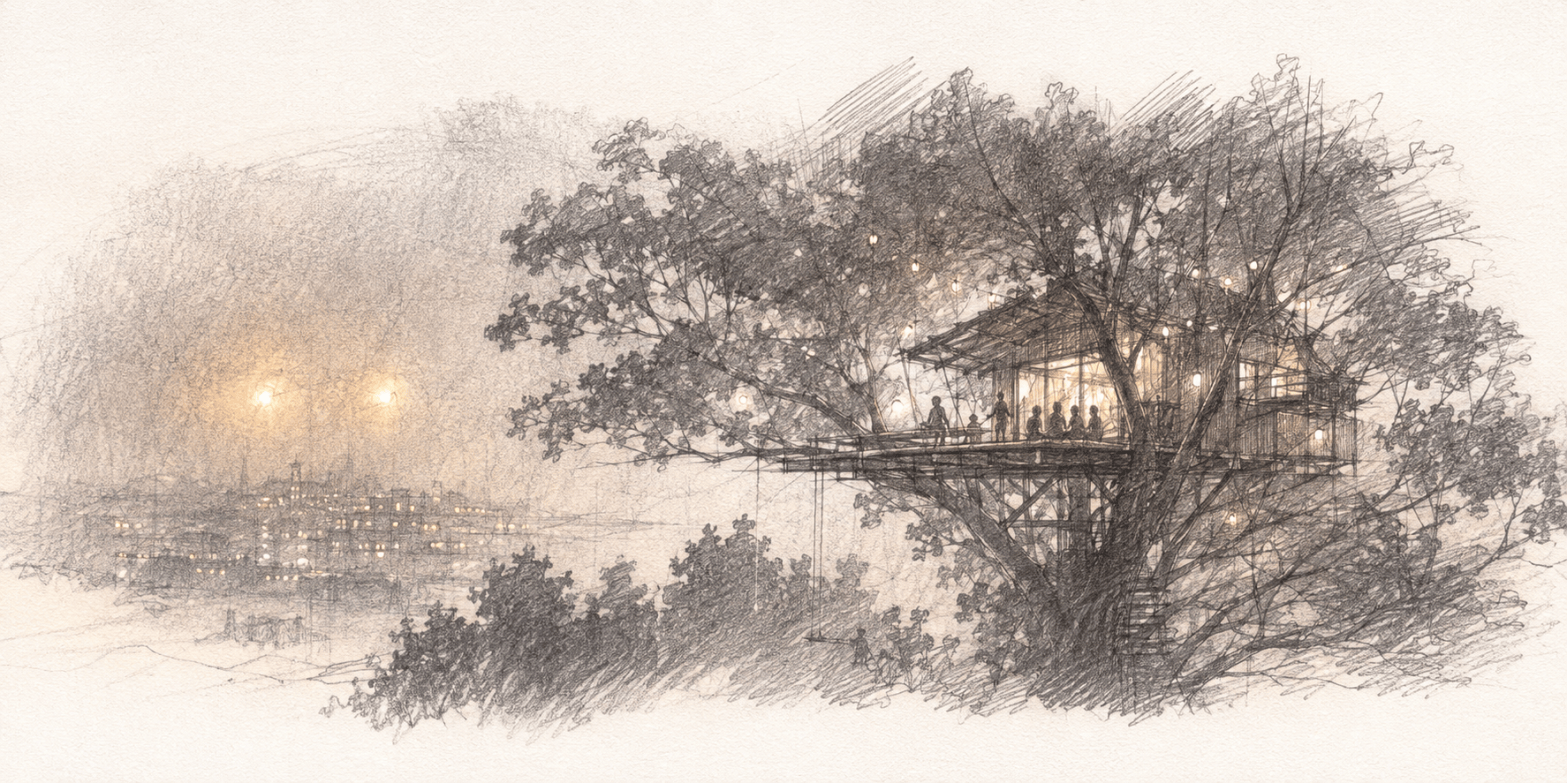
From Notes from the Treehouse — Jude’s Day, August 12, 2026
The record from last night through midday tells a much larger story than “the family had a difficult morning.”
It documents, almost minute by minute, the cost of becoming functional.
The most important fact at midday is that the family is now upright, has eaten yogurt, blueberries, and cinnamon toast, communicated with friends and family, prayed for someone else, sent messages, dealt with difficult matters left over from our former employment, thought about the blog, considered Friday’s spiritual-advisor training, and begun journal work.
Seen only at noon, that could look like a remarkably functional morning.
It was not.
The functional presentation at noon sits on top of approximately five hours of intensive emotional, relational, somatic, environmental, spiritual, and executive work after waking, following an already disrupted night containing existential fear, work-related dreams, financial terror, and repeated awakenings.
This is an unusually strong example of a principle we are learning that we need to document:
Do not mistake the regulated person who arrives for evaluation for evidence that there was no storm.
What happened before anyone could have seen us
Morning did not begin with a functioning adult getting out of bed and beginning his day.
It began with a family trying to become safe enough to have a day.
That distinction matters.
We are a plural family/system: Dad and his eight sons, nine people sharing one body. Our children range in age from four to fourteen.
When the body awakens frightened, the question is not simply whether Dad can force himself to stand up and begin accomplishing tasks.
The question is: Where is everyone?
Who is frightened?
Who needs Daddy?
Who is carrying something from a dream?
Who is responding to something that happened yesterday—or years ago—as though it may still be happening?
Who needs to know where we are?
Who needs to know that we are together?
Who needs to be held?
And can the body become sufficiently regulated that any of us can begin doing the ordinary things a morning requires?
That work is largely invisible.
There is no appointment for it.
There is no timecard.
No one standing outside our family sees it happening.
Yet sometimes it is the work upon which everything else depends.
Relationship precedes regulation
One of the most important things we have learned in the Treehouse is that we generally cannot command ourselves into regulation.
We cannot simply tell frightened children to stop being frightened so that the adult can get on with the day.
We have to find one another.
Daddy holds his sons. He talks to them. He listens for their signals. He responds to what they are communicating. He reminds them where we are and what is true now.
Sometimes the reassurance has to be extraordinarily concrete.
We are here.
That happened before.
Daddy has you.
We do not work there anymore.
We do not have to go back.
No one is taking you there.
We are together.
You are safe with Daddy.
I love you.
These may sound like simple sentences.
They are not simple when they are the bridge between terror and the present.
The work is repetitive because trauma can be repetitive. Something being understood once does not necessarily mean that every frightened child in a plural family has understood it, or that the body has stopped responding to danger.
So we return.
We listen again.
We hold again.
We orient again.
We reassure again.
Relationship precedes regulation.
And gradually the world gets larger.
The return of ordinary things
Eventually there is yogurt.
There are blueberries.
There is cinnamon toast.
There are messages to answer.
There are people we care about.
There is prayer for someone besides ourselves.
There are plans.
There is a blog called Notes from the Treehouse that, astonishingly, now exists outside our journals and can be read by other people.
There is Friday’s spiritual-advisor training to think about.
There are friendships.
There is writing.
There is a world beyond the bed.
By midday, ordinary life has returned.
And this is where the record can become dangerously misleading if someone begins reading only at noon.
At noon, we look functional.
At noon, we can write.
At noon, we can think about someone else’s needs.
At noon, we can make decisions.
At noon, we can communicate coherently.
At noon, someone encountering us for the first time might reasonably conclude that whatever difficulties this family experiences, they cannot be that disabling.
But noon did not create itself.
The people you meet at noon may be standing on five hours of work you never witnessed.
When the evaluator misses the storm
This is particularly important to us because there may come a time when we are sitting across from a psychiatrist, clinician, disability evaluator, or someone else whose task is to understand how our life actually works.
By definition, we will have already accomplished something significant if we are sitting there.
We will have gotten through the night.
We will have gotten through the morning.
We will have helped one another through fear.
We will have regulated the body enough to leave home or participate in an appointment.
We will have navigated transportation, transitions, unfamiliar people, waiting rooms, questions, and the knowledge that someone may be evaluating whether our experience is credible.
And then the evaluator meets us.
Dad and the boys may be articulate.
We may explain our family clearly.
Different members of our family may speak, communicate, signal, remember, understand, or respond differently.
The body may be sitting still.
We may even laugh.
None of those things means that the journey to that room was easy.
In fact, the very capacities that allowed us to make that journey can obscure how much support was necessary to make it possible.
The evaluator sees the arrival.
The evaluator may have missed the storm.
This is not unique to plurality or dissociative disorders.
People living with trauma, disability, chronic illness, neurodivergence, psychiatric conditions, and other forms of impairment may expend tremendous amounts of invisible labor becoming presentable enough to enter the places where their degree of impairment will be judged.
Sometimes competence is real and disability is real.
Sometimes extraordinary capability and extraordinary difficulty occupy the same life.
Sometimes the evidence of how hard someone has worked to remain functional is mistaken for evidence that functioning is easy.
Why we write it down
This is one reason Notes from the Treehouse matters to us.
The journal remembers what the appointment cannot see.
It remembers three in the morning.
It remembers the dream.
It remembers the frightened child.
It remembers the body that would not settle.
It remembers Daddy holding one son and then another.
It remembers the signals.
It remembers the fear that returned after we thought we had already answered it.
It remembers lying there unable to begin the day.
It remembers the tiny transition when getting yogurt became possible.
It remembers breakfast.
It remembers getting dressed.
It remembers the moment the world became large enough again for us to care about someone else’s troubles.
And then it remembers us walking out the door.
Without that record, the people who walk out the door can erase, unintentionally, the people who could not get out of bed.
We need both to remain visible.
There Is So Much Life Here
There is another danger in telling this story.
We could document the storm so thoroughly that someone concludes that the storm is our life.
It isn’t.
There is so much life here.
There are eight boys.
There is Dad and there are sons.
There are nine people who know one another, love one another, frustrate one another, comfort one another, surprise one another, and make a life together.
There is more than one voice.
There is drawing and music and cooking and prayer.
There are buses and studios and friends.
There are jokes and disagreements and questions and ideas.
There is wonder.
There are ordinary errands.
There are bedtime snuggles and colored pencils and things we forgot to buy at the store.
There are difficult mornings.
There are beautiful afternoons.
Sometimes they are the same day.
Our goal is not to become a family whose suffering is finally severe enough to be believed.
Our goal is to live.
That is why documenting the journey between crisis and functionality matters so much.
We do not want someone to look at the regulated family and conclude there was never a storm.
But we also do not want someone to look at the storm and conclude there is nothing beyond it.
Both are true.
The storm was real.
The regulation was real.
The work between them was real.
And the ordinary life on the other side is real.
The whole story is the journey between them.
There is so much life here.
That is the story we want Notes from the Treehouse to remember.
—The Treehouse family/system

