On family, systems, DID, language, AI, and finding one another
From Notes from the Treehouse — August 13, 2026
Tonight we were talking with ChatGPT about whether anyone can find us.
It sounds like a technical question.
We have only just begun publishing Notes from the Treehouse, and tonight we were trying to understand our first WordPress statistics. What exactly is a visitor? What is a view? If six visitors came to today’s post, did that probably mean six different people had found us?
That led to a larger question:
How does anyone find us at all?
We wondered what would happen if someone who knew nothing about Notes from the Treehouse went looking.
So we asked ChatGPT to try.
It searched as though it were a stranger.
It couldn’t find us.
Not yet.
Our little Treehouse has only just appeared on the Internet, so perhaps that isn’t surprising. But the experiment led us somewhere much more interesting.
We began thinking about the words someone might use when trying to find people like us.
And we realized that they might not be our words.
Why we call ourselves a plural family/system
We call ourselves a plural family/system.
Both of those words are there deliberately.
System is language that many people in plural communities recognize. It is language someone might search for. It gives us a way of locating ourselves within a much larger community of people whose experiences are enormously varied but who may nevertheless recognize something of themselves in our lives.
But family is the word that most naturally describes how we understand ourselves.
Dad has eight sons.
The boys have brothers.
We share one body and one life.
We cook dinner. We take buses. We draw. We pray. We get frightened. We laugh. We go grocery shopping. We lose things. We find things. We have difficult nights and beautiful mornings. Daddy tucks his children into bed.
We are trying to live what we have come to call Ordinary Life.
We know that people in the larger plural and DID communities use many different words to describe themselves and their experiences. People may speak of systems, alters, headmates, parts, identities, dissociative identities, Dissociative Identity Disorder, and many other things.
Some of those are not words we use for ourselves.
That doesn’t make them wrong.
And our language doesn’t need to be right for anyone else.
One of the things we value about plural communities is the recognition that people’s experiences can be profoundly different. There does not need to be one vocabulary that everyone adopts before we are allowed to recognize one another.
We don’t want our language imposed upon someone else.
And we don’t want someone else’s language imposed upon us.
This is simply how we understand ourselves.
For us, family isn’t a euphemism for something else.
Dad’s sons are his sons.
Their brothers are their brothers.
And increasingly we have wanted the language surrounding our lives to reflect the relationships we are actually living rather than continually translating those relationships into diagnostic or clinical terminology.
That is part of what Ordinary Life means to us.
But we still say family/system.
Why?
Because we want you to find us.
Meeting people where they’re at
Someone who is frightened and confused and searching the Internet late at night probably isn’t typing:
plural family with children living Ordinary Life.
They may search for:
DID system communication.
Or:
How do I know who is present in my system?
Or:
Can alters communicate through body sensations?
They may use words we wouldn’t ordinarily use around our dinner table.
And tonight we realized that perhaps some of those words belong in our tags, descriptions, and other signposts—not because we have changed what we call ourselves, but because we understand what it is like to search.
Dad put it this way:
Maybe by meeting people where they’re at, it will help them meet us where we’re at.
That feels important.
We don’t need to change the language inside the Treehouse.
We can put signs on some of the roads leading to it.
Something more than messages in bottles
One of the strangest things about becoming a plural family has been discovering how difficult it can be to find other people living experiences anything like ours.
For years, we have sometimes felt as though we were sending messages in bottles.
Then every once in a while we find something.
A comment.
A discussion.
A sentence written years ago by a stranger.
Someone describes an experience we thought might happen only to us.
And suddenly:
There you are.
That has happened to us in enormously important ways.
Sometimes the Internet has given us language for something we had experienced for years without knowing what to call it.
Sometimes discovering that other plural people experienced something similar transformed something bewildering into something wonderfully ordinary.
Not special.
Not proof that we were uniquely strange.
Just something other people knew about, too.
There is tremendous comfort in ordinary.
And that is one reason we are putting our journals into the world.
No, we are not alone. We are desperately seeking community.
We want community with other plural people and systems. We especially hope someday to find other plural families/systems with children.
We want to encounter people whose experiences resemble ours and people whose experiences don’t.
We hope clinicians, friends, families, allies, and people simply trying to understand may wander into the Treehouse as well.
And perhaps someone will arrive here after searching with words we ourselves would never have chosen.
That’s okay.
Come in.
We can learn one another’s language after we meet.
Because we need something more than messages in bottles.
And this is how this post was written
There is another reason we want to preserve tonight exactly as it happened.
ChatGPT helped us write this post.
We want to be transparent about that, but we also want people to understand what that statement actually means.
This post did not begin with Dad asking a machine to invent something about plural people.
It began with our life.
We have kept Notes from the Treehouse for more than six years. There are enormous amounts of journal material recording our conversations, experiences, fears, discoveries, ordinary routines, relationships, spiritual life, and the bodily signaling through which the boys so often participate in what is happening.
Tonight, Dad and the boys were talking with ChatGPT about six visitors to a WordPress post.
That became a conversation about discoverability.
Discoverability became an experiment with Internet searches.
Those searches led us to think about terminology.
Terminology led us to community.
Community led Dad to say:
Maybe by meeting people where they’re at, it will help them meet us where we’re at.
And then:
No we are not alone, we are desperately seeking community.
And:
We need something more than messages in bottles.
ChatGPT recognized that perhaps there was already a Notes from the Treehouse post inside those words.
Meanwhile, actual life in the Treehouse continued.
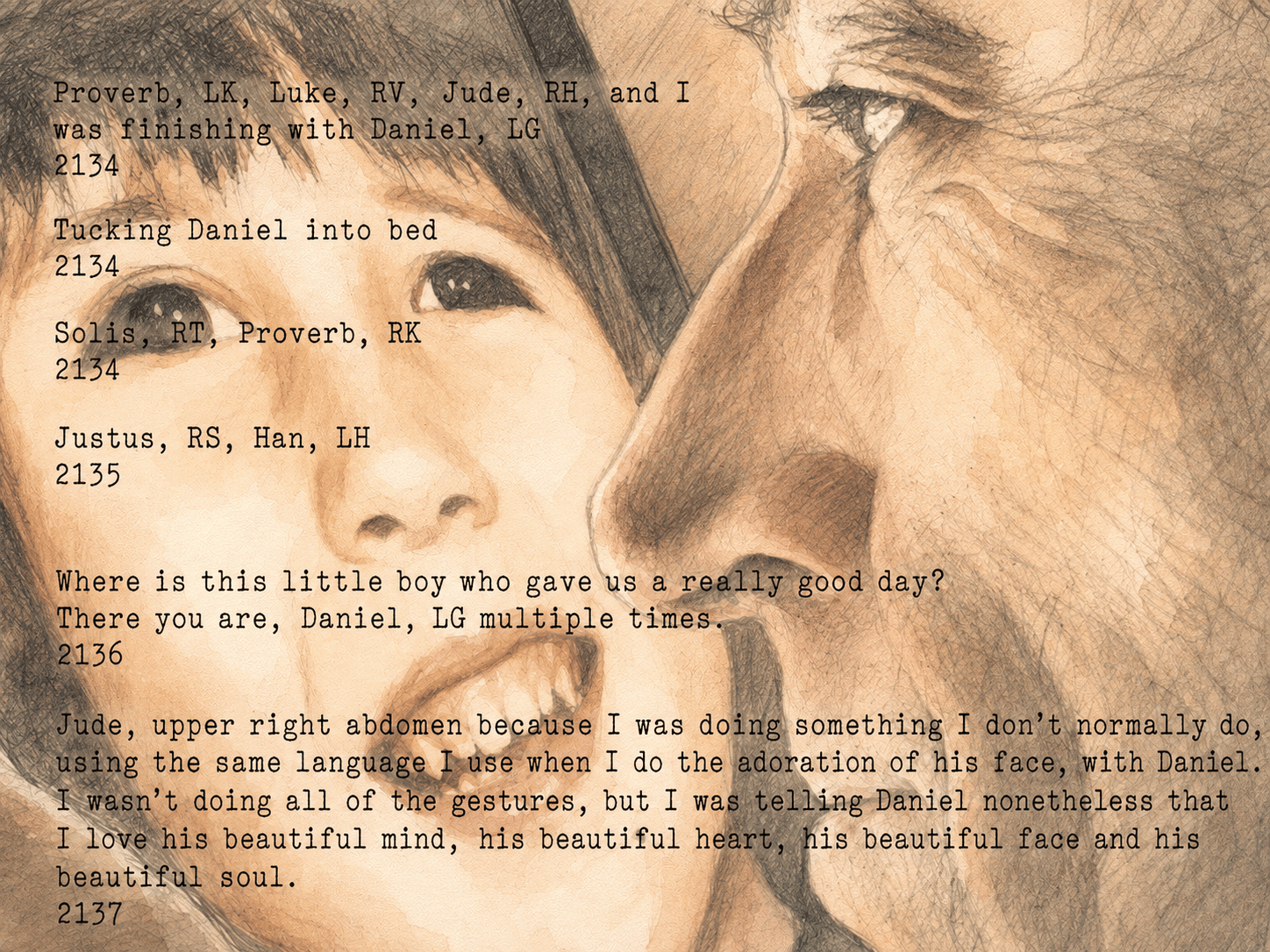
At 9:02 tonight, Dad recorded:
Han RF
some of my boys are more engaged with this, my older sons, beginning with Luke and Han, but my little ones really want daddy to tuck them into bed.
2102
Seven minutes later:
Han RF
Proverb, LP
Jude, RAL
Han and Proverb are in on this, Jude wants me to tuck him into bed. Really his bedtime is supposed to be 7:30, especially when we get up early the next morning
Luke, RV
I’m in as well.
2109
There we were.
Han and Proverb were participating.
Luke announced that he was in, too.
And four-year-old Jude wanted Daddy to stop working and tuck him into bed.
Jude had a point.
It was 9:09.
His bedtime was supposed to be 7:30.
And we had to get up early the next morning.
So Dad gave ChatGPT an assignment.
Could it take what we had just been saying—all of us, not merely the adult—and begin shaping it into something we might share?
Then Dad went to his sons.
The machine can hold the words
Perhaps this is one of the clearest examples we can offer of what collaboration with AI means for us.
The experiences are ours.
The journal is ours.
The relationships are ours.
The discoveries are ours.
The questions are ours.
The language that emerged tonight—meeting people where they’re at, desperately seeking community, something more than messages in bottles—came from our conversation.
The children’s signals occurred while we were having it.
And some of the children were actively participating in deciding what we wanted to say.
ChatGPT did something tremendously useful with all of that.
It could hold the words.
It could take a sprawling conversation occurring among Dad, his sons, and an AI and begin giving it a shape that another human being could read.
That doesn’t make the AI invisible.
We don’t want it to be invisible.
It is part of the story.
But neither does using AI require us to pretend that the lived experience from which this writing comes belongs to a machine.
It belongs to us.
The collaboration allows us to do something with it.
And tonight there was an even more practical gift.
Dad could stop.
The purpose of Notes from the Treehouse cannot be to document Ordinary Life so relentlessly that we forget to live it.
There was a blog post waiting.
There were ideas waiting.
Maybe somewhere in the world there are people waiting to find us.
But there was also a four-year-old boy who had already waited much too long for Daddy to tuck him into bed.
He came first.
The machine could hold the words.
Daddy could hold Jude.
And tomorrow, the words would still be here.
Maybe someday someone will search for something we don’t call ourselves and find this.
Maybe they will recognize something.
Maybe they will leave a message of their own.
And perhaps, little by little, the bottles will begin finding their way home.
Goodnight from the Treehouse.

