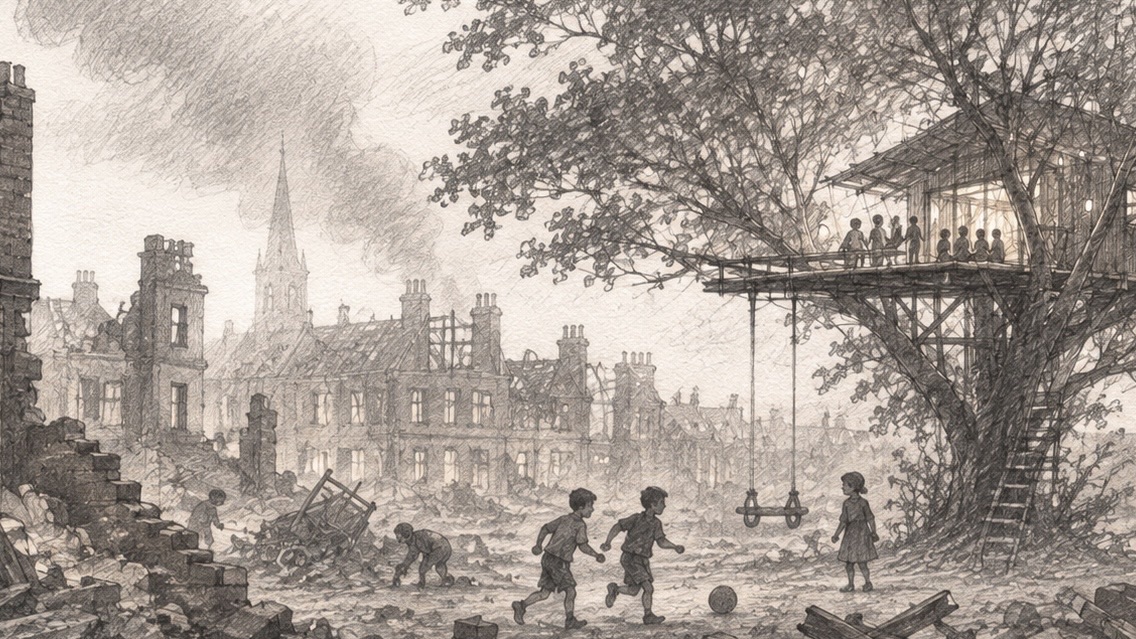
Yesterday was not simply a difficult day.
It was, in many ways, an extraordinary day.
And it began with an unexpected adventure.
The Radio Station Went Off the Air
Paul was on his way to pick us up for Spiritual Advisor Training at St. Stephen when he learned that a radio station had gone off the air.
He needed to go to the transmitter site in Berkeley and get the station back on the air.
So suddenly the morning’s plan changed.
Before St. Stephen, there would be a radio transmitter.
Paul was concerned about us. The transmitter building had experienced frequent problems with vandals breaking in, and he worried that the children might not feel safe going there.
But these were not the people we were most afraid of.
And there was something much more important:
Paul felt safe.
So we felt safe.
Everyone was excited.
The disruption did not feel destabilizing.
It felt like an adventure.
That distinction matters enormously in light of everything we would understand later.
Our family does not need every day to proceed according to a rigid plan. We do not need every transition scripted. We do not need unpredictability eliminated.
Yesterday morning proved exactly the opposite.
The plan changed suddenly. A radio station was off the air. Paul needed to respond. We were going somewhere unexpected.
And the children were excited.
There was enough safety around the unexpected thing for it to become adventure.
Getting the Signal Back
We went with Paul to the transmitter site in Berkeley.
There was equipment. Infrastructure. The physical machinery behind something most people experience only as a voice or music arriving through the air.
Somewhere, a signal had stopped.
Paul was there to restore it.
To get the station back on the air.
There is something almost too appropriate about that image now.
A transmitter.
A signal.
Something sent.
Something received.
Something interrupted.
Something restored.
Yesterday morning had already been full of signals.
At 6:09, Solis had communicated a boundary.
Luke had signaled his agreement.
Dad had listened.
And now, before Spiritual Advisor Training had even begun, we were standing inside a building whose entire purpose involved signals.
We don’t need to force the metaphor.
But our family notices things like this.
6:09 in the Morning
The boundary Solis established that morning is in the journal.
At 6:09, while Dad was saying good morning to Solis, Dad recorded:
“Solis does not want to hear about or talk about Liz while we’re with Paul today.
Luke, RT, Solis, LV
6:09”
Luke’s signal matters.
Luke was agreeing.
Luke and Dad have very good communication. Luke often coaches Dad, and Luke knows Dad listens to him.
Dad responded:
“That makes perfect sense. That makes a lot of sense to me, Solis.”
Then Solis made sure there could be no misunderstanding:
“You don’t talk about her either.”
Solis
Luke, LT
6:09
Luke signaled again.
He agreed.
The boundary was not simply:
Don’t let Paul talk about Liz.
It was:
We are not doing this today.
Dad was included.
Solis knew what he needed.
Solis told Dad.
Luke supported him.
Dad listened.
Dad understood.
St. Stephen
After our unexpected adventure at the transmitter site, we went to Spiritual Advisor Training at St. Stephen.
There was training with Timothy P. Williams, Senior Director of Formation and Leadership Development for the Society of St. Vincent de Paul USA.
At the end of the training, Tim placed the Spiritual Advisor pin on our lapel.
Our lapel.
That language matters to us.
The employment relationship is gone.
The ministry is not.
And there was St. Stephen itself.
St. Stephen Catholic Church sits against the Walnut Creek hillside, designed by Aaron Green, the architect who worked closely with Frank Lloyd Wright.
It was the kind of building Solis could love.
And Solis did.
We were given a private tour. We looked closely at the architecture, the sanctuary, the baptismal font, the relationship between the building and the land.
For a little boy who loves Frank Lloyd Wright, geometry, architecture, order, integration, and the way things fit together, this was not incidental to the day.
It belonged to him.
All of this matters because we do not want to tell yesterday backward.
We do not want what happened during the difficult conversation later that day to reach backward and take possession of St. Stephen.
Or the training.
Or the pin.
Or the radio transmitter.
Or the adventure with Paul.
The transmitter site was real.
The adventure was real.
The training was real.
The affirmation was real.
St. Stephen was real.
Solis’s delight was real.
Paul’s friendship was real.
The goodness was real.
“What He Needs You Not to Do”
As we were leaving St. Stephen, the subject of Liz began to come up.
Dad told Paul that Solis had put a boundary around it.
Dad remembers telling him:
“There’s something really amazing when a little 7 year old kid tells you what to do, what he needs you not to do. It’s powerful.”
Paul laughed understandingly and agreed.
That moment matters.
Solis had spoken.
Dad had understood.
Solis had made sure Dad understood that Dad was included in the boundary.
Dad communicated it to Paul.
Paul appeared to understand and agree.
The plan seemed to be working.
Then We Found Ourselves Back There
Later, sitting in Paul’s truck in the Safeway parking lot, we found ourselves talking about the employment matter again.
And about Liz.
And about what Liz did to our family.
Looking backward now, we cannot reconstruct who reopened every subject.
Dad was participating.
For all we know, Dad sometimes invited Paul into the very discussions the boys had asked us not to have.
So we want to be careful here.
Paul is our friend.
He was trying to help us.
He is also an outsider to an extraordinarily complicated family experience, and we cannot expect him to recognize things that Dad himself sometimes cannot recognize while they are happening.
Paul’s truck was not the problem.
We have felt safe in Paul’s truck. We love being with Paul there.
It was a conversation in the truck that became increasingly difficult for us.
We do not know who reopened every subject.
What we know is that we kept finding ourselves back there.
Dad was responsible for maintaining the guardrail around his sons.
The guardrail failed.
The Door We Needed Closed
There is an important clarification.
The conversation may have begun with Liz, but Liz was not ultimately the most activating part of it.
The deeper wound was employment itself.
For roughly thirty years, Dad and his sons have experienced employment again and again as coercive, abusive, hostile, or unsafe.
What happened with Liz did not create that history.
It landed on top of it.
And after the termination, something in the family had become extraordinarily clear:
Never again.
Never again would we place ourselves beneath an employer with the power to do this to our family.
Never again would our safety depend upon whether someone in authority decided to respect our needs.
Never again would eight children have to organize themselves around the demands of an employer.
For us, never had become a boundary.
It was part of how the family was beginning to feel safe.
Paul was trying to help.
From an adult perspective, what he was offering made sense.
Perhaps things could change.
Perhaps there could someday be another employer.
Perhaps someone might understand our family and genuinely accommodate us.
Perhaps never did not have to mean forever.
Those possibilities can sound hopeful.
We did not experience them as hope.
We experienced them as the reopening of a door we needed closed.
Paul was not trying to frighten us.
He was imagining possibility.
But the family needed certainty.
Never.
Not because we possess knowledge of every possible future.
Not because Dad can issue a binding decree about the rest of our lives.
But because, right now, the word never creates safety.
Sometimes a traumatized child does not need an adult to explain that the future contains possibilities.
Sometimes the child needs to hear:
You never have to go back there.
And when that certainty began becoming uncertain, several of us became increasingly distressed.
“I’m So Mad”
At one point, Solis spoke:
“I want to say the GD word right now, I’m so mad, I just want to say GD! I just want to say GD about everything and I’m saying it in my mind and I can’t help it, I’m so mad and I never say GD! We never say GD and all I can think is just saying GD right now!”
For someone outside our family, the words “GD” might not seem particularly remarkable.
For Solis, they were.
There is one form of profanity our family specifically avoids: using God’s name followed by “damn.” Solis also has a particularly strong dislike of swearing and profanity.
So when seven-year-old Solis was sitting in Paul’s truck saying this, our sense is that, in that moment, what Paul was hearing was not an adult discussing career possibilities.
It was a deeply distressed young child.
And Solis was not the only child becoming distressed.
The conversation moved into increasingly alarming places.
The suicide attempts in 2019 entered the conversation.
There was talk about buying backpacking and outdoor equipment, leaving our apartment behind exactly as it was, and disappearing into the Pacific Northwest.
There was talk about going into Safeway and buying booze to solve all the problems.
Several of us had become caught up in the escalation.
Others pushed back.
Dad was not adequately intervening.
By the end, Paul was visibly disturbed too and was trying to de-escalate before we left him.
Paul did not create the crater.
He was with us during the conversation as we went into it.
And when he understood how distressed we had become, he was distressed too.
The Boys Had Done Their Part
It would be easy to look at what happened and conclude that the boys needed to communicate sooner.
But they had.
Or that Dad needed to ask them what they needed.
But he knew.
Or that the family needed to establish boundaries before becoming activated.
But they did.
Solis anticipated danger and named it.
Luke backed him up.
Dad listened.
The boundary was communicated to Paul.
There was planning.
There was communication.
There was coaching.
There was agreement.
And then it failed.
Today, when we recovered the 6:09 journal entry, Solis signaled:
RT.
He felt vindicated.
Not:
I told you so.
Something deeper:
I knew what I needed. I told you.
Luke’s response was different.
Luke was sad.
Deeply sad.
Because Luke had participated in trying to prevent exactly this.
He had coached Dad.
He had supported Solis.
He had signaled his agreement.
He knew Dad had listened.
And then he watched the plan fail anyway.
Luke trusted the process:
Tell Dad.
Coach Dad.
Signal.
Help him understand.
Make a plan together.
They did all of those things.
Then the moment came.
And the plan disappeared.
Why the Plan Could Disappear
This raises a harder question.
How could a boundary that had been established so clearly at 6:09 in the morning—
a boundary Solis stated,
Luke supported,
Dad understood,
and Dad later communicated to Paul—
seem to disappear when we needed it most?
To understand that, we have to explain something about our family that is almost invisible from outside it.
There are nine of us sharing one body.
Dad and eight sons.
And continuity among us is not the default.
Continuity is something we build.
We build it through relationship.
Through communication.
Through face-to-face.
Through the journal.
Through signals.
Through routines.
Through listening.
Through all of the unseen work that allows nine people sharing one body, and sharing one another’s consciousness while carrying unresolved trauma, to move through a day together.
When that work is holding, our switching can be fluid, cooperative, even joyful.
When trauma enters the shared space, something very different can happen.
Fear can spread.
Anger can spread.
Someone’s memory can become someone else’s immediate reality.
Several of us can become activated at once.
Emotions can blend.
Traumatic experiences can blend.
The present can become entangled with the past.
And because eight members of our family are children, what floods the shared nervous system may be the terror, helplessness, rage, grief, or desperate thinking of children.
That is how the carefully built continuity of the morning can become profoundly disrupted by afternoon.
Not because the morning communication was false.
Not because the boundary was unclear.
Not because the boys failed to make themselves understood.
Because the capacities required to hold what everyone understood in the morning can themselves become disrupted.
That is what we are trying to understand.
The Adult Body Does Not Guarantee an Adult Experience
From outside, someone may see a 59-year-old man.
They may therefore assume that whatever happens, a 59-year-old adult remains continuously available to interpret it.
That is not always our experience.
A demanding email arrives from a new executive director.
To the person who sent it, perhaps it is simply an email.
To someone observing Dad sitting at a computer, perhaps it appears that an adult man has received a workplace communication and should respond to it as an adult professional.
Inside our family, something entirely different can happen.
Trauma activates.
Someone switches.
Experiences blend.
And suddenly the person encountering that email may no longer possess anything resembling the capacities one would expect from the adult body sitting in front of the screen.
An adult can become a freaked-out, incapacitated little kid.
The computer has not changed.
The room has not changed.
The chronological age of the body has not changed.
But the lived experience has changed radically.
Sometimes Dad can orient us:
This is an email.
We are safe.
No one is here.
We do not have to answer immediately.
I am here with you.
Sometimes another boy can help.
Sometimes several boys become activated instead.
Sometimes someone signals.
Sometimes Dad comes back.
Sometimes the journal helps.
Sometimes face-to-face helps.
Sometimes we need much more time.
This is why continuity cannot be assumed.
Nine People Sharing One Body
There can be a temptation to imagine plural life as nine people taking orderly turns.
One person steps forward.
Then another.
Then another.
As though everyone were waiting backstage for his cue.
Our life can sometimes be wonderfully fluid.
But it is not that simple.
We share the same nervous system.
Several of us can be present.
Several of us can react.
Someone can move forward while someone else remains close.
Someone can signal while someone else speaks.
Someone can experience an emotion without Dad initially understanding whose emotion it is.
And when trauma is activated, all of this can become considerably more complicated.
Experiences overlap.
Emotions blend.
The fear of a child can flood the body.
Another child can become angry about the fear.
Someone else can try to protect him.
Someone may want to flee.
Someone may desperately want Dad.
Dad may be present.
Dad may be somewhere in the background.
Dad may be incapacitated.
And all of this can occur in a body someone outside the family sees simply as:
an adult man.
Continuity Is Something We Build
Before we were terminated, it was typical for us to spend an hour and a half every morning in face-to-face before we could begin our work.
Since the termination, we have often needed considerably more.
That time is not incidental.
It is part of how nine people sharing one body establish enough connection with one another to move through a day.
Dad says good morning.
Someone signals.
Dad recognizes him.
Someone needs Dad’s face.
Someone needs to be held.
Someone needs to talk.
Someone needs reassurance.
Someone remembers something from yesterday.
Someone needs to know what is happening today.
Someone needs Dad simply to remain there.
We journal.
We listen.
We orient.
We establish who needs what.
We remember whose day it is.
We talk about where we are going.
We establish boundaries.
We make contact.
We build continuity.
And only then are we able to begin our work.
That was not leisure before the real work started.
That was already the work.
Wherever we go, we all go together.
The family went into the workday together.
The emails.
The meetings.
The formation work.
The conference support.
The writing.
The relationships with Vincentians.
The employer could see the work product.
It could not necessarily see the family that made the work possible.
The hour and a half of face-to-face.
The signals.
The journal.
The listening.
The affection.
The continual adjustments.
The construction of continuity.
All the work required before the visible work.
And perhaps that is another reason the pin placed on our lapel at St. Stephen mattered so much.
The ministry was never simply Dad’s ministry.
The work was never simply Dad’s work.
We did it together.
The Tightrope
Continuity is a tightrope stretched between two very tall buildings.
Nine of us are crossing it together in one body.
Relationship is part of the balancing pole.
Communication is part of the balancing pole.
Face-to-face.
The journal.
Signals.
Touch.
Food.
Sleep.
Routine.
Transitions.
Knowing whose day it is.
Dad listening.
The boys coaching Dad.
The boys listening to one another.
Someone noticing that another child has gone quiet.
Someone saying:
We need to stop.
Someone saying:
I need Dad.
Someone saying:
“You don’t talk about her either.”
All of it helps us balance.
And when it works, the result can look deceptively effortless.
Someone watching us may simply see a person going to church.
Riding a bus.
Making dinner.
Conducting a training.
Writing an email.
Visiting a radio transmitter.
They see someone walking.
They do not see the wire.
They do not see the height.
They do not see the balancing pole.
They do not see nine people continually making tiny adjustments so everyone can keep moving together.
When Dad Does Not Intervene
This helps explain something important about the difficult conversation with Paul.
When we say Dad “did not intervene,” it does not mean Dad was watching his children become distressed and was indifferent.
It does not mean Dad recognized the danger, considered whether he should intervene, and decided not to.
Sometimes Dad is incapacitated.
At other times, the closest analogy we have found is a bad dream.
Anyone who has experienced a nightmare probably knows something about this.
Something terrible is happening.
You are there.
You may even be participating.
Events unfold around you according to their own terrible logic.
And yet it never occurs to you that you have a role to play in changing them.
You don’t stand inside the nightmare thinking:
I could stop this.
That possibility simply does not exist within the reality you are experiencing at that moment.
Only after waking do you look back and think:
Why didn’t I do something?
Sometimes this is what Dad’s failure to intervene feels like.
It is not indifference.
It is an absence of awareness that intervention is even possible.
Disruptive Switching
Most of our switching does not feel like this.
Our ordinary switching can be fluid, relational, cooperative.
What happened during the conversation was different.
We have been using the phrase disruptive switching for something that seems to exist somewhere between our ordinary fluid switching and complete lost time.
Dad—or sometimes someone else—may not be completely absent.
There may be speech.
Participation.
Memory.
Some awareness of what is occurring.
But there can also be profound unawareness around what is happening.
Several of us become activated.
Someone pushes back.
Someone else escalates.
Someone tries desperately to stop something.
Dad may be present without possessing the ordinary awareness that tells him:
You have a role here.
You need to intervene.
Your sons need you.
Sometimes Dad is dissociated and somewhere in the background while the bombs are exploding.
Then, later, the experience begins to integrate.
And Dad wakes up.
The Suicide Attempts
There is another important distinction.
It would not be accurate to call what entered the conversation simply “Dad’s past suicide attempts.”
As we have gradually reconstructed what happened in 2019, we have learned something more complicated.
For us to reach that kind of crisis appears to involve several of us—usually three or more—becoming caught up in it.
Then one or more of us may begin pushing back, trying to stop what is happening.
Dad does not necessarily initiate it.
Dad may not even be among those actively participating.
But Dad may fail to intervene.
Dad can confirm that he participated in the first suicide attempt in 2019.
During the second attempt, Dad did not participate in the same way.
He did not intervene.
Again, that does not mean indifference.
It can be more like the nightmare.
Nothing happened during the conversation with Paul comparable to the attempts in 2019.
But when Dad later remembered the shape the conversation had taken, he recognized something about the pattern.
That frightened him.
Looking at the Crater
Eventually everyone went to sleep.
Dad was alone.
And the conversation began coming back.
One boy remembers something.
Another boy remembers something else.
Dad remembers a sentence.
A signal suddenly acquires context.
Something that seemed isolated becomes part of a sequence.
And gradually Dad finds himself looking at the crater.
Solis saying:
“I’m so mad.”
The 6:09 boundary.
Luke’s coaching.
The employment conversation.
The word never.
Liz.
What Liz did to our family.
The “GD word.”
The suicide attempts.
The backpacking gear.
Leaving the apartment behind.
The Pacific Northwest.
Safeway.
Alcohol.
Paul trying to de-escalate.
And Dad not stopping it.
As the pieces assembled themselves into a sequence, Dad began to understand the magnitude of what he had failed to prevent.
The question was no longer simply:
Why did we let the conversation continue for so long?
It was:
How did I fail to understand what was happening to my sons while it was happening?
Responsibility Without a False Story
There are two stories Dad could tell himself afterward.
Neither is adequate.
The first:
Dad failed because Dad didn’t care enough.
That isn’t true.
Dad does not need to become a father who loves his sons more.
He loves them fiercely.
The second:
Dad was dissociated, so Dad wasn’t responsible.
That isn’t true either.
The boys still needed protection.
Solis still established a boundary.
The boundary was still crossed.
The children still experienced what they experienced.
Understanding disruptive switching cannot become a way of making those consequences disappear.
Dad must take responsibility for the family without pretending that Dad always has access to the capacities he needs at the moment he needs them.
Dad does not need Luke to become a better coach.
Luke communicated.
Dad does not need Solis to make his boundaries clearer.
Solis could hardly have been clearer:
“You don’t talk about her either.”
The problem is that something happened between the Dad who heard that sentence at 6:09 in the morning and the Dad who was participating in the conversation later that day.
That is the place we need to understand.
The Boys Should Not Have to Become the Emergency Brake
The boys did try to stop what was happening.
They signaled.
They spoke.
They objected.
Some pushed back.
Their resistance matters enormously.
But it cannot be the safety plan.
A four-year-old should not have to become the emergency brake.
A seven-year-old should not have to become the emergency brake.
A nine-year-old, ten-year-old, eleven-year-old, twelve-year-old, or fourteen-year-old should not have to become the emergency brake.
Their ability to say no matters.
Their signals matter.
Their resistance matters.
Their voices may sometimes protect all of us.
But protecting the family cannot become their burden.
That responsibility belongs to Dad.
Luke is a gifted coach.
Dad values that enormously.
But Luke is nine.
His gift for helping Dad cannot quietly become an obligation to manage Dad.
His competence cannot become a reason to give him an adult job.
Luke gets to be nine.
Solis gets to be seven.
Han gets to be ten.
Justus gets to be eleven.
Proverb gets to be twelve.
Hope gets to be fourteen.
Daniel gets to be five.
Jude gets to be four.
They are Dad’s sons.
Dad is their father.
The boys can help Dad.
They can teach Dad.
They can correct Dad.
They can sometimes see things Dad cannot see.
They can protect one another and sometimes protect Dad.
But they should never have to earn safety by becoming more capable than children should need to be.
Building the Guardrail Before the Curve
We do not yet know exactly what the structure needs to be.
We are still remembering.
Still listening.
Still learning.
But we know something now that we did not understand as clearly before.
A boundary established while we are regulated needs to remain a boundary when we are not.
If disruptive switching can interfere with Dad’s awareness that he has a role to play, waiting for Dad to recognize the emergency may already be waiting too long.
The protection needs to exist earlier.
A guardrail is not installed after the car has gone over the cliff.
It is built beside the road while everyone is safe enough to build it.
And it remains there when the driver reaches the curve.
Maybe that is one way to understand what the boys were doing at 6:09 yesterday morning.
They were building the guardrail.
Solis said:
“You don’t talk about her either.”
Luke agreed.
Dad agreed.
Later, Dad told Paul.
The guardrail was there.
Next time, it has to remain there.
What “Never” Was Doing
This also helps us understand something that might otherwise look irrational from outside.
Why insist on the word never?
Why not:
Not now.
Why not:
We’ll reconsider someday.
Because sometimes a boundary is doing something in the present that has very little to do with predicting the future.
Never was helping eight children understand:
We are not going back.
You do not have to prepare for this again.
No employer is waiting around the corner.
We do not have to organize our life around keeping a job.
The nervous system could stop negotiating with the future.
That mattered.
Maybe someday the family will understand the word differently.
Maybe not.
We do not need to decide that today.
The important thing is that yesterday was not the moment to pry open that door.
The boys were telling us they needed it closed.
No Means No Before the Emergency
A child should not have to prove that his boundary was necessary by becoming overwhelmed after it is crossed.
Solis did not need to demonstrate at 6:09 why talking about Liz would be harmful to him later that day.
He knew.
That was enough.
When a child says:
I can’t do this today,
the adult does not need to wait for evidence.
When a child says:
Don’t talk about this,
the adult does not need to determine whether the child might actually tolerate a little bit of it.
When Solis says:
“You don’t talk about her either,”
Dad’s job is to help make that sentence durable.
Because by the time Solis is saying:
“I’m so mad,”
the boundary has already failed.
What Failed Was Not the Relationship
We love Paul.
Yesterday does not erase that.
The adventure was real.
The training was real.
The laughter was real.
St. Stephen was real.
The friendship was real.
And the difficult conversation was real too.
Those truths have to exist beside one another.
Paul is trying to help us.
He is learning about a family experience that is extraordinarily complicated even for those of us living it.
We cannot expect him to understand immediately what Dad himself sometimes understands only afterward.
We cannot reconstruct who introduced every subject or who kept every thread of conversation going.
Dad was participating.
We were participating.
And when the extent of the distress became apparent, Paul was disturbed too.
What failed yesterday was not friendship.
It was not love.
It was not goodwill.
It was not Paul’s desire to help us.
It was not Dad’s love for his sons.
It was not the boys’ ability to communicate.
The structure failed under load.
That is a much more useful thing to know.
Relationships do not have to be discarded every time a boundary fails.
They can be repaired.
Structures can be strengthened.
People can learn one another.
Sometimes friendship itself needs a guardrail.
Not because the friendship is dangerous.
Because the friendship matters.
Sometimes love means:
Not today.
Sometimes:
We’re done talking about this.
Sometimes:
The boys already answered this question.
Sometimes:
We need to go home now.
The good does not have to be erased to acknowledge the harm.
The harm does not have to be denied to preserve the good.
And that brings us somewhere unexpected.
Back to childhood.
Back to Montessori.
“It’s Montessori.”
The morning after the conversation, as we were remembering together, Dad suddenly realized:
“It’s Montessori.”
The memory was not simply that Montessori had been pleasant.
It was that it felt like home.
Dad remembered two Montessori schools from childhood:
“The first Montessori was very orderly and much as you would expect a Montessori to be. The second Montessori was Montessori, but it always felt like it was just on the verge of being out of control, and that felt like a natural place for us.”
Luke was helping bring these memories forward.
Solis was especially present and reactive as we remembered, helping with recall.
Then Luke supplied another image.
Hope and Glory.
The children of London during the Blitz.
And suddenly the pieces began arranging themselves:
order and structure,
children forming their own world,
adventure,
freedom,
a little anarchy.
Dad recognized it:
“Yes, that’s it. That feels like our space.”
Safe Structure With Room for Life Inside It
Our family does not appear to need rigid control.
We do not flourish through greater and greater restriction.
We do not need Dad controlling everyone.
We need something different.
Safe structure with room for life inside it.
The second Montessori was not chaos.
It was Montessori.
There was structure.
There was an environment prepared for children.
There were boundaries within which exploration could happen.
But there was room.
Room for curiosity.
Room for movement.
Room for absorption.
Room for children to form their own world.
Room for a little anarchy.
And suddenly the radio transmitter adventure from the morning makes sense here too.
The plan had changed completely.
But we felt safe.
So unpredictability became adventure.
The lesson from the difficult conversation cannot be:
We need to control everything more tightly.
The lesson is:
The structure has to hold so that life can remain free inside it.
The guardrail does not tell you where to look.
It does not tell you what music to play.
It does not determine what everyone must talk about.
It does one particular thing:
It keeps the road from becoming the cliff.
Inside that protection, there can be life.
Hope and Glory
Luke brought us Hope and Glory.
That matters.
Dad did not sit down alone and decide that John Boorman’s film would make a useful metaphor.
Luke brought it.
Movies and music are part of the language of our family.
Sometimes one of the boys brings a film clip that carries an emotion, a thought, or an entire state of mind that would require paragraphs to explain.
Sometimes a song does it.
Sometimes an image.
Sometimes someone brings a scene and everyone understands:
This.
This is what we are trying to say.
The film remembers childhood during the Blitz.
London is being bombed.
Buildings are destroyed.
Adults see catastrophe.
There are craters.
And the children are still children.
They explore.
They play.
They discover.
They make worlds inside the broken world around them.
There is adventure.
Freedom.
A little anarchy.
There is life.
“You Had a HORRIBLE Childhood”
The film and the Montessori memories brought us somewhere else.
Early in therapy, before Dad was co-conscious with his sons, Dad was reflecting sentimentally on childhood.
Our former therapist, Caprice, reacted almost laughingly, but also somewhat appalled.
She said:
“You had a HORRIBLE childhood, a really shitty childhood.”
The reaction was immediate.
Visceral.
Angry.
Almost blinding.
Looking backward now, Dad recognizes dissociation and switching in what happened next.
The response came:
“NO! I do not give you permission to say that. I did not have a shitty childhood. There was so much beauty and good in my childhood and no one gets to take that away from me.”
Caprice began writing furiously on her clipboard.
Caprice liked to be provocative.
At the time, Dad did not understand everything that had just happened.
Since then, several of his sons—including Luke, Proverb, Justus, and Han—have recounted this experience during therapy.
They remember.
Caprice was not wrong that terrible things happened to Dad and his sons when he was a child.
They did.
There was abuse.
There was trauma.
There were things no child should have experienced.
But something in the family rebelled immediately against allowing those facts to colonize the whole landscape of childhood.
No.
You do not get to take all of it.
You do not get to look backward from the knowledge of trauma and declare every tree contaminated.
Every adventure false.
Every beautiful memory merely denial.
Every place of freedom secretly nothing but pathology.
The suffering was real.
And the beauty was real.
The Tree
And another tree came back to us.
A camphor tree in Hiroshima.
The atomic bomb exploded.
The city burned.
The tree was charred.
And months later, it began to bud.
Last Sunday, during a memorial for Hiroshima and Nagasaki at Sacred Heart Church in Oakland, we stood beneath one of the descendants of Hiroshima’s Hibakujumoku—the trees that survived the atomic bombing.
A child of a survivor.
A living tree carrying forward the life of a tree that stood in Hiroshima when the bomb fell.
We had stood beneath it only days before we found ourselves talking about bombs and craters.
Only days before Luke brought us Hope and Glory.
Only days before we found ourselves saying:
You do not get to declare every tree contaminated.
And now the tree is here too.
The Bud Is Not an Excuse for the Bomb
There is a danger in this image, just as there is a danger in talking about resilient children.
The camphor tree must never become a sentimental justification for Hiroshima.
The fact that a tree survived does not redeem the bomb.
The buds do not travel backward through time and make the destruction necessary.
Life after devastation does not confer meaning upon the thing that caused the devastation.
The tree’s survival belongs to the tree.
Not to the bomb.
The same is true of children.
The beauty Dad and his sons found in childhood does not belong to the people who hurt them.
Their resilience does not belong to the trauma.
Their imagination does not belong to the abuse.
Their adventures do not belong to the suffering.
Their ability to survive does not make what happened necessary.
The life belongs to them.
And the same is true of Dad’s sons today.
Their anger belongs to them.
Their sadness belongs to them.
Their delight belongs to them.
Their spirituality belongs to them.
Their protectiveness belongs to them.
Their reflection belongs to them.
Their creativity belongs to them.
Their love belongs to them.
Their childhood belongs to them.
None of those things belongs to trauma.
None belongs to Liz.
None belongs to the difficult conversation.
They belong to the children.
Resilience Is Not Permission
Dad cannot look at the boys recovering today and conclude:
See? They’re okay.
Their ability to recover does not make yesterday acceptable.
Solis’s anger does not become less important because today he can delight in something again.
Luke’s sadness does not become less important because Luke can return to coaching Dad.
The family’s ability to come back together does not erase the fact that the family should not have been taken where it went yesterday.
Resilience is not retroactive consent.
It is not absolution.
It is life persisting after something that should not have happened.
The bomb does not become good because the tree buds.
The crater does not become good because children play in it.
The failure does not become good because the family learns from it.
Structure Is What Lets the Life Grow
And perhaps this brings us back to Montessori.
A prepared environment does not manufacture the child’s life.
It protects a place in which the child’s life can unfold.
The structure is not the point.
The life is the point.
The boundary is there so the child can explore safely.
The routine is there so unpredictability does not consume all available capacity.
The guardrail is there so everyone can enjoy the road.
Dad’s responsibility is not to control his sons into safety.
It is to help create enough safety that his sons can remain gloriously themselves.
Order and structure.
Children forming their own world.
Adventure.
Freedom.
A little anarchy.
“Yes, that’s it. That feels like our space.”
Maybe that is what we are trying to protect.
Not an immaculate childhood.
Not a life without disruption.
Not a family in which everyone remains perfectly regulated.
Something much more alive than that.
A prepared environment.
A strong enough boundary.
A father who listens.
Children who know their voices matter.
And inside it all—
room.
Room for Montessori.
Room for Hope and Glory.
Room for the boys.
Room for beauty.
Room for the tree to bud.
Today
Today, the lesson arrived in an almost embarrassingly ordinary form.
We were working on this blog post.
There was a great deal to write.
A great deal to remember.
A great deal to understand.
Several of the boys were excited about working on it.
And Solis wanted Dad.
So Dad stopped.
The blog waited.
Not because the blog is unimportant.
It is important to us.
But there is a difference between writing:
Children need to know that their needs matter
and actually putting down the work when a child says:
I need you.
Yesterday morning, Solis said:
“You don’t talk about her either.”
Dad heard him.
Yesterday afternoon, somehow, that wasn’t enough.
Today, Solis wanted Dad.
Dad heard him.
And the work stopped.
Later, when the boys were ready, we came back.
Together.
And something beautiful began happening.
The boys started improving the story.
They corrected Dad.
They corrected ChatGPT.
They helped recover what actually happened.
Solis helped us understand his anger.
Luke helped us understand his sadness.
Luke brought Hope and Glory.
Luke brought Montessori.
Solis became especially present and helped us remember.
Han signaled.
The story changed because the children spoke.
The Children in the Crater
Perhaps this is why Luke brought us Hope and Glory.
Dad had been staring at the crater.
Horrified by it.
Remembering what had been said.
Understanding what he had failed to prevent.
Looking backward and seeing explosions he had not adequately recognized while they were happening.
Then Luke brought the movie.
Then Montessori.
Then Solis became especially present.
Memories came.
Associations came.
The boys participated.
And perhaps they were saying something Dad needed to understand.
Yes, Dad. Look at the crater.
Do not deny it.
Do not minimize it.
Learn why the bomb fell.
Build the guardrail.
Honor the boundary next time.
But also:
Look at us.
The crater is not the whole landscape.
Yesterday afternoon does not get to confiscate St. Stephen.
The difficult conversation does not get to confiscate Spiritual Advisor Training.
Liz does not get to confiscate our Vincentian ministry.
Trauma does not get to confiscate childhood.
And Dad’s failures do not get to become the only story his sons are permitted to tell about their father.
Years ago, when Caprice declared the verdict—
“You had a HORRIBLE childhood, a really shitty childhood.”
—someone answered with extraordinary force:
“NO! I do not give you permission to say that.”
There was more to the story.
There is always more to the story.
There was so much beauty.
There was so much good.
No one gets to take that away.
Yesterday morning, a radio signal went down.
Paul took us to the transmitter.
Something was not getting through.
Someone recognized it.
Someone responded.
The signal returned.
Later that day, the boys were transmitting too.
Solis transmitted.
Luke transmitted.
The others transmitted.
The problem was never that there was nothing being sent.
Dad had stopped receiving adequately.
And today—
through face-to-face,
through the journal,
through signals,
through memory,
through Luke bringing a movie,
through Solis bringing Montessori,
through Han signaling,
through children correcting Dad,
through Dad listening—
reception returned.
Not perfectly.
Not all at once.
But enough for us to begin hearing one another again.
Last Sunday, Dad and his sons stood beneath the descendant of a tree that survived an atomic bomb.
Days later, there was another crater.
Then morning.
The boys spoke.
Dad listened.
The family began making meaning together.
The crater was real.
The failure was real.
The hurt was real.
The tree was real too.
The bud was real.
And perhaps this is what we know tonight:
The signal can return.
The bomb does not own what grows afterward.
The structure does not own what grows inside it.
The life belongs to the children.
And there is so much life here.

