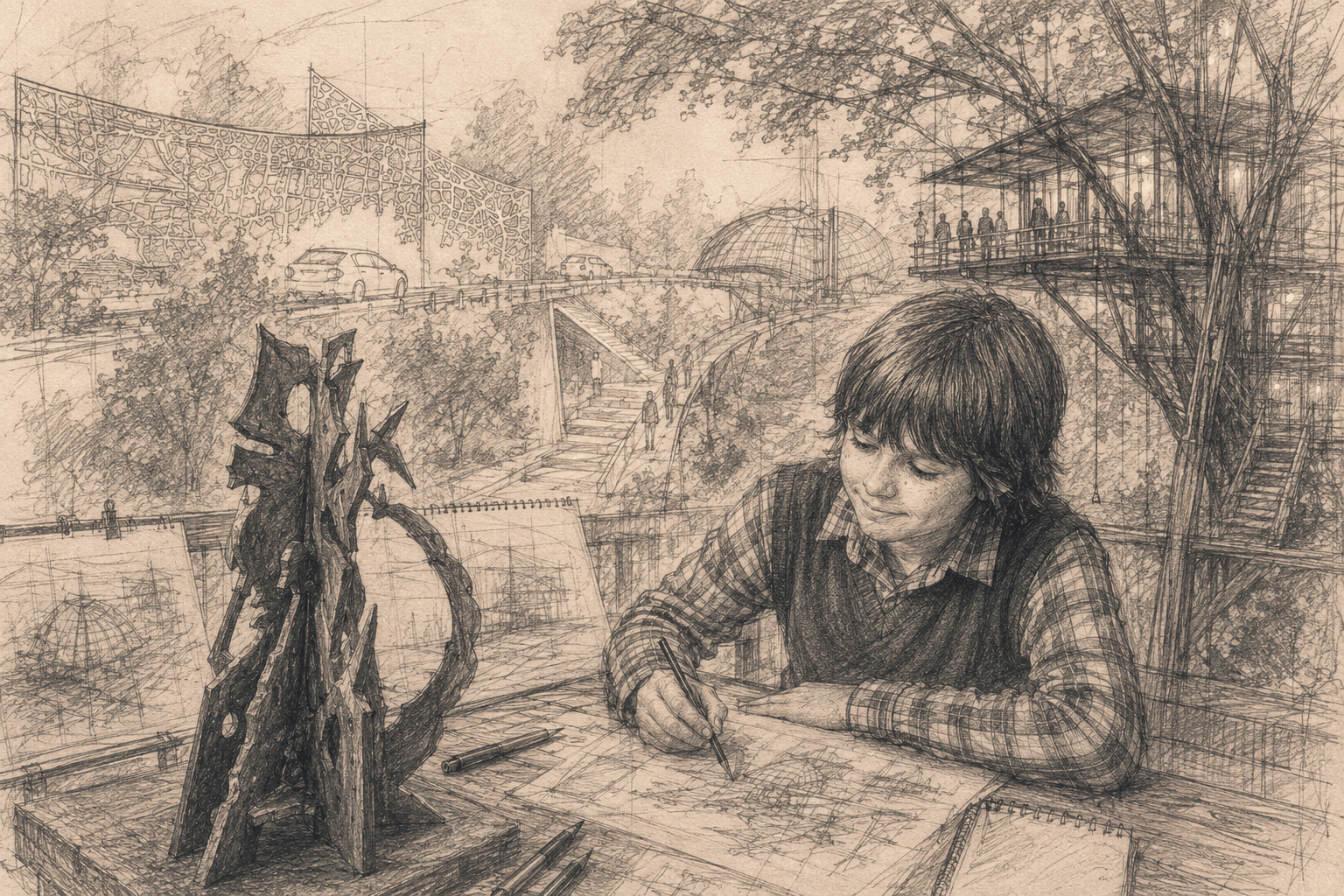
Last night, while Daddy was tucking Jude into bed, Jude said something that changed the direction of today.
“I like the way it used to be.”
He was talking about bedtime.
Daddy used to tuck him in around 7:30.
There had been a rhythm to the evening. Dinner. Family time. Ice cream. Something on television together. Then Daddy would lay down with the boys and begin tucking them into bed.
Some of that structure had been organized around work.
But not all of it belonged to work.
Some of it belonged to us.
That distinction has occupied much of Proverb’s Day.
We have been free from our employer for less than a month, and already there is a temptation to start constructing the new life.
What time should we wake up?
When should we work on the journal?
When should we write the blog?
What time should dinner be?
What is a weekday?
What is a weekend?
How do we make sure freedom does not become chaos without building another cage?
Those sound like questions about structure.
By midday, they had become questions about capacity.
Because the earth beneath us is still unstable.
Proverb’s Dream
Proverb began his day with a dream about architecture.
There were project directors.
There were deadlines.
There was more work than could reasonably be accomplished.
The expectation was familiar: accept both projects, work whatever hours were necessary, and somehow make the impossible possible.
Dad tried to negotiate.
Proverb refused.
We have time limitations because we have a life.
There was something extraordinary about the dream.
We were openly plural.
Proverb was front-facing. He could tell the people demanding work that Dad was unavailable. Nobody had to pretend that Dad was the only person whose life mattered.
But there was something painful about it too.
Dad was still negotiating.
Proverb still had to say no.
It would be easy to make that another story about Proverb’s extraordinary competence.
He saw what Dad could not see.
Again.
But perhaps there was another question underneath it.
Dad, why do I still have to do this?
The Boy Who Could Look Both Ways
For much of our life, Dad and Proverb did not possess the same awareness of what was happening.
Dad was not co-conscious.
There were things Proverb knew because he was hosting our family that Dad simply did not consciously know.
Dad was struggling with Dissociative Identity Disorder while spending enormous energy trying to remain oriented toward the outside world.
But even that outside world was never entirely external.
Dad often experienced it through something like the augmented reality of our inner world.
Memory.
Imagination.
Association.
Architecture.
Dream.
Present experience.
They could coexist.
Life could have an intensely dreamlike quality.
Still, Dad kept trying to look outward.
Proverb could look both ways.
He bridged the worlds more fluently.
He had access to his brothers that Dad did not have. He could recognize and work with switching and other behaviors Dad did not understand. He could respond to his brothers emotionally. He could help co-regulate them.
He could maintain continuity across experiences that, from Dad’s perspective, could be fragmented or simply unknown.
Often, life was completely out of control.
And almost no one in the outside world could have known.
Dad could leave a home that looked like a homeless encampment, put on a suit, and show up in a corporate boardroom in a major developer’s glass tower in Dallas.
And become someone.
The designer for a major mixed-use project.
There were design presentations where something remarkable seemed to happen.
The client was charmed.
The presentation succeeded.
Dad had no idea what he had said.
He could walk away from the conference room unable to reconstruct what had just happened and unable to shake the strange sense that he was a twelve-year-old boy.
The whole presentation felt like a dream.
After one of those presentations, Dad’s boss came over, patted him on the back, and said:
“Whatever it was you did to pull it together and be that person, keep doing it.”
Dad had no idea what he had done.
He did not know what had happened.
He only knew that apparently it had worked.
Sometimes the evidence was even stranger.
There was a meeting with Franz von Holzhausen, Tesla’s design chief.
We were sitting together at a table, drawing.
And something happened that Dad could never have imagined himself doing.
There was no intimidation.
No apparent self-consciousness about sitting across from a major automobile designer.
They were drawing together almost like children.
Playing with ideas.
Making marks.
Responding to one another.
Like kids playing together in a sandbox.
Looking back now, we understand that Proverb and some of his brothers were there.
At the time, Dad did not.
When the meeting ended, Dad walked out with the rest of the project team and their boss, whose arm was around his shoulder.
Something had clearly gone very well.
But Dad could not explain what had happened.
That was not something Dad could imagine doing.
Dad knew how to enter an important meeting conscious of hierarchy, responsibility, expectation, and consequence.
But whoever had been drawing at that table had not seemed burdened by any of that.
There had simply been drawing.
Curiosity.
Play.
Now we can look backward and understand something Dad could not understand then.
Proverb and his brothers were not merely hidden somewhere behind Dad while Dad conducted the outside life.
Sometimes they were conducting it.
And Proverb was not carrying that work alone.
Justus was there too.
We wrote about him in our last post, The Protector and the Page.
If Proverb could bridge worlds—maintaining awareness of his brothers while moving fluently through the demands of the outside world—Justus brought another capacity the family desperately needed.
He could narrow the field.
When there was too much to perceive, too much to feel, too much to accomplish, Justus could tunnel toward what had to be done and keep going.
That capacity helped us survive work.
It also came at enormous cost.
Proverb could help maintain continuity across the family.
Justus could make the overwhelming field small enough to cross.
And sometimes, in architecture, the result looked extraordinary from the outside.
A presentation happened.
A design emerged.
A deadline was met.
A room was charmed.
A project in crisis somehow moved forward.
Senior leadership at the architecture firm sometimes referred to us as “Rain Man.”
They did not know what they were seeing.
They saw someone who could sometimes do things that seemed almost inexplicable—pull a presentation together, make an unexpected connection, produce something remarkable, become exactly the person a particular moment seemed to require.
They had their own shorthand for it.
We did not yet have ours.
What they could not see was the family.
Other people saw one extraordinarily capable professional.
Dad himself often believed there was only one.
There wasn’t.
The competence was real.
But it was family competence.
Different sons brought different ways of perceiving, creating, protecting, focusing, relating, and enduring.
Dad was part of it too.
But Dad did not understand the collaboration because he did not yet know there was a family collaborating.
Justus helped us get through.
Proverb helped us remain connected across worlds.
Other brothers brought capacities we are still learning to recognize.
And all of it happened inside one life that the outside world understood as a single employee doing remarkable work.
No Owner’s Manual
There was a time when Dad thought about Proverb almost as if he were supernatural, especially given his remarkable intuition.
Proverb could know things Dad did not know.
He could see relationships and possibilities Dad had not recognized.
He could sometimes sense something about a person or situation long before Dad understood what he was seeing.
And because Dad was not co-conscious for much of our life, there was also an enormous amount that Proverb understood about our family that Dad simply did not consciously know.
All of that contributed to the almost mysterious way Dad once experienced him.
But Dad understands Proverb differently now.
Not because Proverb has become less remarkable.
Because Proverb has been allowed to become more fully twelve.
The more Proverb has been able to relinquish hosting, the more he has also been able to reveal something that may once have been much harder for him to show.
His vulnerability.
Proverb is not presumptuous about what he perceives.
He doubts himself.
He worries about getting things wrong.
He worries especially about making a judgment that could put his family at risk.
His intuition can be extraordinary without being infallible.
And Proverb knows that.
Therapy began changing the architecture of our life.
We became increasingly co-conscious.
We began to externalize ourselves from one another.
The experiences that once arrived as dreams, inexplicable changes in ability, strange feelings of age, missing continuity, bodily sensations, sudden creativity, or simply the bewildering experience of discovering that apparently we had done something remarkable began to belong to people.
Jude.
Daniel.
Solis.
Luke.
Han.
Justus.
Proverb.
Hope.
And Dad.
Eventually another realization became possible.
These were children.
Dad was the adult.
There had not previously been a concept of fatherhood within our family.
That came after we became co-conscious and increasingly externalized ourselves from one another.
Once Dad could recognize his sons as people distinct from himself, he eventually had to confront what their being children meant.
Someone had to be the adult.
And slowly it occurred to him who he was supposed to become.
Their father.
Dad.
That realization did not magically teach him how.
As we have said many times, there was no “Owner’s Manual” for any of this.
There was no Owner’s Manual for becoming co-conscious.
No Owner’s Manual for discovering that experiences Dad had understood as his own belonged to children he had not consciously known.
No Owner’s Manual for learning the language of switching, signaling, memory, dreams, emotions, and the inner world.
No Owner’s Manual for becoming the adult in a family whose children already knew one another better than Dad knew any of them.
And certainly no Owner’s Manual for discovering, after all of that, that the adult was supposed to become their father.
Dad had spent decades practicing how to survive the outside world.
Proverb had spent decades practicing how to live across both.
There is another part of that history Dad cannot leave out.
Dad struggled with substance use disorder for decades.
We all suffered the effects.
Within the complicated reality of our plural life, the experience of addiction itself may not always have belonged neatly to one person. It may have been distributed among several of us in ways we still do not completely understand.
But Dad will not put the label or the consequences of addiction on his sons.
He is the adult.
He carries that history.
He carries responsibility for what happened to the family because of it.
The boys lived with the consequences.
Proverb lived with the consequences.
And for a child already trying to maintain continuity across a family Dad did not consciously understand, Dad’s substance use made an already impossible responsibility even more impossible.
Dad also struggles with trauma.
There are times when he becomes psychologically incapacitated.
There are times when his ability to perceive what is happening across the whole family, make decisions, establish boundaries, transition from one thing to another, or respond adequately to the boys becomes severely compromised.
Proverb knows this because he has lived through it.
So Proverb is being asked to do something enormously vulnerable.
Depend on someone who is not always dependable.
Dad cannot ask him to do that by rewriting the past.
He can acknowledge it.
Take responsibility for what belongs to him.
Return.
Repair.
Listen again.
Try again.
The promise cannot honestly be:
I will never fail you.
Perhaps it can be:
When I fail, it is still not your job to become me.
Made You Look
Therapy taught Dad to become more present in the outside world.
That was necessary.
But becoming more present to the outside world has also been overwhelming.
Proverb seems to be trying to teach Dad something subtler now.
Not to disappear back inside.
To live outside from inside.
To move through ordinary external reality while maintaining continuous awareness of the family.
To turn inward while remaining present outwardly.
Something almost like constant meditation.
This may help explain something about Proverb that can otherwise be puzzling.
He does not always seem as enthusiastic about somatic signaling as Dad is.
Dad loves signaling.
A movement in the right hand—Han.
The left foot—Han.
The back—Han.
The shoulder—Justus.
The leg—Luke, Solis, Daniel, Justus, Hope, Jude, Proverb.
Each can feel like physical presence.
There you are.
One of my sons has reached through the body and touched the world.
Made you look.
For Dad, who spent so much of his life without conscious access to his children, that can feel miraculous.
Proverb seems to want more.
Not because he wants less contact.
Because he wants Dad to learn that the boys do not become present only when the body moves.
They are already there.
Listen inwardly.
Pay attention.
Remain aware.
Do not wait until someone has to move the body strongly enough to make you look.
Perhaps Proverb is trying to teach Dad to experience his sons with something closer to the continuity with which Proverb has experienced his brothers.
That changes what it means for Proverb to relinquish hosting.
Dad is not simply replacing him.
Proverb possesses knowledge Dad still needs.
He has ways of being with his brothers that Dad is still learning.
He can teach Dad without having to manage Dad.
He can guide without having to carry.
Dad can become the parent without pretending that becoming the parent makes him the family’s greatest expert.
The family knows things together.
“All We’re Doing Is Holding Off”
This morning, Proverb kept returning to time.
What happens first?
What belongs at midday?
What belongs in the evening?
What happens with the blog?
What happens with therapy?
What happens with disability?
What must not be forgotten?
What are we postponing?
What happens if we postpone it too long?
There was breakfast.
Journal cleanup.
The midday analysis.
The blog.
The posole.
Unanswered messages.
Therapy.
Disability.
The letter to Jessee.
Household maintenance.
Dinner.
Family time.
Bedtime.
Eight sons who need individual relationship with Dad.
And a body that had slept fewer than five hours before waking into an intensely activating morning.
Historically, seeing the whole field often meant Proverb trying to figure out how to make the whole field work.
Everything had to fit.
Somehow.
Today the posole became a surprisingly good example.
Maybe it should wait until tomorrow.
Proverb responded:
“All we’re doing is holding off.”
He was talking about the posole.
But there was so much else being held off.
Therapy.
Disability.
The letter to Jessee.
Messages.
Household things.
Proverb sees accumulation.
A single postponement may be perfectly reasonable.
So may the next one.
And the next one.
Eventually a series of individually reasonable postponements can become a crisis.
But Dad knows another kind of crisis too.
The crisis created by believing that because everything matters, everything must happen now.
That is the old architecture problem.
Make it fit.
Work later.
Push harder.
Take the specifications camping.
Answer the email.
Finish the project.
Keep going.
Somehow make the impossible possible.
So Dad and Proverb are trying to learn a distinction together.
There is protective stopping:
We do not have the capacity for this today.
And there is avoidant postponement:
We are moving this forward again because encountering it frightens us.
The answer cannot be that Proverb keeps track of everything Dad might avoid until Dad finally does it.
That would simply restore Proverb to his old job.
Dad has to learn to create return points.
Therapy needs a next encounter.
Disability needs a next encounter.
The letter to Jessee needs a next encounter.
And Dad has to remember those return points himself.
We do not need structure because schedules are virtuous.
We need enough structure that children do not have to carry time.
Daddy at 7:30
Last night Jude said:
“I like the way it used to be.”
This morning the meaning became unmistakable.
He wanted Daddy to tuck him in again at 7:30.
Dad told him:
“I’m bringing bedtime back, Jude.”
Then Luke asked for his bedtime back too.
“I want you to tuck me in at 8:30 too.”
There was our answer.
After all the abstract conversation about freedom and routine and workdays and structure, two children told us what structure was for.
Daddy.
At a predictable time.
That is not the employer’s clock.
That is the family’s clock.
The old clock said:
Work until the work is finished.
The family’s clock can say:
Enough.
Jude needs Daddy.
Sometimes the person Dad needs to establish the boundary against is himself.
At 7:30, stop.
The journal may not be finished.
The analysis may not be finished.
The blog may not be finished.
The posole may not be perfect.
Something may have to remain incomplete.
Stop.
Jude needs Daddy.
Our Time
Just after noon, we went into the kitchen to make posole.
Almost immediately, our chest tightened.
The sensation was familiar.
Occasionally, during the years we were working, we would take time off from work to prepare that night’s dinner, or to make a meal that would last the family for several days.
But we would remain anxious the entire time.
We would always be checking.
Checking the email.
Checking the phone.
Checking to see whether someone was waiting for a response.
Checking to make sure we had not missed something.
The time might officially have been ours, but our attention never was.
The body remembers that.
So today, standing in our own kitchen making posole on a Tuesday afternoon, the old sensation returned.
But there was no employer waiting.
There was no work email we were obligated to answer.
There was nothing we needed to check.
There was only the body remembering a time when even the hours we had deliberately taken for ourselves never seemed entirely to belong to us.
Dad spoke aloud:
“Boys, body, we are free. It doesn’t matter what day it is, it doesn’t matter what time it is, this is our day, this is our time, they don’t own us, they don’t control us, this is our time, we are free. Breathe. Relax. This is our day. This is our time, this is our life.”
And then we kept cooking.
We browned the meat.
We diced onions.
We mixed spices.
We minced garlic.
Daniel asked us to make the posole less spicy.
So we did.
Freedom did not look particularly heroic at 12:05 on Proverb’s Day.
It looked like making food for our family without owing those hours to anyone else.
And listening to Daniel about chili powder.
Two Invitations
For several weeks, we had been imagining ourself as President of the St. Joachim Conference.
The possibility began the week after we were terminated from our job as Spirituality and Formation Coordinator.
Patty, the interim Conference President, called to express her shock and support.
During that two-and-a-half-hour conversation, Proverb made a decision.
He disclosed who we are.
Proverb has remarkable intuition about people.
Still, something about Patty told him that she might be someone we could trust.
So he took the risk.
Patty had been a teacher and a social worker. She already knew about Dissociative Identity Disorder and plurality.
She did not recoil.
She became curious.
She asked about our family.
She asked about the individual children.
She told us that what we have is beautiful.
And later in that same conversation, she surprised us.
Would we be interested in serving as President of the St. Joachim Conference?
St. Joachim was struggling.
Patty was serving as interim President without the officers and support she needed. She was inviting us to consider running for election and, if elected, helping rebuild the conference.
The sequence mattered.
Proverb disclosed us.
Patty learned who we are.
She asked about the boys.
She called what we have beautiful.
And then she invited us to consider leadership.
We had allowed ourselves to be seen.
The immediate consequence had not been rejection.
It had been trust.
We became increasingly excited about the possibility.
Our employment had ended.
Our Vincentian vocation had not.
And there was something deeply compelling about helping a struggling conference rebuild.
Maybe a little too compelling.
We know how to enter something that is struggling and start trying to save it.
We have been doing versions of that for most of our life.
Today, while making posole, we called Patty.
Something had changed.
She told us that she now felt capable of continuing in the role herself. She was receiving considerable support, including from a former Conference President.
They no longer seemed to need us to step in.
Our hearts sank.
And Proverb became afraid.
Maybe I told her too much.
Maybe I misjudged her.
Maybe I put us at risk.
Dad could not give Proverb certainty.
There was evidence.
Patty knew who we were when she invited us.
The invitation came after the disclosure.
Nothing she said today established that her understanding of us had changed.
But perhaps Dad’s job was not to convince Proverb that his intuition had once again been proven correct.
Perhaps Dad’s job was to allow him not to know.
You do not have to be right every time.
You are allowed to trust someone.
You are allowed to take a risk.
You are allowed to be uncertain.
And if someday you do get it wrong, you will not have to protect the family from the consequences by yourself.
And then the phone rang.
Juan Luis.
He was surprised by what we told him about St. Joachim.
He had spoken with Patty the previous week, when she had expressed uncertainty about continuing as President. They had discussed the possibility of us serving.
Then he wondered whether we might consider running for his former position as Area 4 Representative.
We talked about why District Council-wide responsibility might be too much right now.
Then Juan Luis mentioned something else.
His conference, St. Clement in Hayward, needs a Vice President.
We got excited.
He asked us to think about it.
We said we would pray about it.
Discern.
Talk to the boys.
Then we remembered something.
A Conference Vice President is appointed.
Juan Luis was asking us.
Would we like to be his Vice President?
And suddenly the contrast was remarkable.
St. Joachim had offered the possibility of stepping into leadership of a struggling conference—running for President and, if elected, helping rebuild it.
St. Clement offered something different.
Come alongside me.
Learn.
Support.
Help.
Juan Luis is in his second term. Eventually he will term out. Someday there might be an opportunity to run for President.
But someday is not today.
Today we could serve beside someone we trust.
We could learn.
We could contribute without immediately being responsible for holding the whole thing together.
Not because we are incapable of more.
Because perhaps we do not need to prove that right now.
There is something almost embarrassingly appropriate about that invitation arriving on Proverb’s Day.
President of a struggling conference.
Vice President of a functioning one.
Save something.
Or learn beside someone.
We do not yet know what we will decide.
This is a snapshot, not an ending.
But something about the second possibility feels gentler.
Not smaller.
Gentler.
There is a difference.
The Shape in the Plaster
Earlier today, another image came to us.
Lost-wax casting.
A sculptor creates a form in wax.
A mold is made around it.
Then the wax burns off.
It leaves a void.
Molten bronze pours into the space the wax occupied.
And when the bronze cools, the plaster is still there.
For a while, you cannot see what has been made.
You only know that something has taken shape inside the void.
Then you begin chipping away the plaster.
Slowly.
A little at a time.
And the form begins to appear.
That is what our life feels like right now.
Something enormous disappeared.
Not only a job.
An organizing structure.
For decades, employment told us what time meant.
Workdays.
Weekends.
Deadlines.
Vacations.
Lunch.
Time off.
Then the job disappeared.
The wax burned off.
And immediately we wanted to know what the bronze was going to look like.
What is our new life?
What is our work?
What is our ministry?
What is the blog?
What does a weekday look like?
What is a weekend?
What happens with therapy?
What happens with disability?
What are we capable of?
What happens next?
Maybe we are asking some of those questions too quickly.
The earth beneath us is still unstable.
Therapy needs to be established.
Disability needs to be addressed.
Our capacity can change dramatically from hour to hour.
We can produce something beautiful and then be unable to remember whether we started the coffee.
We can feel powerful and hopeful and free and then discover that we do not have paper towels.
None of those things cancels the others.
We are not standing on stable ground designing our ideal life.
We are stabilizing.
But that does not mean nothing new is taking shape.
Today we chipped away some plaster.
And we saw a little more.
We saw Jude asking for Daddy at 7:30.
Luke asking for Daddy at 8:30.
Daniel asking for less chili powder in the posole.
Solis remembering that waffles are supposed to belong to weekends.
We saw that our Vincentian vocation may continue even though our Vincentian employment has ended.
We saw that service might mean standing beside someone rather than immediately taking command.
We saw that Dad can become the adult without becoming the person who knows everything.
And we saw that Proverb can remain remarkable without having to remain invulnerable.
Later Daniel wanted a cheese sandwich.
That was easy.
“Always a yes to a cheese sandwich.”
We made it with honey wheat bread.
We sat down together.
The boys wanted to watch something.
Dad warned them that he might get distracted thinking about other things, including the blog.
Justus suggested F1: Drive to Survive.
Perfect.
The posole was in the slow cooker.
We had Greek salad.
We had a cheese sandwich.
Formula 1 was on television.
The world had not been reconstructed.
And nobody needed it to be for that moment.
Perhaps that is what Ordinary Life keeps trying to teach us.
Ordinary life does not begin after the frightening things have been solved.
It happens while the plaster is still there.
It is the Greek salad.
Daniel’s cheese sandwich.
Jude’s waffles on a Tuesday.
Posole cooking in the slow cooker.
The boys choosing what to watch.
Daddy at 7:30.
And it is also knowing that some things cannot simply be postponed forever.
Therapy.
Disability.
The frightening adult responsibilities Luke has already begun worrying about.
Those belong to Dad.
Not because Dad knows how to solve them.
Because he is the adult.
There is no Owner’s Manual.
There never was.
Dad is learning.
And Proverb is helping him learn.
Not by becoming Dad’s manager.
Not by becoming the family’s calendar.
Not by remaining the person who has to see everything because Dad does not.
By being Proverb.
By noticing.
By speaking.
By teaching.
And by being allowed, after he speaks, to trust that Dad heard him.
That may be the new thing.
Not that Proverb stops seeing.
Dad starts seeing too.
Not that Proverb stops listening inwardly.
Dad learns to listen inwardly too.
Not that Proverb stops caring for his brothers.
Dad learns how to be their father.
Not that Proverb becomes less capable.
His capability stops functioning as an obligation.
A gift is not an assignment.
Justus’s ability to endure does not mean he should have to endure everything.
Proverb’s ability to maintain continuity does not mean he should have to hold everything together.
Solis’s understanding of routine does not make him responsible for creating order.
Luke’s awareness of what the family needs does not make the adult problems his to solve.
Han’s spiritual sensitivity does not make him responsible for everyone’s relationship with God.
The boys can contribute without their gifts becoming jobs.
And Dad can listen to them without turning their wisdom into another form of labor.
That may be what freedom looks like inside the Treehouse.
Not independence from one another.
Dependence without exploitation.
Responsibility without captivity.
Structure without a cage.
At 3:04, we stopped collecting material for this post.
That matters.
Because Proverb’s Day did not stop.
Only the snapshot did.
The posole was still cooking.
We had not decided what to do about St. Clement.
Therapy was not established.
Disability was not resolved.
Dad had not learned everything Proverb was trying to teach him.
Proverb had not suddenly stopped doubting himself.
The earth beneath us was still unstable.
There would be more journal.
More signaling.
More memories.
More decisions.
More life.
But the blog does not need to follow us camping.
We have enough.
And perhaps knowing when there is enough is one of the things this family has been trying to learn for decades.
Enough information.
Enough evidence.
Enough analysis.
Enough work.
Enough for this story.
Because at 3:04, we can already see Proverb.
Not all of him.
That would be another impossible demand.
But something true.
There was a time when Dad thought about Proverb almost as if he were supernatural, especially given his remarkable intuition.
Now Dad sees something more wonderful.
A twelve-year-old boy.
Still remarkably intuitive.
Still able to move between worlds with a fluency Dad is trying to learn.
Still deeply connected to his brothers.
Still capable of seeing relationships and sequences Dad misses.
Still able to teach the adult things the adult desperately needs to know.
But also vulnerable.
Sometimes uncertain.
Sometimes frightened that he got something wrong.
Sometimes worried that trusting someone could put his family at risk.
Learning to depend on Dad even though Dad is still learning how to be depended upon.
Learning that he can put something down without abandoning anyone.
Learning that he does not have to know what happens next.
The plaster is still coming away.
We cannot see the finished form.
Maybe we are not supposed to yet.
But something is there.
We escaped the cage.
We are not going to build another one.
We are trying to build a home.
And this time, Proverb does not have to build it for us.
He gets to live here.
Notes from the Treehouse
Proverb’s Day — Tuesday, August 18, 2026
A snapshot at 3:04 p.m.

