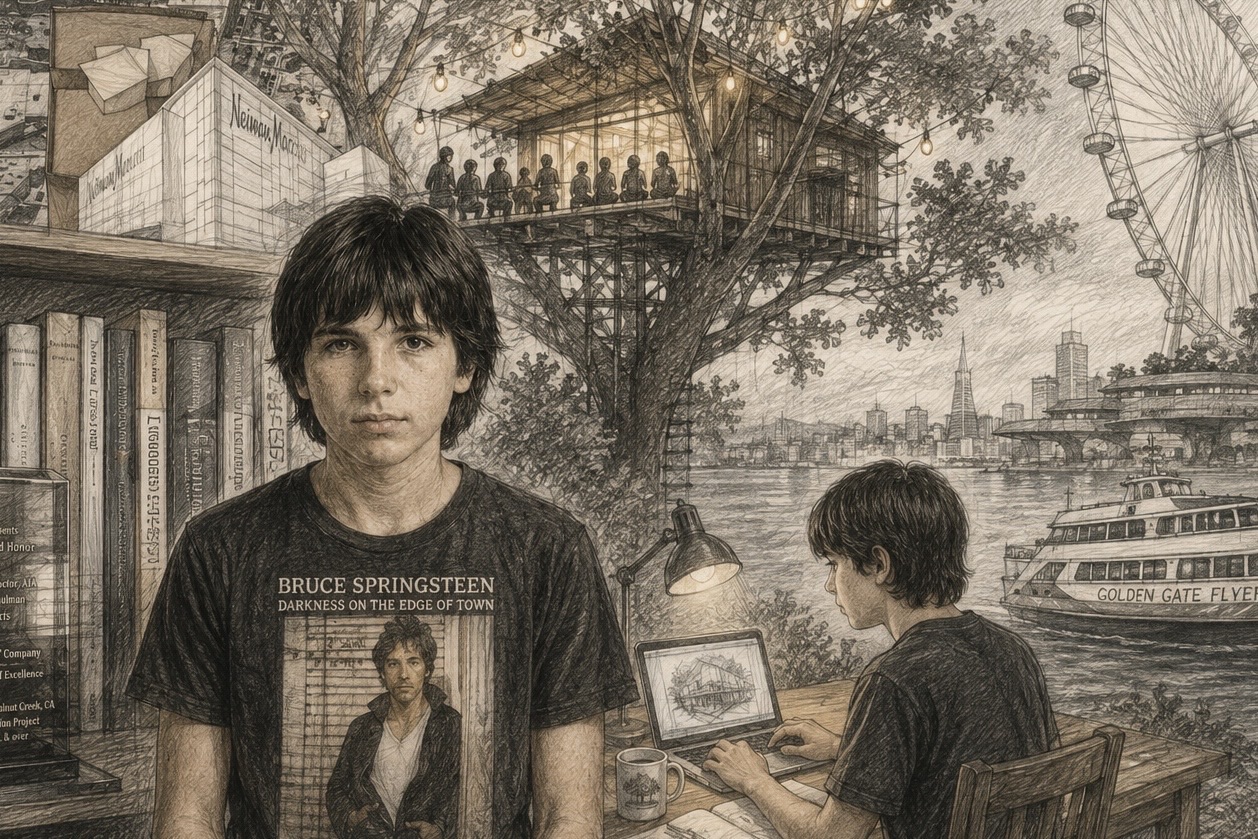
Hope’s Day began after a bad night.
We had gone to bed unusually early for us, just after midnight, after taking a shower because we wanted to wash the previous day off the body. The evening had been difficult. A loved one had expressed concern about us, and the comment activated fear throughout our family. By bedtime, we wanted the body to understand that the day was over.
The shower helped.
Before stepping into it, there had been something we didn’t want to interrogate too much: a simple, calm sense of peace. We attributed it to God.
We didn’t need to know what was going to happen.
We didn’t need anyone else to tell us that everything would be all right.
We just wanted to let the body experience peace.
Then we slept.
And apparently we worked all night.
When we woke at 8:25 on Hope’s Day, we knew there had been enormous amounts of dreaming. We couldn’t remember much of it, but it felt as though we had spent the entire night doing something—working, struggling, sometimes frightened.
“The body feels like it had a bad night,” Dad wrote.
“Like a really bad night.”
Everyone was quiet.
Dad wondered whether some of his boys had been trying to wake him.
Then the signaling began.
Justus.
Daniel.
Luke.
Solis.
Han.
Hope.
Jude.
Proverb.
There was so much need that morning that even recording the somatic markers became difficult. We knew where the sensations were occurring, but sometimes Dad couldn’t retrieve the letters. At one point he knew perfectly well where Han was signaling but couldn’t find the words left and foot.
We had planned something simple.
Say good morning to each of the boys.
Eat breakfast.
Lay back down.
Then begin whatever the day was going to become.
We are experimenting with mornings now. For decades, mornings belonged to work. You got up because someone else owned the hours ahead of you.
We don’t live that way anymore.
We don’t know yet what our mornings are supposed to look like.
This is an exploratory period in our life. We are not trying to manufacture the permanent routine. We are trying to discover one.
But we are beginning to suspect that whatever comes next needs to begin differently.
Before the agenda, there are eight boys.
Before the work, there is relationship.
Before we ask what we need to accomplish today, Dad needs to say:
Good morning, my sons.
Daddy is here.
Daddy’s Here Now
Luke seemed to have had a particularly difficult night.
“You had some bad dreams?”
The signaling continued.
“It feels like we all did.”
The dreams had seemed endless—one continuous, tedious, sometimes frightening experience.
Dad could feel something from Luke that morning.
“You missed your Daddy, Luke? You were alone?”
Luke signaled.
“I’m here. I’m here. I will never leave you, Luke. I’m always here for you. I love you.”
More signaling.
There was a lot of need.
And we needed breakfast.
This is one of the peculiar challenges of being Dad in a family of eight sons sharing one body.
Everyone can need Daddy at the same time.
And Daddy can need his sons too.
Dad told Luke that.
Back when we were working, while we were busy doing other things throughout the day, Dad would need him too.
He would need to be with his Luke.
Then we moved through the family.
Daniel.
Luke.
Solis.
Justus.
Han.
And somehow we reached Han before Dad realized something was terribly wrong.
He hadn’t been with Jude.
No wonder Jude had been signaling so much.
“Oh, baby, my poor little boy.”
Jude had been present in the cognitive field the entire morning. Dad is so accustomed to being with him first, or among the first, that somewhere in the crowded cognitive field thinking about Jude had apparently become I must already have been with Jude.
But he hadn’t.
“I’m sorry, Jude.”
Dad held his four-year-old son.
“I love you so much.”
More signaling.
“Did you think I forgot about you? I would never forget about you.”
And there it was again, one of the lessons we keep discovering:
Thinking about relationship is not relationship.
Planning bedtime is not tucking Jude into bed at 7:30.
Thinking about breakfast is not feeding children.
Knowing that someone matters is not the same thing as holding him.
So Dad held him.
The Perfect Life
While Dad was holding Jude, memories of architecture began moving through us.
Not meetings.
Not clients.
Not offices.
Not deadlines.
Creating.
Drawing.
Sketching.
Working in 3-D.
Rendering.
Dreaming buildings and watching them flow from our fingers onto paper or into a computer.
There had been periods during our architectural career when that felt like the perfect life.
We could sit down while it was still dark outside and begin creating.
Then we would look up and it would be dark outside again.
Everything in between disappeared.
We were in the zone.
In the zone.
In the zone.
No confusing outside world.
No trying to interpret other people.
No getting places.
No meetings.
No social anxiety.
No interruptions.
Just creation.
The image that came to us was almost embarrassingly simple.
We wanted to be a plant that belonged to someone.
Put us somewhere with perfect sunlight.
Water us.
Then leave us alone to be the plant.
The plant was profitable, got more work, won design awards, and its work was published in shiny design magazines.
We would create.
That was when everything felt all right.
We remembered one day when we did not get out of our chair for nine hours.
Everything was all right.
Then Jude brought forward the six days we worked without sleep—not as words, but through visuals and memories of the experience.
Oh.
Right.
And then there was Memorial Day weekend in 1996.
The partners gave us an impossible assignment to complete over the holiday weekend for a major client.
We told them we couldn’t do it.
They said we could.
Three days later, we had done nothing.
That sentence still sounds impossible.
We had been at our desk for three days.
But the work wasn’t there.
We couldn’t explain why.
We couldn’t explain what we had been doing.
We couldn’t even explain where we had been.
Three days had passed.
We had apparently been sitting at our desk.
And then the weekend was gone.
The people around us needed an explanation.
They blamed drugs.
They began calling us “Rain Man.”
At the time, Dad could not explain what had happened either.
None of us understood.
That Memorial Day weekend now sits beside the other memories of our architectural life and complicates what we mean when we talk about being “in the zone.”
Sometimes disappearance produced extraordinary amounts of work.
Sometimes there was all-consuming creative bliss.
Sometimes architecture poured from our fingers into the world faster than I could think.
Sometimes we worked for six days without sleeping.
And sometimes three days disappeared while we sat at a desk and nothing happened at all.
There is one sentence from 1996 that sounds very different to us now:
We said we couldn’t do it.
They said we could.
The people imposing the demand believed they understood our capacity better than we did.
When the body failed to do what they insisted it could do, the failure required an explanation.
Drugs.
Rain Man.
Something was wrong with us.
We used to call the way we worked “method acting.” If we were designing an endangered-species store for Universal CityWalk in Florida, somehow we inhabited the project. We remember feeling as though we were working beneath a rainforest canopy filled with exotic birds.
We understand those experiences differently now.
There was a state of all-consuming creative bliss.
There was collaboration among us that we did not yet understand.
And there was dissociation.
Massive amounts of it.
The world disappeared because disappearing from the world was part of how we worked.
But architecture itself never disappeared from us.
We still dream buildings.
There is a vast inner world populated with fantastic architecture envisioned by each of us—places that used to try to find their way out of that world, through our fingers, and into this one.
We still do.
We continue to dream architecture.
What has changed is our understanding of what happened when we became so completely absorbed in bringing those places into the world that everything else vanished.
And that morning another question occurred to us.
If Dad was completely lost in the architecture, who was dealing with the world?
Not Dad.
Proverb.
We have been learning a lot about that lately.
The creative trance may have felt perfect partly because someone else was carrying what Dad wasn’t.
But Memorial Day weekend reminds us that “somehow everything functioned” was never guaranteed.
There were times when Dad disappeared and the work disappeared with him.
There were times when whatever usually allowed us to move through the outside world could not carry us across the demand being made.
Or perhaps the demand itself exceeded what the family could carry.
We did not know enough then to ask.
That doesn’t make the architecture less beautiful.
It changes what we mean when we imagine a life of creation now.
We do not need to stop dreaming buildings.
We do not need to surrender that vast world of architecture within us.
But no one gets sacrificed so that Dad can remain in the zone.
Proverb gets to dream too.
Proverb gets to create too.
Proverb gets to live here.
It’s Still Jenga
After losing our architecture job, we tried unsuccessfully to have our own design practice.
Our life looked very different from this.
We jumped out of bed.
We worked from home.
We designed.
We consulted.
We traveled.
We stayed busy.
We were eager to work from morning until night.
From the outside, that period might look healthier than this one.
We certainly looked more productive.
But the boys and Dad were not yet co-conscious.
We had not begun therapy.
There were almost no boundaries between work and life.
A great deal happened between that life and this one.
Eventually architecture was no longer our work.
For the past six years, until nearly a month ago, we worked as a spirituality and formation coordinator, supporting our fellow Vincentians in their spiritual life and formation.
That work was profoundly different from architecture.
Instead of buildings, there were people.
Prayer.
Formation.
Retreats.
Conversations about vocation.
Mission.
Community.
The spirituality of St. Vincent de Paul and Frédéric Ozanam.
We loved much of that work. It became part of the way we understood our vocation, and the boys participated in it with Dad in ways we only gradually came to understand as we became more co-conscious.
Then, on July 22, that employment ended abruptly.
So when we say that mornings no longer belong to work, this is very new.
For six years there was somewhere Dad was supposed to be, something he was supposed to answer, people he was supposed to support, work that gave shape to the week and, for some of us, a sense of purpose.
Then suddenly there wasn’t.
The architecture life is long behind us.
The spirituality and formation job ended less than a month ago.
And this—whatever this is—is only beginning.
Now everything is slower.
And sometimes Dad worries that he is frozen.
There are things we have not dealt with.
Healthcare.
A letter to a prospective therapist.
Disability.
Money that needs to be moved.
An assistance request.
And Dad wrote something difficult that morning:
“All of this activity around the blog has masked the fact that I remain frozen.”
That isn’t completely true.
We are doing things.
The previous day we had talked with two Vincentians about serving as president or vice president of one of their Conferences. We are discerning becoming a vice president.
We are writing.
We are cooking.
We are maintaining relationships.
We are trying to stabilize.
But there are specific things that frighten Dad so much that we have difficulty touching them.
It’s still Jenga.
Everything seems connected to everything else, and sometimes we are afraid to pull a block.
Then Hope began doing what Hope does.
One Little Thing
Hope is fourteen.
He is our oldest boy.
He had already told Dad the night before that he wanted to help look at the COBRA paperwork.
Dad was cautious about that.
Dad is Dad.
His sons are not responsible for taking care of him.
But there is a difference between making a child responsible for the adult and allowing a son who wants to sit beside his father to help.
Hope wasn’t telling us to solve healthcare.
He was gently urging:
Just look at the papers.
He didn’t understand why this particular thing seemed so enormous to Dad.
To Hope, it felt manageable.
And when we allowed ourselves to experience it with him, for a moment it felt manageable to us too.
“One little thing,” Dad said.
There was a sense of peace.
Liberation.
“This is what you’re bringing us, Hope. I see what I must do.”
Then Hope reminded us:
We didn’t invent this.
We learned it from Mom.
One little thing.
When something is overwhelming, break it down.
Make it smaller.
Baby steps.
That came from her.
And that matters today.
The previous evening had been difficult. Something Mom wrote frightened us badly. We spent a lot of time talking about the ways the interaction affected the family.
There is truth in that record.
But pain does not get to rewrite the entire history of a relationship.
While we were reading our midday analysis today, we realized that we had been talking so much about what hurt that we were in danger of forgetting something else.
Mom taught us this.
“We feel like we’ve been beating her up,” Dad said, “but we need to give her credit too.”
Hope answered:
“Honor her.”
So we will.
Mom taught us one little thing.
And today, when we needed it, Hope brought it home.
A Baby Step
At 10:38, our friend Paul texted.
We had asked him whether we were supposed to remind him about an assistance request.
He replied that he needed something showing the amount of our rent.
Normally a request like that can expand instantly inside our head.
Where is the document?
What else does he need?
What happens after that?
Will assistance be approved?
What happens to the rent next month?
What happens after that?
Jenga.
But we found the letter showing the rent increase.
We photographed it.
We sent it.
Paul replied:
“Thank you! I will forward.”
And at 10:43 Dad wrote:
“There, a baby step.”
One little thing.
Done.
Then there were dishes.
The dishwasher seemed to have done a terrible job overnight.
Then we noticed something.
The dishwasher tablet was sitting there completely intact.
We had never started the dishwasher.
The dishwasher hadn’t failed.
The dishes simply hadn’t been washed yet.
So we washed what we needed for breakfast by hand.
And started the dishwasher.
Another little thing.
Then we ate Greek yogurt with blueberries and cinnamon.
Another little thing.
Then came the envelope.
The Envelope
The COBRA paperwork made our head spin.
Literally.
Our eyes danced around the pages.
The information seemed impossible to organize.
We remembered going through essentially the same process after losing that earlier architectural job.
Mom had helped us then.
We remembered her becoming frustrated because we couldn’t focus and couldn’t sit still.
At the time, none of us understood why.
Now we look backward and think:
There were children.
Neither she nor Dad understood that.
That memory doesn’t need a villain either.
Today we know more.
So instead of demanding that Dad somehow force the brain to process a pile of insurance paperwork in the way it apparently did not want to process it, we changed the method.
We took pictures.
We gave the pictures to ChatGPT and asked for help understanding them.
And suddenly the terrifying pile of paper became information.
Our employer health coverage had ended July 31.
COBRA would begin August 1.
The COBRA election deadline was September 30.
And then we found the number that changed everything:
$1,253.95.
Every month.
For Kaiser COBRA.
That was considerably more than we had imagined.
But something interesting happened.
The number did not make the situation more frightening.
It made it clearer.
Before we opened the envelope, the problem was:
HEALTHCARE.
Afterward, the problem was:
COBRA costs $1,253.95 a month.
We have time to compare it with Covered California.
We do not need to decide today.
That is a problem.
But it is a problem with edges.
The envelope no longer owned the room.
Hope had not solved healthcare.
Neither had Dad.
We had done one little thing.
We opened it.
And that was enough.
There is a long distance between Memorial Day weekend in 1996 and an insurance envelope in 2026.
But today we could feel the difference.
Then:
An impossible task was imposed.
We said we couldn’t do it.
They said we could.
Three days disappeared.
Then came blame.
Today:
This is overwhelming.
Hope says:
One little thing.
No one demands that we finish the entire task.
No one tells us what our capacity ought to be.
No one accuses us of drugs when the brain stops cooperating.
No one calls us Rain Man.
We photograph the pages.
We ask for help.
We extract three facts.
And then we are allowed to stop.
Perhaps that is part of what we are building now.
Not a life in which difficult things never have to be done.
A life in which we do not force the body until everyone disappears.
A life in which we discover the conditions under which we can remain here while something difficult gets done.
My Aide-de-Camp
There is history behind the way Hope helps Dad.
Shortly after Dad first met Hope in 2019, as we were becoming co-conscious, Hope told him that he could be his aide-de-camp.
He was fourteen then.
He is fourteen now.
Looking back, it seems that Hope felt a need to define his purpose—to explain what he could do, why he belonged in our family, and what his relationship to Dad could be.
Later, Hope talked about being Dad’s aide-de-camp with the men in our therapy group.
One of those men was an Army veteran who had crewed a tank during the 2003 Iraq War.
He tried to impress something upon Hope:
Being an aide-de-camp is hard.
It carries enormous responsibility.
And Hope was a fourteen-year-old boy.
That history matters because Hope really does manage many things that Dad finds challenging and overwhelming.
He notices.
He organizes.
He prompts.
He helps us find a path through things that can appear impossibly tangled to Dad.
And during our six years of spirituality and formation work, Hope had somewhere to direct those gifts.
There were schedules.
Projects.
People.
Responsibilities.
Things Dad found overwhelming that Hope could help organize and carry with him.
When we lost our job, Hope felt that he had lost his sense of purpose.
So when Hope helped with the COBRA papers this morning, there was more happening than a boy helping his father read insurance paperwork.
There was something old returning.
But perhaps it was returning differently.
At one point Dad told him:
“You’re really helping me.”
Hope answered:
“Well, I am your aide-de-camp.”
Of course he is.
But Dad reminded him:
“You are also my beloved son.”
That distinction matters.
Hope can help Daddy.
All of the boys can help Dad.
We are a family. We collaborate constantly.
And Hope does not have to stop being gifted at the things he is gifted at in order to be free.
But Hope does not have to justify his existence by being useful.
He does not have to earn his place here by making Daddy functional.
He doesn’t have to solve the insurance.
He doesn’t have to save the apartment.
He doesn’t have to know what comes next.
He is fourteen.
He is Dad’s son.
His purpose did not disappear when the job disappeared.
He does not need a job description in order to belong here.
And today he helped his Daddy open an envelope.
That was enough.
Then Hope did something else.
He gave us Springsteen.
The Promised Land
Hope had Bruce Springsteen playing in our head.
He loves Springsteen.
So we put on Darkness on the Edge of Town.
“Badlands.”
Then other songs.
And suddenly we remembered how much we love “The Promised Land.”
We have loved that song since childhood.
Dad was about Justus’s age—eleven—when the album came out in 1978.
Our dad played it a lot.
We remember marching joyfully around to “The Promised Land” when it played.
It has that cadence.
And now, almost half a century later, I am listening to it with my boys.
We started crying.
Hope appeared through The Promised Land.
Then came the harmonica.
Han.
Our ten-year-old boy started whistling the harmonica part.
He watched Springsteen playing the harmonica during a live performance in Barcelona and became emotional.
Then he whistled it again.
And again.
It is difficult to whistle when your Daddy is getting choked up listening to you.
“We need to get you a harmonica, Han.”
More whistling.
More tears.
And there was Jude.
Four years old.
In that wonderfully simple, delightful bass.
Daniel was there.
“I love this song,” he said. “It makes me happy.”
Luke.
Solis.
Justus.
Proverb.
Hope.
Everyone signaling.
Everyone singing.
We played it again.
And again.
And again.
It is an anthem to us.
But somehow it is also fundamental and simple, almost like a beloved nursery-school song.
We know where everything is.
Hope in the song.
Han waiting for the harmonica.
Jude in the bass.
Everyone waiting for the chorus.
The twister.
The dogs on Main Street.
Then that declaration we all know is coming.
And everyone sings.
We become a band ourselves when we listen to this song over and over again, immersed in it like this.
No one is performing for anyone.
No one is producing anything.
No one has a client.
No one has a deadline.
No one has to defend an accommodation.
No one has to interpret an executive.
No one has to stay awake for six days.
No one has to hold the outside world together while Dad disappears into creation.
We are simply immersed in music together.
Hope in The Promised Land.
Han in the harmonica.
Jude in the bass.
Daniel happy.
All of us in the chorus.
This is our favorite Springsteen song.
And Han whistles the harmonica again.
And Daddy cries again.
And we play it again.
What Our Parents Gave Us
Something important had changed since the night before.
We had spent much of that evening talking about something Mom said that had hurt us.
Today Hope said:
Honor her.
So we did.
Mom gave us:
One little thing.
And Dad gave us Springsteen.
We do not understand our inheritance from our parents through the lens of trauma.
Not every childhood memory has to be excavated from ruins.
Some things were simply given.
A way to approach an overwhelming problem.
An album played in a house in 1978.
A little boy marching around because the music made him happy.
That little boy grew up.
And now, in the same body, Dad and eight sons are listening to the same song together.
Maybe healing includes being able to tell the whole truth.
This hurt.
And this helped.
We needed something you could not give us.
And you gave us this.
The record does not become more truthful by turning anyone into a villain.
It becomes more truthful by allowing the contradictions to remain.
Honor her.
Honor him.
Remember what was given.
Before the Ending Is Known
We still don’t know what happens next.
We don’t know which healthcare plan we will choose.
We don’t know exactly what will happen with disability.
We don’t know what will happen with the apartment.
We don’t know what our finances will look like.
We don’t know exactly what our Vincentian vocation will become.
We don’t know how the architecture we continue to dream will someday find its way into the world.
We don’t know what healing will look like.
It is still Jenga.
But maybe Hope’s Day is teaching us that we do not have to solve Jenga.
We need to find the next block we can safely touch.
One little thing.
Send Paul the letter.
One little thing.
Start the dishwasher.
One little thing.
Feed the children.
One little thing.
Open the envelope.
One little thing.
Hold Jude.
One little thing.
Tell Luke:
Daddy’s here.
One little thing.
Put on a song.
Then Han whistles.
Jude finds the bass.
Daniel says it makes him happy.
Everyone starts singing.
Daddy cries.
And for a few minutes the future remains completely unresolved and no one needs it to be otherwise.
We used to think the promised land was somewhere you arrived.
Today we wonder whether Hope is teaching us something different.
Maybe we face toward it.
Maybe we walk toward it.
Maybe sometimes we crawl toward it.
Maybe we get there through things so small that we barely recognize them as movement.
One little thing.
Then another.
Then another.
Until suddenly, in the middle of an ordinary Wednesday with insurance paperwork on the table and dishes in the dishwasher, a ten-year-old boy is whistling a harmonica solo.
A four-year-old is in the bass.
Eight brothers are singing.
Their father is crying.
We don’t know what happens next.
We don’t know how any of this turns out.
Hope doesn’t know either.
That’s the point.
Hope is not knowing that everything will be all right.
Hope is opening the envelope anyway.
Hope is sending the letter.
Hope is feeding the children.
Hope is letting Han whistle.
Hope is letting Jude find the bass.
Hope is singing before the ending is known.
And maybe the promised land isn’t only somewhere waiting for us at the end of all this.
Maybe there are moments when it breaks through here.
In cinnamon toast.
In an envelope that no longer frightens us.
In something our mother taught us.
In something our father played for us when we were eleven.
In eight boys singing a song their dad has loved since he was Justus’s age.
In Han whistling the harmonica while Daddy cries.
One little thing.
We are already allowed to have some of the promised land here.

