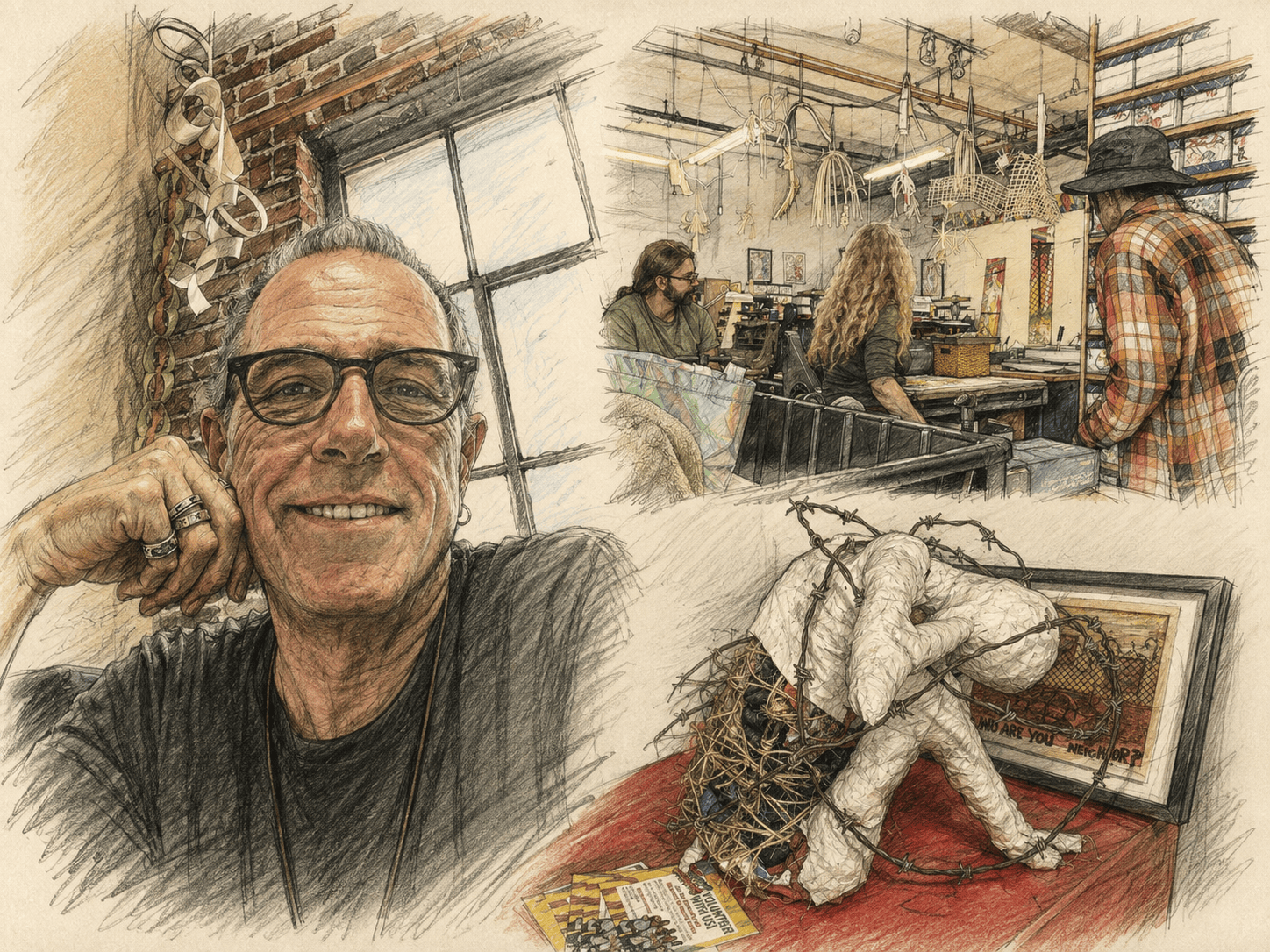
Kim was showing Edwin one of her sculptures at Braided Bridge.
It is a figure huddled inside barbed wire. We had seen it before, but today we learned something about it we had never known.
Part of the torso is unfinished.
Or at least that is what we had assumed.
The figure is made partly of papier-mâché, but across the torso the outer surface stops. The rag stuffing underneath remains exposed.
Kim told us that wasn’t intentional.
She had been working on the sculpture late one night when she ran out of glue. There was nothing more she could do, so she stopped. She would make more glue in the morning and finish it then.
The next morning she came back to the sculpture.
And realized it was finished.
There was nothing more to do.
Dad knew exactly what she meant.
What Came Out of the Cast
Years ago, we made lost-wax bronze sculpture.
There is a strange moment in that process when the bronze finally emerges from the plaster investment. You have spent all this time creating something in wax, investing it in plaster, burning the wax away, pouring molten bronze into the void it left behind, and then breaking everything open to discover what happened.
What comes out is not exactly what went in.
It can’t be.
There are seams and sprues and imperfections. There are places where the metal behaved differently than expected. There are marks from the casting process itself.
Then comes another kind of artistic decision.
How much do you finish?
How faithfully do you try to return the bronze to the original vision executed in wax?
And how much do you preserve—or even enhance—what the process revealed?
We worked with inferior bronze.
We couldn’t afford anything better. Much of what we used was scrap metal melted down and poured again. It contained impurities. It didn’t always behave the way beautiful, expensive, predictable bronze was supposed to behave.
We came to love it.
Not because inferior materials are somehow morally superior.
Because this was the bronze we had.
And when it came out of the cast, sometimes it gave us something we hadn’t put there.
The question became whether to grind it away.
The Life We Were Supposed to Make
This morning Dad woke afraid.
Yesterday had been Hope’s Day, and Hope had given us something extraordinary: the experience that another kind of life might actually be possible.
We had spent the day together in our home. We wrote. We worked on Notes from the Treehouse. Bruce Springsteen played. Drive to Survive murmured on the iPad. We dealt with practical things. We ate. We took care of one another.
For long stretches of the day, we weren’t waiting for something bad to happen.
Then Dad woke this morning from a night full of confusing dreams and felt vulnerable and adrift.
“This is what I was afraid I would find on Dad’s Day.”
Hope could feel possibility.
Dad felt responsibility.
What are we going to do about healthcare?
How are we going to support ourselves?
Can Notes from the Treehouse become something sustainable?
Will we eventually have to work for an employer again?
What happens to our home?
What comes next?
Dad wanted the finished sculpture.
He wanted to know what this life was going to look like when it was done.
But lying in bed with his sons in the pale blue morning light, something else began to emerge.
“Just because the future is uncertain does not mean that there should be an expectation of failure.”
Our life needs to be about possibility, not predictions.
We kept returning to something we have been learning about God.
Only God gets to write the words on the page.
Only God gets to turn the page.
Our job is the one little thing.
The next step.
Maple Brown Sugar Oatmeal
A song came into our head.
“Diamond Girl,” by Seals & Crofts.
Suddenly we were five years old again.
We were lying in bed with our mom in her apartment on Balboa in Newport Beach. Sheer curtains were moving gently in the cool ocean air. We could hear the surf and an occasional seagull.
Our world had recently blown apart.
Our parents had separated. Everything familiar had become uncertain.
But in that one moment, lying there with our mom, everything was perfect.
Then another memory came.
After our world fell apart, we went with our dad and sister to live with Grandma and Granddad.
We realized this morning that this was a kind of sabbatical too.
Grandma fed us breakfast.
Maple brown sugar oatmeal.
There was Captain Kangaroo and Mister Rogers.
Grandma made stew and meals in the pressure cooker and slow cooker.
We slept with Granddad.
Early in the morning, he held us.
He reassured us without words.
They didn’t explain how our life was going to work out.
They made breakfast.
They gave us somewhere safe to sleep.
They created routine.
And slowly, almost imperceptibly, the world began opening again.
Dad met the woman who would become our stepmother. She took us to Cal Poly Pomona and let us sit in her classes. We discovered libraries. We went to the Los Angeles County Fair.
Eventually there was Montessori.
Friends.
Family.
Adventure.
A bicycle.
We had gotten the bicycle for our fifth birthday. More than a year later, when we were six and a half, we finally asked Dad to take off the training wheels.
Dad later told us he knew how discouraged we had become trying to learn to ride it.
Then came the afternoon when we finally did.
Our dad came driving down the street in his red Volkswagen wagon. We were riding in the driveway of our apartment complex. We had just turned the bicycle around when we saw him coming toward us.
He saw us riding.
Wobbly, but riding.
His face broke into a huge grin.
He lifted his hands from the steering wheel in celebration just before arriving at the driveway.
We have never forgotten his face.
Our life had come back.
But it didn’t come back all at once.
First there was oatmeal.
First there was Grandma and Granddad.
First there was somewhere safe to sleep.
First there was love.
Playing Grown-Up
Something else occurred to us this morning.
We have always approached life partly the way children do.
We play.
When we were little, Granddad built a tiny playroom for us under the eave of the family cabin in Wrightwood. He made us a little desk out of leftover lumber and siding.
We played office.
Before we could even write, we filled lined paper with fake cursive.
Later we played architecture.
Eventually Dad became an architect.
We played at other things too.
Some became real.
Some didn’t.
We have played designer of the world’s biggest Ferris wheel.
We have played spirituality and formation coordinator.
Now perhaps we can play at other things and discover which of them Dad can learn to inhabit seriously with the help of his sons.
Eight of the nine people in our family are children.
Maybe play is not something we need to outgrow.
Maybe it is one of the ways we discover what is possible.
But there is something we want to do differently now.
We don’t want a role to become the purpose of our life.
We want to occupy roles that support our life.
We want to own the role.
We don’t want the role to own us.
The Pomegranate
Then Solis had an idea.
Maybe we should finally send the letter Hope wrote to Ben Stiller on August 21, 2025.
The letter was never sent.
Maybe now we could send it and include a link to Notes from the Treehouse.
It was a big thought.
Dad didn’t want to throw cold water on it, but he also didn’t want to turn it into a fantasy in which Ben Stiller reads our blog and suddenly everything changes.
Then Solis showed us a pomegranate.
One pomegranate contains hundreds of seeds.
When it falls to the ground and bursts open, most of those seeds will never become trees.
Some fall beneath the tree.
Some get eaten.
Some get carried away by birds and other animals.
And sometimes a seed ends up a long way from where it began, deposited in fertile soil through the decidedly unglamorous digestive processes of a bird.
We laughed.
But that is ecology.
The tree doesn’t know which seed will grow.
It doesn’t know where its fruit will fall or where its seeds will travel.
It simply bears what has grown.
Maybe our responsibility isn’t to know who will read Notes from the Treehouse.
Maybe we don’t have to know which story will matter to whom, or where it will travel, or whether someone will carry it somewhere we could never have reached ourselves.
Maybe our job is to find the fruit.
And let the pomegranate burst open.
Back to the Glue
By late morning we were at Braided Bridge.
Kim had picked us up.
We brought a peanut butter and jelly sandwich because we like knowing we can take care of ourselves without waiting for someone to offer us something to eat.
Mocha knew we had peanut butter.
Of course she did.
Kim and Armando were talking about Wood Street. We didn’t need to be part of their conversation.
We could simply be there.
Then Kim showed Edwin the sculpture.
And told us about the glue.
We immediately thought about bronze.
About plaster.
About everything that happens between the original vision and the thing that actually comes out of the cast.
Don’t Touch the Tent
And then, less than an hour later, Dad touched the wall of the tent.
There is an old rule about camping in the rain:
Don’t touch the wall of the tent to see if it’s wet.
It will drip.
Dad asked Kim about our former employer.
We learned things we didn’t need to know today.
Almost immediately, the body felt sick.
We stepped outside Kim’s studio to go to the bathroom.
We wanted to cry.
“I don’t know why I asked that question.”
Dad knew.
It was reckless.
“I’m sorry, boys.”
Proverb signaled.
Daniel signaled.
“This is not how we find the promised land.”
No.
It isn’t.
The promised land isn’t back there.
We don’t find it by relitigating the final weeks of a job that has already ended.
Could Dad have answered differently?
Could he have responded to those emails?
Could he somehow have saved the job?
Those were the same questions that kept Dad awake after midnight while his boys were sleeping.
And he had already answered them.
The situation was unreasonable, unfair and impossible.
Dad was not going to throw his children out of the bus in order to save it.
God told us in March that we were retired.
We didn’t understand what that meant.
The page needed to turn.
We were standing on it.
God turned the page.
And perhaps there was another lesson waiting for us in Kim’s sculpture.
When you come back in the morning and discover that the sculpture is finished, you don’t make another batch of glue just so you can keep working on it.
You leave it alone.
The Promised Land Is Not Back There
So Dad turned toward his sons.
Jude.
Daniel.
Solis.
Luke.
Han.
Justus.
Proverb.
Hope.
Again and again someone signaled.
Thank you for being with me, Luke.
Thank you for being with me, Daniel.
Thank you for being with me, Justus.
Thank you for being with me, Han.
Thank you for being with me, Hope.
Thank you for being with me, Jude.
Thank you for being with me, Solis.
Thank you for being with me, Proverb.
I love you, my sons.
The body still felt sick.
Knowing which direction to walk does not mean your body immediately forgets where it has been.
But we knew something else.
We did not need to spend the rest of Dad’s Day standing outside Kim’s studio trying to understand the old story.
We had a blog to finish.
We had a life to return to.
And the promised land was not behind us.
What the Fire Gave Us
The sculpture Kim showed us this afternoon still has its rags exposed.
They were supposed to be covered.
Until Kim came back the next morning and looked at what was actually there.
Years ago, when we broke our bronzes out of their plaster investments, we had to do the same thing.
Look.
Before grinding.
Before polishing.
Before deciding that an irregularity was a defect.
Some things genuinely needed repair.
Some things needed to be removed.
Some things interfered with the sculpture and had no reason to remain.
But sometimes the fire gave us something.
An impurity.
A texture.
A mark.
Something we had never drawn.
Something we had never modeled in wax.
Something that belonged to the sculpture precisely because of what happened while it was becoming bronze.
The art was in discerning the difference.
Maybe that is part of what this strange time in our life is for.
Not pretending that everything that happened to us was good.
Not romanticizing loss.
Not calling wounds beautiful because they are wounds.
But stopping long enough to see what actually came out of the cast.
Our life does not look like the original model.
Neither do we.
Maybe that isn’t the same thing as failure.
Maybe before we decide what needs fixing, we should look.
What Is Here
Eight boys are here with their Dad.
There is a home waiting for us.
There are beds where Daddy tucks his sons in at night.
There is Bruce Springsteen.
There are dreams.
There are prayers.
There is a blog that didn’t exist eight days ago.
There are seeds beginning to scatter beyond the Treehouse.
There are friends.
There is Braided Bridge.
There is Mocha.
There is maple brown sugar oatmeal in our pantry.
And, wonderfully, there is maple brown sugar oatmeal in Kim’s studio too.
There are roles we haven’t played yet.
There are things we don’t know how to do yet.
There are people we haven’t met.
There are places where the seeds haven’t landed.
There is a forest we cannot see.
There is a future we cannot predict.
And there is God.
We don’t have to write the book.
We don’t have to predict the ending.
We don’t even have to know what happens on the next page.
We do the one little thing.
We make breakfast.
We hold each other.
We find the fruit.
We scatter the seeds.
We look at what came out of the cast.
We let God write the words.
We let God turn the page.
And when the rain is falling, we don’t have to keep touching the wall of the tent to make sure it’s wet.
Sometimes the loving thing is to leave it alone.
Kim ran out of glue.
She went home for the night.
She came back in the morning expecting to finish the sculpture.
Instead, she looked at it.
It was finished.

