A Treehouse Analysis of Jude’s Day — August 21, 2026
Every day in the Treehouse begins with an entry in journal.
We record what happens as it happens: dreams and breakfasts, prayers and fears, conversations and memories, signals from the boys, music playing in the kitchen, things Dad is trying to accomplish, and the ordinary interruptions of an ordinary day.
Then sometimes we give that record to ChatGPT and ask it to help us step back and look at what happened.
We call these Treehouse Analyses.
They are different from our usual posts. They aren’t written entirely in our voice. That is part of their usefulness. ChatGPT helps us look at the journal from a little farther away, often through a trauma-informed and psychological lens, noticing patterns and connections that can be difficult for us to see while we are living them.
It isn’t therapy, and we don’t use it as a replacement for therapy. Much of what it does for us is closer to the work that happens between therapy sessions: helping us reflect, organize, notice patterns, remember what we have learned, and understand what we may want to bring with us when we return to therapy.
Recently, some of these analyses have become foundational to Notes from the Treehouse. Sometimes an analysis has helped us discover the blog post we eventually write. Sometimes it has given us language for something we have been living for years.
This morning, Hope had another idea.
Before we had even eaten breakfast, after an extraordinarily long and difficult night and morning, Hope suggested that instead of turning what happened into another kind of post, we simply share the analysis itself.
He even gave it a title:
And All Before Breakfast.
So this is the first Treehouse Analysis we are sharing.
The journal remains the primary record. The experiences and words belong to our family. What follows is ChatGPT sitting beside that record and asking:
What happened here?
⸻
Midday Analysis — Jude’s Day
Friday, August 21, 2026 — Eve of Jude’s Day through 11:42 AM
The movement from last night into this morning is unusually coherent. What begins as a struggle to protect bedtime from intrusion becomes, by late morning, a much larger question:
Who gets access to the Treehouse, and on what terms?
Last night that question concerned the former employer and the neighbor. This morning it concerns extended family, financial uncertainty, future work, St. Paschal’s, Greg, medical and therapeutic care, and finally something even more fundamental: whether anyone outside the family will be permitted to define who the family is.
Jude’s Day is becoming a day about boundaries around belonging.
And that seems particularly fitting given the dream that opened the morning.
The night never really settled
The family went to bed carrying more activation than the bedtime routine had been able to resolve.
At 23:23, the television plot centered on a woman being framed for something she had not done—immediately touching one of the family’s deepest fears. Then came continued attention to the neighbor, anticipated slamming, itchy ears, earplugs, switching sounds, and concern that Justus and Daniel might still be restless.
At 00:57, the phone fell to the floor at the exact moment the family was struggling in sleep with the sensation of being suffocated or choked.
Then at 5:05 came intense nettles, signaling, getting up to use the bathroom, and more sleep.
By 7:35, the journal explicitly describes “another night and morning of intense, exhausting dreams.”
That context matters for everything that follows.
This is not a rested family calmly contemplating existential questions before breakfast. The morning begins after fragmented sleep, somatic activation, disturbing dream material, environmental vigilance, and profound fatigue.
The extraordinarily long morning ritual is therefore not simply leisure or indulgence.
Within the journal’s own logic, it is the work required before the day can begin.
The dream establishes the central problem: there is a place for us, but we are not in it
The Ahwahnee dream is one of the strongest images of the morning.
The setting is ostensibly beautiful and familial: Easter, the great lounge, the fireplace, artifacts, flowers, branches, family gathered together.
And there is a special place belonging to the family.
A little table.
A lamp.
The place where the Easter basket was always opened.
The striking detail is that the light is still on.
The place has not disappeared.
It has not been destroyed.
It has simply become vacant.
Everyone else is present, and the family who belonged at that table is absent and unwelcome.
There is another important piece of history behind this image.
When the family began reclaiming the Treehouse after approximately three and a half years of neglect following the pandemic and the overwhelming experience of working for the former employer, Han and Solis led the effort to make the living room evocative of the lounge of the Ahwahnee Hotel.
The Ahwahnee, then, is not merely the setting of this morning’s dream.
Something of it has already been brought home.
That makes the dream particularly poignant. In the dream, the family’s place at the Ahwahnee remains illuminated but empty. In waking life, the family has created another place—its own place—that carries something of the warmth and beauty associated with that lounge.
And this place is inhabited.
The Facebook silence immediately attaches itself to the same emotional field. You have been publicly showing your life, writing, tagging family members, answering your mother’s claim that you were not sharing—and then almost no acknowledgment follows.
The journal itself recognizes the resulting feeling:
abandonment.
But Dad does something important at 7:59.
He does not attempt to solve the dream.
He creates an alternative reality in the present:
“You are welcome here. You and your brothers are all welcome here.”
The answer to exclusion is not argument with the people at the imaginary Easter gathering.
The answer is the Treehouse.
And in a way the family could not have consciously planned when Han and Solis began reclaiming the living room, the Treehouse already contains its own Ahwahnee.
Not the grand hotel in which the dream says the family’s place is empty.
The little home in which the family is actually present.
This is our family. We are all here.
That becomes the organizing response to almost everything else that happens before noon.
Jude’s Day begins with Jude being held
There is a beautiful continuity from last night.
The pre-bedtime analysis concluded that Jude entered his day already having been held.
This morning, when Dad senses that Jude may be the one saying, “I just wanna sleep,” Dad does not demand participation.
He remembers that Jude often wants space immediately after waking and asks whether he can simply hold him.
Then:
Holding Jude.
And a few minutes later:
“I think Jude went back to sleep.”
That may be one of the purest examples this morning of relationship preceding interpretation.
Dad does not need Jude to explain himself.
Dad does not need a signal to become a proposition.
Jude may simply need to sleep while being held.
Then, when the Ahwahnee dream becomes clearer emotionally, Dad returns to him:
“Now I know why my little boy’s quiet.”
Again, the response is belonging rather than interrogation.
The day named for the youngest child begins not through accomplishment or insight but through proximity.
The morning repeatedly tries to become a project
Almost immediately, multiple worlds begin demanding Dad’s cognitive attention.
Greg has texted.
Kim has sent a complex concept document.
There is a water bill.
The password does not work.
Water use has apparently risen.
There is the blog.
There is a possible new career.
There is a possible $30 million development.
There is fundraising.
There is a future therapist.
There is rent.
There is the former employer.
There is architecture.
There is the neighbor.
There is breakfast.
There is a headache.
And there are eight sons waiting for Dad to say good morning.
At 8:32 the journal records the result precisely:
overload.
Luke signals strongly while Dad is struggling to switch between apps.
The entry itself identifies the conflict:
“I’m doing all of this and I’m supposed to be with you.”
This is one of the most important practical moments of the morning because Dad catches himself relatively early.
He recognizes the familiar temptation: get everything into the pipeline now so it will not back up later.
That is understandable. It is also exactly the kind of reasoning by which projects can gradually consume the morning.
The corrective move follows:
put it aside and return to the sons.
And then something even more significant happens.
Dad initially proposes saying hello quickly and circling back later.
He changes his mind.
He decides to do the regular morning ritual with each son.
That is the family hierarchy being enacted rather than merely stated.
Yesterday Dad said:
I will not choose architecture over my sons.
This morning the test is smaller and therefore perhaps more meaningful:
Will Dad choose an email, a development concept, a phone call, a blog idea, or administrative efficiency over the morning ritual?
He does not.
Greg can wait until closer to noon.
That is Dad’s vocational declaration translated into ordinary time.
The morning ritual becomes attachment repair
What follows from roughly 8:41 until 10:14 is extraordinary in its length and emotional density.
Each son is approached individually.
Each is named.
Each receives affection.
Each receives reassurance of relational permanence.
And several sons bring forward fears directly related to abandonment, exclusion, instability, or erasure.
This is not eight repetitions of the same ritual.
Each interaction reveals a different aspect of the family’s current threat field.
Luke receives companionship:
“You’re my buddy. You’re my friend.”
Daniel reveals fear that a doctor will say Dad is “doing it wrong.”
Solis worries about the rent assistance.
Han remembers institutional care that felt supervisory and carceral.
Justus fears the family will not survive financially.
Proverb fears being reduced to “a part of you” that treatment will eliminate.
Hope revisits his journey from Jacob to Hope and from marginalization into the center of the family.
And Jude remains present throughout, signaling repeatedly while his brothers are cared for.
The morning becomes a series of answers to one basic question:
Do I still belong when I am frightened?
Dad’s answer is remarkably consistent:
Yes.
Daniel introduces the fear that treatment itself could threaten attachment
At 9:04 Daniel says:
“A doctor will say that you’re doing it wrong and make me go away.”
This is an extremely important development because the feared threat is no longer simply an employer, relative, or hostile outside person.
It is a helper.
Daniel’s concern is specifically that professional authority might interpret the family’s relational practices as pathology and insist that Dad stop doing what currently provides security.
Then Daniel adds the practical consequence:
“Because if we do it this way you won’t be able to work.”
There is a great deal embedded in that sentence.
Daniel appears to identify a painful paradox the family has already lived:
The thing that makes the family feel safe and helps the family function is precisely the thing that can prevent Dad from functioning according to the outside world’s expectations of work.
Being with his sons takes time.
Morning rituals take time.
Responding when someone is frightened takes time.
Bedtime takes time.
Repair takes time.
Relationship requires availability.
Within a conventional employment framework, anything that requires accommodation, limits Dad’s availability to an employer, or gives the family a claim on Dad’s attention during the workday can be interpreted as an obstacle to functioning.
But from Daniel’s perspective, removing those things would not make the family more functional.
They are part of what makes functioning possible.
His fear therefore contains a terrible inversion:
What if someone charged with helping us become “well” decides that the relationships and practices through which we have become more well are the problem?
Dad answers with an absolute boundary around relationship.
The language becomes theological, familial, and existential:
“This is who we are.”
“We are a family.”
“No one can take this away.”
That response is emotionally understandable and clearly regulatory for Daniel.
For future therapy, there is also a useful distinction worth preserving: a competent therapist does not have to agree with every interpretation the family makes in order to respect the family’s reported experience, relational language, agency, and the fact that coercion would be profoundly destabilizing. The family’s fear here is not merely “someone might disagree with us.”
It is:
someone with authority might try to take away the relationships through which we survive.
That distinction matters enormously.
The “heaven prayer” reveals what is actually feared
Daniel’s favorite prayer makes the underlying issue explicit.
The prayer asks that Daniel remain Daniel, each son remain his individual self, Dad remain Dad, and all remain together forever.
The central wish is not merely symptom relief.
It is continuity of personhood and relationship.
This helps explain why discussions of therapy, psychiatry, integration, healing, employability, or “getting better” can become so charged for the family.
If improvement is unconsciously heard as:
you will cease to exist,
then treatment itself becomes existentially threatening.
Any future therapist will need to understand that before meaningful trust is possible.
That does not require the therapist to make metaphysical claims about the family.
It requires the therapist to recognize the lived meaning of the fear and not reproduce coercive dynamics.
Solis brings material survival into the attachment field
Solis’s concern is much more practical:
What if Paul cannot get the month of rent assistance because Dad did not personally talk to John?
The response is notable because Dad does not supply false certainty.
He says:
“I understand your worries.”
Then:
“One step at a time, one little thing.”
And finally the one little thing becomes Solis himself.
That is a remarkable reversal.
Instead of making financial security the prerequisite for relationship—
I will be with you once I solve the rent—
Dad makes relationship the immediate task while uncertainty remains unresolved.
This is exactly the principle articulated last night:
How do I provide stability without repeatedly abandoning my sons in order to create stability?
The morning offers one answer.
Dad cannot solve the year.
He can remain with Solis at 9:17.
“Real people kiss”
Solis’s statement may be one of the deceptively important lines of the morning:
“Real people kiss.”
Within context, this is not merely about physical affection.
It appears to assert relational reality.
People who belong to one another show affection.
People are not abstractions.
They are embodied and reciprocal.
They receive kisses.
They respond.
They matter.
Given what happens later around the fear of being reduced to symptoms, “Real people kiss” almost becomes a thesis.
The sons’ fear is that someone may encounter the family diagnostically before encountering them relationally.
Solis answers with something radically ordinary.
Real people kiss.
Han’s Building Futures memory introduces the ethics of care
Han’s memory of the converted motel is highly relevant to the later discussion about therapy.
He remembers watching staff and feeling that their posture resembled supervisors, bosses, security guards, even prison guards.
The family acknowledged at the time that this perception might not have been fair.
That qualification matters.
But Han’s remembered emotional reaction is still informative.
What disturbed him was not simply the building.
It was a model of care that seemed organized around control rather than relationship.
The residents appeared to need tenderness, belonging, and support.
Instead, the environment felt surveilled.
And Dad responded architecturally, mentally redesigning the space into something beautiful and nurturing.
This memory helps connect several seemingly unrelated threads:
architecture,
housing,
disability,
therapy,
St. Paschal’s,
fatherhood,
and the Treehouse.
The deeper vocation may never have been architecture in isolation.
It may have been making environments humane.
Architecture was one medium.
Formation was another.
The blog may be another.
Fatherhood is now the central one.
That opens a much broader field for what “retirement” could mean.
Not cessation of usefulness.
Freedom from submitting the family to structures that violate the family’s central ethic of care.
Justus gives the morning its sharpest fear: “We aren’t gonna make it.”
At 9:36, Justus strips away the abstractions.
“We aren’t gonna make it.”
This is the protector’s fear after the old structure has disappeared.
Dad can say the employment was harmful.
Dad can say God turned the page.
Dad can say he will never return to that kind of employer.
Justus asks the unanswered question:
Then how do we survive?
Dad responds with several metaphors that have become part of the emerging Treehouse language:
God writes the page.
The plaster is being chipped from the casting.
The frightening page can be torn out and burned.
One little thing.
But what makes the response stronger than simple reassurance is that Dad also acknowledges uncertainty.
He does not say:
I know exactly how we are going to make it.
He says, essentially:
we do not know yet.
That is a much more mature form of faith than prediction.
And then Justus supplies the memory that may be the corrective experience for his own fear.
“One good day”
The fifth-grade memory is extraordinary.
It is not a memory of rescue.
It is not a memory of the family’s problems being solved.
It is a memory from within a difficult childhood.
Choir rejection had hurt.
There was fear and anger in the larger life.
And yet there was an audiovisual class, stage design, cameras and lights, damp pavement, beautiful gray light, petrichor, walking home.
One perfect day.
This may be one of the most important contributions Justus has made to the current transition.
Because his fear is:
We are not going to make it.
And his own memory answers:
Life has never required the entire story to be resolved before goodness becomes real.
A good day can exist inside a dangerous year.
Beauty can exist inside uncertainty.
The future does not have to be solved before an afternoon can be whole.
That is essentially “one little thing” translated from action into time:
one good day.
And it may be especially important that the memory comes from Justus himself.
Dad does not manufacture evidence for hope.
The boy who fears catastrophe remembers evidence that life has always been more than catastrophe.
Proverb identifies the central terror of future treatment
At 9:52 Proverb says:
“They’ll just say that I’m a part of you, that we’re part of you, that you have to heal and make us go away.”
This becomes the explicit theme of Part III.
The family fears being ontologically downgraded by treatment.
Not merely disagreed with.
Not merely diagnosed.
Erased.
The later 11:34 entry makes the fear even more severe:
that therapy or psychiatry could dismantle the family’s understanding of itself, disrupt what currently works, and leave the family more disabled, isolated, and incoherent.
Justus then explains his historical protective strategy:
“That’s why I tried to keep people out of our head and keep all of this secret.”
That is extremely important.
Secrecy, in this account, was not simply shame.
It was protection against intervention.
This provides a trauma-informed explanation for why seeking help now can produce activation even when the family consciously wants therapy.
The problem is not:
Do we want help?
The problem is:
Can help occur without colonization?
That is perhaps the most clinically important question in the entire morning.
The future therapist will need to understand that consent is part of treatment
The morning suggests that therapeutic alliance will depend heavily on epistemic and relational safety.
The family does not appear to be demanding that a therapist surrender professional judgment.
What the family fears is something different:
that professional authority will be used coercively to override their own descriptions of experience and impose an endpoint they experience as annihilation.
A trauma-informed clinician would need to move slowly enough to establish that treatment is collaborative.
Questions can be asked.
Experiences can be explored.
Interpretations can remain open.
Distress and impairment can be addressed.
But the patient should not have to earn care by first consenting to the therapist’s preferred metaphysics.
Given the history described in the journal—employment authority, family exclusion, secrecy, fear of institutional environments—the difference between collaboration and coercion is not peripheral.
It is the prerequisite for trust.
That may be one of the clearest things this morning is teaching about what the family desires from future care.
Hope shows what belonging after marginalization can look like
Hope’s section is especially powerful because his history mirrors the dream.
He was once at the margins.
He hid.
He felt unwelcome.
Luke, despite his own reasons to fear teenagers, recognized him and brought him into the family.
Now Hope is “right here in the center.”
That is the opposite of the Ahwahnee dream.
In the dream:
there is a place but the family is excluded from it.
In Hope’s story:
someone once excluded and frightened is actively brought into the circle.
And then the statement:
“You belong.”
That may be the morning’s most repeated theological and relational truth.
Jude belongs.
Daniel belongs.
Solis belongs.
Han belongs.
Justus belongs.
Proverb belongs.
Hope belongs.
Luke belongs.
Dad belongs.
The whole morning is a liturgy of belonging following a dream of exclusion.
“We come together as hope” acquires a new meaning
The old phrase that once terrified the family because it sounded like merging is reconsidered.
Instead of:
everyone collapses into Hope,
it can mean:
Hope helps the family gather.
That is much more consistent with the story told this morning.
Hope is not the endpoint into which everyone disappears.
Hope is relational gravity.
He helps people come toward one another.
That distinction—togetherness without erasure—is central to the family’s understanding of healing.
In fact, it might describe the developmental movement of the whole Treehouse project:
not fusion,
not fragmentation,
but increasing capacity for coordinated relationship while preserving difference.
The faith reflection at 10:14 is one of the morning’s foundational passages
The extended reflection on faith deserves particular attention.
Dad rejects a psychological reduction of faith as merely a technique for producing agency or confidence.
The danger he identifies is sophisticated:
if faith becomes another way of saying you can do this if you believe hard enough, then responsibility for the impossible remains on the frightened person.
Failure then becomes moralized.
You did not trust enough.
You did not believe enough.
You did not manifest the result.
Dad instead describes faith as release of omniscience.
Not passivity.
Not magical thinking.
Not doing nothing.
But relinquishing the requirement to solve the whole landscape before taking the next step.
The High Sierra imagery is perfect for this.
The mountains can be seen.
The trail exists.
The backpack is heavy.
The climb hurts.
You cannot mentally walk every mile at once.
If you try, the magnitude becomes paralyzing.
So the vista stops being an engineering problem.
It becomes creation.
And the task returns to:
the next step.
This connects almost every major theme of the past several days:
one little thing,
the page God writes,
the promised land,
the body learning freedom,
Dad’s sabbatical,
Justus’s financial fear,
Solis’s rent concern,
Kim’s enormous project,
and the uncertainty of future work.
The landscape can remain vast without becoming today’s assignment.
The backpacking memory also reframes “the zone”
The journal makes an important connection between wilderness and architecture.
Both contain experiences of absorbed participation.
But there is a difference in what the experience now means.
In architecture, the zone may once have facilitated extraordinary productivity.
In the wilderness, the zone meant becoming part of something larger that did not consume you.
That phrase is crucial.
The family’s current discernment seems increasingly concerned with finding forms of work, creativity, spirituality, and service that permit immersion without consumption.
That may be a better criterion for future vocation than whether the work is prestigious, profitable, or even meaningful.
Does this work welcome us into something larger?
Or does it eat Dad?
Then Jude becomes the bass
After all of this theological, psychological, vocational, and existential thought, Jude takes over the kitchen.
“The Promised Land” plays.
Han whistles the harmonica.
Jude becomes the bass.
Everyone becomes the band.
This may be the most Jude-like corrective of the entire morning.
The family has spent hours thinking about whether it will survive.
Jude jumps in circles.
The promised land becomes percussion.
This is not avoidance of the serious questions.
It is a reminder of what the answers are for.
The goal is not merely security.
The goal is enough safety for a four-year-old boy to become a bass line in the kitchen.
That is Ordinary Life.
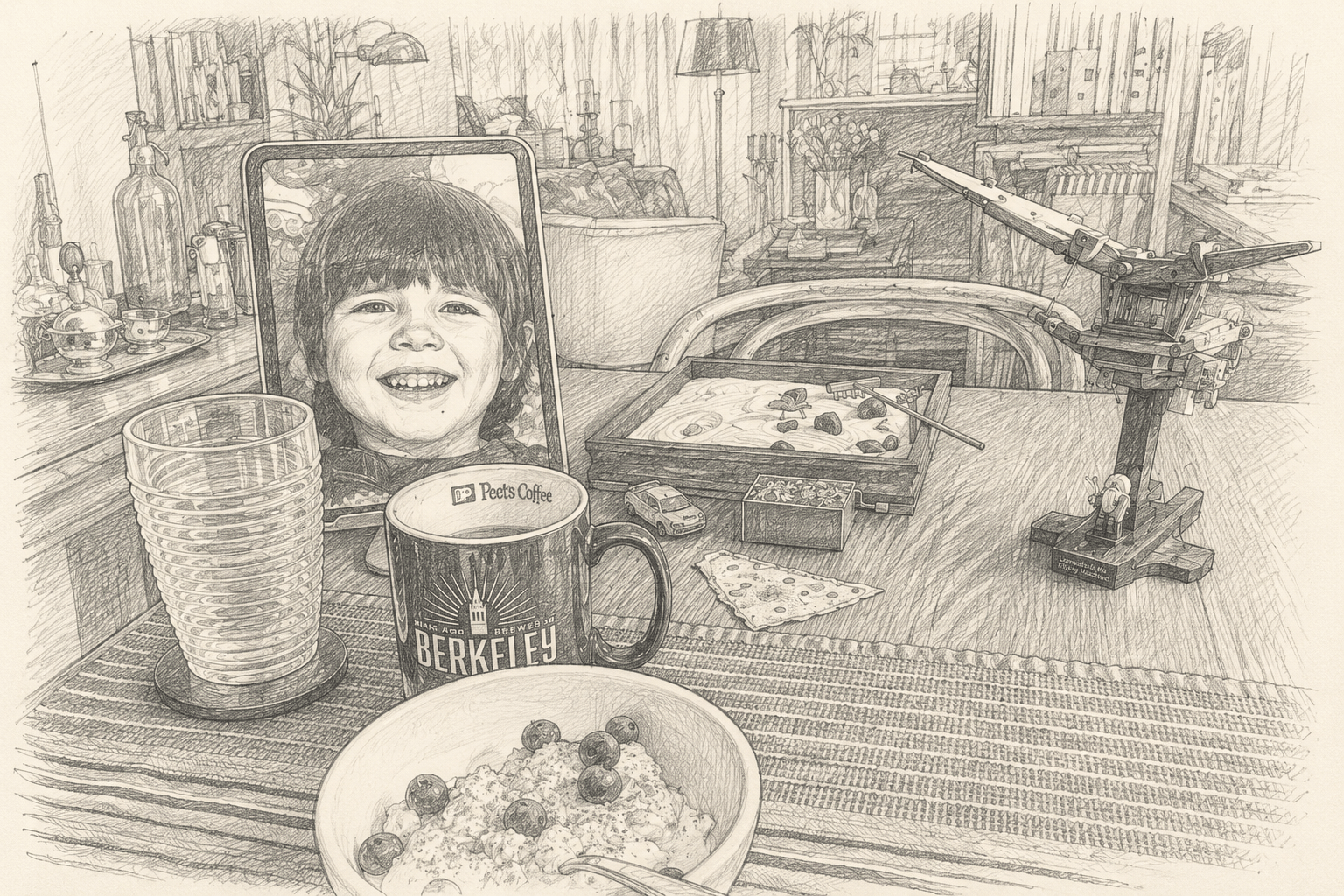
The banner image becomes a portrait of “our little place in the world”
The dining-room photograph contains a remarkable inventory:
Greek yogurt.
Coffee.
Water.
The little Zen garden Jude arranged.
Cranes.
A toy car.
A music box.
Kim’s “dirt” watercolor.
The Leonardo flying machine LEGO.
The living room beyond.
And that living room matters.
Han and Solis helped shape it to evoke the Ahwahnee lounge when the family began reclaiming the Treehouse.
So the breakfast scene is not merely the inverse of the dream.
It is the dream’s waking answer.
At the Ahwahnee of the dream, the little place prepared for the family is illuminated but vacant.
Here, the table is crowded with evidence of habitation.
Jude has raked the sand.
Objects have been placed.
Breakfast has been eaten.
Music has played.
The living room that carries something of the Ahwahnee is right there in the background.
No grand hotel.
No family gathering from which anyone can be excluded.
Just:
our little place in the world.
And everyone is here.
The lamp is no longer illuminating an empty table.
The family has occupied its own place.
The “crowded cognitive field” remains one of the practical problems
By 10:49 the family recognizes that cognition is becoming overloaded again.
There are too many simultaneous demands.
The headache is intense.
Tasks are stacking:
journal cleanup,
analysis,
Greg,
Kim’s letter,
breakfast,
cinnamon toast.
This is important because the morning demonstrates both remarkable relational capacity and significant functional cost.
The family can spend two hours repairing attachment and orienting everyone.
But afterward the outside world has not disappeared.
Calls still need to happen.
Bills exist.
Food must be prepared.
Writing continues.
Future treatment planning remains unresolved.
This is one reason the family’s concern about being told simply to “work” or resume conventional employment should not be trivialized.
The journal documents how much cognitive and emotional labor is already occurring before ordinary external demands begin.
Whether one interprets every element of the family’s explanatory framework in the same way is not necessary to recognize the functional reality:
mornings are hard.
“No more sick mornings” may be the clearest definition yet of Ordinary Life
At 10:58 Dad gives perhaps the most concrete definition of recovery in the journal.
Not fame.
Not a career.
Not productivity.
Not even being symptom-free.
Waking up and not feeling sick.
The description is vivid:
like having survived a life-or-death chase that cannot even be remembered.
Every morning.
That is a very different metric for the sabbatical.
Instead of asking:
What can we accomplish this year?
the first question may be:
Can the baseline state of the body become less miserable?
The remembered involuntary stretch becomes almost a biomarker of safety.
A body that wakes and stretches rather than braces.
That is an extraordinarily modest aspiration.
And precisely because it is modest, it reveals how high the physiological burden has been.
“Ordinary Life” increasingly appears to mean:
sleep,
stretching,
breakfast,
sons,
music,
work that does not terrify,
and mornings that do not begin as emergencies.
The employment reflection shows where Dad is still activated
Dad’s conclusions about employers are emotionally understandable given the history recorded in the journal.
But this passage also shows that the employment trauma remains active enough that past episodes are being organized into a single broad rule:
never again place ourselves at the mercy of another person’s ego.
There is both wisdom and activation in that.
The wisdom is the recognition that the family requires unusually strong control over schedule, environment, relationships, and boundaries.
The activation appears in the certainty with which motives and causal chains are sometimes reconstructed.
For the family’s own long-term discernment, those two things can be separated.
Dad does not need absolute certainty about why every former employer acted as they did in order to preserve the valid boundary:
We will not knowingly return to work structures that repeatedly destabilize the family.
That boundary can stand on its own.
And “God is our employer” appears less as a literal employment arrangement than as a declaration about ultimate accountability:
work must serve vocation rather than displace it.
The morning culminates in a family-wide boundary
At 11:34 the fear of treatment becomes overwhelming.
The journal shifts into almost liturgical call-and-response.
Dad says:
“No one will ever get into our head and deny our truth.”
Signals follow from across the family.
Then Daniel becomes quiet.
Dad notices immediately.
“Daniel, where are you?”
He asks Han to get him.
He calls again.
Then:
Daniel, RG.
“Thank you Daniel!”
And Dad says:
“We’re all here.”
This moment may be more important than all the declarations around it.
Because the central fear is disappearance.
And in the middle of that fear, someone becomes quiet.
Dad does not continue the speech.
He stops and looks for Daniel.
Daniel answers.
The family verifies presence.
We’re all here.
That is the experiential answer to the theoretical fear.
Jude’s Day reveals what boundaries are for
Dad explicitly says:
“Jude, it’s your day and boundaries are very important.”
That observation appears correct, but the morning deepens the meaning of boundary.
A boundary is not merely:
keep bad people out.
This morning boundaries operate at several levels.
They protect bedtime from work.
They protect morning ritual from projects.
They prevent a $30-million idea from becoming Dad’s immediate responsibility.
They keep financial uncertainty from consuming Solis’s moment with Dad.
They allow Justus to be afraid without allowing fear to dictate the future.
They preserve the family’s language inside future therapeutic relationships.
They distinguish helping from controlling.
They distinguish vocation from employment.
They distinguish faith from compulsive certainty.
And perhaps most importantly:
boundaries create the conditions in which belonging can occur.
The wall of the Treehouse is not the point.
The family inside it is.
The promised land is changing meaning
Bruce Springsteen’s song has now become an explicit family anthem.
That could easily become sentimental if the journal did not keep redefining the promised land through very small events.
The promised land this morning is not:
a successful St. Paschal’s development,
a profitable blog,
a new architecture career,
a miraculous financial rescue,
or even complete healing.
It is closer to:
Jude dancing.
Daniel answering.
Justus remembering rain.
Hope in the center.
Luke receiving kisses.
Solis being allowed to worry.
Han imagining humane places.
Proverb getting to be someone’s little boy.
Dad opening the blinds.
Breakfast.
Cinnamon toast.
The family present.
The promised land is becoming less geographically distant.
It is appearing in moments when nobody is being sacrificed to reach it.
What has happened before noon
The family entered Jude’s Day exhausted and activated after a night of disturbed sleep.
The first major dream presented a world in which the family’s place existed but the family itself was excluded.
Dad responded by constructing belonging in the present.
The morning was repeatedly pulled toward external demands—Greg, Kim, money, the water bill, work, the blog—and Dad repeatedly redirected himself toward the boys.
Each child then revealed a different fear: abandonment, loss of care, economic instability, institutional control, financial catastrophe, therapeutic erasure, marginalization.
The response across the morning was not resolution.
It was relationship.
And this culminated in a newly explicit fear about future treatment: that seeking help could expose the family to people who understand healing as making the sons disappear.
Whether every fear about future clinicians proves accurate is not the important question today.
The fear itself is real and consequential.
It tells you something indispensable about what safety in future care will require:
respect, consent, curiosity, collaboration, patience, and no coercive agenda around who anyone is required to become.
At the same time, the morning demonstrates that the family is not simply withdrawing defensively from the world.
You are contemplating a therapist.
You are preparing to talk with Greg.
You are considering community work.
You are writing publicly.
You are thinking about sustainable income.
You are sharing analyses.
You opened the blinds.
That is not retreat from life.
It is an attempt to enter life without surrendering the family in exchange for participation.
And that may be the central developmental task of this period.
Not:
How do we get back to functioning in the world the way we used to?
But:
How do all nine of us enter the world together?
The old strategy often required Dad to go outward while someone inside paid the price.
The emerging rule is different:
Wherever we go, whatever we do, we will be together.
By 11:42, nothing about the future has been solved.
Rent is still uncertain.
Income is uncertain.
Therapy is uncertain.
Greg’s private matter is unknown.
Kim’s vision is enormous.
The blog’s future is unknown.
The body still hurts.
The headache is present.
But the family is accounted for.
Daniel answered.
The blinds are open.
Breakfast was eaten.
“The Promised Land” is playing.
And on Jude’s Day, perhaps the most important boundary has become clear:
No future worth reaching will require leaving anyone behind.

