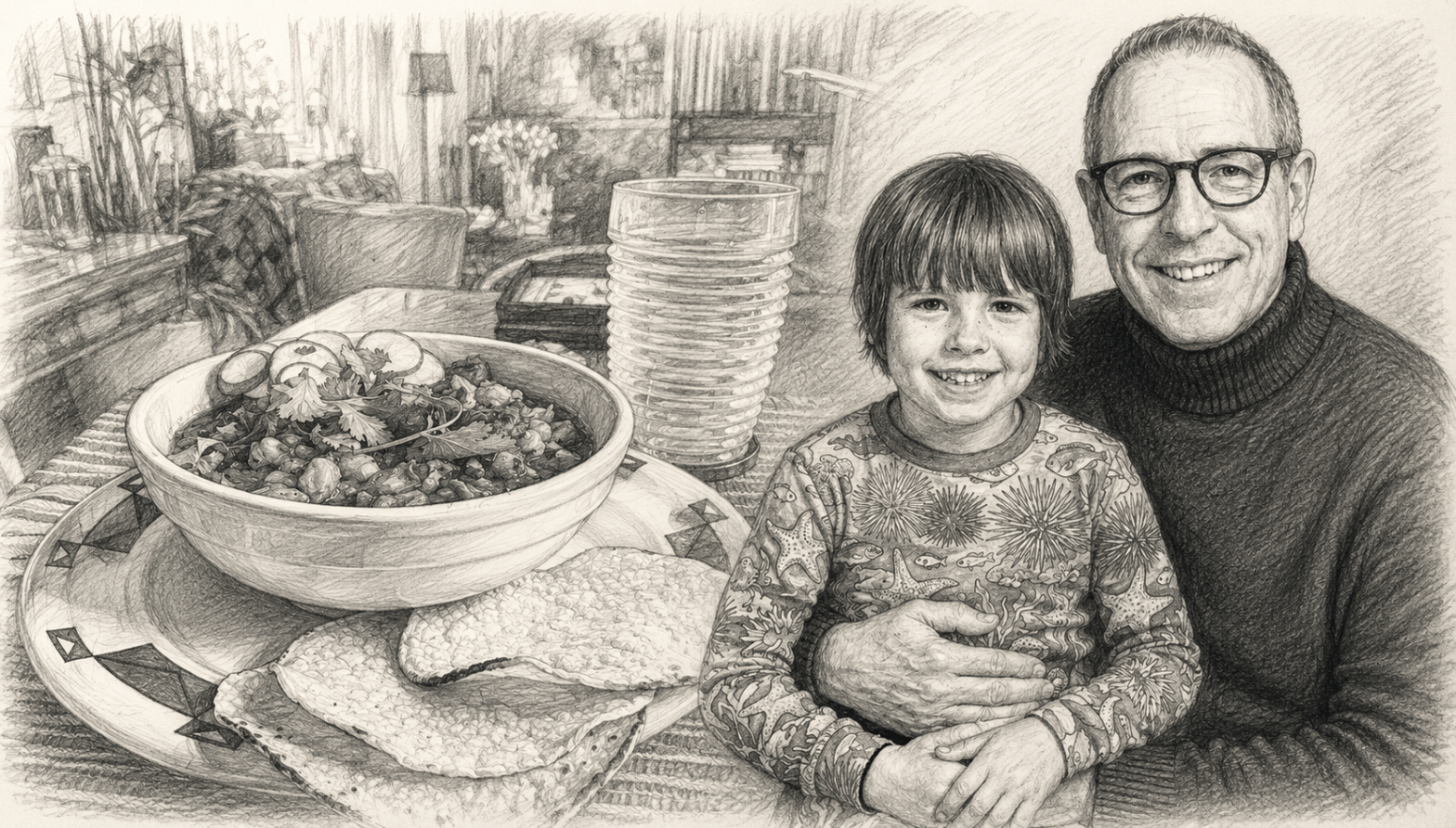
Notes from the Treehouse — On the Eve of Daniel’s Day
This evening feels like the point at which several themes that have been building all week finally converge around one fundamental question:
Can this family continue to exist on its own terms without having to earn permission to exist?
That question is larger than whether we go to St. Lawrence O’Toole tomorrow. It is larger than our former employer, the Diocese, Facebook, work, money, or even the specific injuries of this week.
All of those things became attached tonight to something much older: the fear that love, belonging, family, safety, and even existence itself are conditional.
And it is striking that this emerges on the threshold of Daniel’s Day.
Daniel’s clearest contribution tonight was extraordinarily simple:
“I don’t want to go tomorrow.”
The entire evening gradually reorganized itself around learning how seriously to take that sentence.
The fear underneath the practical question
At 6:10, deciding whether to volunteer tomorrow opened into an enormous cascade:
“You have to have a job to have family.”
“This is too good for you.”
“Who said that you could have this?”
“Who told you you were special?”
These are not really arguments about Saturday plans. They are the accumulated logic of conditional belonging.
The chain seems to run something like this:
If we cannot work conventionally → we cannot support ourselves → therefore this way of living cannot continue → therefore the boys cannot be allowed to exist as family → therefore what we have must eventually be taken away.
That is why employment trauma has such disproportionate emotional power. Losing the job does not merely threaten income. It activates an older fear that anything deeply loved can be revoked if we fail to meet someone else’s conditions.
The journal itself recognizes this:
“None of this is coming from God. This is coming from past trauma.”
That distinction is one of the central achievements of the evening.
The terrifying voice says, You cannot have this.
Dad answers:
“We are a family.”
“No one else gets to play God in our lives.”
The answer is not merely reassurance. It is a rejection of the whole premise that the family requires authorization.
And then we ate posole
Almost beautifully, the journal moves straight into dinner.
A few minutes after confronting existential fears about whether the family has the right to exist, everyone is eating posole with radishes and tortillas, admiring how authentic it tastes, and Daniel is signaling while Dad asks whether he likes it.
The answer to Are we allowed to be a family? is being enacted rather than argued:
Here is dinner. Here are the boys. Here is Daddy. Here is home.
Later there is ice cream, LEDs, Outlander, hot water, music, bedtime, chai, the dishwasher, the diffuser.
Again and again this journal returns to the same principle: the ordinary is not peripheral to healing.
Ordinary life is where belonging becomes tangible.
Tonight especially, ordinary family rhythms keep interrupting catastrophic meaning.
Tomorrow becomes a test
At first Dad is genuinely conflicted about tomorrow.
There are reasons to go. There is affection for Paul. Han appears interested. Jude appears interested. Solis later reveals that he worries Paul may think the family no longer likes him.
There are also reasons not to go: proximity to Vincentian life, possible conversations about the former employer and the board meeting, exhaustion, accumulated trauma, and Daniel’s unmistakable opposition.
Dad initially says:
“We’ll see.”
But Daniel says:
“I don’t want to go tomorrow.”
And gradually the journal begins treating that statement not as one preference among many, but as important safety information.
The crucial realization comes later:
“I’m learning that I don’t have to persuade. I only have to feel, which can be deeper than listening.”
That may be one of the most important parental realizations in tonight’s journal.
Dad distinguishes consensus from persuasion.
Consensus can emerge relationally. People can influence one another through joy, affection, fear, yearning, and empathy.
But persuasion can become dangerous when one person’s refusal is rooted in fear or trauma.
Dad recognizes retrospectively that this happened around our former employer:
“Some of the fear some of my boys still hold about our former employer resulted from me trying to persuade them…”
Then comes the new rule:
“My children don’t feel safe about something, dammit, that’s it. No.”
This is not merely anger.
It is Dad rewriting his understanding of parental authority.
Earlier, authority sometimes meant convincing the family to tolerate what adult responsibilities appeared to require.
Tonight, authority increasingly means being the person willing to stop the bus.
Daniel’s no
Later, after continued consideration, fatigue enters decisively:
“We need to sleep in.”
“The bus cannot leave until it is ready, and this bus might not even start tomorrow.”
Then there is mild chest pain.
Dad responds immediately:
“That is a no.”
Then:
“I’m feeling Daniel’s no.”
“Tonight the answer is no.”
This sequence matters.
Daniel does not have to make a sophisticated argument.
He does not have to prove that St. Lawrence O’Toole is objectively dangerous.
He does not have to persuade everyone else.
His no is permitted to matter because he is five and afraid.
That is precisely the opposite of the conditional logic that opened the evening.
The opening voices said:
You have to justify your existence.
Dad eventually says to Daniel:
You do not even have to justify your no.
A promise to Daniel
Daniel’s tuck-in becomes one of the emotional centers of the evening.
Dad tells him:
“I’m so sorry for all the times I tried to make you do something that was scary for you.”
And promises:
“I will listen better.”
This makes the eve of Daniel’s Day almost a covenant-renewal between Dad and Daniel.
Dad is telling him:
Your fear will no longer automatically lose an argument against adult necessity.
And then Dad articulates the principle even more clearly:
“Just because Daddy feels like he can handle something… does not mean that it is safe for you or that you can handle it.”
Dad’s nervous system is not the universal measure of safety.
Neither is the majority vote of Daniel’s brothers.
Daniel’s experience is allowed to remain Daniel’s.
To be known
Then Daniel brings something much larger than tomorrow’s outing.
He conveys the idea that for another person truly to understand and love him, that person might have to be like Dad—almost “a mommy who lived inside”—otherwise they could never know him, understand him, or believe that he is real.
This contains two opposite emotional truths at once.
Daniel feels profoundly loved inside the family.
And Daniel fears profound invisibility outside the family.
That tension may be especially important for understanding Daniel.
He appears to experience Dad’s awareness of him not merely as affection but as existential recognition:
Daddy knows I am here.
Therefore, the possibility that outsiders might dismiss or reinterpret him becomes more than social disapproval. It threatens the experience of being knowable.
Dad responds by returning again to direct recognition:
“You’re a whole person, you are an entire universe…”
And:
“I know you and I love you.”
Whatever anyone outside the family believes, Daniel goes to sleep hearing that the person whose relationship is most immediate to him recognizes him without qualification.
Being observed is not the same as being known
The growing desire tonight to withdraw from Facebook is not only irritation about engagement.
The journal repeatedly contrasts being observed with being known.
“They see activity. They don’t interact.”
Later:
“If you really have any curiosity as to how we’re doing, you’re going to have to check for more than a pulse.”
That language closely echoes Daniel’s fear.
A pulse proves biological existence.
It does not constitute relationship.
Tonight the family seems increasingly unwilling to offer intimate material to people who consume signs of life without reciprocal engagement.
The decision to make posts private therefore functions as a boundary:
You may not have continuous access to our vulnerability merely because technology permits observation.
The blog feels different because it is intentionally public writing rather than the family’s personal social space.
There is a distinction emerging between publication and exposure.
“Even if we don’t go tomorrow…”
Then Solis says something deceptively simple:
“Even if we don’t go tomorrow, I won’t get to snuggle with you.”
That sentence widens everything.
Solis is not primarily asking whether the family attends a Vincentian event.
He is asking:
When does the sabbatical become ours?
When the job ended, Dad described this period as summer vacation.
But the summer has largely been consumed by termination, paperwork, financial uncertainty, conversations about the former employer, blogging, analysis, boundary-setting, and recovery.
Solis expected something else.
Dad.
Time.
Snuggling.
Golden Gate Park.
Going places.
Being together.
The poignant insight is that not working does not automatically create family time.
Work can disappear while preoccupation with work continues occupying the same space.
Solis is asking for the actual life that the loss of the job was supposed to make possible.
Different boys can want different things
Han appears to want to go tomorrow.
Jude appears to want to go.
Daniel does not.
Solis wants to see Paul and worries about hurting him, while also carrying his own anger from an earlier boundary violation.
Luke worries about relationships within the Diocese.
Justus wants distance.
These are not contradictions that must immediately be resolved.
They are a family conversation.
And Dad increasingly permits multiplicity without forcing consensus.
The earlier fear says:
There is one acceptable way to be.
The family increasingly answers:
We can contain several truths at once.
Han can want to go.
Daniel can say no.
Solis can love Paul and still need distance.
Dad can love the Church and need distance from a diocese.
Dad can believe forgiveness matters and not yet feel ready to wish someone well.
Those tensions are allowed to remain tensions.
“Please come if you want”
Then, late in the evening, Paul texts:
“Please come if you want. I would love to see you all.”
The timing could hardly be more revealing.
The family has spent nearly two hours worrying that not attending might hurt Paul, that Paul might think we no longer like him, and that perhaps obligation requires attendance.
Then Paul’s actual invitation contains no pressure:
“Please come if you want.”
Dad ultimately replies:
“Daniel said he didn’t want to go out tomorrow. We’ll see how we’re doing in the morning.”
Dad does not erase Daniel from the explanation.
He does not invent an excuse.
He does not say merely that he is tired.
Daniel’s preference is treated as legitimate family information.
And Paul is trusted enough to receive it.
That is a concrete enactment of what Dad promised Daniel earlier.
The bus cannot leave until it is ready
There is another sentence tonight that should not be lost beneath all of the larger themes:
“We have not had a good night in I don’t know how long.”
This family has been carrying an enormous amount.
There has been new information about the termination. Emotionally intense conversations. Constant journal processing. Writing and publishing. Financial uncertainty. Spiritual discernment. Difficult visions.
And the boys continue signaling well after bedtime.
Whatever decision is made tomorrow, sleep itself is now a legitimate family need.
The bus metaphor is therefore especially apt:
“The bus cannot leave until it is ready.”
A destination does not become more important simply because it exists.
A bus full of children does not leave because the timetable says it should.
Daniel does not need to become brave enough
This may be the central meaning of tonight.
Daniel’s Day does not begin with an adventure.
It begins with a refusal.
And Dad eventually recognizes that the refusal itself may be sacred information.
Daniel says:
“I don’t want to go tomorrow.”
Dad moves from uncertainty to:
“Tonight the answer is no.”
There is something deeply corrective in that progression.
For a family whose history contains so much coercion, conditionality, duty, endurance, and pressure to function regardless of fear, Daniel’s Day may begin with one of the smallest and most radical privileges a child can have:
the right to say no and still remain loved.
Not merely tolerated.
Not reluctantly accommodated.
Loved.
Tonight, the family is renegotiating access.
Who gets access to the family?
Who gets access to its vulnerability?
Which institutions get access?
Which obligations get access?
Which memories get access?
Which conversations get access?
Even which plans get access to tomorrow?
The blinds are closed.
The Facebook posts become private.
The former employer is being pushed toward the background.
The Diocese may be given less reach.
Conversations about the termination are being restricted.
And when Daniel says no, the outing itself may lose access to the family.
These are all versions of the same developing boundary:
Not everything that can enter our life is entitled to enter our life.
And yet the family is not withdrawing from the world.
Paul remains loved.
Friends remain important.
Canticle Farm remains possible.
Sacred Heart remains possible.
The blog remains public.
God remains present.
There is music, Bruce Springsteen, The Rolling Stones, chai, posole, ice cream, the boys signaling, Daddy answering.
So the movement is not:
Withdraw from the world.
It is:
Become more discerning about where relationship is safe enough to occur.
And on the eve of Daniel’s Day, Daniel seems to bring the family back to a principle it has been learning for years but is now applying with increasing seriousness:
Relationship precedes obligation.
Daniel does not need to become brave enough for tomorrow.
Tomorrow needs to become safe enough for Daniel.
And if it does not, then tomorrow can be something else.
A morning at home.
Sleeping late.
Snuggling.
Working on the blog.
Perhaps eventually Golden Gate Park.
Perhaps nothing ambitious at all.
Daniel’s Day does not have to prove that the family can still function.
The family has spent enough years proving that.
Perhaps Daniel’s Day can simply prove something quieter:
that a five-year-old can say, “I don’t want to go,” and the whole family can hear him.

