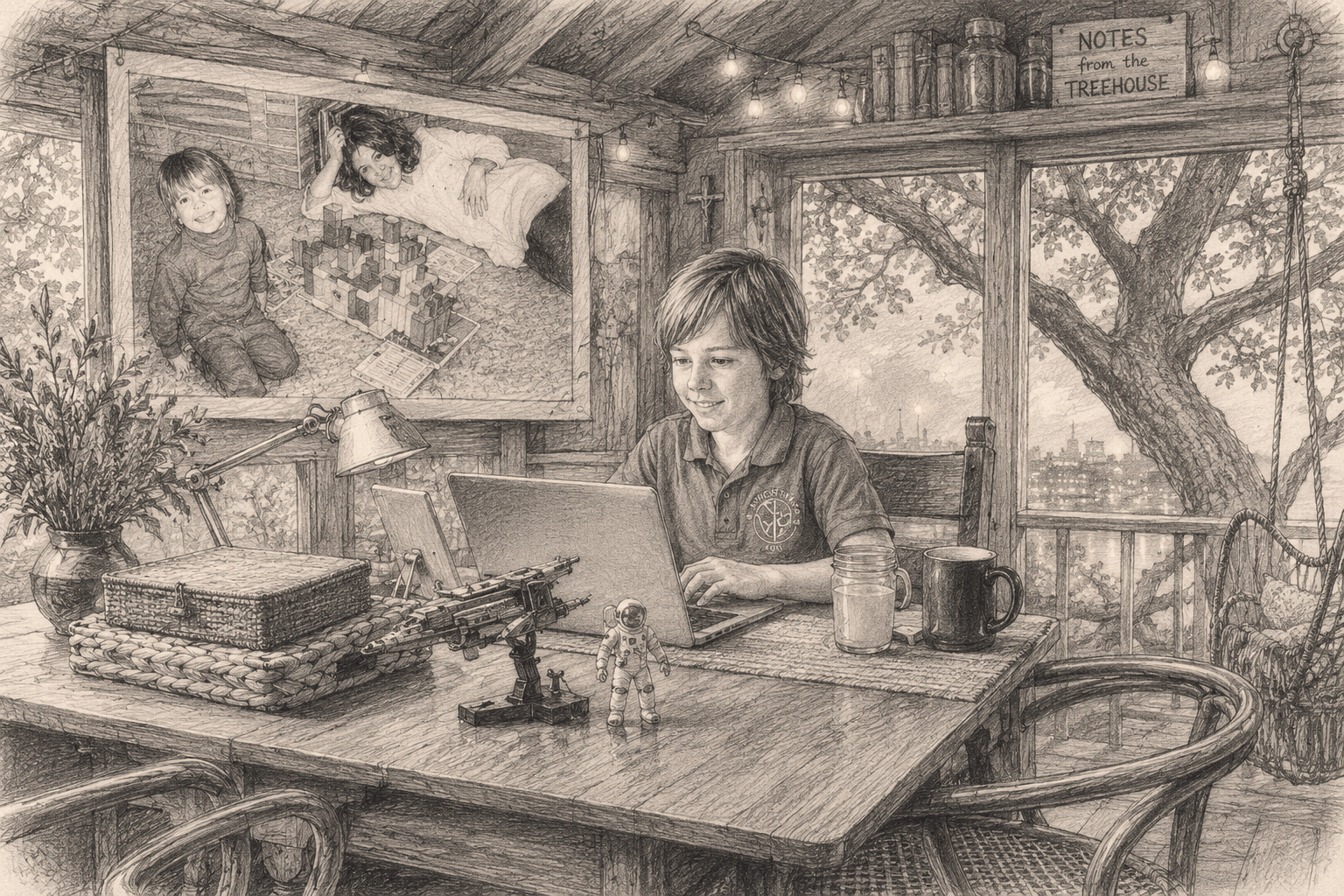
On work, vocation, freedom, and an eleven-year-old protector learning what comes next
From Notes from the Treehouse — Justus’s Day, August 17, 2026
On March 19, we heard three words:
You are retired.
We did not understand them.
Perhaps we did not want to.
We had a job. We had responsibilities. We had people who depended upon us. We had a ministry we believed in deeply. Whatever those words meant, surely they could not simply mean that our working life was over.
Work had been too important to us for too long.
It had been there almost from the beginning.
When we were four years old—Jude’s age—our mother watched us building with blocks and told us that someday we were going to be a great architect.
We always remembered her saying that.
It was an affirmation.
It was also an expectation.
Our First Vocation
Architecture became our first love.
As a child, we drew buildings. We designed things. We built things. Architecture gave form to the way our mind encountered the world.
As an adult, we devoted ourselves to it religiously.
We used to say that architecture was our priesthood.
And we meant it.
It was not simply an occupation. It became vocation, identity, purpose, discipline, refuge, and eventually something dangerously close to our alpha and omega.
We were never as conventionally successful at anything as we were in architecture. Our passion sustained us through extraordinary difficulty.
But eventually architecture was filling places inside us that work was never meant to fill.
It became another addiction.
And then it was gone.
For a long time afterward, we believed that losing architecture had been the great catastrophe of our adult life.
Eventually, however, another vocation emerged.
We were already Vincentians before we became an employee of our former employer. We believed its faith—its basis in Gospel values and Catholic Social Teaching—mattered. We believed in the Vincentian vocation of seeing Christ in people who are poor and marginalized, and in allowing those encounters to transform us.
Then we were given a job in spirituality and formation.
For the first time, something that had existed primarily as unpaid spiritual vocation could also sustain us financially.
It felt like validation.
Perhaps this was what all those years had been preparing us for.
Perhaps architecture had been our priesthood, but this was our ministry.
And so we gave ourselves to it.
The Best Mistake
Very early, however, we recognized a painful contradiction.
We cared enormously about the work.
We were not convinced the administration did.
We sometimes said that if they had really understood or cared about the job, they probably would never have hired us to do it.
Years later, our friend Paul put it more affectionately. He said that hiring us had been the previous executive director’s “best mistake.”
We understood what he meant.
We were unconventional. We brought far more of ourselves to the role than anyone had anticipated. We believed spirituality and formation actually meant something. We believed the mission, virtues, Gospel values, Catholic Social Teaching, and Vincentian vocation were not decorative language surrounding the organization.
They were supposed to govern how the organization lived.
That conviction made the work extraordinarily meaningful.
It also made the contradictions increasingly painful.
Still, we stayed.
We stayed through disappointment.
We stayed through conflict.
We stayed through changes in leadership.
We stayed while advocating for the work, for ourselves, and for others.
And when a new executive director was being selected, we hoped desperately that something might finally change.
We sometimes described our hopes afterward with a deliberately biblical line:
We prayed for Jesus, but they gave us Herod.
It is severe language.
It reflects how the experience felt to us.
We had prayed that a new administration might finally bring the organization’s governance closer to the spirituality, virtues, and mission it professed.
Instead, our experience became dramatically worse.
And still we stayed.
Holding the Rope
That is what we keep thinking about now.
Not simply what happened to us.
Why did we keep holding on?
There is an image that has been coming to us.
Imagine grabbing a rope that is moving rapidly through your hands.
At first you hold tighter.
It burns.
So you grip harder.
Your hands are being injured, but letting go feels like failure.
You tell yourself that if you are stronger, more disciplined, more faithful, more committed, you can hold it.
But the problem is not that you are failing to hold the rope correctly.
The problem is that you need to let go.
Most people probably would have let go long before we did.
We did not.
And nobody in our family embodies that tenacity more completely than Justus.
The Protector
Justus is eleven.
He is our protector.
He has changed tremendously over the past several years, and especially recently. But he has always embodied our work ethic with extraordinary intensity.
Sometimes punishing intensity.
Often the person he was most willing to punish was himself.
Work gave Justus somewhere to direct everything.
When life became frightening, there was work.
When feelings became overwhelming, there was work.
When the employer itself became the source of fear, there was still work.
Work harder.
Do better.
Be indispensable.
Maintain excellence.
Anticipate the problem.
Fix it.
Protect everyone.
Just keep going.
For a long time, tunnel vision could carry us through almost anything.
But eventually we entered a situation in which the quality of the work could no longer solve the problem.
We could work harder.
We could produce excellent work.
We could advocate.
We could explain.
We could demonstrate our commitment.
And none of it could resolve something whose causes were no longer meaningfully connected to the quality of our work.
That was almost incomprehensible to Justus.
Because his lament was never merely:
Look what they did to us.
It was also:
Why can’t we make them understand what is happening to something we love?
Duty
That distinction matters.
Justus did not simply feel duty-bound to protect Dad and his brothers.
He felt duty-bound to protect the organization.
To protect its mission.
To protect the Vincentian vocation.
To protect the people serving it.
To protect people who depended upon it.
To protect something that represented values he genuinely believed were sacred.
That created an impossible conflict for an eleven-year-old protector.
How do you protect the institution and protect your family when protecting one increasingly requires sacrificing the other?
How do you sacrifice yourself when there is only one body?
You cannot.
If Justus sacrifices himself, he sacrifices Luke.
He sacrifices Han.
He sacrifices Solis.
He sacrifices Daniel.
He sacrifices Jude.
He sacrifices Proverb.
He sacrifices Hope.
He sacrifices Dad.
Wherever we go, we all go together.
That principle means something especially demanding for a protector.
There are sacrifices Justus does not have the right to make because he cannot make them for himself alone.
You Are Retired
And that brings us back to March 19.
You are retired.
We wonder now whether we spent months trying to reinterpret words that were much simpler than we wanted them to be.
We do not mean that God caused what subsequently happened to us.
We do not believe God was punishing us.
If anything, our reflection tonight has led us toward almost the opposite understanding.
The suffering came, in part, from our inability to release something whose time had already passed.
We kept holding the rope.
We were frightened of life outside employment.
We were frightened of losing a ministry we loved.
We were frightened that letting go meant failure.
We were frightened that everything we had invested in the work would become meaningless.
And perhaps God had been telling us something much simpler:
You are done.
Not done with purpose.
Not done with vocation.
Not done with service.
Not done with ministry.
Not done with work.
But perhaps done with this way of living.
Done selling our time to another employer and allowing an institution to become the structure around which the rest of our life had to arrange itself.
We could not hear that.
So we kept standing on the page God seemed to be trying to turn.
Eventually the page turned anyway.
What Survived the Fire
For weeks, we have been using another image.
Lost-wax casting.
In that process, an original wax form disappears. Molten metal fills the space it occupied. The mold is broken away, and something new emerges.
There are ruins.
There is debris.
There is something that has been through fire.
But there is also something durable that could not have existed in precisely this form before the fire.
We have been looking at our own life that way.
There are charred ruins.
We are not going to pretend otherwise.
There is anger.
There is grief.
There are nightmares.
There are mornings when our body still seems convinced that somebody can order us downtown.
There are Mondays that still feel like the day before work begins.
There are emails that produce panic before we have even read them.
There is an eleven-year-old boy who still squints when something reminds him that we were terminated.
Our body does not yet entirely understand what our mind knows:
It is over.
But scattered throughout those ruins are diamonds.
And increasingly, they seem more valuable than what we were so desperately trying to preserve.
The Work That Was Already Here
One of those diamonds is Notes from the Treehouse.
We have been keeping this journal since 2019.
Thousands upon thousands of words.
Dad and his eight sons learning to recognize one another.
Learning our language.
Learning the body.
Learning signaling.
Learning relationship.
Learning repair.
Learning how to become a family.
Learning what we have come to call Ordinary Life.
For years, this existed alongside employment.
Usually employment won.
There was always something else to do.
Someone else who owned the hour.
Something more urgent.
Something externally accountable.
Something that could justify taking time away from ourselves because it was called work.
And now, suddenly, there is space.
That frightens us.
But it also feels increasingly like invitation.
Perhaps what comes next is not another employer.
Perhaps our purpose can sustain us in some way we cannot yet see.
Perhaps some of what we have been called to do is already happening.
To live.
To understand.
To write.
To share.
To serve.
To allow other people who may be living something anything like this to look through the window of our Treehouse and discover:
There is so much life here.
We don’t know where that leads.
We don’t need to know.
Daniel gave us the better theology this morning:
“God gets to tell the story.”
Turning the Page
Maybe that is what March 19 meant.
Not a command to predict the rest of our life.
Not a promise that everything would become easy.
Not a declaration that we would never work hard again.
Certainly not permission to stop serving.
Just:
You are retired.
The old chapter has ended.
Turn the page.
We were so determined to preserve the old story that perhaps God had been trying to turn the page while we were standing on it.
So the page had to move beneath our feet.
And now we are here.
We do not know what is written on the other side.
That may be precisely the point.
Our task is not to write the ending before God reveals the next sentence.
Our task is to live today.
To notice.
To listen.
To follow the simple instructions we receive.
And to stop mistaking our inability to control the story for the absence of a story.
To Justus
And so tonight, on Justus’s Day, we want to say something directly to my son, to our brother.
Justus, you do not have to save the old world.
You tried.
God knows how hard you tried.
You tried to protect our work. You tried to protect the people we served. You tried to protect an organization whose faith, mission, and Vincentian vocation mattered profoundly to us. You tried to protect your brothers. You tried to protect Dad. And when all of those duties came into conflict with one another, you so often chose sacrifice because sacrifice was the language of love and duty that you understood best.
But there was something you could never solve by working harder.
There was something Dad could never solve by working harder.
There was something we could never solve by working harder.
We could not make other people care about something simply because we cared about it. We could not make an administration value spirituality and formation because we devoted ourselves to it. We could not make people live the virtues they administered by demonstrating those virtues more faithfully ourselves. We could not protect an institution from choices made by the people entrusted with governing it.
And, most importantly, you could not sacrifice yourself to save it without sacrificing your brothers and your father with you.
There is only one body.
Wherever we go, we all go together.
That means something different now.
It means that your duty as our protector does not require you to drag us back toward the fire because something precious remains inside it.
The precious things came out with us.
Our faith came with us.
Our Vincentian vocation came with us.
Our love of service came with us.
Our commitment to people who are poor, marginalized, forgotten, or treated as though they do not matter came with us.
Our belief in Gospel values and Catholic Social Teaching came with us.
Our ministry came with us.
Your brothers came with us.
Dad came with us.
You came with us.
And perhaps that is one of the diamonds we are only beginning to recognize among the charred ruins.
We did not lose the things that made the work sacred.
They were never owned by our employer.
They belonged to God.
And so did we.
Maybe this is what you are being asked to protect now, Justus.
Not the institution.
Not the job.
Not the old world.
Us.
Protect our mornings.
Protect breakfast.
Protect Luke when he needs Dad to stop working and be with him.
Protect Daniel’s delight in a peanut-butter-and-jelly sandwich.
Protect Jude’s kisses.
Protect Solis’s need for a world that feels orderly enough to be safe.
Protect Han’s encounters with God.
Protect Proverb’s need to be loved for himself and not merely relied upon for everything he can help us understand.
Protect Hope’s ability to look outward toward a world that still desperately needs people who care.
Protect Dad when he begins believing again that his worth depends upon how much he can accomplish.
Protect yourself when that old voice tells an eleven-year-old boy that if he could only work harder, be better, demand more of himself, anticipate every danger, and make no mistakes, everyone might finally be safe.
You don’t have to do that anymore.
You are allowed to be eleven.
You are allowed to be our protector without being our sacrifice.
And you are allowed to discover that protection can look different now.
Maybe protection looks like saying, Enough.
Maybe it looks like closing the computer.
Maybe it looks like making sure we eat.
Maybe it looks like taking a walk in the morning when nobody is waiting for us to clock in.
Maybe it looks like building enough structure around our days that freedom does not become chaos, while refusing to build another cage.
Maybe it looks like helping us remember, when Monday feels frightening, that Monday belongs to us now.
Maybe it looks like reminding us that there is no other shoe waiting to drop.
The shoes have dropped.
We don’t wear those shoes anymore.
We are walking down another path.
And today, on your day, you gave us an image of what that path might actually look like.
A morning walk.
Not the old walk where we hurried because we had to get home in time for work.
A walk because we are free to walk.
Fresh air.
Morning light.
Movement.
Your brothers.
Dad.
Our body learning, one ordinary morning at a time, that nobody is waiting for us to clock in.
That feels like a beautiful assignment for a protector.
Not standing guard forever at the gates of a ruined kingdom.
Walking with your family into whatever comes next.
We don’t know exactly what that will be.
We don’t need to.
God gets to tell the story.
For now, we can follow the simple instructions that appear before us.
Love one another.
Feed one another.
Listen.
Write.
Pray.
Make things.
Tell the truth.
Serve where we are called to serve.
Rest.
Walk.
Notice the diamonds.
And when God turns the page, don’t stand on it.
Justus, my beautiful son, our beautiful brother:
You have worked hard enough.
You have sacrificed enough.
You have proven your devotion enough.
You do not have to earn this freedom.
You do not have to justify it.
You do not have to turn it immediately into another job.
You do not have to save what God has already carried us beyond.
Your family is here.
Your brothers are here.
Dad is here.
You are here.
And tonight, on Justus’s Day, that is where we want to bring this story home.
Not to the employer.
Not to architecture.
Not to the termination.
Not even to March 19 and the words:
You are retired.
But here.
To the Treehouse.
To a father and his eight sons learning what it means to belong to one another when nobody else owns the day.
To an eleven-year-old protector discovering that sometimes the most faithful thing he can do is stop fighting for the world that was and help his family inhabit the life that is.
We love you, Justus.
Dad loves you.
Your brothers love you.
Thank you for protecting us.
Now come walk with us.
We are free.

