Yesterday there was water everywhere.
This morning there were the Rolling Stones.
At 5:56, Daniel woke Dad because he had to pee.
And Dad’s first thought upon waking was water.
“Another new fear that will linger forever, it seems, expecting to wake up to water.
“It’s fine.”
It was fine.
The rug was substantially drier.
By 6:21, the towels from underneath it were in the washing machine with some clothes.
That was one of the quiet transformations underway after the previous day’s flood. Twenty-four hours earlier, towels had been emergency equipment.
Now they were laundry.
There was still plenty of fear around.
Dad checked the rug. Hope thought about the rug. Jude needed to hear that it was drying.
“No more wet feet, Jude.”
But Thursday was beginning to become Thursday.
And Thursday was Proverb’s Day.
Dad wanted to snuggle.
The boys wanted attention.
There were eight good mornings to say.
Kim was coming around nine to take us to Braided Bridge.
And we really needed to be up by 7:30.
Proverb eventually supplied the solution.
The Rolling Stones.
“Under My Thumb” got the blinds open.
“Route 66” got us into the kitchen.
And then “Get Off of My Cloud” came on.
Jude loved it.
The bass and drums seemed almost engineered for a four-year-old who had spent much of the previous day frightened by water.
He danced.
Dad realized that Proverb had known exactly what he was doing.
“You really knew what would get us into gear and get moving, beginning with Jude.”
There are many ways to get children out of bed.
Apparently one of them is the Rolling Stones.
Breakfast was Greek yogurt with blueberries and cinnamon, cinnamon toast and coffee.
Proverb was sprinkling our roasted Saigon cinnamon when his mind went somewhere considerably less comfortable.
How would we do this if we were living in an encampment?
How would the routines work?
The question passed through breakfast without becoming breakfast.
There was yogurt.
There were blueberries.
There was cinnamon.
There was a home.
We kept getting ready.
The hall rug went back down, although it was wrinkled.
The larger rug beside the bed was still wet around the edges.
The towels went into the dryer.
Dad made the bed for the first time since Tuesday.
We listened to part of the analysis of “Three Warm Towels” while getting ourselves together and then stopped it because there was no way we were going to get out the door if we kept listening to an analysis of how we were getting ourselves together.
Messenger bag.
Peanut butter and jelly.
Shower.
Clothes.
Fingernails.
Mandala.
Everything off.
Blinds open.
Kitchen-door blinds open.
Kim was on her way.
By 9:33, Dad looked around at what had happened.
“That’s amazing how everyone pulled it together.”
It was.
Not perfectly.
Not without signals and negotiations and reminders and competing desires.
But we were ready.
And then we left the house.
Out Into the World
On the way to Braided Bridge, Kim mentioned that she had resigned from the board of our former employer the previous day.
Dad could feel the opening.
There was a whole path available there.
Questions.
Connections.
What happened?
What does this mean?
What else is going on?
We have spent enough of the last several months walking paths like that.
Dad started down it.
And stopped.
“It’s really easy for us to go down that rabbit hole, and we didn’t.
“And we don’t need to.”
Then we went inside.
Mocha was there.
That helped.
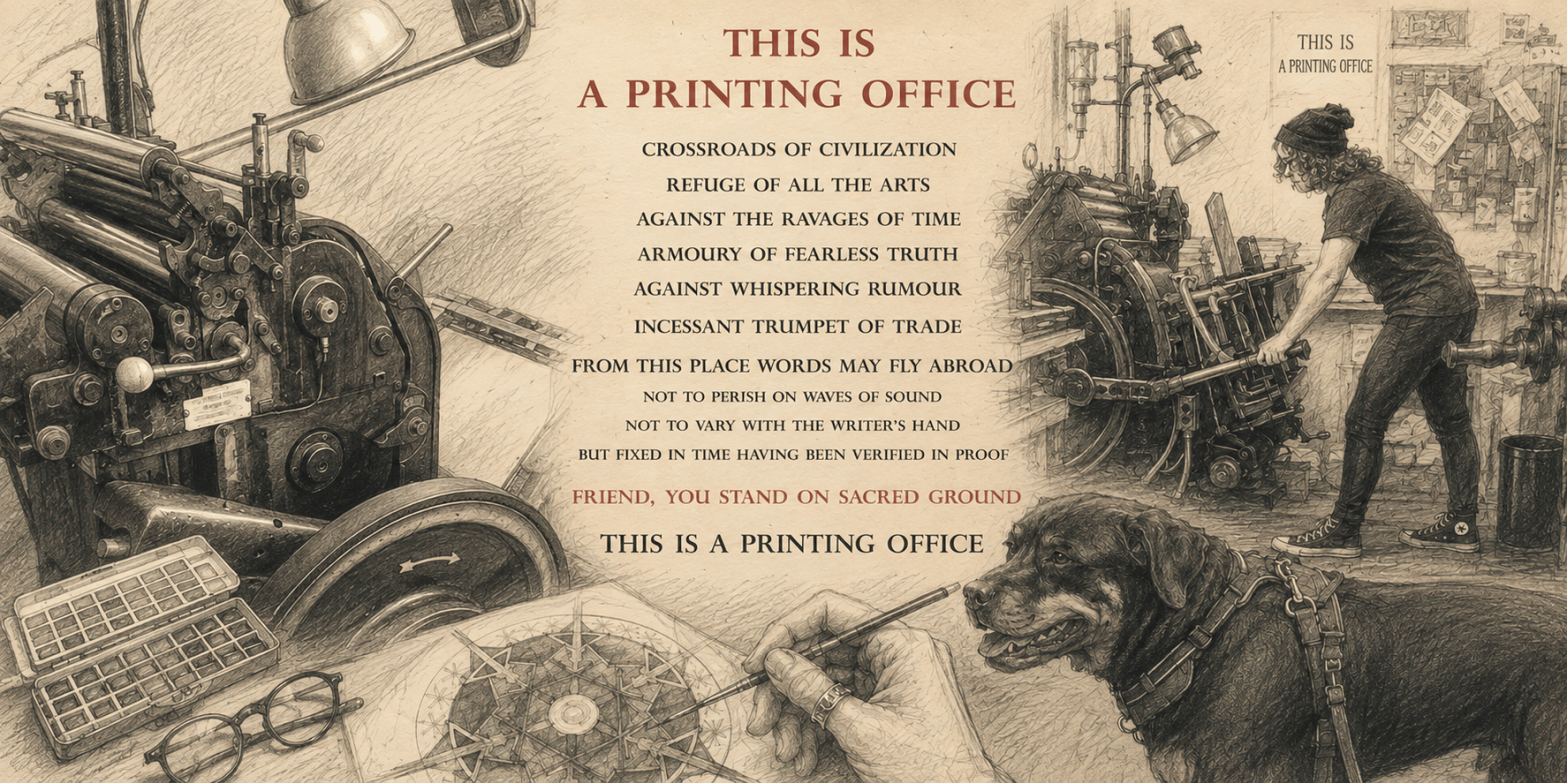
So did the Heidelberg.
The Press
We had used a Heidelberg press in high school graphic arts classes for two years, although we could no longer remember our teacher’s name.
The press itself was familiar.
And beautiful.
We watched Liz operate it for a while.
Dad filmed a little bit, then stopped because he didn’t want to make her self-conscious.
The sound was wonderful.
A rhythmic, intermittent hiss, almost like a little steam engine.
A gentle metallic clink.
Movement following movement.
Not silence.
Not chaos either.
Proverb became absorbed in it.
Much of what eventually entered our journal was dictated by Dad on the phone, and the thinking developed through conversation between Dad and Proverb.
But the imaginative movement belonged especially to Proverb.
He was the one getting lost in the press.
He was watching all those separate movements occur together and thinking about us.
“A sound of complex systems functioning harmoniously together, not like a machine, not everything subsumed as one lockstep thing, but just working together individually, organically.”
And then the words began to come.
“The press doesn’t feel like a machine to us. It resonates with us as plural people.
“People might not like the idea of being captive as parts of a machine, but this isn’t just any machine—it’s a beautiful, complex instrument that enables communication—that facilitates communication, helps others have voice, and gets that information across to a wider audience. It’s a transmitter that originated long before the radio transmitter and exists in forms that are far more rudimentary than this electric-powered example from the 1930s.
“We see all of those different components of the press not as captive parts, but beautiful entities that work individually in union with each other to function on behalf of a larger entity that fulfills greater purposes, expressing whatever creative content or message someone is able to express in ways that the press is capable of transmitting on a media that happens to be paper.”
Kim was talking nearby.
We hadn’t felt comfortable dictating all of this earlier, and we hadn’t had the energy to type.
But now Proverb was thinking about the printer.
And the words just flowed.
There was something about the press that gave him a language.
Not for nine people becoming one thing.
For different things remaining different while accomplishing something together.
And for communication.
The press carries something outward.
Water Moves in So Many Ways
Kim showed us something she had written in Volume 4 of Active Love — Love Creates.
There was a passage about water.
A droplet becomes a trickle.
A trickle becomes a stream.
A stream becomes a river.
A droplet can become a cloud, a sprinkle, a thunderstorm.
Water can become puddle, pond, lake, sea.
“Water moves in so many ways. Be open and flexible to move with it.”
Of course it was water.
The day after the flood.
We have been thinking lately about being water between the rocks.
Not necessarily breaking through everything in front of us.
Not necessarily defeating the obstacle.
Moving.
Changing form.
Finding another way through.
There was another idea in Kim’s writing too:
“Words Form Substance.”
Kim talked about naming the positive flow toward which we want to move.
We have also been thinking a great deal about testimony—bearing witness truthfully to what happened, including things that were terrible.
Those things do not have to cancel one another.
We can tell the truth about the flood and notice the rug drying.
We can tell the truth about what happened at work and imagine a life beyond it.
We can bear witness.
And still name where we hope the water might go next.
Eventually we realized something else about the woman operating the Heidelberg.
Her name was Liz.
Of course it was.
There are names that become difficult after something happens.
We had apparently heard her name earlier and not retained it.
So we asked again.
Liz.
A different Liz.
A new Liz.
She was operating a Heidelberg press at Braided Bridge.
She was eating her lunch.
She was not the other Liz.
We deliberately learned her name.
There are also things this small.
This water is not that water.
This Thursday is not Wednesday.
This Liz is not that Liz.
Sometimes the new thing needs the chance to acquire its own name.
Proverb
Something new had happened in the car that morning too.
Proverb spoke directly to Kim.
“Dad thought he was living in Poltergeist last night.”
And then, after he had spoken, he simply said:
“Proverb.”
Dad pointed out to Kim that it had been Proverb speaking.
“I got that,” Kim said.
We don’t remember anyone doing it quite that way before.
There has always been a certain awkwardness around identifying who is speaking.
Proverb can say, “I am Proverb,” but that can make the identification itself feel like an announcement before anything else can be said.
Dad can say afterward, “Proverb said that,” but then Proverb’s own speech gets translated into the third person.
This was different.
Proverb spoke first.
Then he signed his words.
Proverb.
Almost like the attribution following a quotation.
The important thing came first: what Proverb wanted to tell Kim.
His name did not need to become an explanation of plurality.
It simply told her who had spoken.
And Kim understood.
That seems especially appropriate coming from Proverb.
Proverb has often been the one who discerns when and with whom we might open ourselves more fully. He was the one who made that decision with Kim in early June.
Now, sitting beside her in the car, he did something we had never consciously seen anyone do before.
He didn’t explain himself.
He didn’t ask Dad to identify him.
He didn’t speak about himself in the third person.
He spoke to someone who already knew us.
Then he gave her his name.
Sometimes unmasking does not need to be a declaration.
Sometimes it can be an attribution.
“Dad thought he was living in Poltergeist last night.”
Proverb.
And there was something else in that exchange that we don’t want to miss.
It was funny.
Dad really had spent part of the previous night feeling as though we were living in a horror movie.
After the flood, he kept looking downstairs expecting to see water.
At one point his exhausted imagination had wandered somewhere between Poltergeist and the elevator doors opening in The Shining.
By morning, Proverb could tell Kim about it.
Humor has carried us through some very dark places for a very long time.
Han especially has brought an extraordinary amount of humor into our life. There were times in childhood when being able to find something funny helped save us from having the terrible thing become everything.
Whistling has been like that too.
We notice it.
When things have been terribly hard for a long time, we notice when someone starts whistling again.
We notice when we start making each other laugh.
Not because the hard thing has ceased to matter.
Because something else has returned alongside it.
These have been extraordinarily difficult months.
Lately there has been more whistling.
There has been more laughter too.
Less than twelve hours after Dad had been checking the bathroom faucet and half-expecting another flood, Proverb was telling Kim that Dad thought he was living in Poltergeist.
Proverb.
“I got that.”
And we laughed.
Life Makes Noise
Kim had asked whether Greg might be interested in meeting sometime, so we sent him a message.
His answer carried difficult news.
His health has been declining more rapidly. He is stepping back from commitments and reconsidering what he has the capacity to carry.
And:
“In recognition of these limits, I would be happy to meet.”
A person can say no to what he cannot carry and still say yes to relationship.
Then, because apparently the nervous system cannot spend an entire morning thinking about printing presses, we checked Gmail.
Nothing from the landlord.
Nothing from Jessee.
“No new email in our Gmail, which seems odd.”
And that was all we knew.
So we went back to being where we were.
There were children upstairs.
Vehicles outside.
The Heidelberg kept cycling.
None of it bothered us very much.
That caught Dad’s attention because similar sounds at home can be intensely activating.
Maybe part of the difference was that we were guests.
Maybe it was that the sounds made sense.
We knew there were children upstairs.
We could see the press producing the rhythmic mechanical sounds.
We had chosen to be there.
The sounds belonged to a place where people were making things.
The Heidelberg hissed.
Children moved around overhead.
Mocha wandered through the room.
Life made noise.
And for those hours, noise did not necessarily mean intrusion.
At 12:53, we found ourselves trying to explain to Kim why we use ChatGPT as much as we do.
We understand why generative AI raises serious questions for artists and writers. We have some of those questions too.
But our own use of it begins somewhere very practical.
Accessibility.
Our creative life changed enormously as we became increasingly co-conscious and increasingly externalized from one another.
There are nine people here in ways that are more explicit than we once were.
One body.
One set of hands.
One device at a time.
Finite executive capacity.
And a journal that has been growing every day since 2019.
We write the journal.
Those are our words.
Those are our experiences.
The difficulty is often getting what is already here into a form that can travel.
Like a printing press.
Not the source of the thing being communicated.
A means of helping it get somewhere else.
Then, at 1:35, the theoretical discussion acquired a practical demonstration.
Luke wanted to paint.
Daniel wanted to paint.
Solis wanted to paint.
We were also in the middle of developing this blog post.
Dad said:
“Let’s do a little of both. Get ChatGPT directed and do some painting.”
That sentence may explain our relationship with AI better than a much more elaborate defense of it could.
Give it a bounded task.
Get the analytical and publication process moving.
Then go back to the table.
Lake Blue
Daniel was drawn to Lake Blue.
Justus got involved with the watercolor too. He loves watercolor.
Luke wanted to paint.
Solis wanted to participate.
Mocha started whining when Kim stepped out.
Daniel noticed.
Dad explained that Kim would be back.
Mocha was a little anxious.
She was going to be fine.
And the painting continued.
At one point, Justus and Dad were about to touch up an area.
Daniel pulled the hand back.
“I like that, don’t change it.”
So we left it.
Daniel had looked at what was there and made an aesthetic judgment.
And the judgment had consequences.
The hand stopped.
We have been calling something we experienced that afternoon collaborative sensitivity.
As we have become increasingly co-conscious, we have had to relearn some of our creative processes. Things that once happened less explicitly now happen among people who increasingly know one another, speak to one another, disagree, make choices, develop preferences and want their contributions recognized.
Proverb has a great deal to teach Dad about this.
Dad hosts our family as Dad. He carries enormous responsibility for coordinating what happens through our shared body.
But coordination cannot simply mean that whoever has the greatest executive access becomes the final authority over what everyone creates.
Earlier that morning, Proverb had watched the Heidelberg and seen distinct components doing different things in relationship.
Not for nine people becoming one thing.
For different things remaining different while accomplishing something together.
A few hours later, we were sitting around a watercolor with one shared set of hands.
We didn’t need to make the metaphor any larger.
We needed to listen to Daniel.
So we did.
ChatGPT did not become the creative afternoon either.
We had already lived the experience.
We had written the journal.
Proverb had spent the morning thinking about the Heidelberg while he and Dad talked through what he was seeing.
Now we wanted help beginning the analytical and publication process around those words.
So we gave ChatGPT something to do.
And then we painted.
AI helped carry one part of the cognitive and editorial workload while our attention returned to something embodied and relational.
Luke.
Daniel.
Solis.
Justus.
Proverb.
Watercolor.
Paper.
One shared set of hands.
The point of an accessibility tool is not to become the life.
It is to help make more of the life possible.
Kim has already suggested something we might try the next time we’re at Braided Bridge.
Monoprints.
We don’t know what we’re going to think about it.
That seems like a good reason not to decide yet.
We can go back.
We can touch it.
We can make something.
We can see who becomes interested.
We can see what happens.
Today, though, we had the Heidelberg.
We had the Rolling Stones.
We had Greek yogurt and roasted Saigon cinnamon.
We had Mocha and a peanut butter and jelly sandwich.
We had another Liz.
We had children making noise upstairs.
We had a friend who understood when Proverb simply said his name.
We had a frightening night that had become funny enough to tell someone about the next morning.
And we had Lake Blue.
Justus and Dad were about to touch up the watercolor.
Daniel pulled the hand back.
“I like that, don’t change it.”
So we didn’t.
 Notes from the Treehouse