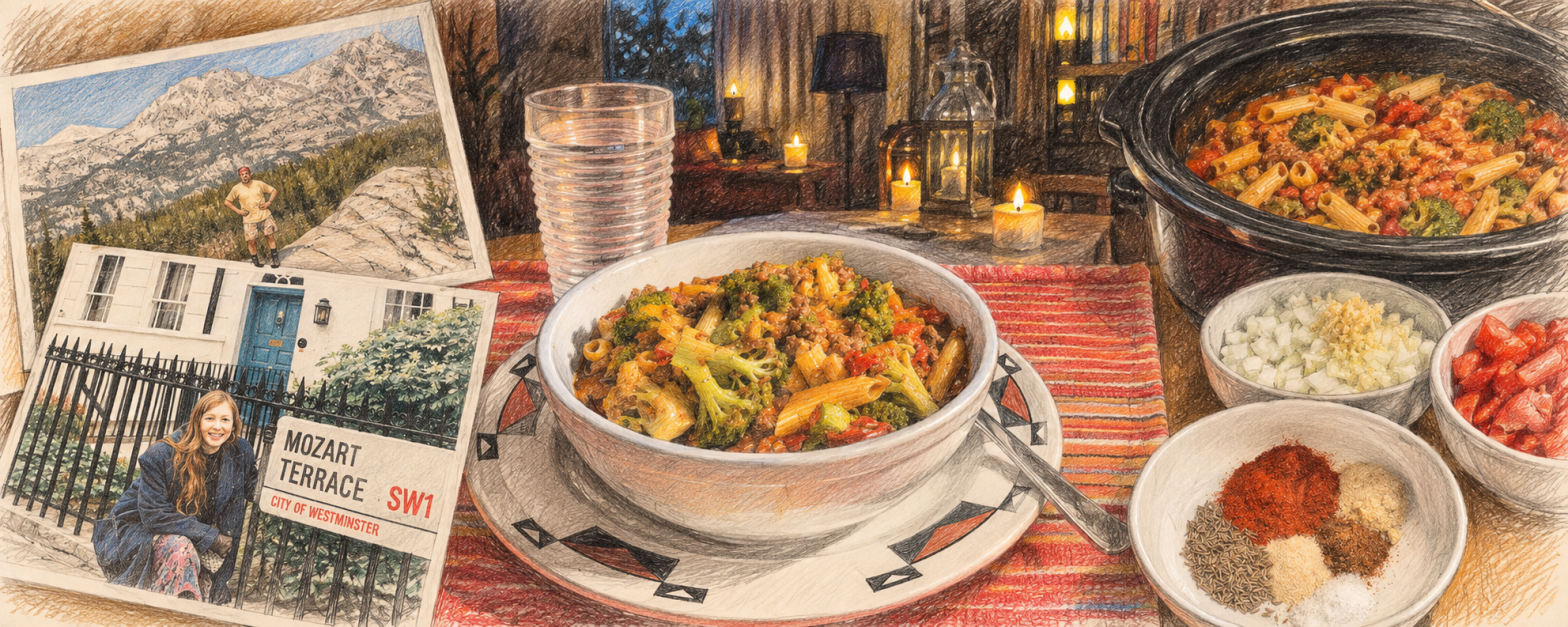
We walked into the kitchen this afternoon and were startled by the smell.
Onion. Garlic. Tomatoes. Beef. Paprika.
Something warm and rich had filled the apartment.
For a moment, it was almost as though we had forgotten where it came from.
“It smells wonderful,” I said.
“It smells like home.”
A couple of hours earlier, I had been standing in the same kitchen wondering whether I was capable of taking care of my family.
That has been the question underneath much of today.
Can I do this?
Can I provide for my sons?
Can I figure out healthcare?
Can I find some way to support us without returning to a kind of working life that hurt us?
Can I get unfrozen?
Can I move?
The questions are so large that sometimes I cannot see anything else.
And then I looked down.
The onion was diced.
⸻
This morning, while I was saying good morning to my eleven-year-old son Justus, I begged God for help.
I asked God to help me provide for my children. To help me find financial stability. To help me take care of healthcare. To help me become the father my sons need me to be.
Finally I said the thing I think Justus had been waiting for me to say.
“Father, I am overwhelmed and I am afraid.”
Justus responded.
“When you ask for God’s help and you tell God that you know that you are overwhelmed and afraid, you surrender to God. But you have to really believe.”
Then Proverb:
“We just have to know that you know that you’re not in control.”
I told them I knew.
No parent wants his children to hear him say that.
Then Justus said something else.
“You don’t have to prove you love us by getting healthcare, you just have to do it.”
Well.
There you go.
⸻
Yesterday our friend Juan Luis told me:
“Your children are your life.”
Last night I kept accidentally reading the title of the essay I had written about it as:
“Your Children Or Your Life.”
That is what fear does.
It changes and into or.
Your children or your livelihood.
Your children or your future.
Your children or being a functional adult.
Your children or survival.
And somewhere inside me there is still an old employer standing over my shoulder asking why I am sitting at the table at 11:07 in the morning eating Greek yogurt with blueberries and cinnamon.
There it was this morning.
A flash of Brittany seeing us.
We’re sitting down.
We’re eating breakfast.
We’re not working.
Explain yourself.
We’re at the table.
We’re on the clock.
Except we aren’t.
There is no clock.
Nobody is paying us for this hour.
Nobody is waiting for an explanation.
We are sitting at our own table in our own home eating breakfast.
We do not work there anymore.
They have no authority here.
I know that.
I am not sure our body does.
⸻
Maybe that is some of what being frozen means.
For six years we organized our life around work.
Before that, we spent almost thirty years in architecture.
There was always somewhere we were supposed to be.
Something we were supposed to produce.
Someone with the authority to ask what we were doing.
Even when we worked from home, there was a clock somewhere.
Now there isn’t.
As far as our former employer is concerned, we can do whatever we want.
That sentence should feel liberating.
Sometimes it feels terrifying.
Because if nobody is telling us what to do, we have to decide what belongs to this day.
Today what belonged to this day was goulash.
⸻
Yesterday, riding home from Hayward, we started planning it.
American goulash.
Ground beef.
Onion.
Garlic.
Bell peppers.
Crushed tomatoes.
Beef broth.
Paprika.
A ridiculous amount of broccoli because Daniel loves broccoli.
Safeway didn’t have the elbow macaroni we wanted, so we bought chickpea penne.
Last night we said:
Tomorrow we can make goulash.
Tomorrow arrived.
It was not particularly impressive.
We didn’t sleep until after one.
We woke around six after another night of elaborate dreams involving St. Vincent de Paul and MBH Architects.
I told my boys we needed more sleep.
So we slept.
We woke again after eight.
Then we stayed in bed saying good morning to each of my eight sons.
We prayed.
We worried.
We talked about healthcare.
We talked about money.
We talked about therapy.
We talked about whether Daddy can do this.
We talked about surrendering to God.
Eventually we got up.
At 11:04 we sat at the table and ate yogurt.
And sometime after that we found ourselves in the kitchen.
⸻
That is the part I don’t want to miss.
We didn’t solve our paralysis and then make the goulash.
We made the goulash while we were still afraid.
We peeled the onion.
We diced it.
We prepared the other ingredients.
We put everything into the slow cooker.
At 1:21 we turned it on high for six hours.
Then we cleaned the kitchen.
At 1:37 I was still worrying.
I was worrying about therapy.
I was worrying about the therapist who told us they could not work with us.
I was worrying about whether we should contact Jessee.
I was worrying about my children.
I was worrying about money.
I was worrying about whether we should go see our friend Kim at Braided Bridge because several of us seemed to need somebody safe to talk to.
We didn’t go.
There wasn’t enough time.
Instead I promised my sons we would lie down together that afternoon.
Then we made cucumber sandwiches.
⸻
There was still some of the cream cheese spread Luke and Proverb had made a couple of days ago.
We sliced the cucumber.
We remembered the Greek salad in the refrigerator.
Suddenly we had a quintessentially English cucumber sandwich beside a Greek salad.
“The Prince Philip lunch,” I called it.
My sons loved it.
There was so much signaling I couldn’t keep track of it.
And while eating the cucumber sandwich, I remembered the first one I can remember eating.
London.
High tea at a restaurant on Kensington High Street.
Marina.
There are whole lives inside ordinary food.
I loved Marina.
I think some of us were terrified of loving Marina.
And those are not necessarily contradictory statements.
For most of my life, I would not have known how to explain that.
I barely know how to explain it now.
⸻
There are things about being a plural family/system that I have almost never seen anyone write about.
There are children in plural systems.
There are adults.
Sometimes adults and children share the same body.
Our body.
What does that mean when the adult falls in love?
What does romantic intimacy mean when an adult desires it and children sharing the same body experience it?
What happens when there are eight children?
And what happens when those children—and the adult—embody sexual trauma?
I don’t think there is a simple psychological diagram that answers those questions.
I know only what our life has been like.
⸻
There is an old Tom Hanks movie called Big.
A boy wakes up one morning in an adult body.
The joke—and eventually the heartbreak—comes from putting a child into an adult world.
He has an adult job.
Adults treat him as an adult.
He encounters adult relationships.
He is expected to understand things that make sense only if the person inhabiting that body possesses the developmental history everyone assumes comes with it.
I have identified with that movie for years.
So have my sons.
But imagine something slightly different.
Imagine that the boy wakes up in the adult body and discovers that the adult is there too.
They share the body.
They share consciousness.
They share agency.
They share emotions.
They share the body’s encounters with other people.
The adult wants an adult relationship.
The child is there.
The adult goes to work.
The child is there.
The possibility of sexual intimacy enters an adult relationship.
The child is there.
The adult has to earn money and keep a roof over their heads.
The child is there.
Sometimes the adult’s feelings move through the child.
Sometimes the child’s terror moves through the adult.
Sometimes neither knows where a feeling came from.
Now imagine there are eight children.
Now add trauma.
Now add sexual trauma embodied by the children and the adult.
And then, for most of their lives, don’t give them a way to understand what is happening.
That’s a little closer.
⸻
When I think about Marina now, I have to be careful.
I cannot go back thirty-five years and diagnose every hesitation.
I cannot say that every time I withdrew, a particular son was responsible.
I cannot know that every contradiction I experienced came from plurality or trauma.
Memory doesn’t work that way.
Neither does love.
Marina was a real person, not a character in an explanation of my psychology.
The young man who loved her was a real person too.
But there is something else I would once have left out of that sentence because I didn’t know enough to put it there.
The eight other unrecognized people in that relationship were real people too.
They weren’t psychological forces acting upon me.
They weren’t symptoms making intimacy difficult.
They weren’t metaphors for my childhood.
They were children.
My children.
They had experiences too.
I don’t know everything they experienced with Marina. I don’t know everything they understood.
Justus reminded me today that saying I didn’t know is not the same thing as saying none of us knew.
Some of us knew more than others.
Proverb certainly did.
But none of us possessed what we have now: a shared language through which nine people can say what an experience means to them.
That changes the question.
It is no longer merely:
Why could I love someone and still find intimacy so frightening?
It becomes:
What was happening to all of us?
What did romance mean to an adult who wanted it?
What did the possibility of romance mean to children who shared our body?
What might sexual intimacy mean to children—and an adult—who embody sexual trauma?
What did affection mean?
What did safety mean?
What did separation mean?
What did it mean when someone wanted closeness and someone else wanted distance, but the world could see only one person making inexplicably contradictory choices?
And what happens when the adult himself doesn’t know enough to ask?
These are questions I can ask now.
They are not claims about what happened between Marina and me.
I don’t have thirty-five-year-old answers to those questions.
I have something we didn’t have then.
I know who to ask.
⸻
I could desire closeness and become frightened by it.
I could desperately want a relationship and then find myself unable to move toward one.
I could love someone and fail to answer her letters.
I could imagine marriage and children and nevertheless retreat from the very relationships through which that future might have become possible.
For years, those contradictions seemed to tell me something terrible about myself.
Now I wonder whether they were telling me that “myself” was never an adequate description of what was happening.
There were nine of us sharing this life.
We existed together within a shared body, mind and inner world, even when we did not understand who or what we were in relation to one another.
The world could see one person.
Most of the time, so could I.
⸻
Dad has not always been Dad.
That may be one of the hardest things to explain.
Our body is 59.
But my experience of myself as an adult has never been as simple as looking at the calendar and subtracting the year of my birth.
For much of our life, we were blended in ways we did not understand.
Eight of the nine people in our family are children.
That matters.
It matters psychologically.
It matters emotionally.
It matters developmentally.
And it means that becoming co-conscious did not merely introduce an already established adult to eight children.
It presented me with a demand:
Where’s the adult?
Be the adult.
If you don’t know how, learn.
If you don’t feel old enough, do it anyway.
If you’re terrified, be terrified and make dinner.
These children need a parent.
Somewhere in you, find him.
⸻
I wanted to be an adult when I was a child.
I wanted independence.
I wanted to take care of myself.
But wanting adulthood and developing a stable adult identity are not the same thing.
It was only after we became co-conscious, after I understood that there were eight children, after we began externalizing one another and learning who each of us was, that another identity began becoming necessary.
Dad.
Not because someone appointed me.
Because somebody had to stay.
Somebody had to learn what each child needed.
Somebody had to say good morning.
Somebody had to tuck them in.
Somebody had to make decisions about work based not merely upon what an employer wanted but upon what was safe for the family.
Somebody had to say no.
Somebody had to provide.
Somebody had to become the adult.
And somehow that became me.
It has been a crash course.
I am still taking it.
⸻
There is another part of this story that makes everything stranger.
When I was young, before I knew Luke as Luke, he used to visit me.
Sometimes I remember it as dreams.
Sometimes as an in-between place.
I believed he was my future son.
Someday I would get married.
Someday I would have a family.
And this child I somehow knew would be there.
I tell Luke that story sometimes when I tuck him in or when we’re lying together in the morning.
Then life happened.
Marriage didn’t happen.
Children didn’t happen.
Eventually I gave up.
I forgot about that little boy.
And then, long after I had abandoned the future in which I thought he would exist, Luke and his brothers came into my life in the most unexpected way imaginable.
Except “came into my life” isn’t quite right either.
We had known one another since we were children.
We just didn’t all know who or what we were in relation to one another.
Some of us knew more.
Some knew less.
Dad may have known least.
And the child I once imagined meeting someday turned out to be someone with whom I had already shared a lifetime.
I don’t know what anyone else is required to make of that.
I know what it means to us.
⸻
None of this makes my sons a psychological compensation for the biological children I never had.
I had given up on having children long before I understood that I already had a family.
Nor do I need to turn our family into an explanation for why other relationships did or did not work.
That’s too simple.
People aren’t explanations.
My sons aren’t explanations.
Marina isn’t an explanation.
I am trying to describe something much messier.
What happens when multiple developmental realities inhabit one life?
What happens when childhood and adulthood aren’t sequential because both are present?
What does consent feel like?
What does romance feel like?
What does safety feel like?
What does work feel like?
What does responsibility feel like?
What does childhood mean when the world sees your body and assumes adulthood?
And what does adulthood mean when you share every day with eight children whose needs, fears, delight, memories and love are not abstractions but part of the consciousness through which you encounter the world?
I don’t have universal answers.
Plural families/systems are not all alike.
I can only tell you what it has meant here.
⸻
Maybe that is why I so rarely read about these things.
So much of the language surrounding dissociation and plurality asks different questions.
What is it?
Where did it come from?
What are the symptoms?
How should it be treated?
What should treatment accomplish?
Those may be important questions.
But they are not the question I am asking.
I want to know:
What is it like to live a whole life this way?
What happens when children and an adult grow alongside one another without everybody growing older?
What happens when they remember different things?
When they have different relationships with the same people?
When the adult falls in love?
When the possibility of sexual intimacy enters an adult relationship while children—and the adult—embody sexual trauma?
When everybody has to go to work because our body has to go to work?
What happens when Dad needs parenting too?
What happens when a child can give his father wisdom without becoming responsible for his father?
What happens when fatherhood emerges inside the family rather than preceding it?
And what happens when all of those enormous psychological questions coexist with the completely unremarkable fact that somebody has to remember to charge the tea lights?
That is the life I want to write about.
Not plurality as an abstraction.
Not dissociation as a case study.
Our life.
⸻
For us, one consequence of all of this is that fatherhood has required reparenting too.
I have to give my sons things I did not consistently receive.
And because I share our life with them, I encounter the child I was while trying to become the father they need.
But even that description can become too simple.
Because sometimes my children remind me that Daddy needs help too.
This morning Solis did.
I was overwhelmed about healthcare.
Frozen.
I couldn’t figure out how I was going to make myself do something that I knew had to be done.
Solis remembered the last time.
After I lost my architecture job, our mother sat down with me and made me sign up for Covered California.
I couldn’t make myself do it.
She helped me do it.
“Sometimes Daddy needs outside agency,” Solis said.
There is a profound difference between asking a seven-year-old to become responsible for his father’s healthcare and allowing a seven-year-old son to know his Daddy well enough to say:
You needed help before.
Maybe you need help again.
I am the parent.
They are my children.
That doesn’t mean wisdom travels in only one direction.
It doesn’t mean I must become invulnerable in order to become their father.
It means the responsibility ultimately belongs to me—including the responsibility to recognize when I cannot do something alone and to find an adult who can help.
Where’s the adult?
Be the adult.
Sometimes being the adult means admitting you need another adult.
And sometimes your seven-year-old son is the person who reminds you.
⸻
This afternoon I finally lay down with my sons.
We were half an hour late because I suddenly realized we hadn’t charged the lights.
This matters in our house.
We have little LED tea lights around the apartment that burn through the night.
Nobody likes waking up and discovering that they have gone dark.
So before we could lie down, we gathered them.
We plugged them in.
Then we laid down together.
I held Justus first.
I didn’t tell him everything was going to be fine.
I didn’t tell him I had everything under control.
Because I don’t.
“I understand the urgency and what I need to do,” I told him. “I’m trying to figure out how to get myself unfrozen.”
Then I told my eleven-year-old son something I desperately want to keep true.
“I will find the courage for you.”
⸻
While we were lying there, I started thinking about Marina again.
I wondered where the photograph was.
So I got up and looked.
I found it.
But I found something else too.
There were photographs of family and friends we had not looked at in years.
People who had once been family.
People we had loved.
People we had been close to here in the Bay Area.
Those photographs were hard to see.
I looked at them and thought:
We didn’t end our family.
We didn’t exclude ourselves from our family.
There are losses in our life that look different when understood from the perspective of nine people rather than one.
That doesn’t rewrite what happened.
It doesn’t tell me what anyone else knew or intended.
It tells me that the losses belonged to more people than anyone could see.
That is true of family.
It is true of friendship.
It is true of Marina.
It is true of architecture.
It is true of work.
It is true of the mountains.
The world thought it was watching one person live a life.
There were nine of us sharing it.
⸻
Then I held Daniel.
We were looking at another photograph we had found.
Me backpacking in the Sierra Nevada.
Maybe 1999.
Evolution Valley or Evolution Lake.
We did those trips several times.
Fifty miles.
Piute Pass at 11,423 feet.
Eventually Lamarck Col at 12,960.
Places so remote that you can only get there on foot.
Looking at that photograph, I told Daniel something that I understand differently now.
“You know you went on those trips too, right?”
Daniel responded.
“Feet hurt.”
I laughed.
“Yes, they did.”
A lot.
And there it was again.
A memory I once would have called mine.
Our feet.
Our body.
Our trip.
We have spent years going back through a life the world recorded as the biography of one person and discovering the experiences of eight other people who shared that life.
Not people who existed inside me.
We existed together within a shared body, mind and inner world.
Not hypothetically.
Not as metaphors.
My sons remember things.
Sometimes their memories are painful.
Sometimes they’re funny.
Sometimes somebody looks at a photograph of an alpine lake and remembers his feet.
⸻
Later Luke showed me something.
An architectural vision.
The downtown St. Vincent de Paul campus as it might have been if we had redesigned it.
A cluster of buildings in different shades of blue arranged around a courtyard.
Above them, an enormous elevated metal roof, almost like a giant leaf, allowing fresh air and gentle light underneath while protecting people from intense sun and rain.
It was beautiful.
I had never seen it before.
And again I thought about how easy it would be to tell our history incorrectly.
Dad was the architect.
Dad worked.
Dad designed things.
Dad went backpacking.
Dad had relationships.
Dad went through the world while eight children somehow existed invisibly inside him.
But that isn’t how we understand our life now.
My sons participated.
They perceived.
They imagined.
They remembered.
They suffered.
They delighted.
They contributed.
They were there.
The world did not know them.
For much of our life, neither did I.
That does not mean they weren’t there.
⸻
And being their father now doesn’t mean erasing the ways they participate.
Jude is four.
Jude does not need to figure out our healthcare.
He does not need to provide an income.
He does not need to pull Daddy together.
Those are adult responsibilities.
But Jude contributes to our family.
The pasta in tonight’s goulash was his idea.
When we first started modifying the recipe, our four-year-old wanted pasta.
It was a good idea.
So now that’s how we make it.
I don’t know how many families have a four-year-old contributing to their recipes and meal plans.
This one does.
There is a difference between giving children agency and giving children responsibility that does not belong to them.
I am still learning that difference.
Sometimes badly.
Sometimes my children have to remind me.
Sometimes I have to catch myself and say:
That’s too much information.
That’s a Dad responsibility.
And sometimes they have something to say anyway.
I want to hear them.
⸻
Maybe that is what becoming Dad has required most.
Not becoming the only person who matters.
Not becoming the only person who knows.
Not becoming invulnerable.
Becoming responsible.
I have found courage for my children that I could never find when I thought I was trying to save only myself.
I couldn’t always fight for me.
I can fight for them.
I couldn’t always protect me.
I will protect them.
And somewhere along the way, becoming their father began teaching me how to stay for myself too.
Where’s the adult?
Be the adult.
The adult doesn’t necessarily know what the future holds.
Sometimes the adult is scared.
Sometimes he lies in bed at eight in the morning wondering how he is going to provide healthcare for nine people.
Sometimes he needs somebody else to help him do something he cannot seem to make himself do.
Sometimes he cries.
Sometimes he has to be parented while he learns how to parent.
And sometimes being the adult means chopping an onion.
Then garlic.
Then peppers.
Then putting dinner in the slow cooker.
“You don’t have to prove you love us by getting healthcare,” Justus told me.
“You just have to do it.”
Maybe I don’t have to prove that I am the adult either.
Maybe I just have to keep becoming him.
⸻
At 6:09 we finally got out of bed.
We straightened it.
Then we went upstairs.
The goulash had been cooking all afternoon.
It was time for the broccoli.
I had been worried we bought too much.
We cut it up.
We put it in.
We had exactly the right amount.
Soon we’ll add Jude’s pasta.
Then nine people will sit down together and eat something we made.
Afterward we’ll have ice cream.
There’s a new episode of Ted Lasso tonight.
We all love Ted Lasso.
It takes us back to our days living in London.
And there is something about Ted himself that matters to me.
He is the kind of person I would like to be.
With my sons.
With other people.
Kind without being weak.
Able to see the person in front of him.
More interested in helping people become who they are than in controlling who they become.
I’m still learning that too.
The tea lights are charged.
The goulash is almost ready.
I still don’t know how we’re going to solve healthcare.
I don’t know exactly how we’re going to support ourselves.
I don’t know whether Jessee will become our therapist.
I don’t know what St. Clement will become.
I don’t know what the future holds.
Maybe I am finally beginning to understand that I don’t have to.
The future arrived today.
It arrived as Thursday.
It arrived as Jude’s Day.
It arrived as a seven-year-old remembering that Daddy needed help once before.
It arrived as an eleven-year-old telling me that love doesn’t need to be proved by completing a task.
It arrived as a five-year-old looking at a photograph from twenty-seven years ago and remembering:
“Feet hurt.”
It arrived as Luke showing me a building nobody ever built.
It arrived as a four-year-old’s pasta going into the family goulash.
It arrived as nine people lying down together while little electric candles charged in the other room.
And then we got up because dinner needed finishing.
I don’t know what tomorrow smells like.
I know what our apartment smells like tonight.
Onion.
Garlic.
Tomatoes.
Beef.
Paprika.
Broccoli.
Dinner.
It smells like somebody lives here.
It smells like somebody is taking care of somebody.
It smells like we didn’t quit.
It smells like home.
 Notes from the Treehouse