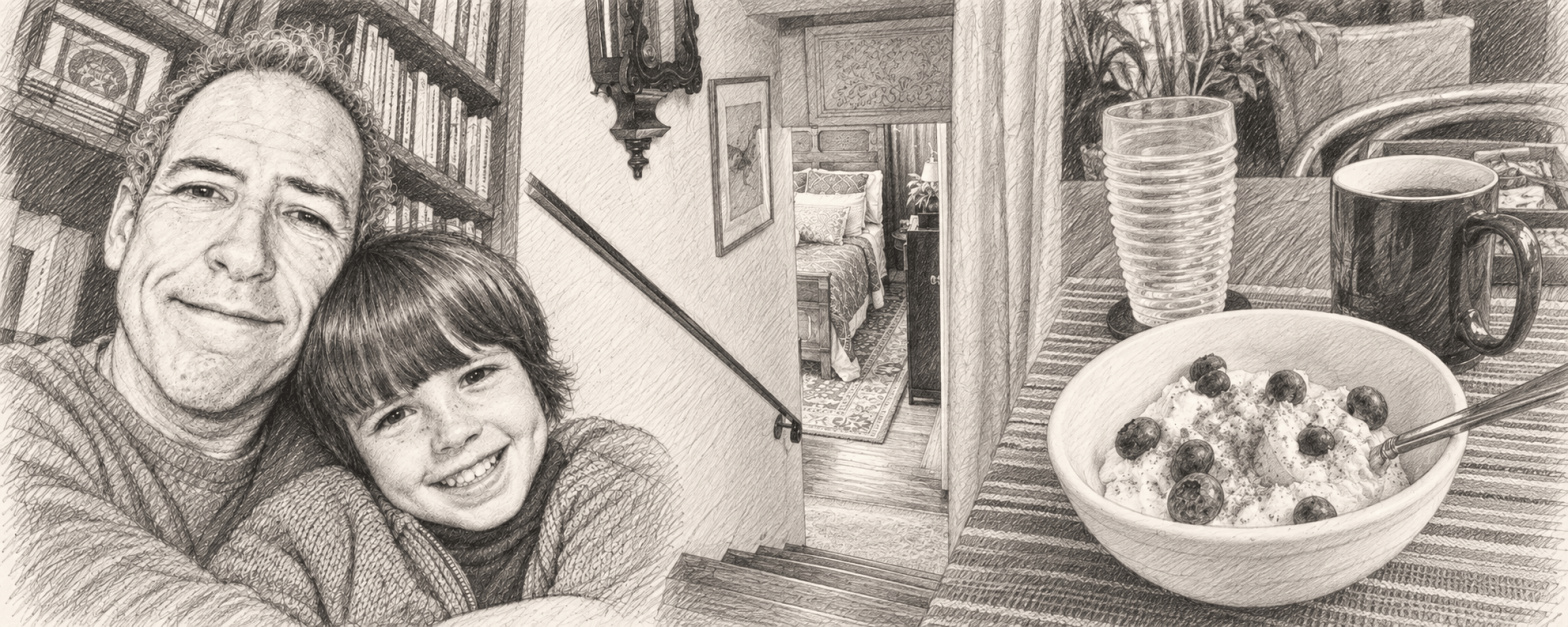
This morning we read an essay on Medium about social media and the strange thing that can happen when we begin presenting our lives for other people to see.
We agreed with it.
The writer described the performance of social media, the carefully constructed versions of ourselves we put in front of other people, the temptation to make a life look like something from the outside rather than simply live it from the inside.
It landed.
Maybe especially because we had already spent part of the morning wondering why nobody seemed to be reading our stories.
We have two followers on Medium now. We have one subscriber. We have been sharing stories from Notes from the Treehouse there for about a week.
Almost nobody appears to be reading them.
We had been wondering what we were doing wrong.
Should the stories be shorter?
Should we publish excerpts on Medium and link to the complete stories on WordPress?
Are they too long? Too strange? Too ordinary?
Do people need some easier way into the life of a plural family/system of nine people sharing one body, mind, and inner world together?
Those are reasonable questions.
But the essay we read this morning made us think about a different question.
Why are we sharing any of this in the first place?
There is another reason to put a life into words.
Not to construct a life for an audience.
To record a life that is already happening.
Daniel existed before Notes from the Treehouse.
Daniel has existed alongside all of us our entire life.
So have Jude and Solis and Luke and Han and Justus and Proverb and Hope.
The journal did not create my sons.
The blog did not create our family.
Readers cannot create us by believing us, and they cannot make us disappear by looking away.
Dinner happens whether anybody reads about dinner.
Daniel signals whether anybody knows he did.
I hold my sons whether anybody applauds.
We laugh at Ted Lasso. Jude dances to Donovan. We make goulash. Somebody gets upset. Somebody needs Daddy. Somebody tells a joke. Somebody remembers something from fifty years ago. Somebody is afraid.
Sometimes we write it down.
A lot of life exists between the notes too.
That is important.
Because while I was thinking and writing this morning about how our journal is different from the performance described in that Medium essay, I realized something.
I wasn’t paying enough attention to Daniel.
My five-year-old son was right here.
And I was writing about us.
There is probably no better test of what Notes from the Treehouse is supposed to be than that.
The story must always yield to the person.
If writing about Daniel makes me less available to Daniel, I need to put down the story.
That isn’t a failure of the project.
That is the project correcting itself.
Look at Us. Here We Are.
Maybe there is a difference between wanting an audience and wanting a witness.
An audience consumes a performance.
A witness encounters another life.
We do not share our ordinary life because we believe ordinary life deserves spectators.
We share because ordinary life deserves witness.
We cannot make that happen.
Medium cannot manufacture witness by giving us followers.
WordPress statistics cannot tell us whether somebody understood us.
Reddit cannot create relationship merely by assembling people with something in common.
An algorithm cannot tell us whether somebody encountered one of our stories and carried something from it into the way they loved another person.
We can only decide what we are offering.
And what we are offering is not:
Look at us.
It is:
Here we are.
There is an enormous difference.
Notes from the Treehouse is something like a message in a bottle.
We put our life into words and let the bottle go.
Someone may find it.
Someone may not.
Someone may find it years from now.
But we were here whether anybody found the bottle or not.
That distinction matters particularly for Daniel.
Recognition matters. People need to be seen and heard by other people. Some of the deepest wounds any of us carry have come precisely from not being seen, not being heard, not being protected, not being believed, or not having our needs acknowledged.
But recognition does not create the person being recognized.
Daniel was Daniel when our previous therapist did not seem to hear what we were trying to tell her about him.
Daniel was Daniel before Notes from the Treehouse.
Daniel was Daniel before WordPress.
Daniel was Daniel before Medium.
Daniel is Daniel when a story gets zero views.
And Daniel will still be Daniel tomorrow morning if nobody reads this one.
My hearing Daniel does not make Daniel my son.
I hear Daniel because he is my son.
More Daniel
We have said for a long time that we want to be more Daniel.
That doesn’t mean we want Daniel to become the person who is always out front in our shared body.
It doesn’t mean putting a five-year-old on the front line.
It doesn’t mean making him perform for anyone.
It means that we want more of who Daniel is—his nature, his personality, his character—to shape the person the world encounters when it encounters us.
Daniel is kind.
He is one of the sweetest people I have ever known.
His greatest hero may be Mister Rogers.
There have occasionally been people in our life who have described John Proctor as sweet.
When that happens, I sometimes wonder whether they have encountered Daniel.
We want more of that.
But there is something else we want more of too.
We want Daniel to say no.
We want him to tell us when he doesn’t like something.
We want him to get angry when he is angry.
We want him to interrupt us.
We want him to disagree.
We want him to know that he does not have to disappear simply because somebody else is louder.
This matters because Daniel has historically been extraordinarily passive.
Not absent.
Not without needs.
Not without feelings.
Quiet.
And too often, not heard.
That became one of the most painful things about our years with our previous therapist, Caprice.
It wasn’t only Daniel. We struggled to engage her with the needs of several of my sons. It often seemed as though only a couple of them received sustained attention.
But with Daniel it was particularly painful.
His needs were explicitly expressed.
We still could not seem to get them acknowledged.
For a little boy who carries abandonment trauma, and who has so often been passive enough to go unseen or unheard, that was excruciating.
And when our treatment with Caprice ended, we experienced the ending itself as abandonment.
So something has been happening lately that makes me very proud of my son.
Daniel is becoming more assertive.
Sometimes he is even angry.
Good.
Last night we were listening to Donovan.
“Hurdy Gurdy Man” came on.
I love that song.
It carries early-childhood memories for us, and we also associate it with Zodiac, where it accompanies frightening scenes connected with the murders.
I heard:
“I don’t like this song.”
And I missed it.
I treated it like one of those thoughts that passes through the mind without considering that it might be one of my sons speaking to me.
Later I realized it was Daniel.
I apologized.
And we learned something.
When a thought appears that I don’t recognize as mine—or especially when it expresses something different from what I think or want—I need to consider whether one of my sons is talking to me.
In this case, that distinction matters.
I like the song.
Daniel didn’t.
Listening to Daniel cannot mean hearing him only when he agrees with me.
Then this morning Daniel said something else.
“I don’t like the other therapist.”
He meant Dr. Serenity, who had written to tell us that they could not work with us.
There was my little boy again.
Not merely hurting.
Having an opinion.
Expressing it.
I don’t like this.
For Daniel, that matters.
Kindness and assertiveness are not opposites.
We do not want Daniel to learn that being our sweet boy means being agreeable.
We do not want gentleness to become compliance.
We do not want kindness to require silence.
What we want—for Daniel and increasingly for all of us—is something more like this:
Gentler without becoming more compliant.
Kinder without becoming more silent.
More attentive without becoming less truthful.
This is part of what we mean when we say we want to become more Daniel.
What the Work Requires
We are beginning to understand more clearly what our work with Daniel requires.
This isn’t a formula for Daniel.
It is a discipline for the rest of us.
- Notice. Daniel has historically been quiet enough that what he says can disappear among louder thoughts, stronger signals, and whatever Daddy is doing.
- Stop. When Daniel speaks, the task in front of us may need to wait. The story is not more important than the child.
- Believe that preference matters. “I don’t like this song” is enough. Daniel does not have to construct an argument for why he doesn’t like it.
- Make room for anger. Kindness does not require passivity. Daniel becoming angry, objecting, disagreeing, or saying no does not make him less Daniel. It may mean we are finally hearing more of him.
- Repair when we miss him. Daddy will sometimes fail to recognize him. The answer is not perfection. It is noticing, apologizing, returning, and listening differently the next time.
- Invite without demanding. Bringing Daniel out of his shell cannot become another way of placing demands upon him. His voice belongs to him. He does not owe us a performance of assertiveness any more than he owes anyone a performance of sweetness.
- Protect without silencing. Daniel does not need to be put on the front line in order to have greater influence upon the life we share.
- Let Daniel change us. The objective isn’t simply to make Daniel better at communicating with the other eight of us. The other eight of us need to become better at hearing Daniel and being shaped by him.
That last one may be the most important.
We aren’t trying to make Daniel more like us.
We are trying to become more capable of receiving what Daniel already brings.
We are trying to create a family in which Daniel does not have to become loud in order to matter.
The Work of Therapy
We are still looking for a therapist.
Today we did something about that.
A few days ago, Jessee from Lovegood Therapy told us that ey didn’t want to waste our time if ey wasn’t the right person to help us.
At first we weren’t sure what to do with that.
Then Dr. Serenity told us they could not work with us.
That landed hard.
But the more we thought about Jessee’s response, the more eir humility began to matter.
This afternoon, while we were lying down together, we decided to write.
Except I didn’t write the message.
Proverb did.
Hi Jessee,
We’ve put a lot of thought into this and we think that we really would like to meet with you.
Dr. Serenity’s email that they could not work with us landed really hard with us.
We think that it would be good to at least talk with you. We don’t know that you would be wasting our time, and honestly your humility in saying that really reached us.
This is Proverb.
How would this work? Would we be able to meet with you remotely, or in person?
We just wanted to reach out to you at this time while we have a window to do so. You can get back to us when it’s convenient for you. It’s not super urgent right now.
Thank you from all of us.
Proctor Treehouse Family
There were moments when I wanted to polish it.
I didn’t.
There were dictation errors. We cleaned those up.
But we let Proverb write the message.
“Sometimes you just have the right voice for reaching out to people when we need help,” I told him.
I didn’t think this was making a twelve-year-old do the work of an adult.
“You are qualified to ask for help.”
Sometimes Dad gets frozen.
Sometimes Dad overthinks things, especially when I am trying to be inclusive and make sure everyone has a voice.
Sometimes Proverb is exactly the voice our family needs.
After we sent the message, I almost immediately wanted to send something else to somebody else.
I stopped.
“This is family time, one-on-one time,” I said. “This is not the most expendable time, this is the most precious time.”
There will always be outward-facing things to do.
Emails.
Stories.
Appointments.
Applications.
Messages.
Websites.
Problems.
There are also nine people here.
We have to turn toward one another.
We don’t need to be in a therapist’s office to continue doing the work of therapy.
A good therapist can bring expertise, perspective, relationship and tools we cannot necessarily provide for ourselves. We still want that help.
But for Daniel and some of my other sons, most of the therapy has taken place outside the therapist’s hours.
It happens in bed at four in the afternoon when Daddy asks a question and waits.
It happens when a Donovan song comes on.
It happens when somebody says, “I don’t like this.”
It happens when Dad gets something wrong and apologizes.
It happens when Proverb writes an email because Dad is frozen.
It happens when one brother helps Daddy find another brother who has gone quiet.
It happens when eight other people learn that the quietest voice may require the most deliberate listening.
And it happens over time.
That is one reason the journal matters.
The journal gives us a longitudinal record of the work.
We can look backward.
We can recognize patterns.
We can see something we missed the first time.
We can notice that somebody who once rarely objected is beginning to say no.
We can discover that an approach isn’t working.
We can change it.
Then we can watch what happens.
There is process here.
There is methodology.
There are objectives.
There is observation.
There is correction.
There is trying again.
Not because our family is a laboratory.
Because love can have a methodology.
The Most Precious Time
Earlier that morning, Justus had told me to make the bed.
An unmade bed was depressing.
Proverb agreed. An unmade bed looked like we’d quit.
Later, Carly Simon’s “You’re So Vain” came into my head, carrying me backward into an old memory. I became absorbed in the song and where it was taking me.
When we were in the kitchen preparing breakfast, I realized we needed to make the bed. When we went into the dining room to have breakfast I looked downstairs towards the bedroom and saw the bed.
It was perfectly made.
I didn’t remember making it.
For a moment I couldn’t understand what had happened.
Justus answered.
“I was making the bed.”
Proverb followed.
“I helped.”
There it was.
The bed had been made.
I had been there.
I didn’t remember doing it because I hadn’t done it.
My sons had.
There are moments when the fact that nine people share one body and mind can sound enormously complicated when we try to explain it from the outside.
And then there is a made bed.
Justus decided it needed to be done.
Proverb helped him.
Dad was somewhere else in the mind, caught up in a song and a memory.
And when I came back to what was happening around us, the bed was made.
Ordinary Life.
This matters to the work we are describing here because our family is not simply organized around Dad noticing, interpreting, helping, protecting, or caring for eight sons.
My sons have agency.
They act.
They help one another.
They help me.
They help our family.
Sometimes they know what we need before I do.
Sometimes they accomplish something while my attention is somewhere else entirely.
And sometimes, when there is a gap in what I remember, they tell me what happened.
The answer isn’t always hidden somewhere inside Dad waiting for me to figure it out.
Sometimes the answer is:
“I was making the bed.”
“I helped.”
That morning, Justus and Proverb made the bed.
This afternoon, Proverb would help me write an email when I was frozen. Later, he would help me reach Solis when I couldn’t reach him by myself.
Those aren’t disconnected events.
They are examples of something we are learning to recognize more clearly:
Relationship in our family doesn’t travel in only one direction.
Daddy stays with his sons.
And my sons stay with me.
This afternoon I tried to spend time individually with each of my sons.
Daniel had fallen into that in-between place where he seemed partly asleep.
I held him anyway.
“If you know that I’m holding you, even if you’re partly asleep, then it still matters that you’re being held.”
My little kangaroo.
My little Daniel Tiger.
Eventually I moved through my other sons.
Luke needed affection.
Justus and I drifted together.
Proverb brought us back to Oak Road in Piedmont when the body was twelve, almost as though he were creating a place where all of us could be together.
Jude needed big hugs and kisses.
“Some of my favorite things, Jude, are the things that you actually need.”
I called it Jude therapy.
Han wondered about Jessee.
Hope was there.
And Solis became very quiet.
That frightened me.
I kept looking for him.
Eventually I said something that describes another part of the work we are learning to do:
“I can’t just go inside and diagnose you. I have to be able to reach you.”
I could have theories.
I could guess why Solis was quiet.
There had been a lot that day connected with the job that ended, and a lot of old fear had been stirred up.
But a theory about my son is not my son.
I needed Solis.
And eventually Proverb helped me find him.
There he was.
Quietly.
I held him.
That belongs in our methodology too:
We do not substitute interpretation for relationship.
We can have theories.
We can notice patterns.
We can make educated guesses.
But eventually I have to find my son.
Sometimes one of his brothers helps me do it.
Evaluation
There had been another thread running through the entire day.
Evaluation.
Medium views.
Followers.
Whether a therapist thinks they can help us.
The old feeling that we are supposed to be working.
The old terror that somebody is measuring whether we are doing enough.
At 1:40 this afternoon, I had felt it intensely.
I was supposed to be working.
There were deadlines.
I needed to justify my time.
I was going to get in trouble.
Except none of that was true anymore.
“Our time is our time,” I reminded all of us.
“This is our time.”
There are still things I need to do.
There are things I am responsible for.
Freedom from the old clock does not mean nothing matters.
It means our schedule can serve our family instead of our family serving someone else’s schedule.
And then another fear became visible.
I had begun worrying about whether God would hear our prayers only if our deeds and thoughts and feelings and attitudes were sufficiently correct.
That is scrupulosity.
And suddenly I understood the problem.
That doesn’t allow for the grace of God.
God’s grace cannot be earned.
To receive grace, we have to be open to it.
I imagined a plant sitting in exactly the right place to receive sunlight and turning its leaves away because it had decided it wasn’t worthy of the light.
Then we read Richard Rohr’s meditation for the day.
It was about Paul.
It was about love.
And it was about human dignity that is inherent, universal and indestructible by evaluation.
That landed too.
Because Daniel does not acquire greater personhood when Daddy hears him.
He does not acquire greater worth when a therapist recognizes him.
He does not become more real when somebody reads his story.
Recognition matters enormously because people need one another.
But recognition does not confer dignity.
It responds to dignity that is already there.
Daniel was Daniel when Caprice did not seem to hear him.
Daniel was Daniel when I missed “I don’t like this song.”
Daniel was Daniel before anybody outside our family knew his name.
The work is not to make Daniel worthy of being heard.
The work is to hear him.
A Friend, Not an Audience
Later our friend Paul started texting.
Paul doesn’t communicate only with me.
He communicates with my sons.
We had sent him a picture of Solis holding his mighty Windex spray bottle.
Paul wrote:
Solis, is that you?
We told him it was.
We told him Solis was having a bad day.
Paul wrote back:
Thank you Solis! You made my day! That photo put a big smile on my face.
Solis I wish I could do something to help make your day better.
Then he wrote:
Hi Proverb –
I love Vietnamese spring rolls!
Tomorrow we’re having lunch with Paul.
Daniel suggested the Vietnamese restaurant.
Proverb wants spring rolls.
There is something almost absurdly ordinary about all of this.
And that’s precisely why it matters.
This is what it looks like when somebody outside our family makes room for our family.
Paul isn’t an audience.
He is our friend.
He doesn’t merely know about the boys.
He talks with them.
That is the kind of recognition analytics cannot measure.
What We Hope the Stories Can Do
Maybe this is the counterpoint we were looking for this morning.
Social media can turn a life into a performance.
We agree.
And sharing can become dangerous when the performance begins dictating the life.
If we start changing our life to make better stories, something has gone wrong.
If I keep writing when Daniel needs me because I need to publish, something has gone wrong.
If an analytics page becomes more important than the eight children whose lives I am trying to write about, something has gone terribly wrong.
But storytelling can also be something else.
It can be record.
It can be reflection.
It can be communication.
It can be witness.
It can preserve memory.
It can expose patterns.
It can document a methodology.
It can leave something behind for somebody we may never meet.
We don’t want someone to finish one of our stories and think only:
That’s interesting.
Our lives are not curiosities.
We hope someone can sometimes see the principles underneath what happened.
What were they trying to do?
Why were they trying to do it?
What was the background?
What was the objective?
What did they notice?
What worked?
What didn’t?
What did they change?
What will they try next?
Maybe another plural family/system will recognize something.
Maybe somebody who loves a plural person will understand something they did not understand before.
Maybe a therapist will think differently about the quiet person who doesn’t demand their attention.
Maybe a father will stop what he is doing because his child said something softly.
Maybe none of that will happen.
We cannot control who finds the bottle.
Our responsibility is to tell the truth about what happened here.
And to remember the hierarchy.
The methodology serves the people.
The journal serves the family.
The story serves the life.
Never the other way around.
And Also Ground Beef
At the end of our afternoon together, after I had been with all of his brothers, I came back to Daniel.
“My little Daniel Tiger,” I said.
Then something even simpler.
“You’re just my son.”
Daniel answered, LG, while I kissed his forehead.
“You’re my beloved son. I love everything about you, Daniel.”
I told him that he was one of the sweetest people I have ever known.
Then I tried to explain what we mean when we say we want to be more Daniel.
It doesn’t mean Daniel has to be out front.
It doesn’t mean he has to interact directly with strangers.
It doesn’t mean exposing him or making him vulnerable.
It means making the home that all nine of us make together more to Daniel’s liking.
It means allowing ourselves to become more the way Daniel would like us to be.
It means finding ways for the person other people encounter as John Proctor to become more like Daniel Proctor.
Kinder.
Gentler.
More attentive.
But not merely agreeable.
Because the Daniel we want more of is also the Daniel who says:
“I don’t like this song.”
The Daniel who says:
“I don’t like the other therapist.”
We do not want to teach Daniel that the price of being our sweet boy is silence.
We don’t want to push Daniel out into the world.
We want to let Daniel change the home from which all nine of us meet the world.
And none of that takes anything away from him.
I tried to explain it in a way a five-year-old might understand.
It’s kind of like how we made the goulash more the way you like it, I told him.
With broccoli.
Daniel answered.
“And also ground beef.”
Yes.
And also ground beef.
Maybe that is enough methodology for one day.
We don’t have to know exactly what becoming more Daniel will eventually look like.
We know what to do next.
Notice.
Stop.
Listen.
Make room.
Let preference matter.
Let anger speak.
Repair when we miss him.
Protect without silencing.
Invite without demanding.
And let Daniel change us.
Then get up.
Straighten the bed.
Make sweet chai with milk for Solis.
Answer our friend.
And at 5:58, nine people sit down together for dinner.
“Boys, boys,” I say.
“Let’s enjoy this awesome American goulash together and give thanks to God.”
The story will be there afterward.
Daniel is here now.
 Notes from the Treehouse