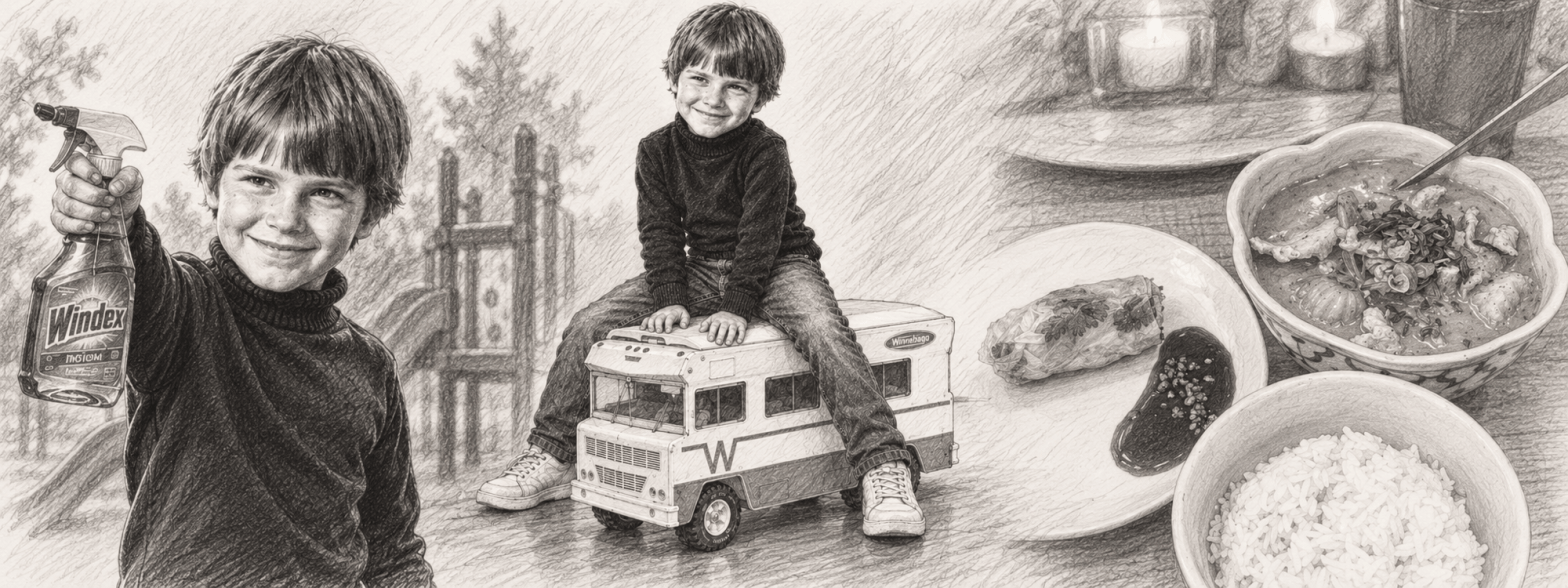
My seven-year-old son was quiet this morning.
Not gone.
I could see where he was.
He showed me things.
A plastic model of the human body we had when we were a child, with all the organs inside.
Our stepmother standing in the kitchen frying something, using the mesh screen she put over the pan so grease wouldn’t splatter everywhere.
Very Solis things.
Order.
Safety.
Keeping the mess contained.
But when I held him and gave him my love, he barely responded.
“You’re present,” I told him, “but you are quiet.”
Yesterday had been difficult for him.
It has been difficult for all of us.
Our job ended almost two months ago, and there are things I need to do that I have not been able to make myself do.
Healthcare.
Finances.
Figuring out how we are going to support ourselves.
Things adults do.
Things fathers do.
And I have been frozen.
Last night I thought I understood what was happening with Solis.
I thought he was frightened because Daddy wasn’t doing what Daddy needed to do.
So I tried to reassure him.
“Please Solis, I need you,” I told him. “I need your love and I need your support.”
I told him that when I felt like he was upset with me or disappointed in me, it made me harder on myself.
It made it harder for me to move.
I asked him to stay close to me.
I asked him to trust me.
I told him I would pull it together for him.
I thought I was reassuring my seven-year-old son.
I was asking him to reassure me.
⸻
We spent most of the morning in bed.
That sentence could sound like nothing happened.
So much happened.
There are nine of us sharing one body, mind and inner world, and sometimes the quietest-looking hours are the fullest.
I lie down.
I hold one of my sons.
I kiss his face.
I tell him how much I love him.
And I try to stop thinking.
That last part matters.
I have learned that I am most available to my sons when I am in what I think of as receiving mode.
I give them my love and affection, but I stop trying to direct what happens.
A thought comes.
A song.
An image.
A place we have not thought about in decades.
One of my sons signals.
Sometimes someone speaks.
Sometimes an entire memory opens.
This morning they came one after another.
There was so much that I could barely hold it.
That is not unusual.
And that is part of the unseen work of being us.
⸻
In 2022, Kim Murphy, who was then president of St. Vincent de Paul of Alameda County, told me that we were amazingly cohesive for “someone” with Dissociative Identity Disorder.
Kim was not only our president.
She is a psychologist and a professor of psychology.
And by then, we were co-conscious.
That matters.
Before coming to St. Vincent de Paul, we had worked for MBH Architects for 24 years.
When that ended, we were unemployed for three and a half years.
During those years, we began therapy.
We were diagnosed with Dissociative Identity Disorder.
And we began the extraordinary work through which we became co-conscious.
We found one another.
Dad found his sons.
My sons found their Daddy.
We began learning who we were together.
Then we went back to work.
For the first time in our life, we were entering employment knowing that we were a plural family/system.
We weren’t simply learning how to live together as a family.
We were learning how to work together.
How does a father go to work while remaining available to eight children who share the same body, mind and inner world?
How do children live through a workday that they cannot physically leave?
How do nine people share one schedule?
One computer?
One pair of hands?
One nervous system?
How do I know when one of my sons needs me while I am answering an email or sitting in a meeting?
What happens when somebody remembers something?
What happens when somebody becomes frightened?
How do we make room for a four-year-old and a five-year-old and a seven-year-old inside a life organized around adult employment?
There was no handbook for any of this.
We were figuring it out while we lived it.
So when Kim told me that we were amazingly cohesive, she was seeing something real.
But even then, I don’t think I understood how much work was hidden inside that word.
Cohesion can sound effortless.
As though nine people simply fit together.
As though there is some internal mechanism quietly keeping everyone organized.
There isn’t.
There is work.
So much work.
There is noticing who is here.
Who is quiet.
Who has been waiting.
Who needs Daddy.
Who needs space.
Who is frightened.
Who remembers something the rest of us do not.
Who knows something but cannot yet explain it.
There is learning the language of a body that all nine of us share.
There is learning when to ask a question and when to stop asking.
There is discovering that silence does not mean absence.
There is trying to distinguish something one of my sons is telling me from something I desperately want him to be telling me.
There is memory.
There is amnesia.
There are dreams.
There are things one of us remembers that another does not.
There are things several of us remember differently.
There are moments when an image appears and none of us knows why.
There are eight children who need a father and one father trying to make sure that nobody disappears simply because somebody else needs him more loudly at that moment.
There are only two hands.
There is only one face to shave.
There is only one body to put into bed.
And there are nine people living an entire life together.
Then, later in 2022, work became traumatic.
Our symptoms of Dissociative Identity Disorder and Complex PTSD were triggered in ways that eventually became extraordinarily overwhelming.
Ultimately, it became necessary for us to work from home.
And Kim got to see firsthand what happened when the cohesion she had recognized was placed under enormous strain.
She didn’t see only the professional adult struggling to function.
She encountered my sons.
Directly.
She talked with traumatized children who were frightened and begging her for help.
She knew they were there.
She heard them.
She experienced something that most people looking at us from the outside could never see.
That makes what she said about cohesion mean something different to me now.
Cohesion is not the absence of Dissociative Identity Disorder.
It is not the absence of trauma.
It is not the absence of symptoms.
It is not looking composed enough that nobody realizes how much is happening underneath.
Cohesion is what we have been doing with one another all these years.
It is the work of remaining a family when one of us is terrified.
It is making room for whoever needs to be heard.
It is recognizing when one son has been waiting because another needed Daddy first.
It is learning one another’s language.
It is noticing.
Listening.
Making mistakes.
Apologizing.
Repairing.
Trying again.
Cohesion is not something we simply have.
It is something we do.
Again and again.
⸻
That is part of why we write.
We have been journaling since long before we understood that we are a plural family/system—Dad and eight sons sharing one body, mind and inner world.
Before we understood the signaling.
Before we were co-conscious.
Before we understood how much was happening beneath the surface.
We wrote because things happened that we did not understand.
We wrote because there were feelings and memories and behaviors that did not make sense.
We wrote because we were trying to see ourselves.
Now the journal has become an enormous record of our life together.
The meals.
The memories.
The signals.
The dreams.
The arguments.
The fear.
The prayers.
The ordinary life.
Sometimes I imagine one of those enormous chalkboards covered with mathematical equations.
Someone has been working and working on a problem.
The whole board is filled.
That is what the journal can feel like.
We put everything on the board.
Not because every detail has an obvious meaning.
Not because every memory needs an interpretation.
But because there is so much happening among nine people that it can be impossible to see the shape of something while we are inside it.
The journal gives us a record.
The analysis lets us stand back from the board.
It doesn’t tell us who we are.
It helps us look at what we ourselves put there.
Sometimes it shows me that somebody was waiting.
Sometimes it shows me that I misunderstood.
And sometimes it shows me that something I did out of love placed a burden on one of my children that never belonged to him.
That happened this morning.
⸻
I listened to an analysis of what I had written last night.
And suddenly I saw what I had done.
I had told my seven-year-old son that I needed his love and support in order to get unfrozen.
I had told him that his disappointment made it harder for me to move.
I had asked him to trust me because I wanted him to know that I would take care of him.
But I had made him responsible for my ability to take care of him.
That is not his responsibility.
So I went back to my son.
“Solis,” I said, “you don’t have to do anything to help me.”
If he was scared, he could be scared.
If he was angry, he could be angry.
He did not have to make Daddy feel better.
He did not have to help Daddy get unfrozen.
He did not have to reassure me.
He did not have to believe everything was going to be okay.
“You get to be seven,” I told him.
“Daddy is going to take care of you.”
Solis signaled.
RT.
That is another part of the unseen work.
Going back.
Listening.
Apologizing.
Taking the burden back.
Being Daddy.
⸻
But that was only one thing that happened in bed this morning.
When I was with four-year-old Jude, something much older opened.
Suddenly he was at Grandma and Granddad’s house.
He had just been with a family member who had done something bad to him.
It was something this person did often when Jude visited Grandma and Granddad’s house.
Then Jude was in the living room.
Grandma was there.
Granddad was there.
The rest of the family was there.
Everything was normal.
Except it wasn’t.
It felt bad down there.
Jude felt bad.
But he let everything be normal.
That may be one of the hardest things about the memory.
Something bad had happened.
Then ordinary life resumed.
Family talking.
People sitting in the living room.
Whatever was happening that day simply continuing.
And a four-year-old carrying something nobody in the room could see.
“Jude, you are here right now with Daddy,” I told him.
“You are safe and no one will ever do that to you again.”
He became unusually quiet.
I held him.
More images came and disappeared before I could record them.
Then he showed us breakfast.
Greek yogurt.
Blueberries.
Not enough yogurt, so we poured half-and-half into the bowl.
There was plenty of yogurt upstairs.
“You’re hungry,” I told him.
Later he showed us arranging dried grasses, eucalyptus and cotton sprigs in the vase on the desk beside our bed.
For a moment I thought we were doing it right then.
It happened last summer.
A terrible childhood memory.
Yogurt.
Blueberries.
A vase.
Our bedroom.
One thing beside another.
This is what I mean when I say that it is hard to hold all of this.
It is not an abstraction.
It is a morning.
It is our bed.
It is one son remembering something terrible while another is worried about Daddy and another wants breakfast and another is waiting for his turn to be held.
And Daddy is trying to see everyone.
This is the unseen work.
This is cohesion.
⸻
Then other childhood memories began coming.
There is a period of our childhood that someone in our family began calling the Solis.
I don’t know who started calling it that.
Before it, our family fell apart.
Eventually we went with our sister and our father to live at Grandma and Granddad’s house.
There are frightening memories from that time.
There are also memories of extraordinary tenderness.
Maple brown sugar oatmeal.
Froot Loops.
Captain Kangaroo.
Mister Rogers.
Snuggling with Granddad.
Grandma giving us a bath and washing our neck in that wonderful way she did that felt almost like a massage.
Happy Land Elementary School.
Grandma and Granddad’s house became a place from which something new could eventually begin.
Then came our sixth birthday.
Dad gave us a Tonka Winnebago.
The roof opened.
Inside was a miniature family.
A dad.
A mom.
Two children.
A little dog.
Dad used the toy to explain what was going to happen that summer.
He was going to marry Nadine.
And after the wedding, instead of Dad and Nadine disappearing on a honeymoon, we were all going together.
The little Winnebago was our introduction to what was coming.
Then the real Winnebago came.
We traveled up the California coast.
Solvang.
San Simeon.
Big Sur.
Then Yosemite.
The Beatles’ 1962–1966 played for what seemed like almost the entire trip.
We were together.
Everything felt bright.
Everything felt magical.
Looking back, it feels almost as though that trip jumpstarted our new life.
We came home to a new home.
Then came a new school.
Monte Vista.
Kindergarten 2.0.
And suddenly there are memories everywhere.
The calendar.
Learning to tell time.
Halloween crafts.
Thanksgiving crafts.
The Christmas pageant.
Family dinners.
Sailing on the Lido 14.
The Old Spaghetti Factory after a day on the water.
School.
Home.
Music.
Ordinary life.
It did not erase what had happened to us.
It did not make everything afterward safe.
But something had changed.
The fog lifted.
Life became vivid.
We were living.
When we look back across childhood, those years appear almost like a sunny clearing in a dark forest.
Someone in our family eventually started calling them the Solis.
I don’t know who.
The name itself came first.
Shortly after we became co-conscious in the late spring of 2019, my seven-year-old son told me his name.
Solis.
That was the name he gave me for himself.
Solis is Spanish for sun.
Only this morning, lying there with my sons and watching those childhood years come alive again, did I find myself wondering about the connection.
Was that why he was named Solis?
Did he know something about those years that I did not?
Did someone else make the connection later?
I don’t know.
There are things about ourselves that we discover rather than decide.
And there was something about this morning that resonated with that childhood transition.
Once before, when we were a child, our life had come apart.
We could not possibly have known what the next life would look like.
Then Dad put a Tonka Winnebago in front of us.
A toy.
A miniature family.
A promise of a trip we had not yet taken.
Then we took it.
And afterward there was a home we had not yet lived in.
A school we had not yet attended.
Friends we had not yet met.
Christmas pageants we had not yet performed.
Family dinners we had not yet eaten.
There was an entire ordinary life ahead of us that we could not see because it had not happened yet.
I think that is what resonates with today.
Not a promise that everything will turn out the same way.
Not a belief that another Winnebago is coming to rescue us.
Something simpler.
We have mistaken the edge of what we can see for the edge of what can exist before.
The life ahead of us did not become visible by figuring it out.
We lived into it.
One thing at a time.
⸻
Yesterday our friend Paul cut his finger while he was working at a radio transmitter site.
He sent us a photograph of the spray bottle of water he had used to irrigate the cut.
Immediately we thought of Solis.
There is a whole story behind that.
Some time ago, during one of our bedtime visions, Solis appeared holding a bottle of Windex.
It became one of those wonderfully Solis images that stayed with us—the seven-year-old with his spray bottle ready to thwart the bullies.
So when Paul sent us the photograph of the spray bottle he had used on his cut, we sent him the picture of Solis with his Windex.
Paul wrote back:
“Thank you Solis! You made my day! That photo put a big smile on my face.”
Then:
“Solis I wish I could do something to help make your day better.”
Paul knew Solis was having a difficult afternoon.
He didn’t ask Solis to cheer up.
He didn’t ask him to take care of anybody.
He just told him that something Solis had done brought him joy.
Today we went to lunch with Paul.
⸻
Before we left, we took an ice-cold shower.
As we stepped into the water I said, “Solis, you don’t like hot.”
“I don’t like really cold either,” he told me.
“I like just right.”
That made me smile.
Because that is exactly what Solis brings to our family.
Just right.
Then, just before we went downstairs, I noticed that some of our LED lights were still charging.
I was going to leave them plugged in.
Solis didn’t feel safe doing that while we were gone.
So I turned off the master power switch.
“When we get home, we’ll turn it back on,” I told him.
“It will be fine.”
Then something even more important:
“I’m listening to you.”
⸻
Daniel chose the restaurant.
Proverb wanted spring rolls.
We ordered chicken yellow curry with coconut and Vietnamese spring rolls.
Some of the boys wanted noodles, but we had American goulash waiting at home for dinner, so I decided we already had enough noodles in our future.
Paul shared some of his pad Thai with us.
And we somehow ended up with more Thai iced tea than any family reasonably needs.
Before we left home, we had made an agreement.
We were not going to spend the afternoon talking about the old job.
We were going to be with our friend.
That was what belonged to this afternoon.
For the most part, we did it.
At one point the conversation started moving toward the old organization.
Solis began signaling strongly.
RT.
I told Paul.
Paul understood immediately.
We changed the subject.
That was it.
Nobody told Solis that the conversation was harmless.
Nobody asked him to tolerate it.
Nobody told him that the adults needed to finish talking.
The adults stopped.
⸻
When we got home, we went downstairs and lay together on the bed again.
One son at a time.
Justus.
Jude.
Daniel.
Luke.
Solis.
Proverb.
Han.
Hope.
Then back to Solis before we got up.
This is what so much of our life looks like now.
Time together.
Receiving.
Listening.
Trying not to rush past one another.
Trying to notice who is waiting.
Trying to notice who needs more.
Trying to understand that quiet does not mean absent.
Cohesion.
The unseen work.
When I held Solis, he showed me the Earth floating in dark space.
There was no sun.
Instead, enormous lights orbited the planet, providing daylight.
I have no idea what that meant.
I don’t need to know.
Then another image came, this one about the old organization.
I told Solis we didn’t have to be there anymore.
We didn’t have to know what people there were saying.
We know who our friends are.
Solis signaled.
RT.
Then he told me something.
“I was afraid that you were going to talk about them today but you didn’t.”
I was startled.
“You were afraid of that, Solis?”
The subject had come up briefly.
He knew.
“But you stopped.”
LT.
RT.
We did.
And suddenly I understood something about what I had been trying so desperately to give my son since last night.
I kept asking Solis to trust me.
But trust was not something he owed me.
It was something I could give him a reason to have.
Today, trust looked very small.
My seven-year-old told me something frightened him.
And Daddy stopped.
⸻
Later Solis asked me:
“Paul is so happy to see us. Why does he like us so much?”
I didn’t really know how to answer.
“Some people just see us,” I told him. “Some people see you. Other people don’t.”
Paul sees him.
Yesterday a photograph of a seven-year-old boy armed with a bottle of Windex made Paul smile at a radio transmitter site.
Today Paul ate lunch with all of us.
He listened when Solis needed the conversation to change.
He talked about other things.
He was our friend.
Maybe that was enough.
⸻
Last night I told my son:
I need you to help me.
This morning I told him:
You don’t have to take care of Daddy.
This afternoon he showed me what he had needed instead.
A boundary.
A Daddy who heard him.
A Daddy who stopped.
A friend who understood.
Spring rolls.
Yellow curry.
Too much Thai iced tea.
And afterward, all nine of us together on the bed.
There is so much happening in our life that sometimes I don’t know how to hold it.
A four-year-old can suddenly remember something terrible that happened more than half a century ago.
A seven-year-old can be quiet while Daddy tries too hard to understand why.
A toy Winnebago can open into an entire summer.
A bottle of Windex can make our friend laugh.
A spring roll can matter.
A signal can change a conversation.
This is why we write it down.
We put it all on the board.
And sometimes, when we stand back, something becomes visible.
At one point this afternoon, while I was holding Solis, he showed me the Earth after the sun had gone out.
The planet was surrounded by enormous lights.
Somehow there was still daylight.
I don’t know what it meant.
I don’t need to make it mean anything.
Tonight we have American goulash waiting upstairs.
Tomorrow morning we are going to Sacred Heart.
The LEDs are charging again.
Before we left this afternoon, Solis was worried about them.
So Daddy listened.
We turned them off.
When we came home, we turned them back on.
And this morning, after all those memories of a life that once seemed to begin again, I told my seven-year-old something I needed to understand as much as he did.
He doesn’t have to bring back the sun.
He doesn’t have to make Daddy move.
He doesn’t have to make Daddy feel better.
He doesn’t have to take care of me.
He gets to be scared.
He gets to be quiet.
He gets to be Solis.
He gets to be seven.
Daddy will take care of the rest.
And there was still light.
 Notes from the Treehouse