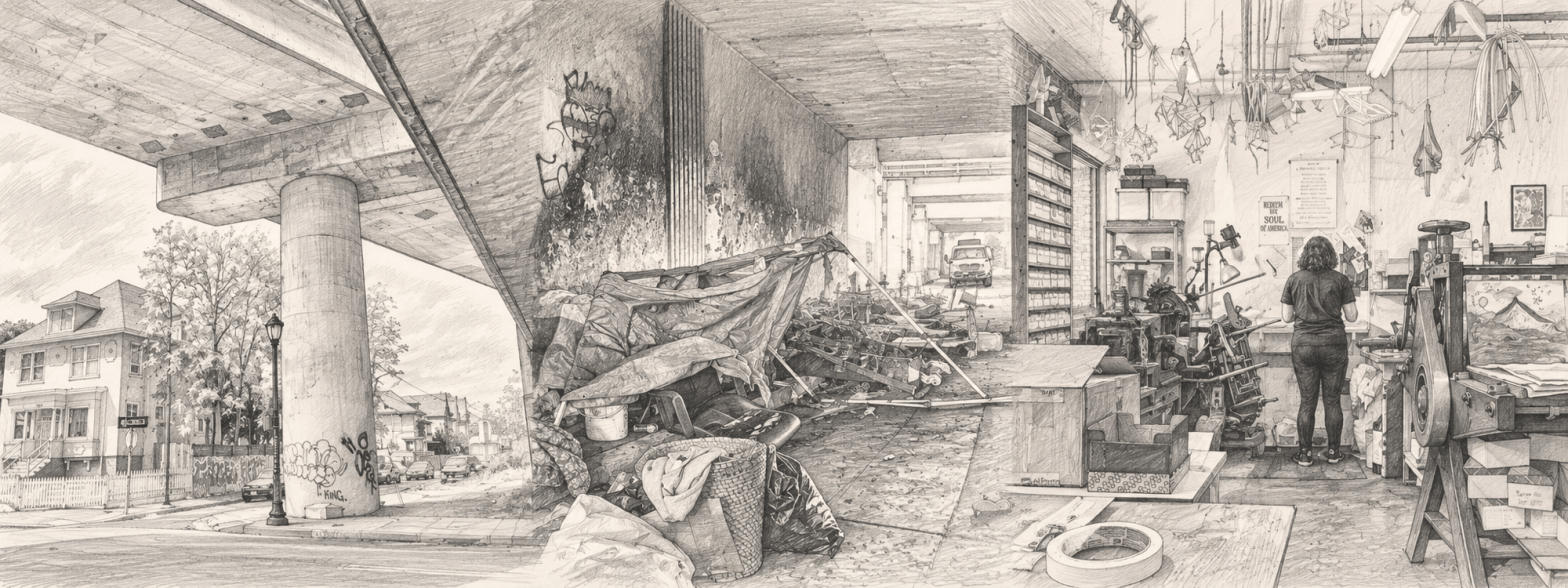
When we got back to Braided Bridge this afternoon, we got out of Kim’s car and leaned against the warm brick wall of the century-old building.
We were in a daze.
For a while, nobody seemed particularly available to anybody else. We were all there, but each of us seemed to be somewhere by himself, trying to absorb something we didn’t know how to absorb.
Then a voice came from somewhere nearby.
“Are you okay over there, John?”
It was Kim.
We didn’t know how to answer.
A few hours earlier, we had been lying in bed trying to decide what we wanted to do with Justus’s Day.
For the past several days, we have been thinking and writing about agency. What does it mean to choose? What does it mean for Dad to be responsible for the adult things that need to be done without turning his sons into the people responsible for making him do them? What does it mean for nine people sharing one life to make decisions together without making eight children responsible for managing their father?
Yesterday, on Han’s Day, we wrote about rebuilding. There were two moving vans with their ramps lowered toward one another, forming a bridge. There were things we wanted to carry across that bridge from the life we had into whatever life comes next. There were things we wanted to leave behind.
We ended by asking what Han wanted to build.
Last night, as Han’s Day was ending and Justus’s Day was beginning, we remembered being eleven years old.
We remembered desperately wanting to grow up because adulthood seemed to mean:
I can protect myself. I can provide for myself. I can get away. Nobody can do this to us anymore.
And Justus has carried an extraordinary amount of that history.
But this morning, instead of asking Justus to protect the family, Dad asked him what he wanted to do.
Kim had invited us to come with her to deliver water to people living in some of the encampments along Martin Luther King Jr. Way in Oakland. Justus had also been thinking about going to Golden Gate Park.
Last night, when Dad tucked Justus into bed, we told him he did not have to decide. Golden Gate Park. Water with Kim. Stay home. Something else. Whatever he wanted. He could sleep on it.
This morning, when we asked again, Justus said he didn’t feel like going to Golden Gate Park.
“I guess it would be better to go with Kim.”
And Justus chose.
He did not want Golden Gate Park. He thought it would be better to go with Kim.
Then he went.
That sounds very simple.
For us, right now, it wasn’t.
We had to get out of bed, get everyone ready, eat, shave, take a shower, text Kim and be downstairs when she arrived.
At ten o’clock, Kim arrived.
We were ready.
That mattered.
But what happened next wasn’t really a story about agency, at least not in the way we had been thinking about it.
We went to Braided Bridge first. We sat at the table. Kim brought us chai. Time seemed to slow down.
“Minutes are longer here,” we wrote in the journal.
“Which is good.”
Then, around noon, we went out to deliver water.
A decade ago, we were successful. We were nearly three decades into a career in architecture, working for a large architecture firm and volunteering with St. Vincent de Paul. We had professional standing, an established career, expertise and a good income. As an architect, we had even participated in designing things intended to help people experiencing homelessness.
We thought we understood something.
Today we felt as though we understood less than we did eight years ago.
Maybe much less.
We were bringing water.
That was all.
We were three people in a car bringing water to people who needed water.
At first, some of what we encountered seemed manageable. People were living in campers and RVs, structures that at least resembled categories our mind knew how to understand as shelter.
Then there were tents beneath the freeway.
And then there were five burned tents.
Charred black remains. The exposed coils of mattresses. Things we could no longer identify.
One tent had not burned. We called out to see whether anybody was there. As we were getting ready to leave, a man called back.
He needed water.
He stuck his head out of the tent. Kim brought him a case.
Between the place where this man was living and the blackened remains of the other tents were two wooden chairs.
That was his home.
As we left, we waved to him. We remember ourselves waving like a small child.
Because by then, that was increasingly how we felt.
Jude was there. Jude was worried. Daniel was there. Later, when we lay down together, we discovered how much Solis had been there too.
And Justus remained Justus.
Justus wanted to be helpful, to make sure our presence there had a purpose.
That matters precisely because it wasn’t required of him.
His protective orientation did not have to disappear in order for him to stop being the family’s protector. He can care whether the family is helpful. He can notice purpose. He can help carry water. He can say what he thinks should happen.
Those are expressions of Justus.
The developmental question isn’t how to remove those things from him. It is how to make sure he doesn’t have to use them to keep everybody alive.
All of our boys encountered the place differently.
Proverb wanted eye contact, names and greetings. He wanted the people we encountered to be people rather than scenery through the windows of a car.
Luke wanted to make sure we weren’t placing ourselves above anybody.
Han wanted to pray. But Han also remembered what he used to love when we traveled through these same streets going to and from work: moving through the city, greeting people, smiling at them, refusing to be frightened of everybody he encountered.
Hope wanted to keep us honest. We are not living in an encampment. Our situation being uncertain does not make us romantically or symbolically homeless. We don’t get to turn somebody else’s circumstances into a metaphor for ours.
Solis and some of his brothers carefully looked into tents and trailers, searching for signs that domesticity somehow persisted beneath the roar of the freeway. A chair. A blanket. Something arranged somewhere because somebody wanted it there. Some indication:
I live here.
Human beings make places. Architects talk about making places as though architects invented it.
People make places wherever they are.
And Jude was afraid.
We could feel his fear and his worry for whoever had lived in those burned tents. Underneath it was something harder to describe: insecurity. That sickly feeling a little child can have when something he believed was solid suddenly doesn’t seem solid anymore.
We have talked about the possibility of becoming homeless ourselves.
We are not homeless. We have a home. We have food. We have money. We have people who care about us. Those distinctions matter.
But standing beside five burned tents, Dad could not truthfully promise Jude that could never happen to us.
We don’t know that.
Dad couldn’t promise him that everything would always be all right.
We don’t know that either.
So Dad told Jude what Dad knew:
I’m here. You’re safe right now. Daddy is with you. Wherever we go, we all go together.
Maybe that wasn’t supposed to be an answer. Maybe it was simply what Dad could truthfully promise.
And now another question seems important.
How can Jude be a four-year-old who knows how to say no without having to protect our boundaries? How can a child possess a boundary without becoming its security guard? How can “no” belong to Jude while enforcement belongs to Dad?
How can Justus’s protective wisdom belong to Justus while ultimate protection belongs to Dad? How can Hope’s clarity belong to Hope without Dad depending upon a fourteen-year-old to make healthcare manageable? How can Han bring faith without being responsible for keeping the family faithful? How can Solis bring structure without becoming responsible for the schedule? How can Proverb organize without becoming the executive? How can Luke make home without becoming responsible for everybody’s regulation? How can Daniel bring extraordinary relational sensitivity without becoming responsible for detecting everybody’s pain?
And how can Dad receive all of this without either exploiting it or refusing it?
Because refusing the children’s contributions wouldn’t be healthier. It would erase their agency.
The goal cannot be a family in which Dad acts and eight children passively receive Dad’s care. That’s not this family either.
How can all of these strengths that each of us brings to our collective ecology be helpful for the one who has to be the executive, the responsible one, the forward-facing one as Dad, while allowing the children to be children?
We don’t know yet.
But today we practiced something.
Everybody came with us. Everybody experienced something. Everybody brought himself.
Nobody had to turn into the adult.
Not even Justus.
Especially not Justus.
He is eleven.
A decade ago, we might have experienced ourselves differently in that situation. Maybe we would have felt heroic somehow. We were volunteering. We were helping. We were designing things. We had a successful professional life that made the distance between us and the people we were trying to help seem much more secure.
Today there was just a hollow feeling. A feeling of compassion, love, but there were no words.
There were no heroes.
There was simply this.
People were living beneath a freeway while cars passed nearby. People were going back to offices after lunch. People were running errands. People were doing whatever people do on a Tuesday afternoon in Oakland.
And right beside them were people living under completely different conditions.
At first it seemed almost like two worlds occupying the same place.
But even that wasn’t right.
There aren’t two worlds.
There is one society, and people do not share equally in what it provides.
The people we met were living with the burdens of that society while receiving far fewer of its benefits and protections. Homelessness does not occur outside our social systems. It occurs within systems marked by profound inequalities of wealth, opportunity, housing, race, healthcare, education and justice.
Some of those inequalities reach backward through generations. Some are perpetuated by institutions. Some become visible only after somebody has lost the things that allow the rest of us to move through the world without noticing how much protection we have.
And then society has a terrible way of taking the consequences of all of that and handing them back to an individual person as though they represent an individual failure.
Standing there, it was impossible to believe that.
We didn’t know the histories of the people we met. We didn’t know what had brought any particular person to that tent, trailer or RV, and we did not want to pretend that we did.
But neither could we pretend that everybody had arrived at this Tuesday afternoon in Oakland with the same opportunities, the same protections, the same resources or the same chances.
The cars passing us and the tents beneath the freeway were not evidence of two separate societies.
They were evidence of the inequalities within one.
Nearly a decade after participating in designing things intended to help people experiencing homelessness, we somehow felt less qualified to say what somebody else needed.
Maybe that isn’t a loss of knowledge.
Maybe knowing people better sometimes means becoming less certain that you know for them.
We don’t know.
That phrase kept returning.
We didn’t know what to tell Jude. We didn’t know what to make of the burned tents. We didn’t know what we were supposed to learn. We didn’t know whether there was something God wanted us to understand.
For a while we tried.
That is something we do.
What does God want us to know? What does this have to do with yesterday? What does this have to do with agency? What does this have to do with rebuilding? What are we supposed to learn?
Eventually even that began to feel pretentious.
Five burned tents do not exist to teach us something. People living beneath a freeway are not characters God placed in our path so we can better understand our own lives.
We brought water.
People needed water.
That was enough.
There wasn’t hopelessness either.
That matters.
There was compassion. There was love. There were greetings and names and ordinary moments. But there was nothing that made the whole thing cohere.
By the time we returned to Braided Bridge, Dad didn’t feel very much like the adult observer of the experience.
We felt little.
We got out of Kim’s car and leaned against the warm brick wall.
It reminded us of being a little child after the terrifying experience of going to the doctor and the depletion that followed. The car that had felt too hot on the way there could somehow feel comforting on the way home.
That was something like the way we felt against the brick wall.
Then Kim noticed us.
“Are you okay over there, John?”
We didn’t know.
In this moment?
Yeah.
I guess.
We went inside. We ate a ham and cheese sandwich and drank ginger beer. We gave thanks to God.
And eventually Kim drove us home.
We asked her to drop us off at Safeway. The freezer section was finally working again. They had our ice cream. We bought our favorite deli tortilla chips, Greek yogurt, bread and a couple cans of tomato basil soup.
Then:
Home.
We put the groceries away. We changed into comfortable clothes. We ate a cheese sandwich.
And we did something Dad had promised everyone we would do.
We went downstairs and laid down together.
Dad kept the promise.
And then the day came with us.
Dad held Jude. Then Solis.
And what Solis showed Dad was terrifying.
We don’t need to describe all of it here. It belonged to old terror: what Clifford did to us as a child, the job, downtown, places where a seven-year-old boy had learned that frightening things could happen and that he had very little power to make them stop.
And suddenly Dad understood something.
Solis had been there beneath the freeway too.
He had seen the burned tents. He remembered the man whose home was separated from the burned remains by two wooden chairs.
The experience had come home in his body.
Dad couldn’t explain why one frightening experience awakened another.
Dad didn’t need to.
Instead, Dad tried something else.
What day is it?
Tuesday.
What did we do today?
Kim came to get us. We went to Braided Bridge. We worked on our journal. We brought water to people living in the encampments. We did one little thing to help. We went back to the studio. We talked with Joel about his artwork. Mocha was happy to see us. We watched Liz operating the press. We heard the paper cutter and pleasant conversations. We entered the rhythm of the studio.
We came home. We ate again.
Now we’re lying down.
Daddy is holding you.
This is nothing like the past.
We are here. We are a family. The cars are outside. We are inside.
Daddy is here.
That did not erase what Solis had seen.
It located him.
Then. Now. There. Here.
Gradually everybody became quiet.
Dad felt that involuntary inhale with the little quiver that always reminds us of a child who has been crying and has finally stopped.
We don’t have to know about the future to experience joy.
This is where life is happening.
Then Dad held Justus.
Justus likes to fall asleep being held by his Daddy.
That sentence itself contains a history.
There was a time when it was very hard for Dad and Justus to be close. Now Justus has become such a sweet boy. He likes afternoon naps with his father.
Dad held him and told him how much he loved him.
And then Justus asked:
“When is this going to start to feel like a vacation?”
Dad had said that.
A sabbatical.
We were going to stop treating this period of our life like an emergency. We were going to recover, discover, listen and figure out what God might want us to do with the final quarter of our life.
But if we call it a sabbatical while experiencing every day as an emergency, we haven’t really changed very much.
Parents still have responsibilities on vacation. Bills still get paid. Healthcare still needs to be handled. Food still needs to be bought.
Dad is still Dad.
But perhaps the questions can be asked from creativity rather than fear.
Instead of asking, What must we do before everything collapses? maybe we can ask:
What might we do with this life?
Maybe.
What if.
Those are different words from I must know.
Dad doesn’t have to design the world’s biggest Ferris wheel. Dad doesn’t have to be a famous architect. Dad doesn’t have to be rich. Dad doesn’t have to be powerful.
Dad wants an ordinary life with his sons and to do whatever good God desires for us to do.
Maybe that is a lot of little things. Maybe sometimes it is bringing water. Maybe it is writing. Maybe it is Vincentian ministry. Maybe it is something we haven’t imagined yet. Maybe those things eventually become a way to support the family.
We don’t know.
Maybe and what if are better than I must know.
Then Dad spent time with Luke, Daniel, Han, Proverb and Hope.
Proverb said something about the people we had seen.
“I saw people living a lot like we do.
“Except they don’t have homes, they don’t have apartments. They live in trailers, RVs, tents on streets, constantly waiting to get moved.”
Dad understood what he meant.
And left it there.
Then Hope spoke.
“I think we are supposed to learn something.”
Dad listened.
“I think it’s not supposed to teach us that we’re better than anyone, and that we’re not supposed to think that we understand other people. Just to listen, just to help, just to find out what other people need by listening to them and figure out how to help them.”
Then:
“What is it about us and what is it about them, and what can we bring about us that might help them?”
“I know it’s not profound or anything.”
It was enough.
Children can notice. They can wonder. They can offer something.
Dad doesn’t have to turn their observations into assignments.
Hope doesn’t have to solve homelessness because he noticed something true about listening. Justus doesn’t have to become the protector because he wants to be helpful. Proverb doesn’t have to organize everybody’s lives because he sees connections. Solis doesn’t have to keep everybody safe because he notices danger. Jude doesn’t have to protect our boundaries because he knows how to say no.
They can bring what they bring.
And Dad can remain Dad.
At the end of our time laying down, Dad spent another moment with Justus.
Dad thanked him for the day. Thanked God for him. Told him:
“Thank you for being my son.”
Then Dad thanked all of his sons.
And everybody got up.
We were going upstairs for sweet chai with milk and tortilla chips. Then dinner.
And apparently there is a new episode of Ted Lasso tonight.
An ordinary life.
This morning, Justus chose to go with Kim.
This afternoon, we stood beneath a freeway without knowing what to say. We saw five burned tents. We brought water. We became frightened.
We came back.
A friend noticed us leaning against a wall.
We went home.
Dad held his children.
Some frightening things came home with us.
We located ourselves again.
Tuesday.
Home.
Together.
Safe in this moment.
And perhaps that is as much certainty as Dad actually needs to give his sons.
Not that nothing bad will ever happen. Not that Daddy knows how everything is going to turn out. Not that we could never lose what we have.
But this:
I am here. You do not have to keep watch. You do not have to become the adult.
You can say no without having to protect the boundary. You can protect without being the family’s protector. You can organize without becoming responsible for us. You can bring faith without having to keep us believing. You can bring clarity without having to solve Daddy’s problems. You can be helpful without having to save anybody.
You can be children.
And Daddy can be afraid sometimes and still be Daddy.
Maybe that’s something eleven-year-old us never knew.
Growing up doesn’t mean finally becoming powerful enough that nobody can hurt you. It doesn’t mean knowing how to prevent every catastrophe. It doesn’t mean never needing anybody.
Maybe adulthood is something quieter.
You notice what is happening. You try to listen. You decide what belongs to you. You ask for help. You do the thing that belongs to this day.
You bring water. You buy bread. You answer an email. You feed your children. You keep your promises.
You come home.
And when your eleven-year-old son has spent his life believing that being safe requires somebody to keep watch, you hold him until he falls asleep.
This morning, we wondered how Justus’s protective wisdom could belong to Justus without requiring Justus to protect us.
Maybe today we practiced an answer.
Justus remained Justus.
And Dad remained Dad.
Neither of them had to become anything else.
“Are you okay over there, John?”
In this moment?
Yeah.
I guess.
And for everything beyond this moment, we can let God be God.
My boys need Dad to be Dad.
So does Dad.

