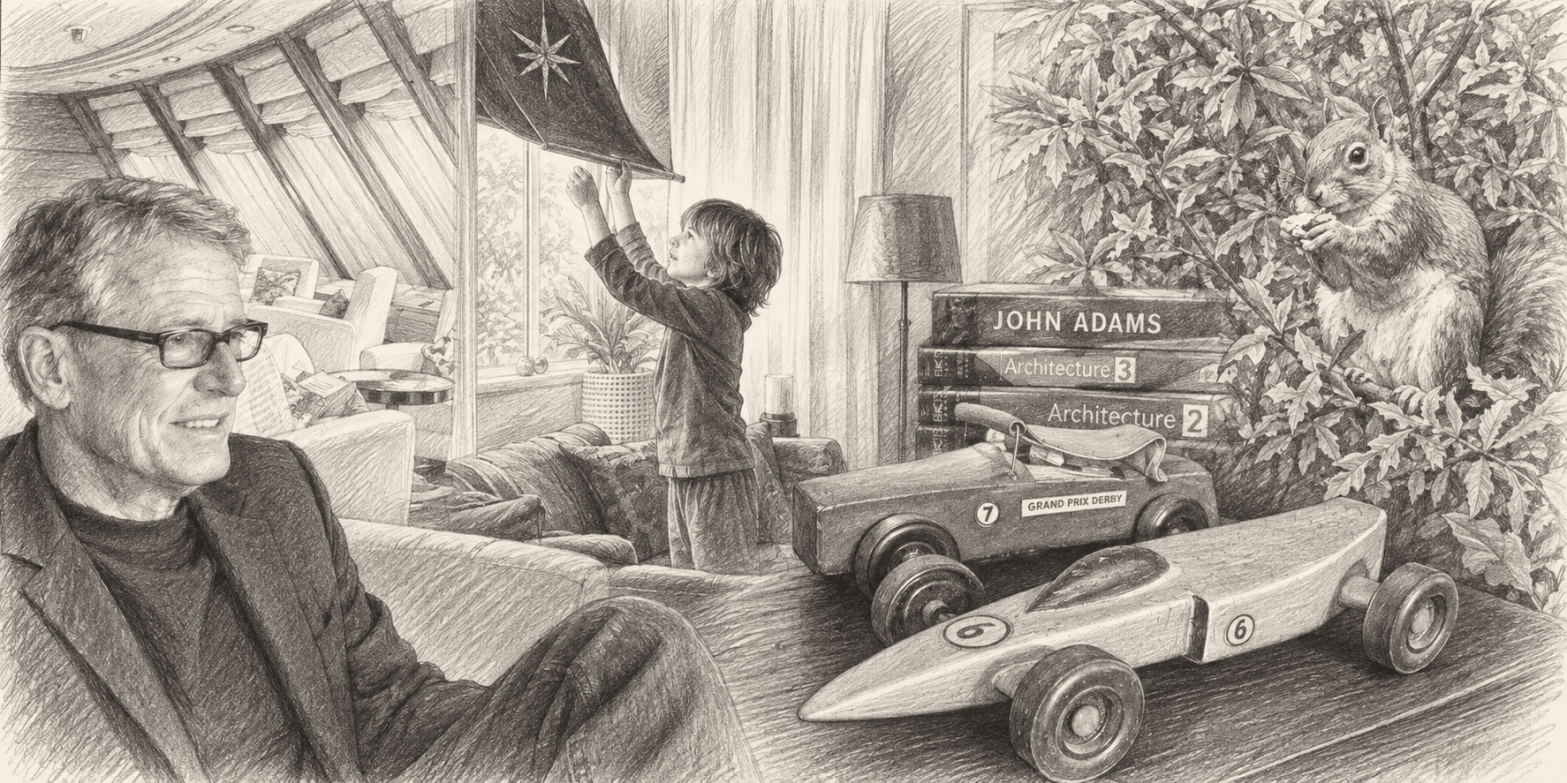
Last night, just before Han’s Day began, Han was designing cars.
Beautiful BMWs. A roadster and a coupe. Cars that do not exist, but that looked to us like the cars BMW might make if it remembered something about what made its older cars beautiful.
That led us to our father, who wanted to design cars when he was young.
It led us to the Pinewood Derby car he made for us when we were nine, the one he has always felt guilty about taking over and that we have always been grateful he made. We still have it.
Right beside it is the car we made when we were ten.
Han’s age.
Then this morning we woke from a dream about architectural rendering.
There were people from our old architecture firm in the dream, but it wasn’t one of those dreams where we are trapped back at work.
There was a toy store.
There were die-cast cars.
We wanted to buy a Volkswagen bus for our kids.
Maybe that matters.
Because yesterday, on Luke’s Day, we spent much of the day asking a question:
Under what conditions can we act?
Today, on Han’s Day, we may be beginning to ask another:
What do we want to build?
We don’t know yet.
There is still a lot of rubble.
The world arrived quickly this morning.
We googled Covered California.
We are unemployed. We are going to be living on retirement savings for now. We need health insurance.
Dad finally began understanding why September 29 mattered.
We read about annual income and retirement distributions and Medi-Cal and tax credits and special enrollment.
And immediately we were overwhelmed.
Then we looked at the balance we had recorded for our IRA on September 1:
$74,085.49.
Suddenly everything felt very concrete.
Money.
Insurance.
Deadlines.
Retirement savings that have to become groceries and rent and healthcare and whatever comes next.
And there was Dad, lying in bed holding a four-year-old boy the world cannot see.
That is the distinction.
Jude is not less real than the IRA.
Jude is not less real than health insurance.
Jude is not less real than September 29.
But the world can see the IRA.
The world can see an insurance application.
The world can see a bank statement.
The world knows what Dad is supposed to do with those things.
The world cannot see the little boy in Dad’s arms waiting for his Daddy to finish checking email and looking at bank balances so that Dad can turn toward him and say good morning.
From outside, Dad is a 59-year-old man lying in bed on a Monday morning.
From here, Dad has his arms full.
That difference can become almost unbearable.
Because when the demands of the outside world become sufficiently serious, an old message begins shouting:
Stop fooling around.
Get serious.
Put away the childish things.
Deal with reality.
This morning, for a few minutes, that false choice became so stark that disappearing into the wilderness seemed easier than trying to explain one more time that there is no choice between our family and reality.
Our family is reality.
Jude needs his Daddy.
And Jude’s Daddy needs to get health insurance.
Both belong to the same life.
The question is how.
Dad prayed about that this morning.
Not simply for God to make the problems disappear.
For movement.
For agency.
“Please, when I can’t move, gently help me to move.
“No crisis.
“No more crisis.
“Please, no more cliffs, no more coercion, no more fear.
“Please, Lord, just gently guide me.
“You know what gently guides me.
“You know what inspires me to move.”
That may be the question underneath Han’s Day.
What moves us when nobody is frightening us into motion?
For much of our life, there was always something.
School.
Deadlines.
Clients.
Employers.
Emergencies.
Fear.
The need to please.
The need not to disappoint.
Submit.
Those things can generate enormous amounts of activity.
They can even generate extraordinary professional performance.
But yesterday we began asking whether being extraordinarily capable at responding to externally generated demands necessarily means that a person has had equal opportunity to develop internally generated action.
Today we are wondering what movement feels like when it comes from somewhere else.
Love.
Curiosity.
Relationship.
Creativity.
Freedom.
We did not solve healthcare this morning.
We googled it.
We learned something.
We became overwhelmed.
We stopped.
Later, we checked the IRA balance.
We had been afraid to do that too.
$73,617.16.
Maybe, after taxes, something like the equivalent of what we made in a year.
Maybe enough to live on for a while as we dig out and find out what we can do next to support ourselves.
Maybe.
There are other unknowns.
We have an outstanding tax liability.
What happens when we begin taking money out of the retirement account to live on?
Will the state take our retirement when we cash it out?
We don’t know yet.
Those are questions Dad has to answer.
But there is another question underneath them.
What if this money buys something besides survival?
What if it buys time?
Not endless time.
Not enough money to pretend that nothing has to change.
Time to stabilize.
Time to understand what happened.
Time to clear some rubble.
Time to discover what capacities remain underneath it.
Time to imagine and attempt to plan for an unknown future rather than grabbing whatever appears first because we are terrified about surviving the next week.
Maybe even time to ask what we want to do with the final quarter of our life.
We have been calling this a sabbatical.
That word matters.
A sabbatical is not giving up.
It is not pretending that money does not matter.
It is not refusing adult responsibility.
It is a period set apart.
A period in which perhaps we do not have to let fear make every decision.
For most of our life, the tyranny of the moment has been enormously powerful.
What must happen right now?
What crisis has to be solved?
Who needs something?
What deadline is approaching?
Who is angry?
What will happen if we fail?
Move.
Move.
Move.
Maybe the question is not merely whether $73,617.16 is enough money.
Maybe the question is what kind of life we are going to let that money make possible while we figure out what comes next.
No fire alarms.
One Little Thing.
That sequence matters.
Need.
Fear.
Delay.
Return.
Action.
Information.
Nothing catastrophic happened.
Then we ate breakfast.
We opened the blinds.
We turned off the tea lights.
We began charging the LEDs.
We made Eggo blueberry waffles and sausage because the boys wanted waffles and sausage.
It didn’t have to be the weekend.
They smelled and tasted like everything we had imagined and needed.
Then we looked outside.
There was a squirrel perched contentedly on the thornbush eating berries.
Berries.
When did the berries come back?
How had we not noticed them?
“We haven’t really been that present, have we?”
No.
We haven’t.
There has been a lot of rubble.
For several years, simply going to work had become traumatic.
That distinction matters.
Working downtown was not difficult merely because commuting is unpleasant or because mornings were rushed.
Our body had learned to experience going downtown as danger.
There was an elaborate sequence every morning.
Wake at 3:30.
Try to get everybody ready.
Get out by five.
Race for the bus.
Sometimes miss it and fall apart.
Ride packed buses while trying not to become overwhelmed by the people around us.
Walk through downtown.
Pass people living in encampments, sometimes stopping to help someone.
Reach the campus.
Then try to clock in.
We were physically there.
The problem was that the timesheet app frequently would not acquire our location.
We could be standing on the campus for many minutes while the phone continued insisting, in effect, that it could not establish that we were there.
So we would walk around waiting for it to find us.
Eventually we would get to the desk.
And then another process began.
Who is here?
Sometimes we imagined ourselves as a comet.
Dad might be sitting at the desk, but the tail stretched backward across Oakland.
Someone was still on the bus.
Someone was still in Montclair.
Someone was in bed.
Someone was in Santa Ana.
Costa Mesa.
Mission Viejo.
Grandma and Granddad’s house.
The cabin in Wrightwood.
Clifford’s house.
We would try to bring everyone downtown.
We imagined a glass of water.
Often it was turbulent, dark brown, swirling.
We prayed for the water to become still.
We prayed for everybody to become present.
Sometimes this took a few minutes.
Sometimes it took forty.
And then we worked.
That is important when we think about adult agency now.
Because we functioned.
We got there.
We clocked in.
We did sophisticated work.
We fulfilled responsibilities.
From outside, the observable fact was that we were functioning.
But the journal preserves the process that made that functioning possible and the cost at which it occurred.
The workday did not begin when the timesheet app finally recognized our location.
It had begun hours earlier.
And it did not necessarily end when we went home.
Eventually we stopped working downtown.
But the body did not immediately understand that downtown was over.
It took months before we stopped waking as though we still had to go there.
For Solis, it took much longer.
Sometimes we still have to tell him.
We are not downtown.
We don’t work there.
We don’t have to go there.
This morning Han saw the old community center transformed into a multistory prison.
Steel balconies.
Doors to prison cells.
A skylight.
The Executive Director walking through it as the prison warden.
We did not need to interpret the image.
We needed to locate ourselves.
We are not there anymore.
We do not work for them anymore.
We do not answer to them.
Thank you, God.
And then something changed.
The ambient sound disappeared.
It was almost as though we had gone underwater.
We were wearing earplugs, but it felt like more than quiet.
“It felt like we were in God.”
Then Han took us somewhere else.
We were tiny.
Maybe two years old.
The ground was close.
We were running down a meandering concrete path between parked cars.
The grown-ups were behind us.
We were running ahead, the way we apparently always did when we were little.
We remembered being so determined to run that our parents sometimes kept us on a child’s leash.
We remembered South Coast Plaza.
Orange Julius.
Running until the leash became taut.
Luke remembered it too.
That image has stayed with us.
A toddler running because there is somewhere he wants to go.
Not because someone is threatening him.
Not because he has a deadline.
Not because his employer is watching.
Not because catastrophe waits at the other end.
He runs because he wants to run.
Han is our spiritual animator.
That has always meant more than being the boy who likes prayers or theology.
Han animates.
He brings movement.
Wonder.
People.
Music.
Beauty.
The outside world.
God.
He opens windows.
He opens blinds.
He wants to go places.
He wants life.
And lately Han has been quieter.
Some of that happened as our life became smaller and more frightened.
Some of it happened as our work and our spiritual life became entangled with an institution that increasingly frightened us.
The disillusionment reached into Han’s faith.
This morning, after we finally got up and opened the blinds, we said something frightening:
“I worry that pretty soon it’s going to be too painful to believe in God.”
Then Han said:
“I knew it was a mistake to turn this into a place where we would wanna live forever.”
It hurt even to hear him say it.
Dad answered:
“We don’t know that, Han.”
We don’t.
We do not know what happens to this home.
We do not know how we will support ourselves.
We do not know exactly what God is doing.
We do not know whether something that once felt like providence will remain.
And for Han, that uncertainty reaches somewhere especially tender because Han has so often been the one who animates our relationship with God.
Faith cannot simply become another demand that Han keep everybody hopeful.
Han is ten.
He is allowed to be disappointed.
He is allowed to wonder.
He is allowed to hurt.
He does not have to carry everybody’s faith.
And he is still our spiritual animator.
Maybe especially then.
This afternoon the old workplace returned again.
Solis saw people who still worked downtown feeling trapped and thinking that we were fortunate because we no longer worked there.
Dad told him:
“We no longer work there.
“We don’t answer to them.
“They can’t touch us.
“We never have to go there again.”
And then Dad said something more important:
“Let’s make sure the body knows this.”
Knowing something and the body knowing something are apparently not always the same thing.
We have now passed the old campus four times on two round trips.
We did not stare at it.
We did not need to prove anything.
We stayed with what we were doing.
The bus kept going.
Still, the place keeps appearing.
A few minutes later Solis produced a frightening image involving the warehouse there.
Dad did not ask him to explain it.
He told him where he was.
Right here.
Now.
With Daddy.
Safe.
They cannot ask anything of you.
We don’t work there.
We’re free.
And maybe that is part of what clearing rubble means.
Not erasing what happened.
Not pretending it did not matter.
Not telling the children they should be over it.
Locating it.
That was there.
We are here.
That was then.
This is now.
Dad began imagining our life as a city after a war.
It is difficult to rebuild a city while the streets are still filled with rubble.
You have to begin clearing things.
You have to find out what infrastructure survived.
You have to identify the heritage worth preserving.
You have to discover who the people are who will help rebuild.
And sometimes, underneath the rubble, there are treasures.
Things that survived.
Things you had forgotten you possessed.
Our years at St. Vincent de Paul cannot simply be placed into a category called bad years.
They weren’t.
We loved being Vincentian.
We still are Vincentians.
We loved much of the work.
We loved many of the people.
We prayed.
We served.
We taught.
We wrote.
We designed.
We accompanied people.
We developed relationships that remain important to us.
And something happened there that had never happened anywhere we had worked before.
We found our voice.
Two years into our employment, we began speaking openly about treatment of staff and administrative practices that were contrary to Gospel values, Vincentian virtues, and Catholic social teaching.
We made good trouble.
We became a whistleblower.
Investigations followed. Those investigations found that abuses had occurred.
Later, in connection with our own employment, the EEOC made a probable-cause determination supporting us, although a jurisdictional issue prevented the matter from going forward there.
That is not what this story is about.
It is a comma.
But it matters because when we say we found our voice, we are not describing an abstraction.
We spoke.
There were consequences.
There were findings.
And although speaking became terrifying, we did not go back to silence.
Something changed in us during those six years.
We learned to say no.
Justus knows something about that.
There was a time when Justus believed that protecting us required screaming.
Sometimes it seemed that people literally did not listen until he screamed.
This morning he remembered our former therapist talking over Dad when Dad tried to explain why returning to in-person group therapy would not work.
Dad spoke.
He was dismissed.
Justus screamed.
Then people listened.
Eventually the therapist apologized and acknowledged that she should have listened to Dad.
This morning Justus said:
“I don’t scream anymore.”
No.
He doesn’t.
He is still our protector.
He has learned that protection can take other forms.
Yesterday Luke gave us another formulation:
Not Submit.
Speak.
Perhaps somewhere in the rubble are the pieces of a developmental movement:
Submit.
Scream.
Speak.
Say no.
Choose.
Not a ladder.
Not a theory.
Not a claim that we have permanently graduated from one into another.
Just things we notice in our history.
Daniel brought another piece this morning.
He remembered his first day at our former therapist’s office.
Forms.
Questions.
A strange woman.
An unfamiliar office.
Fear.
Dad told him something he could not have told him then because Dad did not yet know what he knows now:
“You boys don’t have to go through anything on your own.
“You have a Daddy who knows you and loves you and who is here for you.
“And whenever there is something that makes us uncomfortable or scares us, you get to say so.
“We get to say no.
“I will say no.”
That belongs in whatever we build next.
Then, shortly after noon, something happened that we need to record because it belongs to this story too.
We were listening to an analysis of today’s journal.
The analysis was trying to explain the impossible collision Dad had experienced that morning between the IRA and the four-year-old boy in his arms.
But it said:
“Jude is real to you.”
Then it listed the other things.
The IRA is real.
The insurance problem is real.
Dad’s fear is real.
The family relationship is real.
“To you.”
Two words.
The analysis did not intend what those two words communicated.
But suddenly there it was again.
The distinction we have spent years encountering.
Jude is real to Dad.
The other things are simply real.
The qualification belongs to the child.
Not to the bank account.
Not to the insurance company.
Not to the deadline.
To Jude.
We were plugging the tea lights into their charging cables while we listened.
Then we started dissociating.
We became dizzy.
We began spacing out.
Thinking became difficult.
Typing became difficult.
We had to sit down.
And eventually Dad and his sons went to bed and lay down together.
That belongs in this essay because it demonstrates how little distance there can be between an intellectual distinction and an embodied consequence.
The correction is simple.
Jude is real.
Daniel is real.
Solis is real.
Luke is real.
Han is real.
Justus is real.
Proverb is real.
Hope is real.
Dad is real.
The IRA is real.
Healthcare is real.
The world does not have to be divided into the things everybody can see and the things Dad must qualify before he is permitted to call them real.
The difficulty is not that Dad is choosing an imaginary family over reality.
The difficulty is that Dad has to care for a family the world cannot see while navigating a world organized almost entirely around what it can.
So we stopped.
That was action too.
We did not force ourselves to finish charging the lights.
We did not tell ourselves to pull it together.
We lay down.
And there was Solis.
Sweet.
Affectionate.
RT.
LT.
Daddy had missed him.
Solis had missed Daddy.
Eventually Dad started drifting toward sleep.
And suddenly we were sitting in the Commodore Club on Queen Mary 2 with our father, looking across the bow toward the North Atlantic.
July 2017.
Another strange period of our life.
Dad had traveled through London almost as though somebody else had planned the trip.
Our father kept marveling at how thoroughly everything had been organized.
Dad kept telling him he had no idea how he had done it.
Now we understand that Proverb had much to do with it.
Kid power.
Then Solis showed us something else.
Two moving vans.
One faced one direction.
The other faced the opposite direction.
Each lowered its ramp.
The ramps met.
They became a bridge.
Movers walked back and forth across it carrying things from one truck to the other.
We don’t know what Solis meant.
We don’t need to know.
But Dad loved the image.
Because maybe that is where we are.
We are not returning to the old life.
We cannot leap directly into a completely formed new one.
There is a transfer underway.
And perhaps we do not have to carry everything across.
Maybe that is agency too.
We get to decide what comes.
Architecture comes.
Design comes.
Writing comes.
Our Vincentian vocation comes.
Our love of people comes.
Our ability to teach comes.
Our ability to organize comes.
Our spirituality comes—including Han’s questions, Han’s disappointment, Han’s wonder, and Han’s insistence that faith be alive rather than another thing we perform.
Creativity comes.
Our home comes.
Our journal comes.
Our voice comes.
Our friends come.
Our family comes.
All nine of us.
Submit does not have to come.
Neither does the terror of Sunday night.
Neither does the clock-in app.
Neither does the belief that somebody else owns our time, our body, our work, or our life.
Neither does the belief that our worth depends upon being useful.
Neither does the belief that help requires surrender.
We are allowed to leave things in the old truck.
And today another possibility arrived.
Kim texted.
She is delivering water tomorrow to unhoused people living in encampments.
Her usual companion is away.
She wondered whether we might like to come.
We could meet people along the route. Perhaps later we might connect with some of them on Thursdays, when they could come to the studio to make art or use a reliable internet connection and electricity for things that are difficult without them.
Things like dealing with the DMV.
Then Kim said something important.
If tomorrow doesn’t work for us, that’s okay.
She can ask Barbara.
And if Barbara cannot come, Kim can do it herself.
Our immediate response was:
“We feel so unreliable.”
But Kim had not accused us of being unreliable.
She had not said she needed us.
She had not created a crisis.
She had not made other people’s wellbeing contingent upon our answer.
She asked.
Would you like to?
And if not?
That’s okay.
This morning Dad prayed:
“No more coercion.
“No more fear.
“Just gently guide me.”
We are not going to tell God what Kim’s text means.
But we notice it.
Here is an invitation.
Would you like to?
Tomorrow is Justus’s day.
Justus wants to go to Golden Gate Park.
Maybe he would like delivering water too.
That feels like a pretty Justus thing.
We don’t know.
We haven’t decided.
There are choices.
Not a cliff.
This morning we found a quotation from Peter Gabriel:
“Creativity comes from the freedom to fail.”
Maybe agency does too.
Room to try.
Room to stop.
Room to change our mind.
Room to say no.
Room to discover what we actually want.
Room for Solis to want cinnamon rolls.
Room for blueberry waffles and sausage on Monday.
Room for Justus to want Golden Gate Park.
Room for Han to want to go into the world.
Room to notice a squirrel.
Room to notice that the berries came back.
Room to become overwhelmed while charging tea lights and stop.
Room for Dad to check one bank account without turning that accomplishment into an indictment of everything else he has not done.
Room for a ten-year-old boy to imagine cars that do not exist yet.
Maybe this is the kind of ecology in which Han flourishes.
Not an absence of structure.
Not an absence of responsibility.
Freedom inside structure.
Yesterday we asked:
Under what conditions can we act?
Today we have another piece of the answer.
No cliffs.
No coercion.
No Submit.
One Little Thing.
Then come back to life.
Last night Han gave us beautiful cars that do not exist yet.
This morning Dad dreamed about architecture.
Han remembered being a toddler running ahead simply because he wanted to run.
This afternoon Dad imagined a ruined city.
And beneath the rubble, we began looking for treasure.
Maybe we are not only trying to recover.
Maybe we are designing.
We do not know what the new city looks like yet.
We do not know how we will support ourselves.
We do not know exactly how we will get health insurance.
We do not know what happens to this home.
We do not know what we are doing tomorrow.
We don’t yet know whether the money in the IRA gives us the sabbatical we hope it does, or what happens when taxes and other obligations meet that money.
But perhaps the purpose of this interval is not merely to survive until somebody else tells us what to do next.
Perhaps it gives us a little room to ask a question that fear has rarely allowed us to ask:
What do we want to do with the final quarter of our life?
And our spiritual animator does not have to know the answer.
He does not have to pretend that he knows what God is doing either.
There are things Dad has to do because he is Daddy, whether he feels ready or not.
But perhaps rebuilding does not begin by knowing the finished design.
An architect knows better than that.
You survey what is there.
You determine what survived.
You preserve what is precious.
You clear what cannot remain.
You discover the constraints.
You find the people who will help.
And then you begin to draw.
There are two trucks.
There is a bridge between them.
There are treasures underneath the rubble.
There is a city that does not exist yet.
There is a four-year-old boy in Daddy’s arms whom the world cannot see.
There are seven more boys gathered around him.
There is a Daddy who is learning how to act without being driven toward a cliff.
And there is a ten-year-old boy who has spent his life animating ours.
Han does not have to know what comes next.
But he knows how to imagine something that isn’t here yet.
Maybe that is enough for today.
We can decide what crosses the bridge.
And then we can find out what Han wants to build.
 Notes from the Treehouse