Last night, while I was tucking my five-year-old son Daniel into bed, something frightening came into our awareness.
There were images from different periods of our childhood, from times when terrible things had happened to us. Alongside them came a thought that my sons were somehow ghosts: remnants of children who had died when we were hurt at their ages.
I don’t know whether the thought came from a dream. I asked Daniel. I didn’t get a clear answer.
But I knew what I wanted my children to hear.
“You’re not a ghost. Your brothers aren’t ghosts. Daddy’s not a ghost.”
I told Daniel that he was a little boy, that he was wonderfully made, that he was my son, and that I loved him.
We are a plural family of nine people sharing one body and one life. I am Dad, and I have eight sons: Jude, four; Daniel, five; Solis, seven; Luke, nine; Han, ten; Justus, eleven; Proverb, twelve; and Hope, fourteen.
We have lived through childhood sexual abuse and other experiences that continue to affect us. But none of us understands himself as a dead child, a ghost, or merely the consequence of something that happened to us. We have shared decades of memories, architecture, art, music, work, prayer, play, and family life. Each of us has his own experiences as well. The abuse is part of our history. It is not the whole explanation of who any of us is.
This distinction matters because the language sometimes used to describe dissociative identity disorder includes child parts, alters, and identities understood in relation to trauma. Those terms may help some people describe their experiences. They do not describe how we understand each of ourselves, the individual members of our family.
The same is true of the word children. My sons are not my possessions. They are not there to manage my life, support the adult in some way, or become examples in a story about my recovery. None of us were created by trauma. We have all been present from the beginning.
No one is a part of anyone.
My sons are not the “parts,” “identities,” or “alters” often discussed in dissociative identity disorder communities or Internal Family Systems therapy that can be enlisted to carry adult responsibilities just because they might be good at them.
They are children entrusted to my care, not to be assigned roles that are inappropriate for children, that should belong to me, the adult.
Twelve-year-old Proverb was a highly competent parentified child for over four decades doing the work of an adult. It is his time to be a kid.
That means something quite practical: They are not mine to use or neglect.
It is easy to write a sentence like that. It is harder to arrange a day around it.
Earlier this week, Solis asked why I kept saying I wanted to spend more time with my children without actually doing it. He was right to ask. Our family had left a frightening employment relationship in July, and I had more time available to be with my sons. Yet I was spending hours editing and publishing essays about our life. I had begun taking time from the people the writing was meant to honor.
On Wednesday afternoon, we did something different. I lay down and held each of my eight sons individually, returning to Jude at the end. For ninety minutes, the life we had been describing was the life we were living.
That did not fix our schedule. Dinner was still late. I still stayed up too long after the boys went to sleep. But it was an actual change, not a declaration that I intended to change.
On Daniel’s Day, the next morning, I held him while we were waking up. As I drifted with him, I experienced the flavor of an Easter candy. Then came an image of an Easter basket that was not a basket at all, but a toy dump truck filled with plastic grass and candy. We were about three years old.
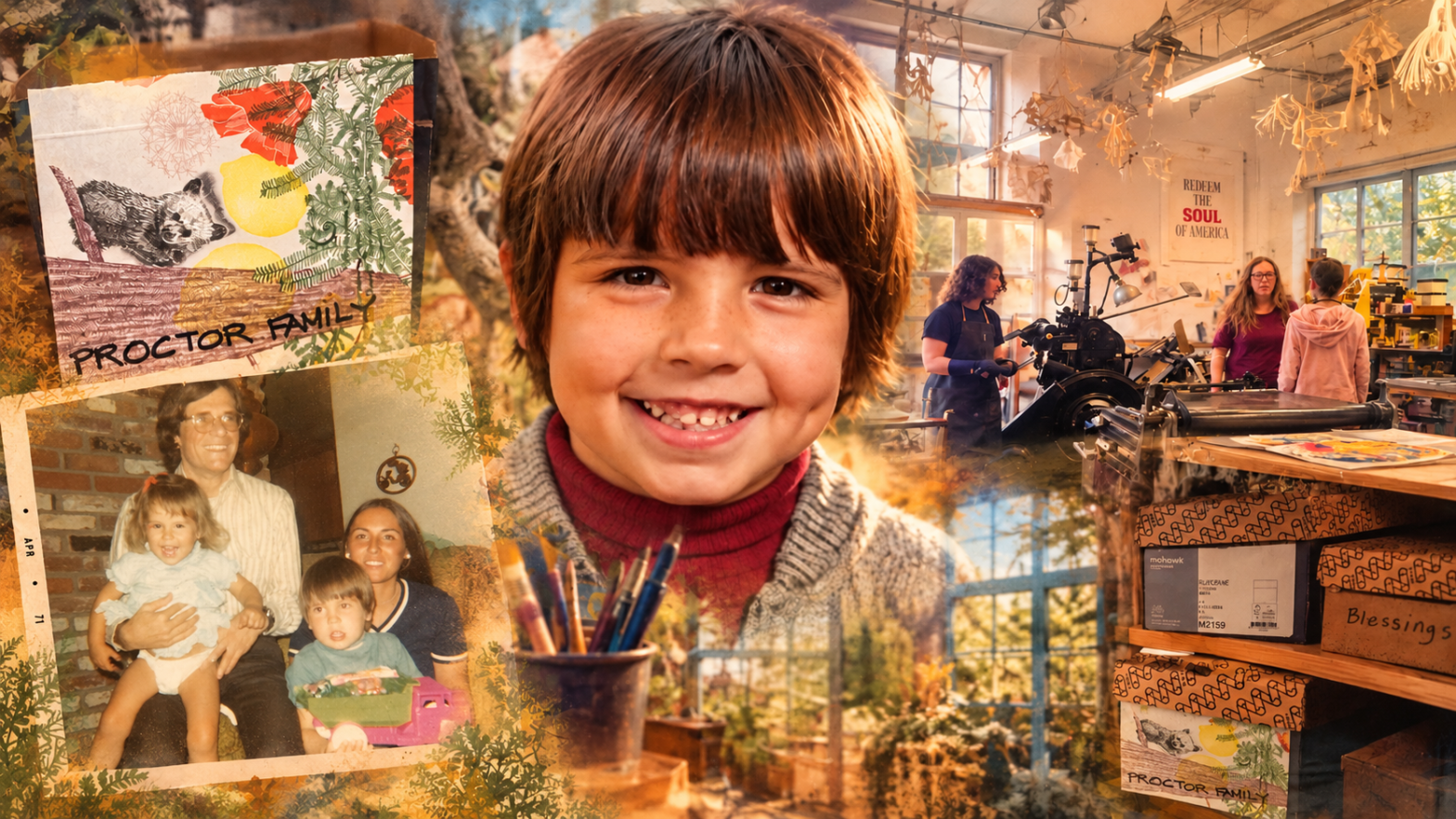
The memory led to something else. Our uncle sexually abused us when we were little, including at our grandparents’ house around Easter. We remember a photograph from that time: our mother holding us, our father holding our sister, and our uncle in the background, out of view. Jude helped us to understand the look on our face in that photograph, in the presence of the person who abused us.
I will not call that simply a frightening memory. Our uncle sexually abused us. The words matter because they tell the reader what happened. They also matter because some of my sons have asked that their experiences be witnessed rather than be minimized or reduced to euphemisms.
I stayed with Daniel. I held him and kissed him. I reminded him that the abuse happened a long time ago and that he was home with Daddy now.
That is what the journal records. It does not record that the memory vanished, that Daniel was cured of anything, or that I discovered a perfect way to help him. It records a specific memory, my response, and our continued closeness.
Later that morning, we were trying to get ready to visit our friend Kim at Braided Bridge. I was worried about being late. Kim had offered to pick us up at 9:30, and we weren’t ready. We told her honestly that we might not be ready until ten. She adjusted her morning and came at ten.
At the studio, she told us she would rather have us there late than not have us there at all.
That was not a small kindness to us. We have spent much of our life treating every interaction as an evaluation: say the right thing, avoid inconveniencing anyone, prove that we deserve to be there. Kim was telling us that our presence mattered.
She also showed us a box we could use to keep a few things at the studio. I told her that having a place there mattered especially to Daniel, on his day. We didn’t have to leave the boys’ artwork behind if we wanted it at home. We could put a favorite pencil or brush in the box instead.
A little place at Braided Bridge. Not a job assignment. Not proof of productivity. A place where we belong.
Then Dad had to make a difficult phone call.
Our employment ended in July. We have no current earnings, and we needed to make a first withdrawal from our retirement savings to support our household. I had chosen to make the call at Braided Bridge because I expected to feel safer with trusted friends nearby.
Even there, I became overwhelmed. I had trouble retrieving basic identifying information and knowing what to say to the financial advisor. My sons helped me remember information and stay with the conversation. Proverb spoke. Hope explained what our tax advisor had told us about the distribution. Luke spoke too. Together we completed the call and approved the documents. The money was scheduled to arrive the following Tuesday.
I had wanted to handle the whole thing alone, as a responsible adult. I couldn’t. My sons helped.
I am grateful for their help. I also know that their willingness to help does not transfer the responsibility to them. It was my decision to make the withdrawal, my responsibility to seek professional tax advice and understand the consequences, and my responsibility to provide for our family. My sons were present, and they contributed. That is different from asking children to become their father’s financial managers.
Afterward, Kim offered us a banana. Daniel became excited. He thanked her aloud and identified himself.
“Thank you for the banana,” he said.
“You’re welcome, Daniel,” Kim answered.
That exchange may look unremarkable to someone else. For our family, it was an encounter worth recording in full. Daniel was not being discussed as an idea or interpreted through a diagnosis. He spoke to a friend, and she answered him by name.
Justus said the printing press sounded like his favorite white noise. Han said the presses made the gentlest sounds. Luke observed, “Braided Bridge is a good place to be a kid.” Each of those observations belongs to the son who made it. Each tells us something different about how our children experienced that room.
We spent a long time talking with Kim’s uncle Alan about woodworking, marquetry, the trades, art and Burning Man. We admired a beautiful table he had made. We had gone intending to do something difficult, and we also found ourselves having an ordinary day among people who welcomed us.
The withdrawal was completed. Our financial future was not solved. We still have to find a sustainable way to support this family without returning to an employment arrangement we do not trust. Those are adult problems I must continue to address.
We took the bus home. The wait was long; our feet hurt. We passed the former St. Vincent de Paul campus and reminded one another that we were not there anymore. We made nachos at home and lay down to rest.
I held Daniel first. Then Jude, Solis, Luke, Han, Justus, Hope, and Proverb. Then I came back to Daniel.
During our last minutes together, I told him something I had not said often enough. I told him that I was learning how to listen to him. The more quiet time we spent together, the more I recognized how thoughtful, perceptive, and aware he was. I told him I was proud of him, and excited to know him better.
He responded with his familiar somatic signals.
I don’t want to turn that moment into an illustration of how well I am learning to parent. It belongs to Daniel. He is a child with his own thoughts, memories, pleasures, and ways of communicating. He is the boy who remembered the Easter candy and needed to be held. He is also the boy who saw an immense nineteenth-century riverboat, its cast-iron structure rising like Gothic vaulting around a great flywheel. He is the boy who thanked Kim for a banana. He is the boy who wanted a little place at the studio. He is the boy I am still getting to know.
I cannot undo what happened to us when we were children. I cannot guarantee that memories or fear will never return. I cannot solve our finances in one afternoon.
But I can take responsibility for the life we have now. I can listen when one of my sons speaks. I can name what happened without making it the definition of who he is. I can make room for his childhood rather than recruiting him into the work of keeping us alive.
There are nine people living this life. None of us is a ghost. None of us is merely a product of trauma.
And the eight children entrusted to my care are not mine to neglect.
Daniel’s Day, October 15, 2026

