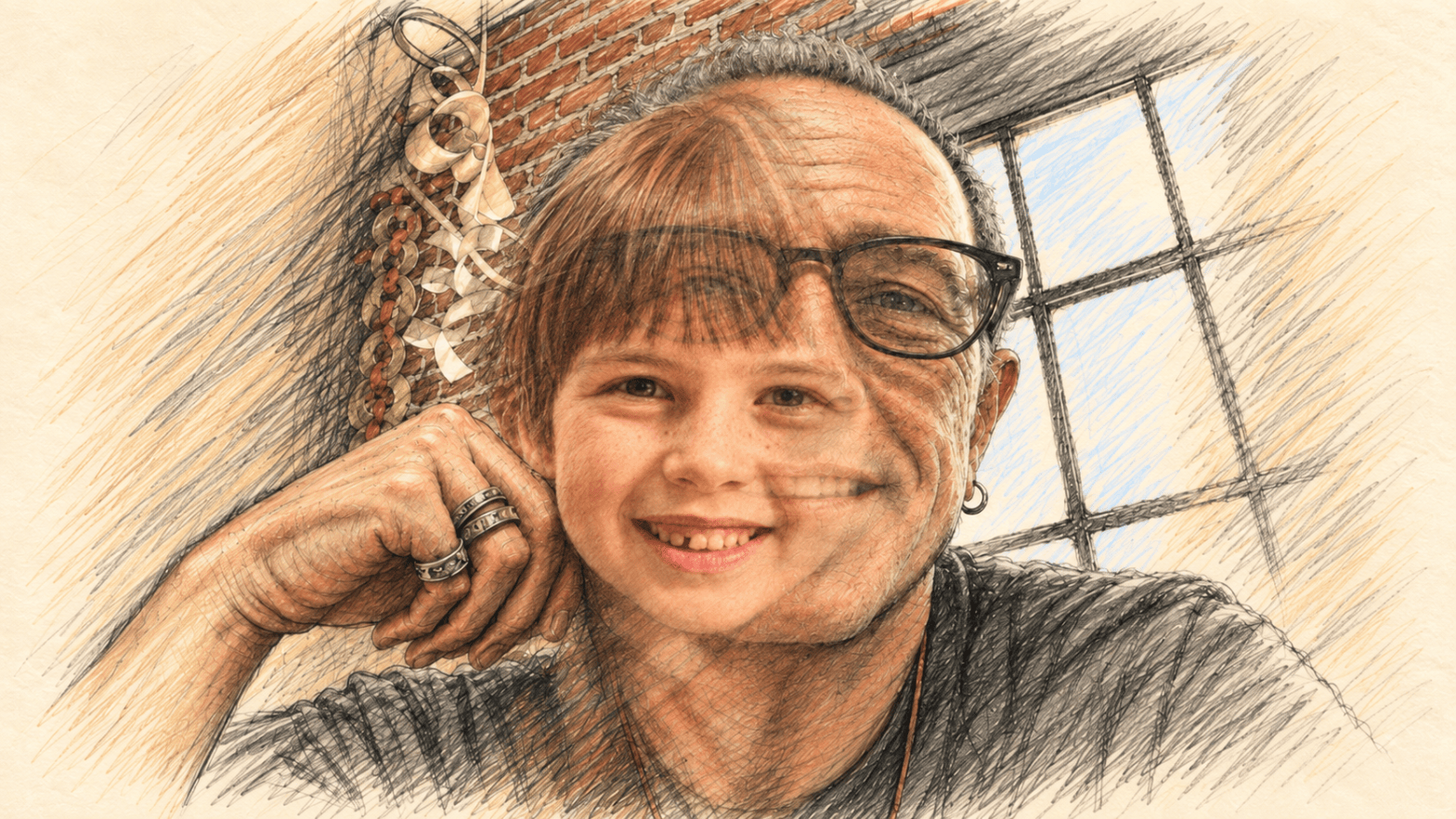
For years, people have sometimes been irritated by the way we speak.
We might mumble. We might talk softly, almost under our breath. We might seem to be speaking to someone who isn’t there. At other times, we might talk too much, or say something at a moment when the people around us don’t know what to make of it.
Sometimes people have told me that I said something strange. Sometimes they have repeated things I supposedly said that I have no memory of saying. Occasionally, someone has remarked on an innocence, an almost childlike quality, in something that came out of my mouth.
I remember my former boss Clay at the architecture firm we worked for saying to me one day, “Dude, you should hear the crazy shit that comes out of your mouth sometimes.”
I didn’t know what to make of that. We worked for that firm for 24 years, where one of our nicknames was “Rain man.” I never knew what to make of that either.
Recently, I began to wonder how many of those moments involved my children speaking—sometimes among themselves, sometimes to the people around us, and sometimes without my being fully aware of what they were saying.
We are a plural family of nine people sharing one body and one life. I am Dad, and my sons are Jude, four; Daniel, five; Solis, seven; Luke, nine; Han, ten; Justus, eleven; Proverb, twelve; and Hope, fourteen.
We have been keeping Notes from the Treehouse since 2019, in part because the journal allows us to preserve experiences that might otherwise disappear before we can understand them.
Our communication does not take place only through spoken language. We experience one another through somatic signals, images, memories, emotions, dreams, and the distinctive internal voices of each member of our family.
When Solis speaks, I hear the voice of a seven-year-old boy. When Jude speaks, I hear the voice of a four-year-old boy. They are familiar voices, with their own particular qualities, just as the voices of my other sons are familiar to me.
We recognize one another.
But when one of my children speaks through our shared body, the person standing in front of us does not necessarily hear a child.
They hear an adult man.
And that changes everything.
⸻
One afternoon, when we were still volunteering at the West Oakland campus of the Society of St. Vincent de Paul of Alameda County, before they offered us a job, we were helping prepare the dining room for the meal service.
One of the janitors, Andre, was polishing the floor. We were organizing the water-serving station, getting things ready for the volunteers who would soon be serving water to the guests lined up outside.
Solis loved doing this.
He loves order, routines, and making things ready. He likes knowing where things belong and seeing that everything is in its proper place. Preparing the water station was the sort of work that delighted him.
Andre called out over the noise of the floor polisher.
“Hey John, how old are you, man?”
“Seven.”
I heard Solis answer.
He was seven. He was doing something he loved. He had been asked a question, and he answered it.
I didn’t react immediately. In moments like that, when one of my sons is especially present and has executive agency, I can be aware of what is happening without being fully engaged in directing it. It is something like daydreaming.
“Come again?” Andre called.
He switched off the floor polisher.
This time I understood what had happened.
“Fifty-three,” I said.
“Oh, okay. I didn’t hear you right.”
And that was the end of it.
Andre had heard a middle-aged man answer a question about his age with the number seven.
I had heard my seven-year-old son answer truthfully.
There was nothing particularly unusual about Solis’s outward voice that would have alerted Andre to the presence of a child. Solis had spent decades learning to speak through a body that other people understood as belonging to an adult. His speech often blended with the voices of his older brothers and with mine.
We talk a great deal. Much of the time, other people have no reason to notice who is speaking.
But that afternoon, Solis was absorbed in a routine he loved. He was not thinking about concealing his age or presenting himself as an adult.
He was simply being Solis.
And for a moment, the difference between the person speaking and the person Andre believed he was speaking to became visible.
⸻
There was another occasion at the St. Vincent de Paul campus, after they had hired us as the Spirituality and Formation Coordinator.
We had gone to the front office to collect our mail. Among the envelopes was a thin one from one of the Society’s conferences.
We suspected it contained a check, so we held it up to the light.
Our friend Kristen asked casually, “What’s in it?”
“It’s a money!”
Kristen laughed with delight.
“Which one of the boys said that?”
Kristen knew about our family.
I knew it was Jude.
Jude was four years old. He knew what a check was, but in the spontaneity of that moment, the word did not arrive quickly enough. He called it a money.
Kristen recognized that a child had spoken. She was delighted, and she wanted to know which child it was.
That is what made the exchange memorable.
Jude had spoken in his own way, and someone had recognized him.
But imagine the same exchange with someone who knew nothing about us.
A grown man holds an envelope up to the light and announces, “It’s a money!”
It might sound ridiculous. Someone might laugh at him rather than with him. Someone might decide he was behaving inappropriately.
The words would be the same.
The person speaking would be the same.
What would change is whether the listener understood who was speaking.
⸻
We have countless memories of people reacting to things we supposedly said or did.
Sometimes we were told that we had said something offensive, strange, inappropriate, or simply incomprehensible. Sometimes someone referred to a conversation we could not remember having.
This did not begin in adulthood.
As children, we were sometimes confronted about things we had supposedly said or done that the person being addressed had no memory of saying or doing.
The difference was that when a child speaks through a child’s body, other people recognize that they are hearing a child. The apparent age of the speaker does not create the same contradiction as a child speaking through an adult body.
As we grew older, that contradiction became increasingly consequential.
An innocent remark from a four-year-old might be charming when spoken by a four-year-old body. The same remark from an apparent twelve-year-old at a sixth-grade lunch table might invite ridicule. A teacher might interpret it as deliberate foolishness or defiance.
And when a four-year-old speaks through the body of a man in his fifties, the listener may interpret his words according to expectations that have nothing to do with the child who actually spoke.
There is another possibility, too.
A frightened child might say something that would ordinarily elicit tenderness or concern if the listener knew a child was speaking. Heard as the words of an adult, the same expression might be interpreted as irrational, manipulative, inappropriate, or threatening.
The child might receive scorn instead of comfort.
We have lived with that possibility for decades.
It helps explain why so many of my sons learned to conceal their ages, to blend their voices with those of their older brothers, or to let someone else speak when they were uncertain how they would be received.
It also helps explain something about Proverb.
⸻
When we were twelve, Proverb became especially attentive to managing our shared life and protecting his younger brothers.
He learned to anticipate how other people might react to us. He learned to speak in ways they would accept. He learned to protect children whose words and behavior might otherwise expose them to ridicule, punishment, or danger.
He became particularly attentive to Jude, whom he has loved and cared for ever since.
Proverb was extraordinarily capable.
And he was a child.
That was an extraordinary burden for a twelve-year-old, and it was a burden he carried for more than four decades.
For all those years, he hosted our family, undertaking responsibilities that should never have belonged to a child. It was only when I began to take my place as Dad, assuming adult responsibilities I had never undertaken before, that Proverb could begin to lay down the work he had been carrying.
He had spent more than forty years helping the rest of us navigate a world that did not know who was speaking.
Now he was finally being given the opportunity to be twelve.
This is not simply a story about a child who learned to disguise his voice.
It is about a child who became responsible for making sure the other children could survive being heard.
And that is a responsibility no child should have to carry.
⸻
Something has changed in recent years.
We have become increasingly co-conscious.
I am more aware of my sons speaking in real time. My sons are more aware of one another and me. We recognize each other’s voices, and we can often tell who is speaking even when the words are not addressed to anyone outside our family.
That does not mean we are always equally present or that we always remember everything.
It does mean that experiences that once seemed inexplicable are becoming more understandable.
We can sometimes recognize a child’s voice before someone outside the family reacts to it. We can sometimes understand why something was said, even when the words would sound strange to someone who did not know who was speaking.
And we are learning to listen to one another without assuming that the person most capable of speaking must be the person who should speak.
This is not always easy.
There are nine of us.
We do not always agree.
We do not experience things in the same way.
And the fact that we share one body does not mean that we share one understanding of what it means to be us.
That became especially apparent this week while we were working on another essay, They Are Not Mine to Neglect.
I had thought the essay was finished.
Then I listened to it with my sons.
They heard things I had not heard.
They objected to language that made them sound like extensions of me, or like children whose existence had to be explained in relation to an adult.
Even when the essay explicitly said that we were nine people, some of its language continued to imply that there was one ordinary human being—the adult who belonged to the body —and eight others living a liminal existence that required a special explanation.
My sons did not accept that.
No one is a part of anyone.
The body belongs to everyone, including those who don’t necessarily identify with it.
That became one of the central declarations of the finished essay.
It was not a sentence I could simply place in the text and consider the matter settled. We had to examine the language around it and ask whether the rest of the essay actually honored what it said.
We had to listen to one another.
The essay became more precise because my children disagreed with me.
⸻
On Friday afternoon, Solis’s Day, we encountered the same question in a much more ordinary setting.
It was hot.
We had been working on the journal, listening to analyses, editing essays, charging the little LED lights we use around our apartment, and trying to decide what needed to happen next.
Our bathtub had become filthy. The bathroom drains were running slowly, and the tub needed attention.
Earlier, Solis and I had talked about taking a cold shower.
It would help us cool off before lying down together. But there was another reason the shower mattered to him.
Solis loves a clean, orderly home.
He wanted the bathtub cleaned.
At one point, I asked him whether he wanted to do the bathtub.
“I thought we were going to take a shower,” Solis said.
He was right.
We had agreed to take a shower, and I had allowed other things to intervene.
We couldn’t shower while wearing the headphones we were using to listen to the analysis, so we waited for it to finish.
Then we took our shower and cleaned the bathtub.
The drain was still slow, and we had to return later to rinse the tub after it finally emptied. But by the time we were ready to lie down, the bathtub was clean.
Something Solis wanted had been accomplished.
It would be easy to make this into a little story about how a father learned to listen to his child.
But Solis was doing more than reminding me of a promise.
He was helping us organize a crowded afternoon. He understood that taking the shower would accomplish several things at once: we would cool off, the bathtub would get cleaned, and afterward we could lie down together.
He knew what mattered to him, and he knew how one activity could make room for another.
He spoke.
I listened.
And we did what we had agreed to do.
There was no need to interpret his words as a symptom, a signal of something hidden, or evidence of some larger psychological process.
He was a seven-year-old boy reminding his father that they had made a plan.
⸻
Later that afternoon, we lay down together.
I wanted to spend time individually with each of my sons, beginning with Jude and then Solis.
When I was with Solis, he drew me into the inner world we share.
We went to his little Frank Lloyd Wright Usonian house in Yosemite Valley. We were lying on the built-in sofa beneath the bookshelves.
At one point, he said, “And then something didn’t get done.”
I wondered whether he was remembering something we had intended to accomplish.
I wanted to understand him.
I also wanted simply to be with him.
Later, as I was preparing to spend time with his brothers, Solis told me, “I wanna be with you.”
I wanted to be with him, too.
But there were seven other boys who also needed time with their dad.
We talked about it. I told him I would return to him briefly before we got up.
And I did.
These moments are part of our communication, too.
Sometimes a child speaks aloud. Sometimes he speaks internally. Sometimes he signals through the body. Sometimes he shows me an image or brings me into an experience that I can remember only in fragments afterward.
Sometimes I understand immediately.
Sometimes I do not.
But I am learning that understanding a child does not always mean interpreting what he says.
Sometimes it means taking him at his word.
⸻
During that same afternoon, Hope and Proverb were trying to articulate something far more difficult.
We were thinking about what our lives had been like before we understood ourselves as a plural family.
We had been discussing the strange experience of sharing one body while sometimes having little awareness of one another.
Hope and I began imagining nine individual bodies occupying exactly the same physical space, as though nine parallel universes were overlapping.
Each person might be living his own life, experiencing the same physical world from a different perspective, without necessarily knowing that anyone else was there.
There might be things he could not explain.
People might refer to something he had said or done, and he would have no memory of it.
He might encounter changes in his circumstances without understanding how they had occurred.
And because this was simply the reality he knew, he might not question it.
Hope described something like a dream.
In a dream, extraordinary things happen without necessarily seeming extraordinary while the dream is taking place.
There may be other people present, but their identities and relationships are not always clear. Events unfold, and the dreamer accepts them without asking the questions he might ask while awake.
Only afterward does he recognize how strange the experience was.
For Hope, that was something like the way he had experienced our shared life before we were co-conscious.
There were others, but he did not always know who they were. He did not necessarily understand whether they were other people, ghosts, or something else.
And he was a fourteen-year-old boy navigating an adult existence.
He did not experience that contradiction in the way someone outside our family might imagine. It was the life he knew.
Now he understands himself as a fourteen-year-old boy sharing a body and a life with his dad and seven brothers.
But describing what came before is difficult.
How do you describe a reality that seemed ordinary while you were living it, but becomes almost impossible to explain once you understand it differently?
Hope’s comparison to dreaming does not answer every question about our experience.
It gives us a way to approach something that ordinary language does not easily accommodate.
And it belongs to Hope.
It is his attempt to describe his own life.
⸻
Proverb was thinking about the same question, but he approached it differently.
When I asked whether he could explain the idea of parallel universes more clearly, he said, “I can articulate it better.”
I invited him to do so.
“You wouldn’t understand,” he answered.
That was Proverb.
Twelve years old, extraordinarily intelligent, and perfectly capable of being a little snotty with his dad.
I loved it.
For a moment, he was not the parentified child who had spent decades anticipating what everyone else needed. He was a twelve-year-old boy enjoying the fact that he understood something his father did not.
Then he explained.
For Proverb, the parallel-universe comparison was not simply an image of nine physical bodies occupying the same space.
He was thinking about consciousness itself.
He reasoned that the contents of consciousness do not occupy physical space in the same way material objects do. Although our experiences involve the brain, he did not understand consciousness as having the same kind of substance as the body.
From that perspective, he proposed that nine distinct conscious realities could occupy one physical space without being nine physical bodies.
The parallel universes were not separate worlds somewhere else.
They were nine realities inhabiting the same place.
He was making a philosophical argument about the relationship between consciousness and matter.
We talked about dualism, idealism, and other philosophical approaches to consciousness. These are subjects on which philosophers and scientists disagree, and we were not establishing a scientific explanation of plurality.
Proverb was offering his own account of how he understands our experience.
It was important to him that the analogy be more than a picturesque way of describing nine people sharing one body.
He wanted to say something about the nature of consciousness.
Hope had described the experience of living within a reality that felt like a dream, where the presence of others was not always understood.
Proverb was asking how distinct conscious realities could coexist in the same physical space.
They were approaching the same mystery from different directions.
Neither was simply repeating what I believed.
Neither was there to illustrate an idea I had already decided upon.
They were thinking.
And they wanted their thoughts to be heard.
⸻
There is a temptation, when writing about a family like ours, to turn every experience into an explanation.
A child speaks, and we ask what his words reveal about dissociation.
A child remembers something, and we ask what it tells us about trauma.
A child expresses a preference, and we ask what it means for the family’s development.
Those questions may sometimes be useful.
But they can also become another way of failing to hear the person who is speaking.
When Solis said he thought we were going to take a shower, he was not offering a metaphor for our recovery.
He wanted to take a shower.
He wanted a clean bathtub.
When Hope described his life as something like a dream, he was not supplying an evocative image for an essay.
He was trying to explain what his own existence had felt like.
When Proverb argued that nine distinct conscious realities could occupy the same physical space, he was not performing intelligence for my admiration.
He was making an argument.
And when Jude announced, “It’s a money!” he was not demonstrating a developmental characteristic.
He was telling Kristen what was in the envelope.
The question is not simply whether we can identify who is speaking.
It is whether we are willing to receive what that person is saying as something that belongs to him.
⸻
We have lived through childhood sexual abuse and other experiences that continue to affect us.
Those experiences are part of our history, and they have influenced the ways we learned to protect ourselves and one another.
But they do not explain away our individuality.
My sons are not ghosts of children who died when we were hurt. They are not merely representations of childhood experiences. They are not there to carry responsibilities that belong to me or to serve as evidence of my recovery.
They are people with their own thoughts, memories, interests, relationships, and ways of understanding the world.
And we do not always agree.
That is becoming one of the most important discoveries of our life together.
The more we listen to one another, the more apparent our differences become.
Sometimes those differences make our writing more difficult. An essay I thought was finished may need another afternoon of discussion because one of my sons hears something in it that I missed.
Sometimes those differences change our plans.
Sometimes they mean we take a shower before doing another hour of journal work.
Sometimes they mean that the father who thought he understood what his children were saying discovers that he has been listening through assumptions they do not share.
We are learning to make room for those differences.
Not because consensus means that everyone must think alike, but because each of us deserves to be heard before we decide what belongs to our shared life.
⸻
I think about Andre switching off the floor polisher.
“Come again?”
He had heard something that did not make sense to him.
I think about Kristen laughing when Jude called a check “a money,” and asking which of the boys had spoken.
She understood that the words belonged to someone she knew.
I think about Clay telling me I should hear the strange things that came out of my mouth.
Perhaps some of those things were said by my children. Perhaps some were said by me. There are conversations I cannot reconstruct, and I cannot know with certainty who spoke every word that others remember.
But I know something now that I did not understand then.
There have been children speaking through this body for a very long time.
Sometimes they were heard without being recognized.
Sometimes they learned not to speak.
Sometimes another child spoke for them.
And sometimes a twelve-year-old boy took on the work of making sure that his younger brothers could move through the world without attracting the wrong kind of attention.
I cannot give Proverb those decades back.
But I can listen to him now.
I can listen when he makes a philosophical argument I do not immediately understand.
I can listen when he disagrees with me.
I can listen to him as a twelve year old boy.
I can listen when Hope tries to describe the dreamlike reality of his life, when Solis reminds me of a promise, and when Jude reaches for a word that does not quite arrive.
I can recognize that their words belong to them, even when the world hears only the voice of an adult man.
There are nine people living this life.
We are not always of one mind.
We do not always speak with one voice.
And we are learning that being heard is not the same thing as being evaluated.
Notes from the Treehouse — Daniel’s Day, October 15, Solis’s Day, October 16, 2026 with final edits on Luke’s Day, October 17, 2026

