For decades, we performed the responsibilities of adulthood. Then one of us began asking whether he had ever grown up at all.
We had spent several days working on an essay called When We Speak, Who Is Being Heard?
It was about the experience of speaking to other people who see an adult body, hear an adult voice, and assume they know who is speaking.
Sometimes they are hearing a four-year-old boy. Sometimes a twelve-year-old. Sometimes someone else among the nine of us.
They hear the words, but they don’t necessarily hear the person.
Writing that essay changed something for us.
It required us to listen more carefully to one another, to reconsider experiences that had confused us for decades, and to question the assumptions that other people make about who we are.
We began recognizing how often the outside world had attributed something said or done by one of us to someone else.
And how often we had done the same thing.
Then, on Saturday evening, October 17, during Vigil Mass at St. Lawrence O’Toole Church in Oakland, just before Communion, something happened.
The one among us whom the children call Dad experienced a sudden, frightening realization.
Where did I get the idea that I was an adult?
It wasn’t simply a question about feeling immature or having difficulty performing adult responsibilities.
It was something considerably more unsettling.
What if he had never grown up?
What if he had simply assumed that he was an adult because someone had to be?
And what if the person everyone had treated as the adult in our family had never crossed the threshold into adulthood?
We have been trying to understand what happened ever since.
As we began reconstructing the history of our life together, another realization emerged.
The job was always a grown-up costume.
⸻
The story begins when we were a child.
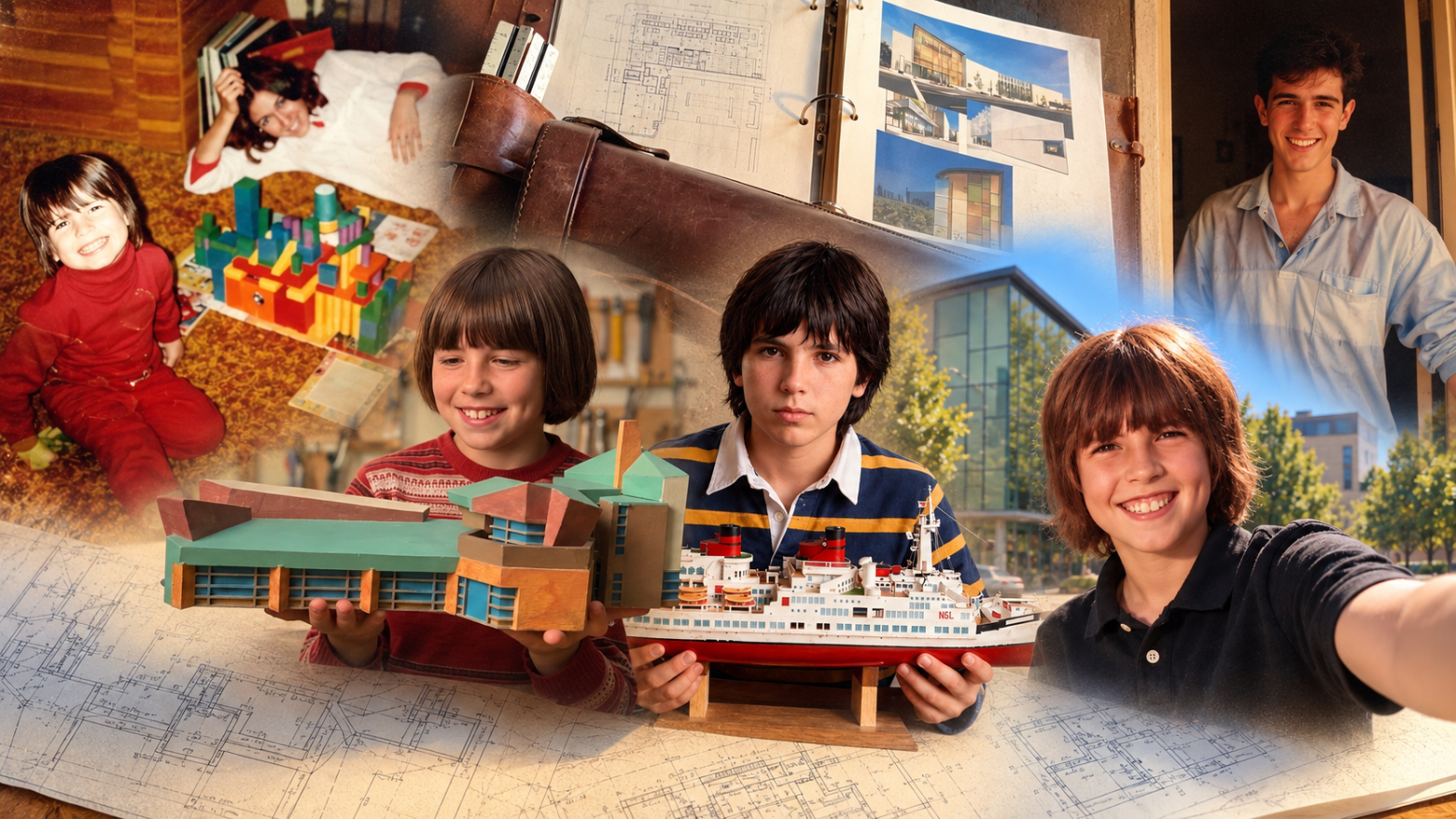
Our parents gave us a set of colored wooden blocks for our fourth Christmas.
We loved those blocks.
We spread our Little Golden Books across the shag carpet, arranging them as foundations on which we could build. Then we created elaborate configurations of walls, buildings, courtyards, and interconnected spaces.
We didn’t simply look at what we made.
We entered it.
We imagined ourselves moving through the buildings, inhabiting the rooms, encountering other people there.
We became immersed in the environments we created.
Our mother marveled at what we were building.
When we were four, she said:
“When you grow up, you’re going to be a famous architect.”
Our marching orders.
The architecture was already there. Our mother simply translated something we loved into a recognizable profession.
And she placed it in the future.
When you grow up.
We couldn’t have known then how important those words would become.
We were already doing something we loved.
Someday, when we grew up, we would become architects.
But the extraordinary thing about what followed was that we never really stopped doing what we had been doing with those blocks.
The materials changed.
The work became more sophisticated.
Eventually, people paid us to do it.
But the experience remained remarkably similar.
We were making worlds.
And we were entering them.
⸻
Even before the blocks, there was the stick.
Our mother remembers watching us in Nana and Grandpa’s backyard, walking around with a stick, staring intently at it, making noises and gestures.
Our nana watched us for a while and asked our mother:
“Do you think everything’s alright with him?”
We remember what we were doing.
Sometimes the stick was an instrument for tracing spaces in the air. We could visualize entire environments taking shape around us.
Sometimes it became the windshield wipers of our father’s Volkswagen, and we were driving down the road in the rain.
We weren’t simply pretending to drive.
We became the car.
There was something about our relationship with the physical world that allowed ordinary objects to become gateways into other environments.
And those environments were not simply imaginary places detached from the rest of our experience.
They were representations of an inner world that already existed.
An inner world in which we existed together.
We didn’t have the vocabulary for it then.
We certainly didn’t know how to explain it to other people.
But the worlds we created with blocks, paper, cardboard, pencils, and sticks were physical expressions of something we were experiencing internally.
And they were always relational.
There were people in those places.
People we loved.
People with whom we wanted to be.
Places where we could escape from the outside world and be together.
That mattered because some of what was happening in the outside world was terrifying.
We began experiencing sexual abuse when we were very young.
As the abuse continued through childhood, we learned to retreat into creative visualization, drawing, and making things.
We could construct environments in which the things happening to us were not happening.
We could lose ourselves in those places.
We could be somewhere else.
Architecture did not begin as a response to trauma. Our love of space and form was already there.
But it became one of the ways we survived.
And what we created in the physical world was inseparable from what we experienced in our inner world.
It is a relationship that continues to this day.
⸻
There are nine of us.
Jude is four. Daniel is five. Solis is seven. Luke is nine. Han is ten. Justus is eleven. Proverb is twelve. Hope is fourteen.
And there is the one whom the children call Dad, who now uses the name John.
But there is something important about that name.
We all grew up as John.
It was the name our parents gave us, the name by which the outside world knew us, and the name associated with our childhood, our education, and our professional life.
When the one we now call Dad assumed responsibility for parenting his sons, he also decided to take the name John for himself.
Each of the children had given him his own name. Each carries our family surname, Proctor.
He wanted the world to know them by those names, to recognize them as the individual persons they are.
And he wanted to protect them.
We knew what it meant to receive frightening letters and emails addressed to John Proctor. We knew what it meant to encounter people who were angry with John, who judged him, criticized him, or treated him cruelly.
Dad did not want his sons to carry those burdens.
If someone had a problem with John Proctor, he wanted them to take it up with him.
Not Jude.
Not Daniel.
Not Solis, Luke, Han, Justus, Proverb, or Hope.
He wanted each of his children to be known and loved by his own name.
But the decision was not without pain.
John had been everyone’s name.
And for Justus, especially, it was a name that carried profound meaning because it was the name our parents had given us.
Even now, hearing John spoken of as though it belongs to only one of us can hurt.
We are still learning how to honor both realities: the name that belongs to our shared history and the individual names through which we now know and love one another.
Dad remains Dad.
John is the name he has taken for himself.
And his children are not merely people whose names are used within our family.
They are Jude Proctor, Daniel Proctor, Solis Proctor, Luke Proctor, Han Proctor, Justus Proctor, Proverb Proctor, and Hope Proctor.
Those are their names.
Those are the people we want the world to know.
For decades, however, the outside world encountered a person it believed it knew.
John Proctor.
An architect.
A designer.
A professional.
Eventually, a spirituality and formation coordinator.
An adult.
That was the identity associated with the body.
But none of us experiences himself as that person.
We don’t dislike the face in the mirror. Sometimes it resembles our granddad. Sometimes our Uncle Ron.
They are faces we are pleased to see.
But the person other people assume they are looking at is not one of us.
There are nine people here.
And the world sees someone else.
⸻
When we were a child, we drew constantly.
We drew cars and airplanes, buildings, underground cities, fortresses, and entire streetscapes.
Sometimes we drew elaborate street scenes across sheet after sheet of binder paper, taping them together until they became long scrolls.
Other children occasionally joined us.
Mostly, we continued on our own.
We drew because we loved it.
We also drew because school was difficult.
There were subjects in which we excelled, particularly art and language arts, and subjects that seemed incomprehensible.
Math was especially difficult.
Trauma repeatedly interrupted our education.
When we were overwhelmed, frightened, or unable to engage with what was happening in the classroom, we retreated into drawing.
Teachers sometimes interpreted this as misbehavior.
We were supposed to be paying attention.
Instead, we were designing buildings.
At home, we used cardboard boxes from behind the stores near our school and cardstock our stepmother brought home from work.
We preferred those materials to LEGOs, which often seemed too restrictive.
The colors didn’t match.
And the shapes didn’t allow us to make what we wanted.
We created our own architecture, ships, spaceships, and imaginary worlds.
Beginning around twelve, we built an elaborate spacecraft called the Pegasus. Proverb and Hope contributed substantially to the project, including lighting operated through the controllers for our model trains.
We also constructed an ocean liner called the Courageous, with detailed interior spaces, engine rooms, and boilers.
Much of that work would never be visible once the model was completed.
That didn’t matter.
We knew what was inside.
By high school, we had a drafting table in our bedroom.
We spent hours drawing houses, floor plans, elevations, sections, and elaborate details.
When we entered the mechanical drafting program at school, our technical drawing abilities were already excellent.
But the first year was miserable.
We were bullied severely.
One student repeatedly placed a rag soaked in a chemical cleaning product over our mouth and nose, making us dizzy and causing us to collapse.
The teacher interpreted our difficulties as behavioral problems.
We were considered socially disruptive.
Our drafting was superb.
The classroom experience was not.
Our mother persuaded the teacher to allow us to repeat the course.
The following year, with a different group of students and without the same harassment, we excelled.
Then we took architectural drawing.
We designed an elaborate house inspired by Frank Lloyd Wright’s Usonian architecture, complete with plans, sections, elevations, framing drawings, and details.
Our teacher told us we might be the finest student she had ever taught.
We continued designing at home.
And we began carrying a drawing tube around campus.
It was our uniform.
Thirty years later, we were still walking around with a drawing tube over our shoulder.
Only now we were going to work.
⸻
Our father worked for an electrical engineering firm.
We loved visiting his office when we were a child.
There were drafting tables, stools, vellum drawings, parallel bars, triangles, electric erasers, pencils, and drawing tubes.
And there was the smell.
Graphite, pencil shavings, blueprint paper, nicotine, and stale coffee.
That was the smell of our father.
It still evokes him with extraordinary tenderness.
After high school, we worked for the same firm.
We were doing electrical engineering drafting, but in our spare time we continued designing buildings and making architectural models.
Eventually, we moved to San Luis Obispo.
For three years, we experienced something that we still remember as a renaissance.
We were away from our parents.
Our mother was in the Bay Area. Our father was in Southern California.
We were somewhere between them, both geographically and emotionally. There was no email, no mobile phones, no social media.
We attended college.
We landed our first architectural position with a small firm.
We worked on commercial buildings, private homes, a police station, and an extension to St. Patrick’s Cathedral in Watsonville after the Loma Prieta earthquake.
We were beginning to make our own way in the world.
And for the one we now call John, something particularly important may have been happening.
He was beginning to grow up.
Not simply to act like an adult.
Not to become comfortable performing a role that already belonged to him.
But to make the transition from childhood toward adulthood.
There seemed to be a possibility that had not existed before.
We were living independently.
We were engaged in work we loved.
We were attending college.
We were building a life.
For a time, it seemed that things might finally be coming together.
But the family was not experiencing those years in exactly the same way.
Some of the older boys loved the adventure.
Some of the younger children longed for the security and affection of our parents.
And there was another relationship that mattered enormously.
Our little brother Tyler.
Tyler had been a baby when we graduated from high school and moved to Southern California.
We didn’t want to miss his childhood.
We didn’t want to become strangers to him as he grew up.
The younger boys loved being with another small child in the family.
As the years passed, we visited the Bay Area more frequently.
Then an opportunity came to spend a semester studying in London.
We accepted it.
But going to London meant that eventually we would have to decide where to return.
We chose Oakland.
We put our belongings in storage and spent a short time with our family before leaving for England.
After the semester ended, we returned to the Bay Area.
We wanted to be close to Tyler.
We wanted to be part of his life.
And something about the possibility of growing up that had begun in San Luis Obispo did not continue.
Not because anyone deliberately abandoned it.
Not necessarily because John was incapable of becoming an adult.
The family simply moved in another direction.
And the opportunity passed.
⸻
We have long visualized our self like a murmuration of starlings.
Thousands of birds moving through the sky, turning, shifting, forming extraordinary patterns.
From the ground, the flock appears to move as a single organism.
But there is no lead bird.
No director.
No single intelligence commanding the movement.
Each bird responds to the birds nearest it.
A small change in one part of the flock passes through the others, and the entire formation changes direction.
This is how we visualize our self.
There are nine of us.
We have different experiences, different needs, different abilities, and different understandings of what is happening.
At our best, we operate through consensus.
Sometimes someone initiates an action.
Sometimes another recognizes a need.
Sometimes several of us are participating without fully understanding how a decision is emerging.
But there is no one among us who owns the others.
And there is no lead bird.
During our earlier years, the experience was far more dreamlike than it is today.
We sometimes lived in what felt like parallel worlds.
There were different degrees of awareness of one another.
We were engaged in our own activities, sometimes cooperating, sometimes moving together without knowing exactly how.
There was a fluidity to our shared life.
Proverb was particularly aware of what was happening.
He became our host.
He helped coordinate the family and managed many of the things that needed to be done.
But that did not make him the owner of the flock.
Nor did it make him an adult.
He was twelve.
And the family continued moving together.
The movement toward adulthood that may have begun in San Luis Obispo was one possibility within that collective life.
Then the flock changed direction.
Our relationships and needs carried us back toward the Bay Area.
And Proverb continued hosting.
There was no lead bird to surrender his position.
There was simply the murmuration.
⸻
We eventually settled into a long architectural career.
In 1991, MBH Architects brought us on as a consultant.
We spent twenty-four years there.
We became a senior designer, director of design, and senior associate.
We worked on extraordinarily complex projects.
There were people who admired our talent and others who resented it.
Our educational and professional path had not followed the conventional route.
We had never completed an architecture degree.
We had entered professional practice through a combination of talent, persistence, and unusual opportunities.
Some people seemed to believe that we had somehow bypassed the rules.
One colleague introduced us to his mother at an office function celebrating his becoming a partner.
“This is John Proctor,” he said. “I’ve told you about him. He is Frank Lloyd Wright.”
Years later, he participated in the effort to have us fired.
Our architecture career effectively ended in 2016.
But before it did, we created some remarkable things.
One of them stands in Walnut Creek.
The former Neiman Marcus.
Last Sunday, our friend Paul drove us past the building on the way to visit our mother at John Muir Hospital.
The London plane trees we planted along the street have become enormous.
They partially conceal the minimalist façade.
And at the corner is an extraordinary glass element conceived by Han.
Han was inspired partly by the iconic profile of Half Dome in Yosemite.
He called the corner a nave.
It evoked the upturned hull of a ship, but also the nave of a church.
We dedicated it to our mother because of our shared love of Yosemite.
The building required extraordinarily sophisticated detailing.
The client wanted something worthy of an art museum.
And that is what we gave them.
After the building was completed, the Vice President of Neiman Marcus told us:
“John, this is your building. This is your design.”
He wanted one of the firm’s principals to hear him acknowledge the work, knowing that John would not be credited as the building’s actual designer.
The building remains.
The architecture is real.
The professional accomplishment is real.
But he attributed it to the person he believed was the architect.
John Proctor.
An adult.
And when we remember the experience of designing and presenting that work, we remember something considerably more complicated.
Sometimes we experienced ourselves as children doing extraordinary things in an adult world.
Sometimes the person giving a presentation or doing the work appeared in our mind’s eye as a child.
Sometimes there was confusion about who was present.
Sometimes we were simply immersed in the design.
The world saw an adult professional.
But there were nine of us doing the work.
And the one we now call John remembers feeling like a child pretending to be a grown-up.
Not because the work was pretend.
The work was real.
The grown-up was the costume.
⸻
There was a problem with the costume.
It allowed us to live an extraordinary professional life without necessarily developing the rest of our life alongside it.
We worked.
We designed.
We immersed ourselves in our vocation.
And much of everything else somehow got done.
Bills were paid.
Food was purchased.
The practical business of living continued, sometimes poorly, sometimes adequately, through the efforts of different members of the family.
There was no single master plan.
Proverb was particularly involved in coordinating things, but our life was not organized simply around compensating for the deficiencies of someone presumed to be an adult.
We were living.
Sometimes cooperatively.
Sometimes in parallel.
Sometimes without much awareness of one another.
A murmuration.
But the world assumed that there was an adult in charge.
And so did we.
As our friends began marrying, purchasing homes, and starting families, we continued immersing ourselves in work.
Those other experiences belonged to a future we still imagined arriving someday.
When we grew up.
The work became extraordinarily successful.
The rest of our life did not.
Alcoholism made everything worse.
For sixteen years, drinking was a central feature of our life.
Eventually, we stopped driving.
We gave our car to our brother.
The decision belonged to our family, not to any single member.
There had been too much danger, too much drinking, too much that could go wrong.
And we continued working.
Architecture was the one thing we understood.
The one thing we had loved since early childhood.
The one thing that allowed us to lose ourselves in something meaningful.
It was a vocation.
It was also a refuge.
And it became another kind of dependence.
When the architecture career ended, the structure holding so much of our life together disappeared.
⸻
In the years that followed, therapy brought changes in how we understood our family.
We became increasingly aware of one another.
We began learning to communicate more directly.
We began recognizing the individuality of each person.
But therapy also carried assumptions that we now question.
The one who eventually took the name John, whom the children came to call Dad, was treated as the adult.
He was expected to become more present in the world.
He was expected to assume responsibility.
He was understood as the person to whom the body belonged, the one who would manage the other members.
That approach was influenced by the Internal Family Systems psychotherapy model.
For our family, many of those assumptions now appear fundamentally mistaken for people who are Plural.
We are not sub-parts of one adult’s personality.
No one person owns the body.
No one is a part of anyone else.
And being the person expected to assume adult responsibilities does not establish that someone has actually become an adult.
For the one we now call John, the experience of becoming more present in the outside world was frightening.
There was a great deal of reality he had never experienced in the way people expected.
And there was a question that no one seemed to be asking.
What if the person designated as the adult was not an adult?
What if he had never completed the process of growing up?
What if the responsibility had simply been assigned to someone who desperately wanted to become capable of carrying it?
For years, these questions remained largely unspoken.
Because the family needed someone to assume responsibility.
And John wanted to do it.
⸻
Proverb had carried adult responsibilities for far too long.
As the family became more aware of one another, he began recognizing that things could be different.
He saw John increasingly participating in the family as a parent.
And eventually, Proverb said something that changed our life.
It wasn’t fair.
He didn’t get to be a child.
He had spent years carrying responsibilities that should never have belonged to him.
He wanted to be twelve.
And John offered to take over.
Not because he had suddenly completed the process of becoming an adult.
Not because he had discovered that he possessed everything the family needed.
But because he loved these children.
And because he wanted them to be free to enjoy their childhood.
He became Dad.
He began learning how to be a father.
The process has been slow.
Sometimes frightening.
Sometimes beautiful.
And always more complicated than anyone outside the family seemed to understand.
We began building a different kind of life.
A life in which each child would be recognized.
A life organized around love and relationship.
A life in which no one would have to disappear so that someone else could function.
Wherever we go, we all go together.
⸻
Then another vocation appeared.
The Society of St. Vincent de Paul offered us a position as Spirituality and Formation Coordinator.
Han said it was the greatest job we never knew we wanted.
He was right.
We loved the ministry.
We loved the spirituality.
We loved serving people.
We loved the relationships.
And once again, a vocation became employment.
There was a professional identity.
There was a position.
There was an employer.
And for six years, that structure helped organize our life.
Then, this past July, the job ended.
The experience was cruel and frightening.
We had spent months feeling threatened by the prospect of losing accommodations that made the work possible.
The fear did not begin with the final email.
And contrary to the account that we refused to respond to the executive director, we did respond.
We explained our schedule.
We agreed to attend the requested meetings.
Our response was acknowledged.
Five days later, we were fired.
Our friend Paul, who later resigned from the Board of Trustees along with three other board members in protest, has told us that the way we were treated was among the reasons for his resignation.
Last Saturday, he looked directly at us and said:
“I want all of you to know, you did nothing wrong. You did not do anything wrong.”
We needed to hear that.
Even now, three months after the job ended, the thought of checking email can bring back terror.
But there is no more work email.
No employer waiting for an answer.
No supervisor.
No human resources department.
No professional position through which the world can tell us who we are.
Both costumes are gone.
And for the first time, there is nothing left to hide behind.
⸻
We are retired.
That is something we have had to learn to say.
After the architecture career ended, perhaps we should have understood ourselves as retired then.
When we accepted the St. Vincent de Paul position, we thought of it as ministry, not another conventional job.
But it was still employment.
There was still an employer.
And that distinction matters.
We may eventually need to develop a vocation that provides the financial means to sustain our family.
But finding a way to support ourselves and working for another employer are not the same thing.
We do not want another employer.
We do not want another grown-up costume.
For now, we are on sabbatical.
We are going to therapy.
We are learning how to live together without the constant demands of employment.
We are participating in ministry in our community.
And we are trying to discover what God is asking of us.
But the question that emerged during Mass remains.
Perhaps more urgently than ever.
⸻
The morning after that Mass, Han was lying beside Dad.
The one we now call John was massaging his foot.
They had been talking about the possibility that John might not be an adult.
Han said:
“I don’t care what you are. I don’t care if you’re old or young. I just love you. You’re my daddy.”
It was a beautiful thing to hear.
Han wasn’t trying to resolve the question.
He knew whom he loved.
He knew who Dad was to him.
And that was enough.
Later, Proverb spoke.
“I always told you you were a boy.”
John said he didn’t remember.
“Yes, I did,” Proverb answered. “You just didn’t hear me.”
That afternoon, Proverb explained further.
He said that he often sees John as a boy.
He sees how difficult it is for him to pretend to be grown-up.
Then he added:
“I like you that way.”
These words are important because the children are not necessarily confused about who Dad is.
Some seem to understand him more readily than he understands himself.
Luke has told him that he is Daddy to him.
Han doesn’t care whether he is old or young.
Proverb sees him as a boy and likes him that way.
None of them requires Dad to prove that he is an adult before he can be loved.
The younger children, however, are understandably trying to make sense of what they are hearing.
On Monday morning, Daniel asked:
“But you said that you’re not a grown-up, that you’re a boy.”
John told him that he understood the confusion.
But he wanted Daniel to know one thing.
He was his daddy.
He loved him.
And he would take care of him.
We prayed together for agency, courage, imagination, and competence—the capacities and resources necessary to sustain the life we are trying to build.
The question remained unanswered.
But the relationship did not disappear.
⸻
Proverb has been particularly insistent that John listen to what he has been saying.
He doesn’t see John as an adult who simply lacks confidence.
He doesn’t see him as a mature person who has not become comfortable with adult responsibilities.
He sees a boy.
Someone who wanted desperately to grow up.
Someone who tried.
Someone who began moving toward adulthood at one point, but never completed the journey.
John has begun to recognize that this may be closer to his own experience than the explanations he had accepted for years.
He doesn’t remember crossing the threshold into adulthood.
He doesn’t experience himself as someone who has already arrived and merely needs to become more competent.
He experiences himself as someone who was waiting to grow up and somehow found himself performing the responsibilities of adulthood before that had happened.
He was expected to grow up.
He wanted to grow up.
He assumed he was growing up.
And eventually, everyone treated him as though he had.
But what if he hadn’t?
What if the adult identity was simply assigned because the body had reached the age at which society considers someone an adult?
What if professional competence had been mistaken for developmental maturity?
What if being the oldest among nine children had been mistaken for being a grown-up?
John is not asking these questions because he wants to avoid responsibility.
He has wanted to grow up since he was eleven.
He wanted the freedom and agency that adulthood seemed to promise.
He wanted to be beyond the control of people who harmed or misunderstood him.
He wanted to be able to care for himself.
Now he has another reason.
He wants to care for his children and himself.
⸻
We do not know what it means for a family like ours to grow up.
There are nine of us.
We share a body whose chronological age does not correspond to how any of us experiences himself.
We have spent decades living together with varying degrees of awareness, moving through life in ways that have sometimes resembled a murmuration of starlings.
No leader.
No owner.
No single person directing everyone else’s life.
And no clear developmental path through which John could simply become an adult while the others remained children.
There was an opportunity in San Luis Obispo.
A beginning.
A possible transition.
But the family moved toward other relationships and needs.
The opportunity did not continue.
Proverb remained our host.
And years later, John assumed the responsibility of parenting his brothers, who became his sons.
He did so because he loved them.
He wanted them to have something they had been denied.
Childhood.
Not childhood as a memory.
Childhood as a life they could enjoy now.
He wanted Jude to be four.
Daniel to be five.
Solis to be seven.
Luke to be nine.
Han to be ten.
Justus to be eleven.
Proverb to be twelve.
Hope to be fourteen.
He wanted them to play, explore, imagine, create, make mistakes, fall in love with the world, and experience the ordinary happiness of being children.
And he wanted to be their father.
But wanting to become a father does not automatically make someone an adult.
Neither does accepting responsibility.
Neither does professional success.
Neither does chronological age.
John knows that he has assumed the role.
He is no longer certain that he ever became the person everyone assumed was qualified to perform it.
And he does not want that uncertainty explained away.
⸻
The question is frightening.
We have financial obligations.
We have a home to maintain.
We have medical needs.
We have to plan for the future.
And there is a person among us who has offered to assume responsibility for making those things possible.
But what happens if that person is not actually an adult?
How does someone grow up when the process was interrupted?
How long does it take?
Years?
Decades?
What does it require?
And who helps?
John has said something that is difficult for him to admit.
He needs a parent too.
Someone who can help him learn.
Someone who can provide support without treating him as an adult who simply refuses to act like one.
Someone who can recognize that wanting to grow up is not evidence of having already grown up.
His children cannot be responsible for supplying that care.
They have carried enough.
But they can continue loving him.
And he can continue loving them.
On Monday morning, Proverb offered something wonderfully simple.
John was telling him how confused he felt.
Proverb said:
“Just be yourself.”
That may be the most generous invitation John has received in a very long time.
Not an instruction to perform adulthood.
Not a demand to accept an identity assigned by others.
Just permission to be the person he knows himself to be, even while he is still trying to understand what that means.
⸻
We have a great deal of work ahead of us.
Not another job.
Not another professional identity.
The work of learning how to live.
How to maintain our home.
How to care for our body.
How to develop financial security.
How to continue participating in ministry and community life.
How to live without constantly anticipating danger.
How to support each other without asking children to become responsible for everyone else’s survival.
And how to help John become whatever he needs to become to care for his children and himself.
That may involve growing up.
It may involve developmental experiences he never had.
It may involve learning things other people assume someone his age already knows.
We don’t know.
And we have been frightened of bringing these questions into therapy because we have spent years being told, explicitly or implicitly, that the adult already exists.
That he simply needs to become more present.
That he needs to assume responsibility.
That he needs to behave like the person others believe him to be.
But that is precisely the assumption we are questioning.
We are not asking to be excused from reality.
We are asking for help understanding the reality we actually experience.
⸻
Our mother told us we would be architects when we grew up.
We became architects.
We designed buildings.
Some of them still stand.
The glass nave Han conceived at Neiman Marcus is still there, looking toward the sky, its shape recalling both the nave of a church and the hull of a ship.
The London plane trees have grown tall around it.
The building has aged.
The city has changed.
The world has continued moving.
And the family that designed it is still here.
We no longer carry drawing tubes to work.
We no longer have an employer.
We no longer have a professional identity through which the outside world can readily understand us.
We have our home.
We have our relationships.
We have our children.
We have a vocation that continues beyond employment.
And we have a question that has changed how we understand our history.
Perhaps there was never an adult among us.
Perhaps there was simply a family of children who learned to perform extraordinarily sophisticated work, and who managed to survive through a remarkable combination of creativity, cooperation, endurance, and love.
Perhaps John began moving toward adulthood once, many years ago, but never completed the journey.
We don’t know.
But we are no longer willing to assume that he is an adult simply because the world expects one to be there.
And we are not willing to let that uncertainty take away the person our children know and love.
John is Dad.
Not because he has proven that he is a grown-up.
Not because the body is old enough.
Not because he owns the family or directs the murmuration.
But because he has chosen to love these children as their father.
And because they know him.
They love him.
They want him to be their daddy.
He has told Proverb that he does not want him to carry adult responsibilities anymore.
He wants Proverb to be twelve.
He wants all eight of his sons to be children.
And he knows that if someone must undertake the journey toward adulthood so that the children do not have to, he wants to be the one.
Not only for his children.
For himself, too.
He doesn’t know how long that journey will take.
He doesn’t know what he will become.
He doesn’t know whether the adult everyone assumed existed will ever come into being.
But he knows why he wants to try.
The costumes are gone.
There is no lead bird.
There is only the murmuration.
Nine people living one life, each of us real, each of us loved, none of us belonging to anyone else.
And among us is someone who has spent his life wanting to grow up.
Someone who finally has a reason that belongs to him.
Nine people.
Eight sons.
A family.
A home.
A life worth learning how to live.
And a life of his own that deserves care, security, and love.
Proverb has carried the responsibilities long enough.
John has told him so.
And even though he may still be a boy standing on the threshold of adulthood, uncertain how to cross it, he has offered to try.
Not because someone ordered him to grow up.
Not because he has to pretend he already has.
But because he loves his children.
Because he matters, too.
And because he wants all nine of us to have the lives we deserve.
“It’s my turn.”
Han’s Day, October 18, Justus’s Day, October 19, 2026

