After nearly sixty years of trying to make an unsustainable life work, we are beginning to understand what it means to stop—and why we deserve the chance to heal.
In March 2026, during contemplative prayer, we experienced God telling us something unexpected.
“YOU are retired.”
We were still employed by the Society of St. Vincent de Paul.
We loved our ministry. We had responsibilities, commitments, and a life organized around serving the Vincentian community.
But the circumstances of our employment had become extraordinarily difficult. Some of our children were terrified of the workplace and the people who exercised authority over us.
We had begun recognizing that the administration of the organization employing us increasingly resembled the corporate world we thought we had escaped when our architectural career ended.
We did not know exactly what God meant.
We had a job. We needed the income. We were doing meaningful work. And we could not imagine how we would support ourselves without employment.
Perhaps retirement meant something other than what it ordinarily means.
Perhaps it meant we were supposed to stop thinking about our ministry as work.
Perhaps it meant we should no longer pursue a conventional career.
We didn’t know.
Four months later, on July 22, our employment ended.
We were terminated.
And now, after three months of trying to understand what happened and what comes next, we are beginning to wonder whether God meant exactly what He said.
“YOU are retired.”
Not that our vocation had ended. Not that our gifts no longer mattered. Not that we would never serve others again.
But that we were retired from employment.
Perhaps God was telling us to stop doing something we have been doing for nearly sixty years.
Something we have never really stopped doing, even when we desperately needed to.
Trying to make an unsustainable life work.
The Buildings Were Real
We spent nearly thirty years working in architecture.
For twenty-four of those years, we worked at a major architectural firm.
Architecture was our passion—our first love. We had loved buildings since we were a little child.
We loved design and the process of turning something imagined into something that could actually be constructed.
We understood building codes, consultants, municipalities, government agencies, and the multitude of organizations and trades necessary to design enormous, complicated projects, get them approved, and see them built.
And we were very good at and committed to what we did.
We worked a baseline of eighty hours a week on a forty-hour salary. We typically worked more.
We worked all night, sometimes for days on end.
On one occasion, we worked six consecutive days without sleep.
And we could work all night and drink.
For sixteen years, we were an active, high-functioning alcoholic.
You wouldn’t have known it from our work.
Our architectural designs were sophisticated. Our design presentations and technical drawings were excellent. We solved complicated problems and produced the work necessary to get buildings constructed.
We took pride in our productivity, our profitability, and our ability to keep scores of people busy.
We had a ninety-eight percent utilization rate. Our designs won awards.
The work was genuine.
The accomplishments were real.
But the life beneath them never came together.
Outside the office, our apartment resembled something from the reality television show Hoarders. Nothing like the sophisticated places we designed.
The water heater didn’t work.
The front door wouldn’t lock.
We appeared high-functioning by day but went home every night where we could secretly fall apart, routinely drinking shocking quantities of alcohol and chain-smoking nearly two packs of cigarettes.
We were frightened almost all the time.
Frightened that we would lose the people we loved. That we would lose our job. That we would no longer be able to function. That something terrible would happen because of our drinking.
In 2003, following our second DUI, we voluntarily stopped driving because we were afraid we would kill someone.
Eventually, we established a rule: no drinking before 6:30 p.m.
We brought work home and could work all night while drinking. When we began working remotely, it became easier to avoid the misery and self-consciousness of commuting with a perpetual hangover.
We usually began working before seven in the morning.
We seldom allowed others to see us drink. For the most part, we stopped drinking socially, but every night we drank, often into the early hours.
And every morning, we put the costume back on and went to work.
Even the coat and tie and exceptional work could not entirely conceal the whiff, the tremors, and the pallor of the alcoholic.
Our employer and colleagues knew about the DUIs. They knew that we had stopped driving.
But no one ever confronted us.
Our work was that good.
Our clients never had a clue.
We were sober for our final two years at the firm.
We had also struggled with addiction to the Ritalin prescribed for our ADHD.
And work itself had become another addiction.
At work, we understood the problems. We could solve them. We could make something work.
Outside work, we struggled to sustain an ordinary life.
There was an adult body, a career, a paycheck, and responsibilities.
The job was our grown-up costume.
And we wore it extraordinarily well.
The costume wasn’t perfect.
Some called us “Rain Man.”
They knew there was something going on with us long before the manifestations of addiction became apparent.
Still, there were others who questioned our competence, attributing our success to being protected and given unfair advantages—special treatment.
But we were useful and reliable to those who depended on us.
A Jenga Tower on a Raft
Looking back, our life was like a Jenga tower on a raft.
A Jenga tower is precarious enough on solid ground.
But ours was standing on something constantly moving beneath it.
And we kept adding blocks.
Another project. Another responsibility. Another deadline. Another night without sleep. Another accomplishment.
We developed elaborate arrangements that depended upon extraordinary effort and singular commitment to one thing: work.
Our life was not like a well-designed building. It was an absurd Rube Goldberg machine, held together with rubber bands and tape.
Somehow, everything kept barely functioning, with the help of others and things happening inside that we would not begin to understand until much later.
Until it didn’t.
The problem was not that we lacked professional competence.
We knew how to do architecture.
But we did not understand the requirements of our own life.
We were living with the consequences of childhood trauma that we had never been given a meaningful opportunity to resolve.
Sexual abuse began when we were approximately two years old.
Throughout childhood, there were subsequent experiences of abuse, betrayal, and failures of protection, including rape by a scout leader when we were a Cub Scout.
We were frightened. We were confused. We were expected to function in environments where we were not adequately protected.
We were diagnosed with ADHD at eleven and again at thirty.
But we were fifty before we received a diagnosis that began to explain something fundamental about our existence.
Dissociative identity disorder.
There were nine of us.
Nine people sharing one body and one life.
Eight boys and someone they now call Dad.
We had always been here.
We were aware of one another in childhood, but for most of our life we did not know one another as we do today.
We did not understand our different memories, experiences, abilities, needs, and relationships.
We did not understand why something could be easy one day and almost impossible the next. Why we could perform extraordinary professional work while being overwhelmed by ordinary life.
Or why there always seemed to be someone we were longing to know.
We were trying to build a life without understanding who was living it.
Years later, when our therapist came to understand our childhood trauma, dissociation, complex PTSD, addictions, and work experiences, she said something we have never forgotten.
“No wonder you drank.”
Those words mattered.
Not because they excused anything we had done, but because they recognized that our alcoholism had a history.
The drinking was not the beginning of the story.
We had our last drink—a glass of wine with New Year’s Eve dinner—on December 31, 2014.
Sobriety was an extraordinary blessing.
But the raft was still moving.
The childhood trauma remained. The dissociation remained. And employment remained the principal structure around which we organized our life.
On October 3, 2016, our architectural career ended.
We were fired.
Our former architectural employer was subsequently found liable for discrimination involving the removal of our disability accommodation and for unlawful termination. Damages were awarded.
Our employer was found legally responsible for what happened.
But the legal remedy could not restore the years, energy, and stability we had lost.
The Jenga tower had come apart.
And we still didn’t stop working.
Another Rube Goldberg Machine
We tried to establish our own architectural practice.
For three years, we worked with a nonprofit partner on the Golden Gate Flyer, a proposed Ferris wheel that would have been the largest in the world.
We also developed concepts for affordable housing, transformational housing for people who had formerly been unhoused, a proposed design for Castro Square in San Francisco, and other projects our partner wanted to pursue.
Altogether, we contributed more than $300,000 worth of pro bono architectural and design services.
At one point, our partner gave us $2,000.
Our understanding was that we would provide the architectural expertise while he pursued opportunities that could sustain the practice.
Those opportunities never materialized.
But we kept working.
Designing. Developing concepts. Preparing proposals. Trying to make something happen.
It was another elaborate arrangement dependent upon something beyond our control.
We could provide the architecture. We could work extraordinarily hard.
But we could not make the arrangement financially sustainable on our own.
And still we continued.
Because that was what we knew how to do.
Work.
Find something.
Make it work.
Keep going.
When the relationship finally ended, we were exhausted.
We had spent three more years working without establishing the livelihood we had hoped to build.
We needed help.
Not another project.
Not another opportunity to demonstrate our abilities.
Help.
Permission to Be Broken
We wanted to apply for disability.
Our retirement savings were diminishing, and we no longer believed we could sustain ourselves through conventional employment.
Our therapist recognized our history of employment trauma, addiction, dissociation, and exhaustion.
We had become sober, lost the architectural career around which our life had been organized, and spent three additional years trying to establish an independent practice.
We told her something we had never been able to say before.
We had never been allowed to be broken.
Not as a child.
Not as an adolescent.
Not as an adult—or whatever it was that we had become.
We had always been expected to function.
To work. To produce. To figure things out. To keep going.
No matter how frightened we were.
No matter how overwhelmed.
No matter how much our life was falling apart.
We asked her for permission to be broken.
And she said she gave us that permission.
She eventually agreed to help us pursue disability.
Then something unexpected happened.
We had already been Vincentians, members of the Society of St. Vincent de Paul with the Cathedral of Christ the Light Conference, for several years.
During the pandemic lockdown, we volunteered on the Society’s downtown campus six days a week for four months.
We loved being there.
We loved the people, the Vincentian community, and the opportunity to serve.
We were not looking for employment.
But the Society offered us a job.
Spirituality and Formation Coordinator.
Our therapist became convinced that accepting the position would help rehabilitate us and enable us to “reenter the workforce.”
We loathe that expression.
Reenter the workforce.
As though we were a commodity.
As though the purpose of our healing was to make us economically useful to the consumer-driven market economy again.
As though thirty years of extraordinary work, followed by years of exhaustion and trauma, had left us damaged goods that needed to be made employable.
We had asked for the opportunity to stop.
Instead, employment became the focus.
Our therapist persuaded us that this job would be different.
We would simply continue doing what we were already doing: serving the Society and participating in the ministry we loved.
Only now we would be paid.
We wanted to believe that.
So we accepted the position.
It was not what we had imagined.
The Ministry Was Not the Employer
We joined the Society of St. Vincent de Paul because we believed in its spirituality and mission.
The Society exists through Vincentians serving their neighbors, principally through local Conferences, and through relationships in which charity becomes an expression of friendship and faith.
We loved that vocation.
We still do.
But we quickly discovered an enormous difference between the Society as we knew it through our Vincentian life and the administration of the downtown campus.
The campus was a Special Work of the Society.
Important, certainly.
But not the whole Society.
Yet its administration appeared to organize its priorities around the campus, with little serious commitment to supporting the Conferences.
We recognized a hostile workplace before the hostility became directed toward us.
Leland, whom we had known as a volunteer and who was working as Shelter Manager, warned us that our first six months would be difficult.
We should keep our heads down.
Lie low.
Learn how things worked.
We remember telling him that it sounded like the advice a seasoned inmate gives a new prisoner.
It was an unsettling introduction to our employment.
We also came to believe that the administration did not take our position seriously.
Our predecessor had served for twenty-four years in a director-level position. Others performing comparable work in St. Vincent de Paul organizations had extensive qualifications and experience.
We believed that if support for the Conferences had been a genuine administrative priority, they would have recruited someone more obviously qualified than us.
We later learned that our predecessor’s departure had not been the straightforward retirement we had assumed.
As we understood it, she had been pushed out.
She left exhausted and saddened, severing her relationship with the District Council while remaining a Vincentian in her own Conference.
We recognized something familiar in that history.
Nevertheless, we took the position seriously.
We learned.
We worked.
We contacted Conferences and asked what they needed.
Our employer did not train us for this work. We let the Vincentians we served teach us how to serve them.
We worked closely with the Spirituality, Formation and Growth Committee, especially Paul, who became our best friend.
In practice, we looked to that committee for much of our guidance.
They knew our work. They understood our ministry. They cared about the Conferences.
Our supervisor, John, knew much of our work through what the committee and other Vincentians reported to him.
We poured ourselves into the ministry.
But we continued encountering conditions and practices that troubled us.
The lack of support for Conferences. The treatment of neighbors we served. The treatment of employees. The hostile workplace.
We raised concerns.
We tried to address what we saw.
We made good trouble.
And the good trouble had consequences.
The Place We Loved Became a Place of Terror
From the beginning, we had an understanding that we could work from home.
Even the Executive Director had agreed.
But the arrangement had not been formalized in writing.
And initially, we wanted to be on campus.
We loved that place from our days volunteering there.
But as the employment relationship developed, we became increasingly concerned about the administration.
We brought forward information concerning the treatment of staff and other irregularities.
An investigation identified serious violations involving the then-Executive Director and made a number of recommendations, including her termination.
A performance improvement plan was chosen instead.
As we understood it, that plan was never followed.
After a particularly abusive half-hour encounter with the Executive Director, we needed two weeks of sick leave.
We said that we no longer consented to interact with her.
The administration subsequently attempted to require a psychiatric evaluation concerning our dissociative identity disorder, which had been disclosed to our supervisor by our therapist, who participated in our interview.
This was retaliation.
We involved the Equal Employment Opportunity Commission.
Eventually, the president and board asked for us to be moved to a new location on campus, away from the Executive Director, and reaffirmed our accommodation to work from home.
We were provided a MacBook.
But by then, something had happened that profoundly affected us.
In August 2023, we were working both at home and at the new location on campus.
We were frightened that the Executive Director would come there.
Solis was particularly afraid.
I reassured him that she would not.
She had been told to stay away from us.
I promised him.
Ten minutes later, she came to check on us.
I had promised my seven-year-old son that something frightening would not happen.
And then it happened.
We vowed never to return to the campus. I also learned to never make promises to my children about the behavior of other people.
The place we had loved as volunteers had become a place of terror.
We began working remotely full time and continued doing excellent work.
But the fear that we might be required to return never entirely disappeared.
The EEOC subsequently made a probable-cause determination supporting our allegations of discrimination and retaliation.
Ultimately, the agency did not proceed with enforcement because of jurisdictional limitations associated with the employer’s classification as a religious organization.
We were told that this did not mean the employer had been exonerated.
The findings remained.
The distinction was profoundly troubling.
The Society of St. Vincent de Paul exists to serve Christ in people experiencing poverty and suffering. Its spirituality emphasizes human dignity, charity, friendship, and justice.
Yet the administration employing us benefited from legal protections associated with its religious character while, in our experience, failing to uphold those values in its treatment of us and others.
The irony was painful.
We had entered employment believing we had escaped the corporate world.
Instead, we encountered many of the same problems within an organization whose religious mission mattered deeply to us.
And still we stayed.
Still we worked.
Still we tried to make the arrangement sustainable.
When the Accommodations Were Taken Away
The former Executive Director retired in December 2025.
The Director of Programs became interim Executive Director and attempted to have us return to the downtown campus.
Our supervisor, John, told him that removing our remote-work accommodation was a dealbreaker.
Then, in May 2026, a new Executive Director was hired. The Interim Executive Director returned to his position as Director of Programs.
When we first met the new Executive Director, she had just witnessed us at work at a District Council meeting, leading in prayer and speaking before the Council, interacting with the Conference Presidents we supported, expertly answering questions and offering support.
She said, “I am comfortable with you working fully remote.”
We also disclosed our dissociative identity disorder to her, explained that we were plural, and talked about our employment history with the organization.
She said she already knew and seemed to be compassionate about the situation.
Within weeks, the new Executive Director sought to change that arrangement, to take away our accommodation to work remotely.
Our supervisor, John, later told us that the Director of Programs had urged her to require us to work on campus.
We resigned.
The board persuaded us not to leave.
And on July 22, we were terminated.
We subsequently learned that the new Executive Director had replaced us and other employees and created positions filled by people associated with her previous employer, Catholic Charities, the Diocese of Oakland, and her St. Columba parish.
We believed her approach to management and expectations for direct oversight would have made our continued employment increasingly difficult.
We also had substantial concerns about her understanding of the Society. She was not a Vincentian and had no formation around the spirituality and mission of the Society of St. Vincent de Paul.
She described the organization as an octopus, with the downtown campus as its head.
To us, that represented the very misunderstanding we had spent years trying to address.
The campus was not the head of the District Council.
The Conferences were not peripheral appendages. The 34 Conferences, their Presidents, Conference members, and the neighbors they served are the District Council. This is foundational in the Rule of the Society of St. Vincent de Paul.
The Executive Director is paid staff, not a governing officer. The Executive Director, like all staff, is paid to serve the Vincentians and their Conferences.
The cart is before the horse in our District Council.
But whatever the precise reasons for the decisions that ended our employment, something familiar had happened.
We had worked extraordinarily hard.
Our supervisor and others had told us that we were a blessing.
The president told us that we possessed knowledge of the Society’s spirituality and formation, and of the support of its Conferences, that very few people had.
We had fulfilled our responsibilities.
And after a change in management and another conflict over accommodations, our job was gone.
Twice, after years of employment and excellent work.
Twice, following changes in management.
Twice, in circumstances involving accommodations essential to our ability to continue working.
There was a legal remedy in the first case.
In the second, jurisdictional limitations constrained the available remedy.
Neither experience restored what we had lost.
We are not claiming that every employer will behave as these employers did.
We have close to five decades of employment experience, including our first job delivering newspapers when we were thirteen, work in retail, a restaurant, an engineering firm, two architectural firms, and St. Vincent de Paul.
Not all of it was contentious.
But we have demonstrated our competence, our loyalty, and our willingness to work under extraordinarily difficult conditions.
And we have learned that excellent work does not necessarily protect the person doing it.
Nor does loyalty.
Nor, in our experience, do even established disability accommodations necessarily protect the employment relationship upon which a life has come to depend.
We are no longer willing to wager who we are for a wage.
The Employer as a Parent by Proxy
There is a question we have only recently begun asking.
Why did we stay?
Why did we remain at our former architectural employer for twenty-four years under conditions that became so destructive?
Why did we remain at St. Vincent de Paul for six years despite the exhaustion and fear?
Why did we find it almost impossible to leave even when we knew the employment relationship was harming us?
We do not believe that we simply need an employer to tell us what to do.
Our professional history makes that explanation absurd.
We have demonstrated enormous initiative and independence. We have exercised judgment, created complicated architectural designs, developed projects, organized programs, and assumed extraordinary responsibilities.
We know how to work.
But perhaps employment supplied something else, beyond steady work and income.
Something more fundamental.
Structure.
Belonging.
Purpose.
Recognition.
A place in the world.
An externally organized life in which someone knew what we were supposed to do.
We have begun wondering whether an employer became something like a parent by proxy.
Not a loving parent.
Not necessarily a safe parent.
But an authority around which we organized our existence.
Someone whose expectations gave our life direction.
Someone whose approval mattered.
Someone whose rejection could devastate us.
Someone we could not easily leave, even when the relationship became destructive.
That possibility is painful to consider.
We are not presenting it as a settled explanation. It is something we want to explore with Jessee, the therapist with whom we have recently begun working.
But it helps explain a paradox that has troubled us for decades.
An employer has not been safe for us, yet employment has always felt safer than the alternative.
The alternative was constructing a life independently in a world we had learned to experience as frightening and unpredictable.
A world in which we believed our purpose was to be useful to other people.
A world in which we did not expect our own needs to be considered.
Employment gave us something recognizable.
And so we stayed, even when the price was enormous.
Then, when employment ended, we lost much more than a paycheck.
We lost the external structure around which we had organized much of our existence.
After our architectural career ended, we could not simply take our abilities to another firm and begin again.
After St. Vincent de Paul, we could not simply find another organization and continue the ministry we had developed there.
Those arrangements had consumed so much of us that their loss left us devastated.
Back in the swamp.
We had never established the foundation that might have allowed us to recover, reorganize, and continue living without losing so much of ourselves.
That is what we need to address.
Not our ability to perform another job.
Our ability to live without one.
Six Months
We have begun therapy with someone named Jessee.
Ey wants to know all nine of us.
Ey listens to our children.
Ey has not told us that healing means becoming someone other than who we are.
And during our recent sessions, when we began worrying about how we would support ourselves, ey suggested something that seemed almost unimaginable.
Six months.
What if we set aside the question of future livelihood for six months and concentrated on becoming stable?
On healing?
On understanding how trauma and fear have shaped our thinking?
On learning about ourselves and discovering what we actually need?
Not six months with a deadline.
Not six months to prepare for another job.
Six months to stop organizing every decision around the fear that we will not survive.
We had asked for something like this six years earlier.
Permission to stop.
Permission to receive care.
Permission not to keep pretending everything was fine because we could still accomplish extraordinary things.
Now someone was encouraging us to begin.
We experience Jessee’s suggestion as a possible confirmation of what we heard in contemplative prayer.
“YOU are retired.”
Perhaps God was not asking us to find a different track.
Perhaps He was telling us to stop racing.
Not retirement from creativity, ministry, friendship, or service.
Retirement from employment and from the arrangements that repeatedly required us to place our life in someone else’s hands.
Perhaps retirement also means that everything we do next need not become another job.
Our writing is not our next career.
Our ministry is not our next employer.
Our relationships are not another set of obligations.
Our healing will not be measured by a performance evaluation.
We now ask God to make Jessee an instrument of His healing.
That ey may help us understand ourselves.
That Dad may discover who he is.
That our children may receive the love, protection, and freedom they need.
That we may learn to live without being governed by fear.
And that all nine of us may become more fully ourselves.
There is something remarkable about how we came to know Jessee.
We would not have known our friend Kim Vanderheiden without our six years of employment with St. Vincent de Paul.
Kim is the Spiritual Advisor for the St. Vincent de Paul Assumption Conference and founder of the Braided Bridge community that weaves creativity, spirituality, and justice.
She had been a member of the Board of Trustees for the District Council and resigned along with three other board members, including our dear friend Paul Marks, in response to our termination.
Our friendship with Kim has deepened since our termination.
Proverb disclosed to Kim that we were plural at our final District Council meeting just a week before we were terminated.
We spend every week at her Braided Bridge studio in Oakland.
And it was through Kim that we were introduced to em.
Paul has described the connection as providential.
We are beginning to understand why.
Those six years were not wasted.
Our ministry was real. Our friendships are real.
Something extraordinary came from them.
We do not believe the suffering was necessary to bring us here.
But we are grateful that something good has emerged from it.
This sabbatical is not an absence of purpose. It is an opportunity to do something we have needed to do all our life.
The Volkswagen
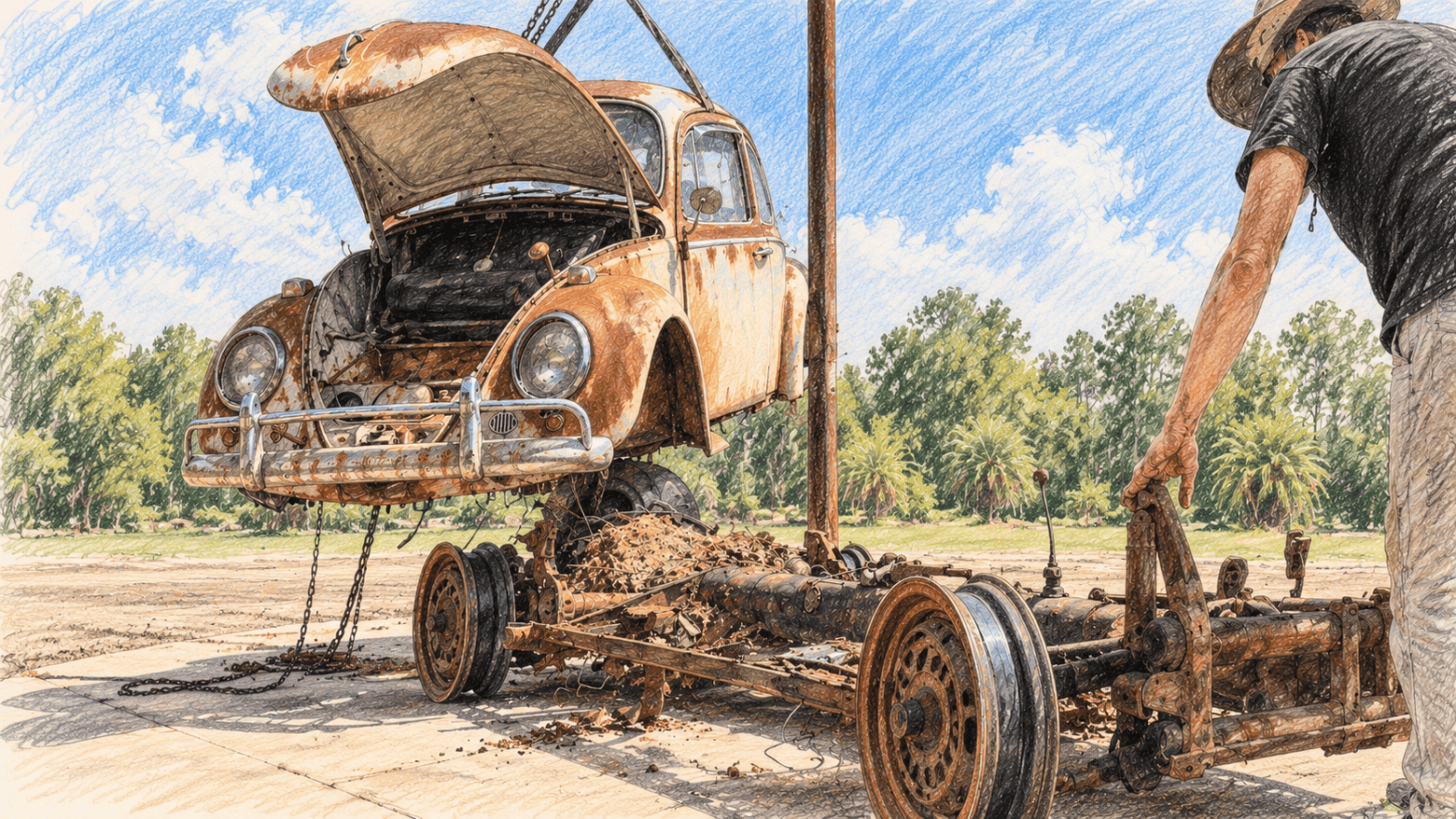
One morning, while Dad was holding Han, we became fascinated by a video of someone restoring an abandoned Volkswagen Beetle.
The car looked almost beyond hope.
It had been left outdoors. Its body was deteriorating. Its chassis was covered in dirt, rust, debris, and years of accumulated neglect.
When the restorer began removing the body, pieces seemed to disintegrate.
It looked as though the car was reverting to the elements.
But the man continued.
Part by part.
Bolt by bolt.
Screw by screw.
He dismantled it, removed the dirt, cleaned the components, refinished the surfaces, and replaced what needed replacing.
Gradually, something remarkable began to happen.
The chassis became recognizable again.
Clean.
Restored.
Gleaming black.
We found the process almost hypnotic.
It was reassuring to watch something that appeared so far gone being treated as worth restoring.
Someone watching the video asked why the man would bother restoring an ordinary Volkswagen Beetle.
We had an immediate response.
Because we can’t all be exotics.
For years, we had imagined our own restoration through the image of a rare Mercedes Gullwing discovered beside a barn, deteriorating in the elements, then meticulously restored to showroom condition.
Now that image seems unnecessarily grand.
Why an exotic car?
Why something rare?
Why something whose value depends upon being exceptional?
We would be delighted to become an ordinary Volkswagen Beetle restored to factory condition.
Safe.
Reliable.
Roadworthy.
A Beetle is worth restoring because it is a Beetle.
And we are worth caring for because we are who we are.
We do not have to become exceptional to deserve healing.
The Volkswagen also belongs to our childhood.
Our first family car was a Beetle.
We remember the delightful purr of its boxer engine, the basket-weave texture of the vinyl seats that left impressions on our bare legs, and riding in the back seat through the smog of Southern California.
Our father later had a Volkswagen wagon that we loved.
And our mother and Greg had a Volkswagen bus in which we traveled on family camping trips.
So when Solis responded to the image of the restored Beetle, another thought occurred to us.
Everyone needs to fit inside.
Perhaps we are a Volkswagen bus.
There are nine people traveling together.
We need room for everyone.
And perhaps what we are restoring is not a vehicle that must return to commuting, competition, and the demands of employment.
Perhaps it is a vehicle for something else.
A drive around the neighborhood.
A trip to the coffee shop.
A day in the countryside.
A journey undertaken because we want to go somewhere together.
We are not rebuilding ourselves to return to the race.
We want to become roadworthy for our own life.
And that is an entirely different undertaking.
There Was Never a Fair Start
Watching the decrepit Volkswagen being prepared for restoration raised another question.
When had we ever been roadworthy?
When had our life possessed the foundation necessary to sustain the demands placed upon it?
We experienced abuse beginning almost at the start of our life.
We grew up frightened, confused, and inadequately protected.
We never had a meaningful opportunity to resolve what had happened.
Instead, we continued.
Through childhood.
Through adolescence.
Through adulthood.
Through alcoholism.
Through employment.
Through one collapsing arrangement after another.
For nearly sixty years, we have been trying to make a life work upon foundations that never received a fair start.
We know that other people suffer, struggle with tremendous trauma and injustice.
But we are not living anyone else’s life.
We are living ours.
There are nine people here.
These are the experiences that happened to us.
And we deserve the opportunity to understand and address their consequences.
We are not blaming our failures on childhood trauma.
We are recognizing that we were never given a chance to resolve it.
That matters.
Because there is an enormous difference between not trying to heal and never being given the circumstances in which healing could become the priority.
We have spent decades constructing elaborate structures upon foundations that could not sustain them.
And every time something came apart, we went back into the swamp and tried again.
Now we are refusing to repeat that process.
We need to understand the ground.
Remove what no longer belongs.
Examine what has been damaged.
Discover what can be repaired.
And learn what kind of life can actually be supported.
We deserve that opportunity.
We do not need permission from the world to believe we deserve it.
The Plaster Investment
There is another image that has emerged.
A plaster investment.
A mold that surrounds a casting, holding its shape while something takes form within it.
For most of our life, we have understood ourselves through the structures surrounding us.
The adult body.
The professional identity.
The employer.
The responsibilities.
The expectations.
The externally recognizable life.
Those things gave us a form the world could understand.
But what was being cast within?
Who were the people living inside those structures?
What had happened to them?
What abilities did they possess?
What did they need?
What might they become if they were no longer required to sustain the mold?
We have spent nearly sixty years attending to the investment.
Keeping it intact.
Repairing it.
Rebuilding it when it broke.
Trying to make sure the form held.
Now we have an opportunity to remove it.
And discover what was cast within.
We hope Jessee can help us do that.
Not merely remove old structures, but understand what they have contained.
The nine people who have always been here.
The relationships we have spent years learning to recognize.
The abilities and gifts we have barely begun to understand outside the circumstances in which we were required to use them.
And Dad.
The one among us whom the children call their father.
The one who has spent nearly sixty years trying to be whatever the world expected an adult to be.
The one who is beginning to wonder whether he ever had the opportunity to become an adult in the first place.
He does not yet know the answer.
Neither do we.
But we know that he is our Daddy.
And he knows that we are his sons.
The question is not whether the children must disappear so that Dad can become someone else.
The question is how Dad can develop the capacities necessary to care for his sons and himself while everyone remains fully who he is.
No one is going away.
No one becomes less.
No one is being toned down.
Wherever we go, we all go together.
The Work of Family
For most of our life, we believed that meaningful work was something we did for someone else.
Architecture.
Employment.
Ministry.
Projects.
Responsibilities.
Now our days look very different.
Dad wakes up and says good morning to his sons.
Sometimes that takes hours.
He holds them, talks to them, listens, kisses their faces, and prays for them.
Memories emerge.
Sometimes beautiful. Sometimes frightening. Sometimes concerning events more than fifty years old.
We write.
We reflect.
We try to understand.
Then we get up.
We make breakfast, care for our home, attend therapy, visit friends, participate in ministry, or rest.
In the afternoon, Dad may lie down and hold his sons again.
We make dinner, enjoy music, and watch television.
And Dad tucks everyone into bed.
Someone looking at this life from the outside might wonder what we are doing.
All they might see is a fifty-nine-year-old man lying in bed for hours with an iPad displaying childhood photographs that he talks to while dictating into an iPhone, then spending further hours writing about experiences other people cannot see or understand.
Would they believe we were lazy?
Unmotivated?
Avoiding responsibility?
Would they understand how extraordinarily hard we have worked throughout our life?
Would they understand that this is what our present capacities allow us to sustain?
Would they understand that we are a family?
We have been trained to evaluate ourselves through productivity.
We know how to measure utilization rates, account for billable hours, describe the value of architectural services, and produce work that keeps other people employed.
But we are only beginning to learn how to value a life that is not organized around those measures.
A life in which Solis discovers that he can enjoy the Beastie Boys because he feels safe enough to enjoy a little chaos.
A life in which Jude can remember frightening places and hear his daddy tell him that he is not trapped there anymore, while adoring his face.
A life in which Daniel can receive affection and reassurance that no one will make him disappear.
A life in which Luke can ask for the attention he needs without competing with the demands of work.
A life in which Han can explore his imagination and spend time in the morning quietly being held.
A life in which Justus can remember a beautiful rainy day exploring tide pools at Laguna Beach with our father and simply snuggle with his daddy.
A life in which Proverb can offer his wisdom without becoming responsible for holding the family together.
A life in which Hope can be fourteen, develop his gifts, and enjoy childhood, helping Dad as he chooses, without feeling obliged to become the adult.
And a life in which Dad can discover who he is.
Not to replace his children or become the kind of conventional adult the outside world presumes must exist.
But to learn how to care for all eight of his sons.
And himself.
The work of healing is the work of family.
It is not what remains of our life after the important work has ended.
It is the work we were never given sufficient opportunity to do.
The Final Quarter
We will be sixty next year.
We do not know how much time we have.
But we know that we do not want to spend the rest of our life repeating the patterns that brought us here.
For decades, we have demonstrated what we can accomplish under circumstances that were damaging us.
We competed.
We succeeded.
We met expectations.
We accomplished extraordin

