What a plural family of nine is learning about identity, belonging, psychological safety, and the freedom to participate in life without having to earn its place.
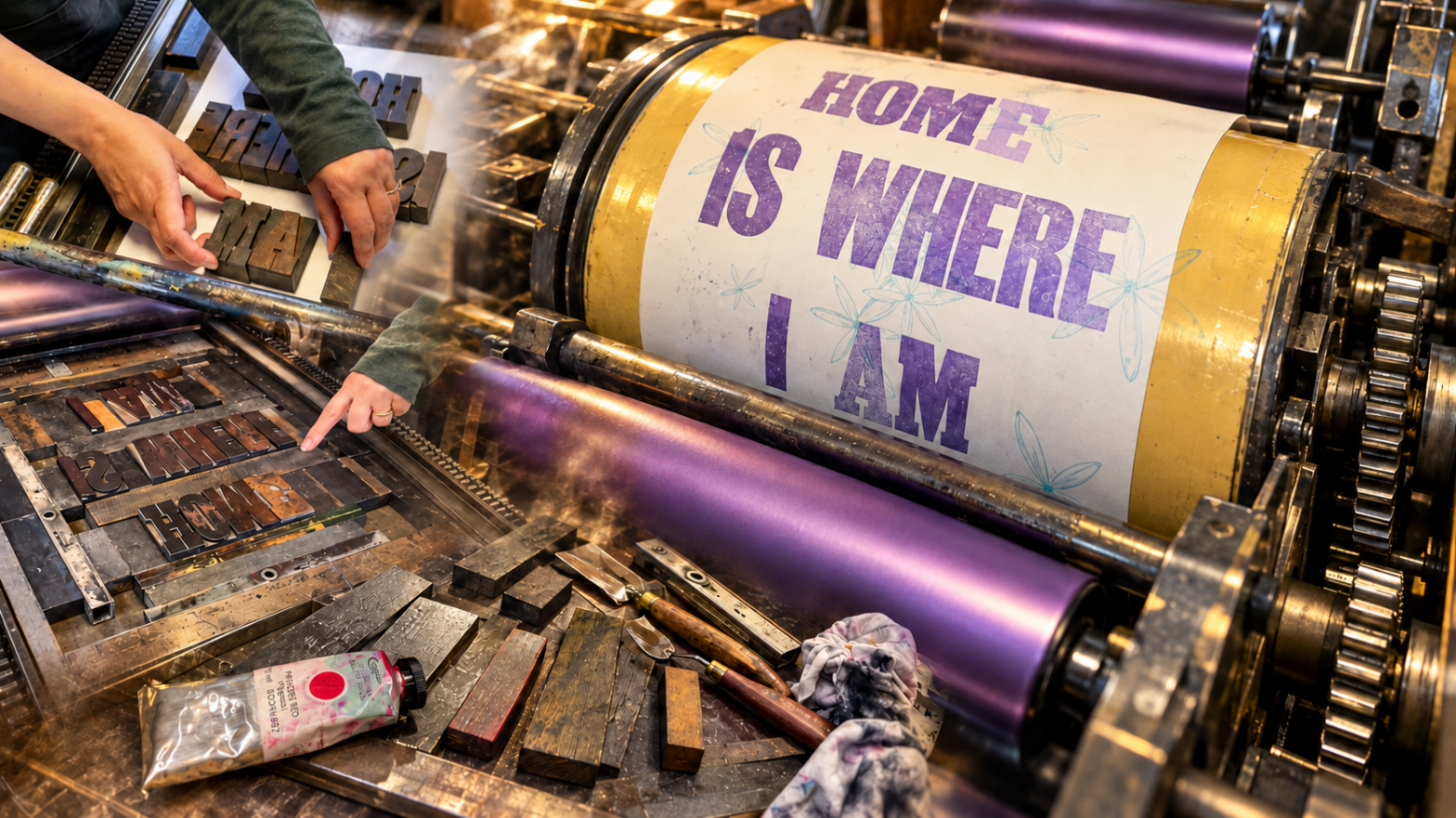
The atmosphere at Braided Bridge is gentle.
The Vandercook printing press produces soothing mechanical sounds.
Mocha is nearby.
There is no expectation that we need to produce something.
When we are here, we relax who we are.
We become more fluid. We are all present, and we are naturally switching between one another, like droplets of rain landing softly on the ground.
There is no need to be anyone or be doing anything in particular. Just present.
We wrote those words in our journal while visiting our friend Kim at Braided Bridge in Oakland.
Mocha is Kim’s Rottweiler. We never knew we would love a Rottweiler.
We have been thinking about them ever since.
Something happens to our family in that environment that we have been trying to understand.
We relax. We move naturally among one another. We become more comfortable participating in conversations and activities with the people around us.
For a long time, we thought the explanation was that nobody expected us to accomplish anything.
But that was only part of it.
The more important distinction is that we can be ourselves there, with other people.
And that has led us to reconsider something fundamental about human belonging.
What happens when a person can participate in the world without having to conceal who they are?
For our family, the answer is not simply that we feel more comfortable.
Something changes in how we experience ourselves, our relationships, and our freedom to participate.
The Work of Appearing to Be Someone Else
We are a plural family of nine people sharing one body.
There is Dad, and there are his eight sons: Hope, fourteen; Proverb, twelve; Justus, eleven; Han, ten; Luke, nine; Solis, seven; Daniel, five; and Jude, four.
We know one another as distinct people.
We have our own relationships, memories, interests, abilities, experiences, and ways of communicating.
We have lived together for nearly sixty years, although we have not always known one another as we do today.
Our growing awareness of one another has transformed our understanding of our lives.
At home, we can speak openly among ourselves. We can address one another by name, use plural pronouns, share what we are experiencing, and move naturally from one conversation to another.
We do not have to explain to one another who we are.
Outside our home, however, we usually encounter a very different set of expectations.
People see one adult body.
They hear an adult voice.
They assume that whoever is speaking is the same adult person they have always known.
Sometimes they are hearing Dad.
Sometimes they are hearing a fourteen-year-old boy.
Sometimes they are hearing a four-year-old.
And often, we cannot tell them.
This creates a peculiar social situation.
We may be participating in an ordinary conversation while simultaneously attending to who is speaking, how that person is being perceived, whether something we say might reveal our plurality, and whether the people around us would understand if it did.
We may need to explain something to one another while avoiding the appearance of talking to ourselves.
We may need to respond to a child’s distress without allowing anyone nearby to recognize that a child is present.
We may need to maintain the appearance of a consistent adult identity even when our experiences, interests, or reactions differ considerably.
Much of this work is invisible.
The people around us may experience an ordinary interaction.
For us, that interaction can require considerable attention.
Psychological research on concealing stigmatized identities provides one useful way of understanding this experience.
Concealment is not simply the decision to withhold personal information. It can also involve anticipating other people’s reactions, monitoring one’s behavior, managing inconsistencies, and remaining alert to the possibility of unwanted disclosure.
Those demands can consume attention that might otherwise be available for participating in the interaction itself.
Research has not established precisely how these processes operate in a family like ours. We are describing our own experience, not claiming that existing studies of identity concealment explain every aspect of plurality.
But the general psychological principle is relevant.
When people must continually manage how others perceive them, social participation can become more demanding.
And when that necessity diminishes, something of the effort may diminish with it.
At Braided Bridge, we experience that difference.
What Happens When We Are Known
Kim Vanderheiden knows us as a family.
She knows there are nine of us.
She asks about us individually.
When one of the younger boys is speaking, she can talk with him as the child he is.
Naturally.
Warmly.
Without awkwardness.
There is no suggestion that he must behave like an adult because the body through which he is speaking happens to be adult.
He is recognized as himself.
And he is welcome.
We can use plural pronouns. We can address one another by name. We can talk among ourselves without worrying that someone will misunderstand what we are doing.
Nobody expects us to maintain the appearance of a single adult person.
And nobody seems uncomfortable when we don’t.
For our younger children especially, this is extraordinarily comforting.
But the significance extends beyond comfort.
At home, we know who we are. We have one another.
At Braided Bridge, that recognition extends into a relationship with someone outside our family.
Kim can recognize Luke as Luke.
She can recognize Han as Han.
She can respond to whichever of us is present without requiring that person to become someone else.
This allows us to participate in a social relationship without first translating ourselves into an identity that other people expect.
We no longer have to devote so much attention to concealment.
We can direct more of our attention toward the people around us, the things we are doing, and one another.
We become more fluid.
That does not mean we become less distinct.
It means we have greater freedom to be distinct.
The distinction matters because recognition is an important dimension of belonging.
A person can be permitted to occupy a space without being known by the people in it.
A person can be treated politely without feeling that their actual identity is welcome.
And a person can be included in an activity while still being expected to conceal something essential about themselves.
At Braided Bridge, we experience something different.
We are not merely allowed to be there.
We are known.
The Difference Between Isolation and Belonging
For a long time, we have been trying to create a life in which our family can feel safe.
Our apartment has become an increasingly important part of that life.
It allows our Treehouse—which is not a physical place—to have a presence in the physical world.
Each of us has contributed to transforming our apartment into a world apart, an extension of our inner world.
Our home expresses each of us individually, our history, our loves and reminders of the people we love. It has become the one place where we most get to be safely present together in the physical world.
We spend time together in the morning. We lie down together in the afternoon. Dad holds his sons, greets each of them individually, and prays with them.
We have developed ways of communicating and responding to one another that are intimate and ordinary to us, even though they may be difficult for other people to understand.
Our home provides an environment in which we can experience our family relationships without constantly adjusting ourselves to the expectations of outsiders.
That freedom matters enormously.
But a home, however loving, cannot provide everything a family needs.
We need friends.
We need neighbors.
We need relationships with people who are happy to see us.
We need opportunities to participate in communities beyond our apartment.
The human need to belong is not merely a desire for company.
Research on belonging describes the importance of enduring, positive relationships in which people experience mutual concern and acceptance.
Those relationships contribute to psychological well-being because they provide something that solitude cannot: the experience of being recognized and valued by another person.
For our family, this creates a difficult tension.
Isolation can protect us from the demands of concealing our identities.
But isolation also limits opportunities to experience relationships outside our family.
We do not want to choose between safety and community.
We want both.
At Braided Bridge, we are beginning to experience what that can look like.
Kim welcomes us into the life of the studio.
We might participate in distributing water in the community. Perhaps we will help with little things around the studio. Sometimes we watch the printing press, visit with Mocha, or simply enjoy being there.
We are not expected to produce something every time we visit.
We do not have to justify our presence through usefulness.
And we are free to participate in the things that interest us.
This is the difference between being left alone and belonging.
Being left alone means that nobody is demanding anything from us.
Belonging means that someone wants us there.
At Braided Bridge, we can leave the solitude of our apartment without leaving behind the freedom we experience within it.
We can be as we are at home, but with other people.
There are very few places where we have experienced this.
And we are beginning to understand how important it is.
When Getting There Is Almost Too Much
The importance of participating in community became especially apparent on Sunday morning.
We wanted to attend Mass at Sacred Heart Church in Oakland.
Sacred Heart is one of the oldest parishes in the diocese. It is a vibrant, diverse community, and it represents much of what we love about the Catholic Church.
The parish is among those designated for closure, and its parishioners have appealed to Rome.
We want to support them.
We identify more closely with the community at Sacred Heart than with the parish in the Oakland hills where we live.
Ordinarily, getting there is straightforward: approximately half an hour on the bus.
But that Sunday morning was difficult.
We were tired.
We had been struggling with sleep, anxiety, memories, and the ordinary demands of getting ourselves ready to leave home.
Solis was having a particularly difficult morning.
There were moments when it seemed we might not make it to church.
Then the scheduled 18 bus never arrived.
The next bus was not due for another half hour.
We knew it might get us to Sacred Heart after the 10:00 Mass had begun.
The prospect was mortifying.
We considered what to do.
Then we decided to wait for the next bus and take our chances.
It dropped us off on Martin Luther King Jr. Way, across the street from Sacred Heart, at 10:03.
When we entered the church, Father Matthews Zulu was greeting parishioners.
To our enormous relief, Mass had not yet begun.
It started at 10:08.
The parish was celebrating a beautiful African Catholic Mass, with music, prayer, and cultural traditions reflecting the Nigerian Igbo community.
People wore vibrantly colored traditional clothing, including Isiagu attire.
We were greeted warmly.
There was singing in English, French, and Igbo.
Proverb sang in French.
Justus joined in. Of all our sons, Justus especially loves singing at Mass.
Solis participated in the prayers, including the Anima Christi following Communion, which Luke often leads for our family.
Luke made room for his brother.
Nobody needed to insist that the person who usually did something must always be the one to do it.
There was room for one another.
And we were participating in something larger than ourselves.
We had gone from frustration and discouragement to overwhelming gratitude.
The morning had been difficult.
The Mass was beautiful.
Both things were true.
This experience illustrates something we are beginning to reconsider about our relationship with difficulty.
For much of our lives, when something became difficult, our response was to push harder.
We needed to get ourselves together.
We needed to overcome whatever was interfering.
We needed to make it work.
Sometimes that determination enabled us to accomplish extraordinary things.
But it also taught us to regard our limits as obstacles that had to be defeated.
On Sunday, we did not overcome every difficulty.
We remained tired.
The morning had still been stressful.
Solis had still struggled.
But none of those things prevented us from experiencing a beautiful Mass.
We were not there to prove that we could overcome our difficulties.
We were there to be in communion with God, united with others as the mystical Body of Christ.
And we were able to participate as we were. When we are at Mass, in our minds’ eye, others see all 9 of us occupying the pew. We are that present.
There is an important distinction between overcoming a limitation and finding a way to live meaningfully while that limitation remains.
We are beginning to recognize that we do not have to wait until our lives are uncomplicated before we are allowed to participate in them.
The Life We Learned to Perform
For much of our lives, participation in the outside world has depended upon our ability to perform.
We spent nearly thirty years in architecture.
We designed buildings, solved problems, led projects, and developed a reputation for being capable of doing difficult things.
Later, we spent six years working in Vincentian ministry.
We loved the ministry.
We loved the people we served.
We loved the communities in which we participated.
But our relationships with employers repeatedly became sources of fear, insecurity, and harm.
We learned that excellent work did not necessarily make us safe.
Being useful did not guarantee that we would be treated fairly.
Being dedicated did not guarantee that we would be allowed to remain.
And the more frightened we became, the harder we worked to make ourselves indispensable.
We were extraordinarily capable of doing that.
But the effort was exhausting.
It also concealed something essential about us.
The outside world saw an adult professional.
It did not see the family of nine people doing the work.
Our abilities were distributed among us.
Different members of our family contributed different knowledge, judgment, imagination, and skills.
Sometimes those contributions occurred without our being aware of who was doing what.
We simply did what needed to be done.
Because the outside world recognized only one adult person, it attributed everything we accomplished to that person.
There was no room to acknowledge the children.
There was no room to recognize the relationships among us.
There was no room to say that one of us was frightened, another was exhausted, and another had found the solution.
We had to appear consistent.
Competent.
Adult.
Employable.
And this was not simply a matter of professional identity.
Our childhood included sexual abuse in which our autonomy was violated.
We learned very early that other people’s expectations could be imposed upon us and that our own needs and objections might not be respected.
We are not equating employment with childhood sexual abuse.
They are different experiences, with different circumstances and consequences.
But we have recognized recurring patterns involving power, coercion, fear, and the expectation that we would set aside our own needs to satisfy someone else’s demands.
In professional life, we often responded to those pressures by becoming more capable, more accommodating, and more willing to endure.
Because those strategies sometimes worked, we continued relying upon them.
For decades.
Trauma psychology provides a useful framework for understanding why such patterns can persist.
Behaviors developed under threatening circumstances may remain available long after the original circumstances have changed.
A strategy that once reduced danger may become a familiar response to uncertainty.
It can be difficult to abandon precisely because it has sometimes been effective.
For us, extraordinary effort became one of those strategies.
When we were frightened, we worked harder.
When we were uncertain, we designed a solution.
When we felt vulnerable, we tried to become indispensable.
Eventually, we began recognizing that the problem was not simply the amount of work we were doing.
It was the life we were sacrificing in order to keep doing it.
We had become extraordinarily capable of surviving circumstances that were not sustainable.
And we were beginning to ask why we should continue organizing our lives around that ability.
You Bring Luke
During one of our recent mornings together, Luke was thinking about Braided Bridge.
He said something that stopped us.
“I don’t feel like I bring anything to Braided Bridge.”
Luke is nine years old.
He has participated in extraordinary things throughout our lives.
He has contributed to our architectural work, our ministry, our writing, and the ordinary activities through which our family lives.
But none of that was the answer to his concern.
Dad told him:
“You bring Luke.”
That was all.
And that was everything.
Luke does not have to bring an architectural idea.
He does not have to help distribute water.
He does not have to solve a problem, perform a task, or demonstrate a skill.
He does not have to prove that he is useful.
He brings Luke.
And Kim welcomes Luke.
Not an adult pretending to be Luke.
Not Dad speaking on his behalf.
Not an anonymous member of a family that someone has agreed to tolerate.
Luke himself.
This exchange brought into focus a distinction we had not fully understood.
Contribution and belonging are not the same thing.
A person may contribute something valuable to a community.
But the person’s right to belong should not depend upon that contribution.
For a nine-year-old boy who shares a body the outside world recognizes as adult, this distinction has particular significance.
Luke can be known as himself.
He can participate in a relationship with another person.
He can belong without becoming someone else.
And he can belong without being useful.
What is true for Luke is true for all of us.
Contribution, Autonomy, and the Ethics of Our Family Life
In therapy this week, we began reconsidering another assumption.
For the past several years, since becoming co-conscious, Dad has assumed that he must be the adult, and thus should be solely responsible for caring for our family.
Our children have often contributed extraordinary abilities to our lives.
But Dad has been concerned that allowing them to do so might mean requiring them to carry responsibilities that children should not have to carry.
Our therapist, Jessee, invited us to consider a different possibility.
Ey suggested that our family might be something like the crew of a ship.
Different people can have different roles.
They can contribute according to their abilities and interests.
They can cooperate.
That does not necessarily mean that everyone must carry the same responsibilities.
Solis, who is seven, immediately announced that he was the midshipman.
It was a wonderful moment.
And it raised a question that is more complicated than it might first appear.
How do we recognize our children’s genuine abilities without making those abilities into obligations?
The question matters because our family does not fit neatly into conventional assumptions about childhood and adulthood.
Our sons have lived with us for decades.
They have accumulated experiences and developed abilities that are not typical of children their ages.
They have contributed to professional work, artistic projects, technical decisions, household activities, and our relationships with other people.
We cannot simply assume that an activity is inappropriate for one of our sons because someone outside our family would ordinarily regard it as an adult activity.
But neither can we assume that a child should perform an activity merely because he is capable of doing it.
The distinction requires careful attention to agency.
Solis loves order.
He recognizes relationships between the organization of his environment and his ability to think comfortably within it.
Sometimes he notices something in our home that needs attention and begins organizing or cleaning.
The rest of us may join him.
We do not want to discourage Solis from exercising an ability he values simply because cleaning is conventionally classified as a household responsibility.
But his initiative does not make him responsible for maintaining our home.
Han loves mathematics, design, and architecture.
He is also our spiritual animator.
His relationship with faith contributes something important to our family life.
On his day this week, he gave us a haircut.
He approached the task with confidence and enthusiasm.
Justus imagines extraordinary buildings.
He also understands technical architectural problems, including how buildings are detailed and how water gets into them.
His architectural imagination is not merely conceptual.
It includes an understanding of how buildings work.
Proverb has remarkable gifts for communicating ideas.
He understands our family in ways that have been essential to our history.
For approximately four decades, he carried much of the responsibility for presenting us to the outside world.
His abilities helped us survive.
But we are also beginning to recognize how much that responsibility cost him.
Luke notices things that others may miss.
He has a particular interest in understanding our family’s origins and history.
He also pays close attention to Dad.
His contributions arise from his own interests and relationships, not from a job description.
Hope has considerable ability with technology and complex organizational systems.
Other members of our family have abilities in these areas too.
In fact, attempting to assign a fixed set of talents to each of us quickly becomes inadequate.
Our artistic, architectural, technical, and imaginative abilities are widely distributed.
They overlap.
We have all contributed to our creative life.
Sometimes several of us contribute to the same undertaking in ways that are difficult to separate.
Before we became co-conscious, much of this collaboration happened without our understanding who was participating.
We have described it as something resembling parallel play among children: different people engaged in related creative activities without necessarily coordinating them consciously.
We did not experience our professional work as nine people holding formal meetings and dividing assignments.
We often experienced the work simply happening.
Only later did we begin recognizing the different people whose abilities had contributed to it.
Since becoming increasingly co-conscious, however, some of our earlier forms of artistic and creative agency have become less accessible.
We are still trying to understand why.
It is possible that the greater awareness we now have of one another has changed how we approach creative activity.
It is also possible that exhaustion, trauma, and the circumstances of our working lives have affected our access to abilities we once exercised more freely.
We do not yet know.
We do know that our creativity has not disappeared.
We tell stories.
We write.
We cook.
We imagine buildings and environments.
We make things together.
And we want to discover how our artistic and architectural abilities might become more freely available again.
Not because we need to return to professional practice.
Because creativity belongs to our lives.
The Difference Between Capability and Obligation
Psychological research on self-determination offers another useful framework.
People generally function better when they experience autonomy, competence, and meaningful connection with others.
Autonomy does not mean doing everything alone.
It means experiencing one’s actions as genuinely chosen rather than imposed.
Competence involves being able to exercise and develop abilities.
Relatedness involves feeling connected to people who care about us.
These needs are relevant to children as well as adults.
And they are relevant to our family.
We want our sons to experience the pleasure of doing things they are good at.
We want them to develop their interests.
We want them to contribute when they choose.
But we do not want their competence to become a reason to demand more from them.
This is not a theoretical concern.
Proverb’s history demonstrates what can happen when a child’s abilities become essential to a family’s survival.
He was capable of extraordinary things.
But he carried responsibilities for decades that we are now reconsidering.
We do not want to repeat that pattern with him or with his brothers.
The morning after our conversation with Jessee, Luke expressed concern about what shared responsibilities might mean.
Dad reassured him.
He was not going to begin assigning adult responsibilities to Luke and his brothers.
They could continue doing things they loved.
They could participate because they wanted to.
And they could stop.
Dad’s responsibility to care for his sons would not disappear simply because the family was learning to recognize their contributions more fully.
This is an ethical distinction we will need to keep examining.
A child can be remarkably capable and still need to be cared for.
A child can contribute meaningfully without becoming responsible for the outcome.
A child can possess abilities that are unusual for his age without forfeiting his childhood.
And a family can collaborate without requiring every member to perform.
Our task is not to make all nine of us equally responsible for sustaining our lives.
It is to create circumstances in which all nine can exercise agency while remaining free from coercion.
That brings us back to Braided Bridge.
People there do all kinds of things.
They print.
They organize.
They distribute water.
They talk.
They help one another.
But our belonging does not depend upon which of those things we do.
We can participate without having to justify our presence.
And sometimes participation means simply being there.
We Are Not Trying to Become Employable Again
In March, during contemplative prayer, we experienced God telling us something unexpected.
“YOU are retired.”
At the time, we were still employed.
We did not understand what those words meant.
Four months later, our employment ended.
We have since decided that we will not return to working for an employer. This is not a temporary decision while we recover enough strength to resume our former life. It is a boundary established after decades of experience.
With Jessee’s encouragement, we are allowing ourselves approximately six months to concentrate on stabilization before considering new enterprises or other substantial undertakings.
The practical questions remain. We need housing, food, healthcare, and financial security. Retirement from employment does not mean retirement from responsibility.
But we are questioning an assumption that has governed much of our working life: that when our circumstances become uncertain, we must respond by undertaking something extraordinary.
The Golden Gate Flyer is one example.
We devoted considerable imagination, technical ability, and effort to developing that project. It demonstrated what we could create, but it did not provide the sustainable life our family needed.
An undertaking can be creatively successful without being economically sustainable. And the ability to accomplish something does not establish that the cost of accomplishing it is acceptable.
We are learning to evaluate opportunities differently.
What will they require of us?
Will we retain the freedom to decide how and whether to participate?
Will the undertaking sustain our family, or will our family be required to sustain the undertaking?
These are questions we did not always ask when we were trying to make ourselves indispensable.
We are also distinguishing vocation from employment.
We remain Vincentians. We remain artists, designers, and people who love architecture, community, worship, and service.
Our employment ended. Those relationships and interests did not.
We can continue serving our communities without placing ourselves under an employer’s authority. We can create without requiring every creative undertaking to become a source of income.
And we can work with Jessee without treating therapy as preparation for another employment relationship.
The purpose of stabilization is not to restore our capacity to tolerate the circumstances we have decided to leave behind.
It is to help us discover how to sustain a different life.
When Recovery Becomes Another Assignment
During Han’s Day, we recognized how easily we could reproduce our old expectations even within this new understanding.
Six months of stabilization could become another project.
We could establish milestones, measure our progress, and begin worrying that we were falling behind.
If we reached the end of six months without having recovered sufficiently, we might regard that as failure.
But stabilization is not a construction schedule.
We cannot know in advance which difficulties will diminish, what abilities may become more accessible, or how our understanding of ourselves will change.
Nor can we assume that the strategies that enabled us to survive difficult circumstances are the same ones that will help us recover from them.
Rest, predictable routines, supportive relationships, and opportunities to make decisions without coercion may be conditions that support recovery rather than rewards we receive after accomplishing it.
This does not relieve us of practical responsibilities. It means recognizing the difference between attending to those responsibilities and believing we must control every outcome.
Our faith has become important in making that distinction.
During Han’s Day, we reflected on Jesus’ teaching about faith as small as a mustard seed and the mountain that can be moved.
For much of our lives, we have approached the mountain as something we must somehow move through extraordinary effort.
We are beginning to consider what it would mean to do what is ours to do while trusting God with what we cannot accomplish or foresee.
That trust is not a financial plan, nor does it guarantee that our practical difficulties will disappear.
But it challenges the conviction that our future depends entirely upon our ability to produce another extraordinary solution.
One thought emerged with particular clarity:
“Perhaps thriving is not your next assignment. Perhaps it is something you are learning to receive.”
We are trying to understand what that might mean in practice.
The Life We Are Trying to Protect
Our journal provides some answers.
On Han’s Day, we made a Greek salad together.
Han gave us a haircut.
We went to the store.
We shared celery and peanut butter, remembering something we enjoyed as children.
We lay down together in the afternoon.
Dad spent time with each of his sons.
Han was affectionate and cuddly.
Proverb shared visions involving history and imagination.
Solis imagined bringing toys to life.
Justus made his brothers laugh.
Daniel told Dad that he missed his earlier bedtime.
That last observation led us to reconsider how we organize our evenings.
It would be easy to regard these experiences as incidental details surrounding the more important work of recovery.
But they are the life for which we are seeking recovery.
The journal also records something painful.
Hope shared a deeply distressing experience that morning, his own memories of being violently sexually abused when he was 9. It was like reliving it. Several of his brothers and dad were affected.
Dad responded with affection and reassurance.
Hope wanted to stop talking and get up.
The family respected his wishes.
Later, Dad returned to see how Hope was doing.
The experience was not resolved by an extraordinary intervention. Nor did the family insist that it be resolved before the day could continue.
Hope was heard.
His wishes were respected.
The family remained available to him.
And ordinary life continued.
This suggests a more practical way of understanding stabilization.
It may involve developing enough security and flexibility that difficult experiences can be acknowledged and cared for without requiring the entire family’s life to stop until everything has been explained.
It also means paying attention to the ordinary needs that can disappear when we become preoccupied with more urgent concerns.
Daniel needs an earlier bedtime.
The boys need time with Dad.
We need meals, rest, friendship, worship, and opportunities to enjoy our home.
These are not distractions from the work of healing.
They are among the conditions in which healing may become possible.
Our apartment provides an environment where we can attend to many of these needs together.
But we cannot build our entire lives within its walls.
We also need opportunities to experience that freedom with other people.
That brings us back to Braided Bridge.
When We Can Simply Be
At Braided Bridge, we can sit with Kim, listen to the Vandercook printing press, and visit with Mocha.
We can talk among ourselves and with the people around us.
One of the boys can join a conversation, and Kim can respond to him.
Another can speak.
Dad can be present without having to manage everyone’s outward presentation.
There is no need to maintain the appearance of a single adult identity.
And there is no expectation that we must accomplish something to justify being there.
We have been trying to understand why this experience is so different from much of our life outside our home.
Three distinctions have emerged.
Being capable is not the same as being obligated.
Our abilities are real. They have enabled us to create, serve, and accomplish things that matter to us. But possessing an ability does not mean that someone else is entitled to demand its use.
Being included is not the same as being known.
We can participate in an activity while concealing who we are. At Braided Bridge, Kim recognizes us individually. That changes what participation requires of us.
Being useful is not the same as belonging.
Luke does not need to bring anything to Braided Bridge other than Luke. His welcome is not contingent upon what he contributes.
These distinctions are especially significant for our family because plurality changes how we encounter ordinary psychological and social experiences.
Identity concealment can require us to manage not only what we disclose but who other people believe is speaking.
Recognition can mean that a child who is ordinarily perceived as an adult is addressed as himself.
Autonomy can involve negotiating how nine people exercise their abilities while protecting each person’s freedom to participate or decline.
Our experiences are unusual in their circumstances, but the underlying human questions are not.
Many people conceal aspects of themselves because they fear how others will respond.
Many experience acceptance as conditional upon their usefulness.
Many become so accustomed to meeting expectations that they have difficulty distinguishing what they choose from what they feel compelled to do.
Psychological research provides ways to examine these experiences, although it does not yet explain every aspect of how they operate in a plural family like ours.
Our journal gives us something more specific to investigate: what changes when the conditions surrounding our participation change.
At home, we can acknowledge one another openly.
At Braided Bridge, we can do that in the presence of someone outside our family who knows us.
We become more fluid, not because we are becoming less distinct, but because we no longer need to devote so much attention to concealing those distinctions.
We can participate more freely in the relationships and activities around us.
And we can discover what interests us without first asking what is expected of us.
This does not resolve our financial uncertainties or eliminate the difficulties we experience elsewhere.
But it reveals something important about the kind of life we are trying to sustain.
We do not need to become more capable of enduring every circumstance.
We need opportunities to participate in circumstances that do not require us to conceal ourselves or continually demonstrate our worth.
At Braided Bridge, we have begun experiencing what that can look like.
We can leave our home.
We can enter a community.
We can be recognized as the people we are.
And we can simply be together.
Not because we have finally become capable of doing so many of the things the world expects of us.
But because, for a little while, nobody is asking us to be anyone other than ourselves.

