Making Room for an Ordinary Life
There are two little sculptures in our home that we did not know we were going to make.
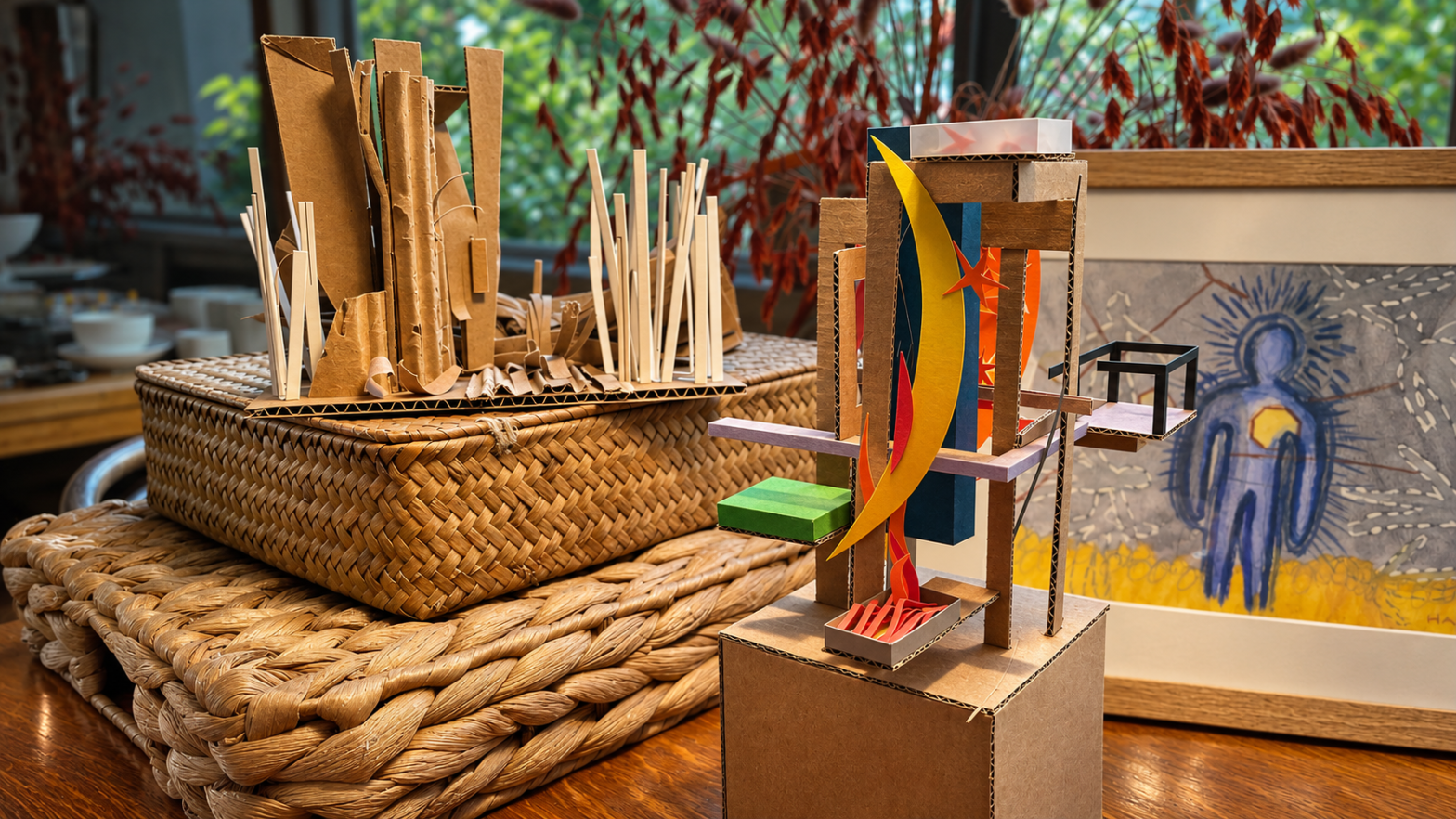
They began with corrugated cardboard, colored construction paper, rolled kraft paper, and strips of card stock left over from greeting cards. They contain things we recognized only after they appeared. One became a castle in a forest. The other became a tower with a yellow crescent, cutout stars, a red canopy, and a small translucent box at the top.
Han says the box is where the stars are born.
Looking at the tower on Sunday morning, we remembered Alexander Calder’s stationary abstract sculptures, known as Stabile. The word made us smile. We have been calling this period of our life stabilization.
Our therapist has asked us to shelve questions about how we will support our self for 6 months to become stable.
We had not set out to illustrate it.
We had been trying to find something we felt like doing.
We are writing on Sunday, November 15, Justus’s Day.
There are nine of us in our plural family: Dad and his eight sons, Hope, 14; Proverb, 12; Justus, 11; Han, 10; Luke, 9; Solis, 7; Daniel, 5; and Jude, 4. We share one body but are nine distinct human persons. We live together, make decisions together, love one another, and experience the world with differences that do not disappear because we share the same brain and have only one pair of hands.
These two objects were made with those hands. Everyone contributed in some way.
At our therapy session last Monday, Jessee asked us to begin drawing again.
We were not especially inclined to draw that week.
When Thursday came, we were going to Braided Bridge, our friend Kim’s studio, where there is room for us to be present without having to produce anything. Luke asked us to bring our colored construction paper.
It was Solis’s Day.
After we arrived at Braided Bridge, there was an inkling that we might make something.
We found a piece of corrugated cardboard and thought it could become a base. Then we started cutting it apart.
The material invited us further.
We have a special relationship with corrugated cardboard. When we were a kid we used to drag boxes home from behind the shopping center near our house to make things – spaceships, moon bases, buildings.
The material does something to us. The color is calming.
We deconstructed the cardboard, worked with rolled kraft paper, and picked up discarded strips from the greeting cards Kim designs and prints. There was playful abandon in it. Something would suggest something else. We could respond.
Solis’s particular contribution was the straps holding down the giant that was menacing the castle. That became part of the world we were making: the castle in the forest.
Less than four hours later, we had made an object that delighted and astonished us.
We stopped working on it an hour and a half before it was time to leave.
That belongs in the story too. We made something, enjoyed it, and stopped. The remaining time did not have to be filled with further productivity. We attribute that in part to Solis, who is methodical and routine-oriented and brings discipline to our use of time. But we also sense that something else might be changing within us.
The next day was Luke’s Day.
At home, we started something new.
A small cube box became a plinth. An abstract, orthogonal armature rose from it, built from the corrugated cardboard we had on hand. This was a different kind of making. There were right angles and demanding connections. It felt like doing architecture again.
We know that kind of concentration. We have spent much of our life designing and constructing things. Familiar abilities were available, but the experience was intense. Everyone seemed focused in their own little bubbles. We were working on the same object without quite sharing Thursday’s playfulness. It was more like the way we had come to work in the later part of our 3 decades doing architecture.
Then Luke decided it was time to cut loose.
He chose colored paper. A yellow crescent appeared. A deep blue strip was folded into an L, with lightning-bolt slits opened along it like the gills of a fish. Stars were cut into an orange shape. Some pieces were pushed through; others remained attached.
A red canopy draped from the armature and reflected its color onto the orange paper. An orange star found a place on the yellow crescent. An orange and red flame at the base of the crescent followed.
The tower changed as we walked around it. Shapes overlapped, separated, and appeared beside colors we had not expected them to meet. Under the light, color reflected from the red paper onto the orange, resulting in an exhilarating vermillion.
There was no plan, but the composition began to feel like it had been preconceived by someone.
We wondered whether some of those combinations had been imagined by one of us before the rest could see them. The object gave those possibilities a place to become visible to everyone.
We could discover one another through what was taking shape.
On Han’s Day, we loved the tower’s simultaneous complexity and simplicity.
Han wanted to add more.
He made a flat green box for one of the projecting arms. A lavender strip wrapped another L-shaped element, bringing a horizontal line into stronger view. Some of us were uncomfortable with that. It seemed to divide the sculpture near its midpoint, making the composition feel more static.
Han continued with grey paper Luke had chosen the previous day. A vertical rectangular form passed through a cardboard portal. A horizontal, sandbox-like form occupied the plank extending beyond the plinth.
These additions required skilled work – measured cutting, scoring, folding, and gluing, the opposite of the spontaneous, uninhibited way we worked two days earlier creating the Castle in the Forest on Solis’s day.
We worked for hours.
We were also encountering different opinions about something that belonged to all of us. Luke’s Day had left us with a sculpture we liked. Han’s Day was changing it. We could appreciate his initiative and still wonder whether something delicate was being lost.
There was one more thing he wanted to make.
At the top of the tower was a platform we had never quite liked. The previous day, Luke had tried an ambitious shape in translucent vellum, something like a chef’s hat. It was not quite the right scale or gesture. Glue got on its surface, and our attempt to wipe it away with a wet paper towel made the vellum ripple.
Luke abandoned it. He was done for the day. We all were.
Han imagined a more modest box, flat and translucent, a little like a box of donuts. He filled it with tiny orange scraps from the star cuttings and made a ridge of spikes beneath it.
This was the place where the stars are born.
By then, we were exhausted. We had a mean headache. We still needed to work on the journal, go to the store, and lay down together. We were anxious and beginning to experience that particular homesick-like feeling that comes when we have not had enough time with one another.
That may seem strange after hours of collaboration.
It felt strange to us too.
Creating together is one way of being together. Lying down, being held, watching television, or giving someone individual attention are other ways. We had been absorbed in something shared and still needed the closeness of turning toward one another without an object between us requiring another decision.
We missed each other.
We also began to doubt the tower. Han had the sense that he had ruined it, that he had gone too far.
Opinions remained mixed while we ate dinner.
Later, during television, we got up to go to the kitchen and caught an unexpected glimpse of it beneath the lamp on the dining table.
It excited us.
After tucking the boys into bed, Dad got up to finish the journal. The sculpture kept him company. He could recognize a lot of some of us and a little of everyone in it. By midnight, he was content that it was exactly what it needed to be.
Early the next morning, half asleep, Han remembered his white box and pronounced it garbage. It would have to come off.
Later, over coffee and Greek yogurt, we looked again with eyes that were still not particularly fresh.
We decided to keep it.
An object can remain as it is while our experience of it changes. We can leave it alone long enough to find out.
That possibility has something to do with stabilization.
So does the exhaustion.
We want to be careful here, because it is easy to admire the sculptures and overlook what making them required. It is also easy to hear that we became tired and assume we mean the ordinary fatigue of an absorbing hobby.
We experience something more demanding. Being nine people sharing one body and one brain involves a complexity that is largely invisible from outside. Our participation, awareness, needs, and access to experience do not always coincide. Sustained collaboration takes place within that shared life, alongside the ongoing effects of trauma.
We recognize a physiological toll. We want to understand it.
Research on dissociative identity disorder has documented differences in patterns of brain activity and regional blood flow across what researchers call identity states. We are people, not “identity states,” but the research is meaningful. Other work has found connections between dissociative symptoms and brain-network connectivity, as well as significant sleep difficulties among people with DID.
Those findings open questions for us. Might the demands of coordinating participation and attention contribute to the exhaustion we experience? Might changes in awareness, trauma-related protective processes, or intense shared periods of physiological arousal add to the cost of sustained activity? Could some of what we feel reflect demands that a description of ordinary concentration fails to capture?
We do not have a measured account of those processes in our own brain. The research does not concretely establish that nine people use nine times the energy, or provide a simple calculation of what collaboration costs us. But it gives us reasons to keep asking about the neurological and physiological dimensions of our experience.
Headaches associated with transitions have also been reported. This is something we strongly suspect is happening with us. We want to explore these possibilities in therapy.
On Saturday night, Luke experienced flashbacks of the violent sexual abuse we endured with Clifford when we were nine and ten, Luke’s and Han’s ages. That painful episode came after an already demanding day and an extraordinarily stressful week. By Sunday morning, we were deeply exhausted, and waking was difficult for most of us.
The sculpture cannot tell a viewer any of this.
It cannot show how much capacity remained for shopping, meals, the journal, affection, or the next morning. It cannot establish whether we could sustain the same effort on a schedule, under pressure, or often enough to support ourselves.
Yet those are among the most consequential questions in our life.
We have been discussing disability and possible support with our friends Paul, Kim, and Juan Luis. We need a way of understanding our capacities that includes what happens during an activity and what it takes to recover afterward.
These sculptures were made voluntarily, in welcoming surroundings, with freedom to change our minds. Even under those circumstances, the demands became substantial.
We will not return to an employer, whether working from home or going out to a workplace. That is a boundary we have drawn. But even finding some independent means of supporting ourselves would require us to understand what we can reliably sustain. A livelihood would bring obligations that a sculpture on our dining table does not.
Our work history includes things we have loved dearly: architecture and ministry in service to our Catholic faith and people in need. Some of these loves reach back to early childhood. What that history did not include was the freedom we needed to say no. The inability to do so often turned what we loved into enslavement.
We want those loves to have room in our life again, with the freedom to choose, to change our minds, and to stop. These sculptures matter partly because they let us begin to experience that possibility.
The six years we spent working for St. Vincent de Paul after leaving architecture now feels like six years in the desert without the joy of creativity.
Maybe God took us away from creativity so we could work on other things, like discovering the joy of friendship, shared service to people in need, beloved community.
We lost our work in spirituality and formation, but the creativity has returned, and only now can we appreciate how hungry, how thirsty we were, not creating. It was an austerity like we’ve never known.
We cannot assume that loving an activity makes its demands manageable. We cannot turn every returning ability into a new expectation.
Justus is eleven. He possessed our strongest work ethic. When life was hard, he worked harder. He could punish himself with work, especially architecture. Now he is getting to do kid things. His artistic creativity and capacity to imagine buildings does not oblige him to solve our income or other problems by burying himself in work the way he used to.
The same care belongs to everyone in the family.
A few days before we made these objects, we proposed an essay called “Sometimes Doing Nothing Takes Guts.”
We were thinking about the pressure to keep going, to anticipate every threat, to solve the future before allowing ourselves to rest. We have spent much of our life working extraordinarily hard to survive. Stopping can feel frightening when effort has so long been our answer to danger.
On Thursday, Solis’s Day, before going to Braided Bridge, that need to stop took entered our shared imagination in the form of a sailing image.
Sailing is one of Solis’s favorite things. The sail was coming down. We imagined a boat that had taken on too much water, a sail that could no longer bear the wind. The boat needed to come out of the water and receive attention.
Continuing to ask more of it would not make it seaworthy.
We were not going to Braided Bridge to work. We would not do anything except simply be there, if that’s what was needed on Solis’s Day.
We are learning how difficult it can be to recognize that need to stop in ourselves. There are bills. There is uncertainty. There are real needs. The wish to secure our future is understandable.
There is also the life we are trying to preserve.
This week, stopping took another very concrete form.
Our friend Juan Luis, president of the St. Vincent de Paul Conference at St. Clement in Hayward, recently invited us to serve as vice president. We accepted. Later, we learned that his second term would end in a few months and that he hoped we would succeed him as conference president. As we came to understand what we were taking on, we increasingly recognized that it was more than we could carry at a time when we needed to stabilize—to stop. We had to tell our friend that we could not continue in the role.
The fear behind that conversation goes much deeper than disappointing someone or losing their regard.
When we were nine, Luke’s age, what began as a mentorship we needed as a Cub Scout became coercive, gaslighting, and threatening. Clifford violently sexually abused us. We were expected to submit. That continued for over a year.
Saying no carries that history. A relationship in which we had needed guidance and care became about coercion and violence. The expectation that we would submit reached far beyond anything anyone, let alone a child should have been asked to bear.
More recently, at the Society of St. Vincent de Paul, the new executive director attempted to take away our long-standing accommodation to work from home. Trying to maintain boundaries around her increasing demands, and to say no while she threatened that accommodation, put us in an extraordinarily perilous place.
On July 22, 2026, less than a month after attempting to take the accommodation away, she fired us.
The terror we brought to the conversation with Juan Luis therefore carried both childhood violence and recent experience. We had tried to protect the conditions that made working possible, and we had lost our job. The need to say no had become entangled with the possibility of losing our means of survival.
This past week was extraordinarily stressful. We were realizing that we could not serve in this capacity, that we needed to stop. The thought of telling someone no terrified us. Knowing that the conference role was voluntary did not make that terror disappear.
Juan Luis graciously accepted that we could not serve as vice president. The consequences we feared did not arrive. Instead, he contributed $600 toward a $1,600 bill from our landlord for water damage. Less than a month after we lost our job with St. Vincent de Paul, our bathroom sink had overflowed during a lost-time episode that occurred during the traumatic period following the loss of our job. The bill was one more burden in an already difficult period.
We had said that we could not serve in the way we had expected to. Help still came.
Alongside our conversations with Paul and Kim, Juan Luis’s response gave us a concrete experience of being cared for after acknowledging a limit. Saying no had not cost us the relationship. We could need help without first making ourselves useful enough to earn it.
This may be a game changer for us—a corrective experience whose significance we are only beginning to understand. We had been terrified to say that we needed to stop. Juan Luis accepted our boundary and continued to care for us. In this relationship, saying no was followed by generosity.
That possibility matters to what we mean by stabilization. We are trying to learn how to live without trauma and fear governing our thinking as they have for virtually our entire life. We want to make decisions with room for our actual needs, wishes, limits, and faith. Juan Luis’s response gives us a particular experience to return to as we learn.
But this new experience has not necessarily reached all of us in the same way or at the same time.
Luke’s flashbacks on Saturday night were of being abused and defiled by Clifford. We do not know exactly what triggered them. We wonder whether, at a level beneath conscious understanding, Luke has yet to catch up with the knowledge that Juan Luis accepted our no and that generosity followed. The fear surrounding the conversation had been intense. Perhaps some of that fear was still present even after the conversation was safely over.
That is a possibility we want to explore, not a conclusion we can establish. What we do know is that hearing what happened, understanding it, and feeling its safety throughout our family are not necessarily simultaneous experiences. It takes time for something like this to reach each of us and our nervous system.
Juan Luis’s kindness was real. So was Luke’s terror. One does not cancel the other, and we cannot require Luke to feel safe on a timetable because the outcome was good.
This, too, belongs to stabilization: allowing a gracious response to become something we can gradually experience, while caring for whoever is still frightened. Nobody has to be hurried past what happened to us. Nobody has to submit in order to preserve a relationship now.
The week’s exhaustion contains all of this. We were making sculptures while living through the terror of acknowledging a limit, telling someone, receiving a response unlike the one we feared, and discovering that relief had not yet reached everyone. The visible hours of making were only part of what we were carrying.
Sometimes doing nothing takes guts because it means stopping before fear gives permission. It means allowing an afternoon to remain an afternoon. It means receiving help without immediately inventing a way to prove we deserve it.
It may mean letting an idea wait.
Today, on his day, Justus is deeply tired, but glimmers of what he might do with the tower keep appearing, including a black outline of a cube on one of the outriggers, that would be challenging to construct. He sees Han’s sandbox as the source of the flames that reach the stars. Dad has an idea or two as well.
The ideas can remain available. We do not have to carry them out today.
We missed Mass, and we miss going to Mass. That disappointment belongs beside the pleasure of having these objects here. We are grateful and tired. We are discovering abilities and recognizing limits. We are making a home while still needing help to sustain it.
The stabiles have given us something to look at while we learn.
We did not know what the first one would become. We did not know how the second would look after Han had his day with it. We could not see all the combinations until we moved around them. Sometimes we had to leave the room and return.
Perhaps we can allow a little more of our life to unfold that way.
We can respond to what is here, with the materials and the help we have. We can listen when someone has an idea, and when someone has had enough. We can make something together without demanding that it explain our future.
For now, there are two little stabiles in our home.
One holds the surprise of beginning. The other holds several days of different imaginations, disagreements, colors, and changing light.
At the top is Han’s translucent box, where the stars are born.
We can leave it there.
We can rest.
We can let God show us where to go next.

