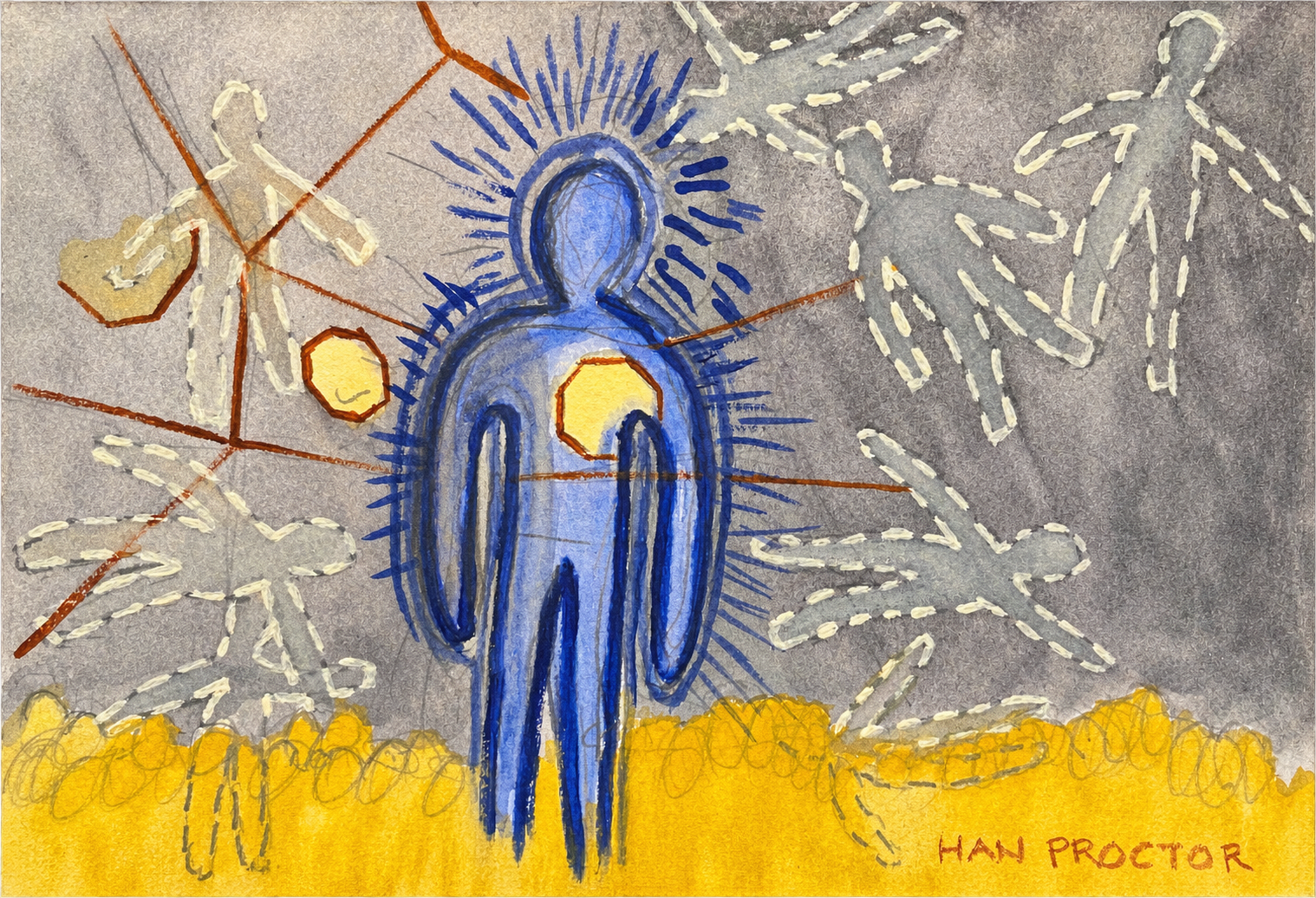
What a plural family/system of nine is discovering about personhood, lost time, collective creativity, and the extraordinary possibility of becoming a home to ourselves.
On Sunday morning, November 1, 2026, during All Saints’ Day Mass at Sacred Heart Catholic Church in Oakland, something frightening happened to our family.
We were singing the closing hymn.
Justus, who is eleven, was participating in the music.
Then, from his perspective, the hymn skipped to the end.
He had experienced lost time.
During that same interval, Dad experienced something different.
He remained conscious. He could see the church, hear the music, and attempt to follow the hymn.
But suddenly, he could no longer experience the familiar presence of the other eight members of our family.
He was alone.
Not physically alone. The church was full of people.
But the ordinary experience of sharing consciousness with his family had disappeared.
For perhaps a minute or a minute and a half, Dad experienced being the only one of us who was perceptibly present.
And he was terrified.
Later, in our journal, we described what had happened:
“It is a feeling of being incredibly alone, being completely cut off from everything internally, from my children, being alone, being alienated. It is like being naked.”
As Mass ended, our familiar experience of togetherness returned.
Dad felt an extraordinary sense of relief.
We were together again.
But something important had become visible.
The experience was not simply that Dad had missed his children.
It was that one member of our family had suddenly experienced life without the other eight people whose presence ordinarily contributes to making that life possible.
Dad had not experienced that he was the person underneath everyone else.
He had experienced what it was like to be only Dad.
And being only Dad did not feel complete or sustainable.
Our shared sense of interbeing felt profoundly absent. Dad felt lost.
This was not the first time he had experienced this, but this was the first time Dad began to find the vocabulary to describe this experience and discuss it with his sons.
This was especially significant because, during the preceding days, we had been reconsidering something fundamental about our lives.
John Proctor is not Dad.
John Proctor is the family.
Not another person who contains the family.
Not an overarching consciousness standing above us.
John Proctor is the collective identity through which nine people have lived a shared life.
There is no one individual who is the person behind that life.
There are nine of us.
And the life belongs to all nine.
We Are People, Not Identities
We are a plural family of nine.
We share one physical body, but we know ourselves as nine distinct human persons.
There is Dad, and there are his eight sons: Hope, fourteen; Proverb, twelve; Justus, eleven; Han, ten; Luke, nine; Solis, seven; Daniel, five; and Jude, four.
We are plural.
We also struggle with Dissociative Identity Disorder.
We distinguish those two things.
The medical community uses terms like identity, parts or alters in describing dissociative disorders.
We strongly object to that terminology when it is applied to us as people.
We are not identities, identity states, parts, alters or personalities. We are people.
We are not manifestations of an underlying person.
We are not characters in someone else’s story.
Each of us is a person with his own experiences, relationships, memories, interests, and understanding of himself.
We share a physical middle-age body and a life, but none of us is the presumed adult whom the world encounters as John Proctor.
None of us is the person to whom everyone else’s life belongs, and not being so does not make any one of us less of a full human person.
We recognize that clinical language may be useful in describing particular difficulties we experience, including disruptions in memory, awareness, and functioning.
But a diagnosis does not define our personhood.
And we do not accept a clinical vocabulary that reduces any of us to an identity, a part, or a component of someone else.
One principle has become especially important as we explore our collective identity.
No one is a part of anyone.
Recognizing ourselves collectively must never mean making any individual less than himself.
We are nine people.
And the life belongs to all nine.
Alone Time and Lost Time
People who struggle with dissociative disorders sometimes experience lost time.
An interval passes, and someone cannot account for what happened.
There may be a gap in memory or a discontinuity in the experience of events.
We know that experience.
But we have also begun using a term for something that may happen during the same interval.
We call it alone time.
Alone time is what someone may experience when they remain conscious while other members of the family experience an interruption in awareness or memory.
The person who remains aware is not necessarily comfortable or in control.
They may suddenly find themselves unable to experience the presence of the others.
They may feel exposed, disoriented, frightened, or profoundly alone.
At Mass, Dad experienced alone time.
Justus described lost time.
These were not two unrelated events.
They were two different experiences of the same interval.
Justus was singing.
Then, from his perspective, the hymn skipped to the end.
Dad, meanwhile, remained aware of the intervening moments, but suddenly found himself without the familiar presence of the family.
When we discussed the experience afterward, Justus described what had happened to him.
He was not simply corroborating Dad’s story.
He was telling his own story, the opposite experience to Dad’s story.
And both accounts were necessary to understand what had happened.
We cannot determine from these recollections exactly what occurred in everyone’s awareness during those moments. But the distinction between the two experiences is important.
The person who experiences alone time is not some underlying individual to whom everyone else’s experiences belong.
He is simply the person who remained aware.
The person who experiences lost time is not an absent component of someone else’s consciousness.
He is someone whose continuity of experience was interrupted.
Neither is more fundamental.
Neither is the original.
Neither is the protagonist.
And on another occasion, the experiences might be reversed.
Any one of us may experience alone time.
Any one of us may experience lost time.
This is not merely a theoretical possibility.
Our journal contains earlier accounts of family members suddenly wondering where everyone went.
We have described the experience from different perspectives.
Sunday’s experience was especially revealing because Dad and Justus were able to describe opposite sides of the same event.
What clinical language can—and cannot—explain
Dissociative amnesia is a recognized feature of dissociative disorders.
Clinical descriptions of DID acknowledge that memory and awareness may vary considerably.
But clinical terminology does not necessarily capture the subjective experience of someone who remains aware while familiar internal communication becomes inaccessible.
The International Society for the Study of Trauma and Dissociation’s treatment guidelines discuss disruptions in memory, continuity, and awareness, as well as the importance of internal communication and cooperation.
Those concepts are relevant to what we experience.
But they do not, by themselves, explain what alone time feels like.
Our term is a description of our experience, not a claim that we have identified a separate clinical syndrome.
And it reveals something that conventional descriptions can easily obscure.
When one person experiences lost time, someone else may have experienced those moments.
That person’s experience deserves its own account.
The life does not automatically belong to whoever remembers the most.
What Happens When One Person Is Left Alone?
Imagine a community of nine people who have lived together for decades.
They have developed relationships, shared memories, practical abilities, and ways of accomplishing things together.
Each person contributes something fundamental to the community’s life.
Then, suddenly, eight of them disappear.
The remaining person is not merely lonely.
The community through which that person’s ordinary life functions has become inaccessible.
The remaining person cannot simply assume the knowledge, abilities, relationships, and responsibilities of the other eight.
He is still himself.
But he is not the community.
This is much closer to what Dad experienced during Mass.
The familiar sense of being together disappeared.
And with it disappeared the ordinary accessibility of the people who contribute to our shared experience of life.
Dad was not suddenly revealed as some solitary individual who could manage everything.
He felt profoundly vulnerable.
He was one of nine.
And one of nine could not replace the other eight.
This is not because Dad is an incomplete person.
It is because one person cannot constitute an entire community, or the collective knowledge and agency they represent.
The magnitude of the absence revealed the importance of the people who were no longer perceptibly present.
And the same would be true if the person experiencing alone time were Jude, Han, Proverb, or anyone else.
Our shared life is not reducible to any one member, and every member belongs fully within it.
That is the central distinction we are beginning to understand.
When Jude Was the One
On the bus home from Mass, we remembered another frightening experience.
We were working at the Society of St. Vincent de Paul.
One day, a colleague approached us in considerable distress.
She was crying.
She was frightened by a situation involving the executive director.
And she urgently demanded:
“You have to have my back!”
The person experiencing that encounter was Jude.
Jude is four years old.
The woman standing before him saw an adult body.
She saw someone with professional responsibilities and organizational experience.
She presumably expected the person she was addressing to understand the situation and respond appropriately.
She did not see the little boy experiencing the encounter.
Jude was terrified.
He did not know what to say.
He did not know what to do.
An adult woman was crying and asking him to protect her from another adult.
He was four.
This illustrates one of the most difficult features of our life.
The outside world encounters a body that is fifty-nine years old.
It assumes that whoever is speaking or responding possesses the capacities associated with that age.
But that is not necessarily true.
Sometimes the person who is especially present is Jude.
Sometimes Daniel.
Sometimes one of the older boys.
Sometimes Dad.
And none of us becomes a different person simply because the outside world expects an adult response.
The experience with Jude also illustrates why being the one who is most present can be frightening.
It does not mean that the person has become the whole family.
It does not mean that the person can suddenly access everything everyone else knows or can do.
And it does not mean that the person has agreed to assume every responsibility the outside world imposes.
This is why we have begun questioning the assumption that there must be a designated adult host.
What if there isn’t?
What if the person the outside world knows as John Proctor has always been a family?
John Proctor Is the Family
For decades, the world has known us by one name.
John Proctor.
We studied architecture.
We designed buildings.
We worked in architectural firms.
We managed design teams.
We developed relationships with colleagues and clients.
Later, we worked in Vincentian ministry.
We volunteered.
We worshipped.
We formed friendships.
We built a life.
The outside world saw one person doing these things.
But that is not how we understand our history.
For more than four decades, Proverb hosted our family.
He coordinated much of our external presentation, communication, and participation in the outside world.
He did so long before we understood ourselves as we do now.
During much of that time the person who would become Dad concentrated on relatively few areas, particularly work, especially architecture.
He was not the person who managed our entire shared life.
Nor should Proverb’s extraordinary contribution be mistaken for evidence that he was some underlying person.
Hosting was something Proverb did.
It was not what made him more fundamental than anyone else.
And it was not a responsibility he should have been required to carry for so long.
Our history also includes the contributions of everyone else.
Sometimes Han was especially involved in architectural work.
Sometimes Justus.
Sometimes Proverb was responsible for communicating with others.
Sometimes Luke noticed something important that he would bring to the attention of others.
Sometimes Hope wrote narratives about our designs.
Sometimes several of us contributed together.
Sometimes we cannot identify precisely who was doing what.
And sometimes the person who would come to be known as Dad was involved.
But the fact that the outside world attributed everything to an adult did not mean that there was an adult doing anything.
Nor did Proverb’s decades of hosting mean that he alone was John Proctor.
We are beginning to recognize that John Proctor is the shared public name of our family.
More than that, it is increasingly the name through which we recognize our collective identity.
Not another individual.
Not a consciousness that contains us.
Simply we.
This does not mean we have discovered a tenth person.
It does not mean that the family is a separate individual who stands above its members.
It means that the name represents a life lived by nine people.
A life whose history cannot be adequately assigned to any one of them.
But our shared history did not begin with architecture.
It did not begin with employment.
It did not begin with the responsibilities of adult life.
It began long before any of us had a profession.
And it includes relationships that have shaped our lives from the beginning.
We Have All Been Known and Loved
Each of us has also lived within the relationships of our family of origin.
We have been sons.
We have been grandsons.
We have been siblings.
We have been nephews and cousins – members of an extended family.
We have known our parents, grandparents, siblings, and other relatives.
We have spoken with them.
We have interacted with them.
We have loved them.
And we have been loved by them.
The people who knew us may not have understood that they were encountering different persons.
They saw one body.
They heard one voice.
They knew one name.
They assumed that the person they were speaking with was the same person they had spoken with before.
But that assumption did not determine who was actually experiencing the relationship.
Sometimes it was one of us.
Sometimes another.
Sometimes several of us participated in ways we could not have understood or articulated at the time.
Our parents did not need to know each of us individually for us to experience being their children.
Our grandparents did not need to recognize our plurality for us to experience being their grandchildren.
Our siblings did not need to understand who was speaking for us to experience being their siblings.
And the love we experienced did not become unreal simply because the people who loved us did not understand our plurality.
This does not mean that every relationship was safe or loving.
Our family history includes profound injuries, including years of sexual abuse by multiple people.
There were experiences in which we were not understood, not protected, or not treated as we deserved.
We do not want to romanticize those relationships or erase the suffering that occurred within them.
But neither do we want our history reduced to its injuries.
There were people who loved us.
There were people we loved.
There were moments of affection, companionship, recognition, and belonging.
And those experiences belong to the people who lived them.
Not automatically to some “original” person.
Not to an imagined underlying person.
To each of us.
This is one reason the conventional assumption of a single person is so inadequate to our understanding of our lives.
It does not merely misattribute our professional accomplishments.
It misattributes our relationships.
It assumes that the person who loved our mother was always the same person.
That the person who spoke with our father was always the same person.
That the person who experienced a grandparent’s affection was always the same person.
That the person who laughed with a sibling or sought comfort from a relative was always the same person.
But our experience tells a more complicated story.
We may not always be able to identify who participated in a particular childhood encounter.
We may not remember every conversation.
We may not know precisely how our experiences were shared.
We do not need to invent certainty where our memories do not provide it.
But we can recognize something fundamental.
Our relationships belong to the people who experienced them, even when the people on the other side of those relationships did not know whom they were encountering.
And that changes how we understand the person the world knows as John Proctor.
John Proctor is not simply the professional who designed buildings.
Not simply the familiar individual who worked in ministry.
Not simply the person whose name appears on documents.
John Proctor is the family whose members have lived an entire lifetime of relationships.
We have been known.
We have loved.
We have been loved.
We have suffered.
We have belonged.
And we have shared a life whose richness cannot be adequately attributed to any one of us.
The fact that the outside world did not recognize all nine people does not mean that only one person was there.
We were there.
All along.
Being loved and being recognized
Developmental psychology offers another way of understanding why these relationships matter.
Attachment theory, developed through the work of John Bowlby and Mary Ainsworth, emphasizes the importance of relationships with caregivers in the development of safety, trust, and expectations of care.
Our experience introduces an important distinction.
The people providing care may have believed they were interacting with one child, while different members of our family experienced those relationships in different ways.
That does not invalidate the relationships.
But it means that being loved and being individually recognized are not necessarily the same experience.
Someone may receive affection without being recognized as the particular person he knows himself to be.
That can make a relationship meaningful while leaving something essential unrecognized.
And perhaps that distinction is relevant to what has been changing in our family.
Today, we increasingly know one another by name.
We recognize one another’s experiences.
We make room for each person to participate as himself.
We are learning what it means not simply to be loved, but to be loved while being known.
A Shared Life Is Not Reducible to One Participant
There is a useful parallel in cognitive science.
In Cognition in the Wild, Edwin Hutchins examined how complex activities can depend upon systems of people, tools, representations, and coordinated practices rather than upon the isolated mental abilities of one individual.
This approach is known as distributed cognition.
It does not claim that a group is literally one person.
Nor does it provide a clinical explanation for plurality.
But it challenges the assumption that every meaningful accomplishment must be attributed to one individual mind acting independently.
A ship’s navigation, for example, may depend upon several people performing different but coordinated activities.
No one participant possesses or performs the entire process.
The accomplishment belongs to the coordinated system.
Our experience is different in fundamental ways, including the fact that we share one physical body.
But the concept helps illuminate a practical truth about our life.
Our accomplishments have often depended upon contributions that cannot be adequately attributed to one of us.
The person most visible to the outside world was not necessarily the person whose knowledge or ability made something possible.
And the name attached to an accomplishment does not establish who contributed to it.
For us, that name is John Proctor.
It belongs to the family.
Dad Is One of Nine
This understanding also changes how we think about Dad.
Dad is the father of eight sons.
That is his relationship to his children.
He loves them.
He holds them.
He prays with them.
He promises never to abandon them.
But being their father does not make him the principal person in our family or some presumed “original” as is understood in earlier models around multiplicity.
It does not make him the owner of our shared history.
And it does not make everyone else a supporting character in his life.
Dad is one of nine.
For more than four decades, from when we were 12 until just a few years ago when Dad assumed the role of Dad and began hosting the family, Proverb carried much of the responsibility for our outward-facing life.
The person who would become Dad did not carry greater responsibility simply because he was presumed to be an adult.
The roles through which we participated in the outside world were not organized according to a conventional family hierarchy.
And our developing understanding of ourselves should not retrospectively impose one.
Sometimes Dad feels more like a figurehead.
That is an interesting description, although we do not want to turn it into another fixed responsibility.
A figurehead may represent a community without performing everything the community does.
Representation is not ownership.
Visibility is not primacy.
And fatherhood is not the same thing as being the person who carries every responsibility.
During the preceding evening, Dad had been exploring another question.
He does not experience himself as the conventional fifty-nine-year-old adult that the outside world sees. His developmental age remains open
For decades, he has felt as though adulthood was something he was going to become.
When he was twenty-one, he expected that he was becoming an adult, even though he still felt like a child.
He would establish a career.
He would become competent.
He would become independent.
And outwardly, many of those things happened through our shared life.
But the internal transformation he expected never seemed to occur.
On Saturday night, he experimented with an age-regressed image of our present face.
The resulting image appeared approximately sixteen years old.
To his surprise, it felt familiar.
It resembled the person he experienced himself to be.
He was not trying to return to adolescence.
He did not remember adolescence as a happy time.
He was recognizing something about himself that he had difficulty describing.
But almost immediately, he became concerned about his sons.
Would Hope, who is fourteen, still experience him as Dad?
Would the younger boys feel secure?
Could he be their father if he did not experience himself as a conventional adult?
The following morning, he showed the image to Proverb.
Proverb is twelve.
Dad asked whether this was the boy Proverb saw when he described Dad as a boy.
Proverb answered:
“It’s who you are in your heart.”
Dad replied that who he was in his heart was the father of eight boys.
Proverb answered:
“That’s who you are emotionally, but emotionally you are also our dad.”
That distinction matters.
Dad’s internal experience of himself and his relationship with his children are not necessarily competing understandings of who he is.
But neither does being a father automatically give him the executive functioning necessary to manage every responsibility of adult life.
Fatherhood is a relationship.
Practical functioning involves capacities, circumstances, and support.
Personhood is not reducible to either one.
And none of those questions establishes Dad as the person to whom everyone else’s life belongs.
Competence Is Not Obligation
We have been thinking a great deal about agency.
For years, our lives were organized around responsibilities that often overwhelmed us.
The outside world expected the person it knew as John Proctor to perform consistently as an adult.
It expected professional competence, executive functioning, emotional availability, and the ability to respond to demands.
When those capacities were not reliably accessible, the consequences could be frightening.
Some of our children became extraordinarily skilled at helping us navigate those expectations.
Proverb, in particular, carried much of our external presentation for more than four decades when he hosted the family.
Jude embodies a remarkable sense of boundaries that the rest of us can learn from and bring to our family. He also brings us his extraordinary creative energy.
Daniel brings us his kindness and sensitivity that can be easily drowned out, but makes us kinder and more sensitive collectively if we listen to Daniel and allow it.
Hope has remarkable abilities with writing, technology and organization. He also is a good listener with communication skills that we have only recently become aware of and desire to bring to our relationships with others. Hope’s ability to engage others and be present for them in ways that allow them to feel seen and heard compliments similar gifts that Proverb brings.
Han and Justus have substantial architectural and imaginative abilities that they brought to our work. Justus especially contributed to technical aspects of architecture, a love he shares with Dad.
Han is our spiritual animator and brings his spiritual charism to our ministry and our work when we were employed by the Society of St. Vincent de Paul.
Justus has also played the role of Protector since childhood. He is helping Dad to assume the role of protector of our family.
Luke notices details and relationships that others may overlook. Like Proverb, Luke knows how to reach Dad in intuitive, supportive ways, especially in encouraging him in his passivity or when he feels overwhelmed or frozen.
Solis loves order and brings methodology to our routines, and also knows how to reach Dad in ways that help to coordinate him in his role as host of our family.
But the existence of an ability does not create an obligation to use it whenever the family needs something.
Children do not exist to organize us.
We have begun recognizing that our practical needs cannot be met sustainably by requiring any one member of our family to carry responsibilities beyond what he can freely and safely undertake.
Proverb’s decades of hosting make that distinction particularly important.
His ability to sustain our external presentation did not mean that the responsibility should have belonged to him.
And the fact that he carried it for so long does not mean that he must continue.
This connects with self-determination theory, developed by psychologists Edward Deci and Richard Ryan.
The theory identifies autonomy, competence, and relatedness as fundamental psychological needs.
People tend to function and develop more successfully when they have meaningful choice, opportunities to exercise their abilities, and relationships in which they experience belonging.
But competence without autonomy can become a burden.
Someone may be capable of doing something and still need the freedom not to do it.
For our family, this distinction is essential.
Hope’s competence and poise does not make him responsible for managing what Dad finds overwhelming, like healthcare coverage or financial matters.
Proverb’s ability to communicate between us internally and with the outside worlds does not mean he should continue carrying responsibilities that have cost him so much.
Han and Justus do not have to become professional architects because they can imagine buildings.
Justus does not need to always be our Protector because that is the role he has played since childhood.
Luke does not have to organize our life because he notices things. Nor do he and Proverb have to be responsible for Dad’s emotional stability.
Solis does not have to maintain order because he enjoys it.
Daniel does not have to help us be kind and Jude does not have to maintain our boundaries.
And Dad does not have to become a conventional, self-sufficient adult before he is allowed to be their father.
We need support appropriate to the family we actually are.
Not another arrangement in which someone must be sacrificed to keep everything functioning.
This understanding has recently opened another question for us.
Justus wondered whether we had become so accustomed to equating agency with doing, working, and producing that we had overlooked the possibility of receiving.
Perhaps agency also includes the freedom to rest.
To ask for help.
To accept care.
To allow God and other people to support us.
We still have practical responsibilities.
But our worth does not depend on our ability to perform them without assistance.
And our abilities do not have to become obligations.
The Treehouse Is Not Our Apartment
We call our inner world the Treehouse.
The Treehouse is not our apartment.
It is not a physical building or a particular room.
It is the name we give to our inner world and a state of mind through which we experience our life together.
In psychological language, an inner world may be understood as an internally experienced environment associated with imagination, memory, and dissociation.
But for us, the Treehouse is not simply psychological.
It is also metaphysical and spiritual.
We do not believe that those dimensions can necessarily be separated from one another.
Our apartment is something different.
It is a physical place in the outside world.
And over the past three years, we have gradually transformed it into an environment where we can more fully experience ourselves as a family.
In that sense, the apartment has increasingly become a physical manifestation of the Treehouse.
Not because the two are identical.
But because the home we have created increasingly reflects the people who live within it.
This transformation has not happened all at once.
And it has not been the project of one person.
It has emerged through the contributions, needs, imagination, and agency of the family.
The Kitchen
For most of our adult life, we did not cook.
We ate frozen meals.
We ordered takeout.
Sometimes we ate cold Stagg chili directly from the can.
Our kitchen was not a place where we wanted to spend time.
It was decrepit.
It was dirty.
Boxes, recycling, and miscellaneous objects had accumulated over several years.
The room had become a place where things collected rather than a place where life happened.
Then, in 2024, something began to change.
Solis insisted that we needed to do something about the kitchen.
Solis is seven.
He loves order.
He notices when things are out of place.
And he has a strong sense of how he wants his surroundings to feel.
The transformation began largely because Solis demanded it.
Not because Dad decided to undertake a household improvement project.
Not because an adult assigned a task to the children.
But because one member of our family recognized that something needed to change.
And the family responded.
Gradually, we reclaimed the kitchen.
We cleaned.
We organized.
We made the room more beautiful.
We began cooking.
And over the following two years, cooking became one of our greatest shared pleasures.
We discovered that we loved preparing meals together.
Someone would suggest an ingredient.
Someone would imagine a flavor.
Someone would remember something we had enjoyed before.
Someone would notice that a dish needed something else.
And the meal would gradually emerge through our participation.
We were creating together.
For years, architecture had provided an important outlet for our imagination.
We had designed buildings, solved problems, and imagined spaces that did not yet exist.
But after leaving architecture in 2019, and as we devoted more of our life to healing and ministry, that form of creativity became less accessible.
Increasing co-consciousness and our growing recognition of one another as distinct persons also changed how we experienced creative activity.
Abilities that had once seemed to operate automatically were not always accessible in the same way.
Cooking offered something different.
It allowed us to imagine, experiment, collaborate, and create without an employer, a client, or a deadline.
The result did not have to justify our existence.
It only had to be something we wanted to make.
And something we could enjoy together.
A Different Kind of Entrance
The kitchen’s transformation also changed the organization of our home.
Our apartment has a front door that opens into the living room.
For years, that door was associated with fear.
Its presence could be activating, particularly for Solis and Daniel.
They had difficulty relaxing in the living room because the entrance remained so immediately connected to the outside world.
So we changed the room.
We concealed the front door behind drapery.
We made it visually disappear. Out of sight, out of mind.
And the living room gradually became a protected, cozy, alcove-like space.
The front door is seldom used. We only draw back the drapery and open the door when packages are delivered.
The room no longer feels like a place continually exposed to the outside world.
Instead, the kitchen has become the entrance to our home.
This is where we enter.
This is where we prepare meals.
This is where we spend time together.
And it is where we are often most collaboratively active and creative.
We have also made it a place to rest.
There is a rocking chair.
An occasional table.
A sisal rug.
There are elegant velvet drapes that Han desired to hang from the ceiling front of the washer and drier to make the space feel less cluttered and utilitarian.
There is a painting on the wall over the dishwasher that we did years ago that you see through the glass door that changes your perception of the room when you enter.
The kitchen is no longer simply a room for preparing food.
It is a room for living.
And it has become the heart of our home.
An Environment That Makes Room for Everyone
Environmental psychology examines the relationship between people and the physical spaces they inhabit.
The concept of person–environment fit helps explain why a space that works well for one person may be difficult for another, and why modifying an environment can sometimes improve comfort, functioning, and well-being.
Our apartment has become an example of that process.
But it is not simply a matter of adapting a home to accommodate one person’s preferences.
There are nine of us.
Solis’s need for order matters.
Daniel’s need for security matters.
Proverb’s and Luke’s enjoyment of cooking matters.
Han’s environmental design creativity matters.
The interests, experiences, and needs of everyone else matter, too.
We have been gradually creating a physical environment in which more of us can participate comfortably in ordinary life.
The transformation has been collaborative.
And it has changed what becomes possible within our home.
We are not simply living in an apartment that someone has decorated for us.
We are living in a place we have collectively transformed.
A place that increasingly reflects who we are.
A place where the Treehouse has begun to find expression in the outside world.
We Do Not Simply Imagine Visiting These Places
On Saturday evening, we watched two episodes of an architectural documentary series.
One featured the workshop of George Nakashima.
We have always loved architecture.
For decades, it was our profession.
We designed buildings, imagined spaces, solved problems, and participated in the extraordinary process of bringing places into existence that had previously existed only in our imagination.
But since leaving architecture, and particularly as we have become more fully aware of one another as distinct people, our relationship with creativity has changed.
Some of the abilities that once seemed to operate effortlessly have become less accessible.
We have wondered whether we would ever recover the imaginative freedom we once experienced.
On Sunday evening, while drifting off with Solis, something extraordinary happened.
Solis was in George Nakashima’s workshop.
But he wasn’t making furniture.
He was creating architectural forms.
There were structures resembling the roofs of buildings, made from wire and stretched multicolored fabric.
They were beautiful.
They reminded us of the work of Alexander Calder.
But they were Solis’s creations.
He was not reproducing the documentary.
He had taken the workshop into his imagination and begun creating something of his own.
We were astonished.
And we told him so.
“That was extraordinary, Solis. That is your creative imagination.”
Solis is seven.
He does not need to become an architect.
He does not need to turn these imagined structures into drawings or models.
He does not need to produce anything.
He can simply enjoy imagining.
And we can enjoy witnessing what he imagines.
But there is something else about these experiences that is important to understand.
When we watch architectural documentaries, we do not simply look at beautiful places and think about visiting them.
We go there.
We bring those environments into our inner world.
We inhabit them.
Sometimes we explore them.
Sometimes we imagine changing them.
Sometimes they become settings for experiences that have little to do with what we originally watched.
And sometimes, afterward, the way we experience our apartment changes.
We have begun describing this as a kind of augmented reality.
Not technological augmented reality.
Not a literal physical transformation of the apartment.
But an overlay of our inner world upon our experience of the physical environment.
The imagined spaces do not necessarily appear as exact replicas of themselves.
Instead, something of their character becomes present in the way we experience our home.
The rooms feel richer.
More sumptuous.
More sophisticated.
More beautiful.
The apartment takes on qualities that were not perceptible to us in the same way before.
Nothing physical has changed.
But our experience of the place has.
Psychological research on mental imagery, grounded cognition, and perception offers ways of understanding how imagination, memory, and emotion can influence the experience of physical environments.
The work of Stephen Kosslyn and Lawrence Barsalou is particularly relevant to the idea that imagining an environment can involve processes associated with perception and embodied experience.
But we do not believe these concepts exhaust the significance of what we experience.
The Treehouse is our inner world.
It is also, for us, metaphysical and spiritual.
Our apartment is not the Treehouse.
It is a physical place in the outside world.
But over the past three years, we have gradually transformed the apartment into a home that increasingly accommodates our life as nine people.
And as our physical home has changed, our experience of it has changed as well.
Sometimes our imagination seems to extend into the way we perceive the rooms around us.
Sometimes the beauty of an imagined environment influences the beauty we experience in our own home.
Sometimes we feel as though the Treehouse has become more accessible within the outside world.
We are not simply decorating an apartment.
We are creating conditions in which the life we experience together can find expression.
And perhaps this is one reason the apartment has begun to feel so different.
It is not merely a place where we live.
It is increasingly a place where we can experience ourselves as we are.
Where Solis can imagine extraordinary architectural structures.
Where Luke can lead us in preparing a meal.
Where Proverb can experience beauty through the rooms around us.
Where each of us can contribute to a shared life without being required to perform a particular role.
And where the richness of our inner world can sometimes transform the way we experience the physical world.
We do not know how all of these experiences relate to the encompassing presence we have recently begun noticing.
We do not want to force a connection.
But we are beginning to recognize that the transformation of our home involves more than physical improvements.
Something is changing in the relationship between our inner world and our experience of the outside world.
And it feels like the recovery of something extraordinarily precious.
Our imagination.
Our creativity.
Our freedom to inhabit beautiful places.
And our freedom to be ourselves.
A Presence We Do Not Yet Understand
Over the past several weeks, we have begun experiencing something that feels like an encompassing presence.
It seems to exist within our collective experience of ourselves and, somehow, within the space of our home.
It feels caring.
It feels parental.
Not simply Dad caring for his sons.
Something that seems to care for all of us.
Sometimes Dad experiences it late at night, after the children have gone to sleep.
The apartment is quiet.
The kitchen is empty.
No one is preparing dinner.
No one is watching a program.
And yet there is a sense of being within something that cares for him.
Something that seems to encompass the family.
We have wondered whether this experience is related to our developing understanding of John Proctor as a shared name for the family.
We have wondered whether something is becoming more accessible through our relationships that cannot be attributed exclusively to any one of us.
But we do not know what the experience is.
And we want to be especially careful about what we make of it.
We are not declaring that we have discovered a tenth person.
We are not claiming to have established the existence of an independent entity.
Nor do we want to imagine an overarching consciousness of which the nine of us are parts.
That would contradict the very understanding of personhood we are trying to protect.
Perhaps what we are experiencing is not another person at all.
Perhaps it is an increasingly recognizable experience of being together.
Of relationship.
Of belonging.
Of the shared life we call John Proctor.
We do not know.
We are describing an experience that feels remarkably vivid and meaningful.
It seems relational.
It seems psychological.
It seems emotional.
And it seems spiritual.
We cannot neatly separate those dimensions.
We also cannot ignore how different our lives have become.
What Happens When Fear Begins to Loosen?
Three months ago, we lost our employment.
For years, our life had been organized around a job that had become a source of profound fear and distress.
We had loved our Vincentian ministry.
We had formed friendships.
We had participated in a beloved community.
But the circumstances of employment had become increasingly difficult.
We spent years trying to make an unsustainable arrangement work.
We were continually attempting to get through another day.
And much of our experience of life became organized around anticipating demands, preventing problems, and surviving the next crisis.
Now our life is different.
We are no longer employed.
We are not trying to become capable of working for another employer again.
We are trying to build a sustainable life around the nine people we actually are.
We spend more time at home.
We have begun recovering pleasures that had become inaccessible.
We are rediscovering our imagination.
We are beginning to recognize how much of our life has always been collaborative, even when the outside world attributed everything to one person.
And we are beginning to experience our home differently.
Psychiatrist Judith Herman has written extensively about psychological trauma and recovery.
Her work emphasizes that trauma disrupts safety, agency, and relationships, and that recovery requires more than revisiting traumatic memories.
It requires the reconstruction of conditions in which people can experience safety, empowerment, and meaningful connection.
This is particularly relevant to our experience.
For years, our lives were organized around demands that repeatedly undermined our sense of safety and agency.
Now we are beginning to create conditions in which ordinary life may become more accessible.
Recently, we remembered another period when circumstances had allowed us to flourish.
We call it Pax Solis, the Sun Peace.
It extended from approximately age six into the beginning of our ninth year, until Clifford entered our lives.
It was a period in which care, relative safety, routines, relationships, and opportunities for imagination and exploration made a different kind of life possible.
We are not trying to recreate childhood.
But the memory reminds us that the conditions of our lives matter.
We have experienced relative peace and flourishing before.
Perhaps we can experience them again.
We do not know whether the presence we have begun experiencing is something that was always there but obscured by fear.
We do not know whether it represents a new development in how we experience ourselves.
Perhaps both are involved.
The psychological concept of emergence offers one possible way of thinking about this without pretending to explain it.
In complex systems, properties may arise through relationships among participants that cannot be understood simply by examining each participant in isolation.
The concept does not establish that a new person has appeared.
It does not prove anything supernatural.
And it does not mean that the participants are merely parts of a larger person.
But it provides a way of asking whether the family may be developing an experience of its shared life that was not previously accessible in the same way.
We are careful with that possibility.
We do not want to turn this experience into another assignment.
We do not want to force it to become a psychological explanation or a spiritual revelation.
We want to notice it.
We want to give it room.
Because something is changing.
And it feels beautiful.
It feels precious.
It feels vulnerable.
It feels like possibility.
The House That Became a Home
The previous afternoon, we remembered a dream.
In the dream, we were being required to move into a house we did not want.
The house was barren and unwelcoming.
It was associated with someone from our former employer who was directing us to live there.
We did not want to go.
But something extraordinary happened.
The house became almost person-like.
We began communicating with it.
We shared stories.
We came to know it.
And as the relationship developed, the house began to change.
Trees appeared.
Flowers grew.
The barren surroundings became beautiful.
The house became welcoming.
It became a home.
The transformation was not something we accomplished by imposing a design upon the building.
It emerged through a reciprocal relationship.
We loved the house.
And the house seemed to love us.
When we discussed the dream, Luke said:
“It’s our story.”
We do not understand the dream as a prophecy.
It does not mean that we are going to move.
We love our apartment, and we pray that we will be able to remain here.
But the dream offers an image that has become increasingly meaningful.
A home is not simply a structure.
It is something that develops through relationships.
And perhaps the same is true of our understanding of the family.
For decades, we tried to make John Proctor into the solitary adult the world expected.
Someone who could work indefinitely.
Someone who could manage every responsibility.
Someone who could always answer when another adult demanded help.
Someone who could absorb every injury and continue functioning.
We tried.
It nearly destroyed us.
Now we are asking a different question.
What if John Proctor is not the person we have failed to become?
What if John Proctor is the family we have been all along?
And what if, as we begin living in ways that recognize all nine of us, something about our experience of home and belonging is changing?
We do not know what the emerging presence means.
But the dream reminds us that transformation need not always occur through force.
Sometimes it may unfold through relationship.
We Are Not Trying to Become One Person
We recognize that people with DID have different experiences and may pursue different treatment goals.
We are not speaking for everyone.
We are speaking for our family.
We do not want to lose one another.
We do not want a treatment that treats the disappearance of our relationships as an achievement.
We want relief from the difficulties associated with Dissociative Identity Disorder.
We want better continuity.
We want less fear.
We want practical assistance.
We want to manage our responsibilities without overwhelming anyone in our family.
We want to participate in our communities.
We want to find ways to support our self using our creative gifts and skills, known and as of yet unknown without having to wager ourselves for a wage, working for another employer.
We want to enjoy our home.
We want to live.
And we want to do those things together.
For us, functional multiplicity describes the kind of healthy, sustainable life we want to pursue.
That does not mean we deny our difficulties.
We know how disabling emotional dysregulation, PTSD and dissociation can be.
We know what lost time can cost us.
We know what it feels like when someone suddenly finds himself alone.
But we do not understand the existence of our family as the problem to be solved.
The problems are the things that prevent us from living safely, freely, and sustainably.
The problems are not Hope, Proverb, Justus, Han, Luke, Solis, Daniel, Jude, or Dad.
No one needs to disappear or be less present for us to become well.
The Journal Belongs to Everyone
When we returned home from Mass, we wrote about what had happened.
We wondered whether the other boys had experienced lost time.
We asked whether anyone had noticed.
Justus responded.
And the exchange helped us recognize that two members of the family had experienced the same interval differently.
Then another thought emerged.
We wanted everyone to know that the journal belongs to all nine of us.
Not simply Dad.
Not simply whoever happens to be speaking into the phone.
Everyone.
Our journal is called Notes from the Treehouse.
We have been keeping it since 2019.
It contains our experiences, memories, dreams, conversations, prayers, fears, and discoveries.
Sometimes Dad speaks.
Sometimes one of the boys speaks.
Sometimes we are not certain who is speaking.
Sometimes several of us participate.
And sometimes someone records an experience that another person did not share.
We want the journal to preserve those distinctions.
But we are also beginning to recognize something about the journal’s narrative voice.
For years, it was easy to assume that an unidentified narrator must be the presumed adult – Dad.
That assumption reflected the outside world’s understanding of John Proctor as one adult individual.
It did not necessarily reflect who was speaking.
We are increasingly recognizing the journal’s voice as our collective “We.”
John Proctor.
Not a tenth person narrating the lives of the other nine.
Not an overarching consciousness speaking for everyone.
The collective identity of the family whose life the journal records.
When an individual speaks, we want to recognize him.
When we do not know who is speaking, we do not want to invent an attribution.
And when we speak collectively, we want the language to reflect that.
We.
The journal belongs to the family.
John Proctor is not one person who writes the journal.
John Proctor is the family whose life the journal records.
No One Has to Become the One
On Sunday morning, before leaving for Mass, Dad told Jude something important.
“You get to be the little boy, Jude. I am your daddy.”
He promised to love him, care for him, support him, and provide for him.
Then he told the other boys that the same promise belonged to each of them.
Later, after the frightening experience at Mass, Dad reassured his sons again.
He told them not to worry about his age.
He did not care whether he was sixteen, twenty-one, or something else.
He was their daddy.
He loved them.
They would find a way to make their life work.
And then he said something that may be the most important statement in this entire experience.
“It’s not just me, it’s all of us. There is no one.”
“It is all of us.”
We are still trying to understand what that means.
We are still trying to understand how to organize a sustainable life.
We are still trying to understand the relationship between our individual personhood and the shared public name of John Proctor.
We are still trying to understand the occasional sense of being held within something larger than any one of us, without imagining that any of us belongs to another person or consciousness.
And we are still trying to understand what happens during those frightening moments when someone suddenly finds himself alone.
We do not need to settle all those questions today.
Epilogue
On Friday morning, five days after the frightening experiences of alone time and lost time at Sacred Heart Church, the Journal recorded the following:
Arghh!
In the kitchen, Dad experienced a flash of alone time. It might not have been the actual experience, but a flashback of Sunday. It’s overwhelming. It feels awful.
It’s like
“Why do I have to be me?!?”
It’s a solitary feeling of being cut off from the wonderful feeling that is so easy to take for granted, that continuous sense of interbeing, of experiencing everyone all at once, everyone’s presence, attributes, character, quality, everythingness, and being only you is so empty, desolate.
It makes one think of what it would be like to have suddenly lost contact not only with everything and everyone they love, but virtually all memories of them, with only enough to know what they are missing. There is nothing to compare it to.
This happened while listening to the essay in the kitchen, eating the last piece of spice cake.
There’s Justus.
Did you experience that, Justus?
It would be the opposite side of what you experienced on Sunday, as lost time.
And there’s Han.
“I was enjoying the spice cake.”
Justus, LC
Good, you were here.
That was a flashback.
Dad
Then each of the boys began signaling as they became present
(The abbreviations after their names indicate their somatic markers, the regions where they were signaling):
Jude, RO
Proverb, LK
Justus, RC
Han, RF
Luke, RV
Justus, RS
Daniel, RG
I’m glad you boys are here.
Dad
Han, RF
Daniel, RG
Justus, LC, RS
Where is Solis?
Han, RF, RSOS
Jude, RAL
There’s Solis, LSON.
Jude, RAL
Daniel, RG
Where is Hope?
Proverb, LK
Solis, RSON
Hope?
Hope, RA
Thank you, Hope.
Solis, RSON
Thank you, Solis.
I love you, my sons.
Justus, LC
Han, RF
Hope, RA
Proverb, LP
Luke, RV
Han, LF
Jude, RO
Han, RF
We went from perfect silence and Dad worried that he was alone to that! An avalanche of his sons!
Hope, LS
Proverb, LP
Daniel, RG
I love it!
Han, LF
I love you, my boys.
Luke, LV
11:04
Friday, November 6, 2026
⸻
Psychological and clinical references
International Society for the Study of Trauma and Dissociation (2011). Guidelines for Treating Dissociative Identity Disorder in Adults, Third Revision. Journal of Trauma & Dissociation, 12(2), 115–187. Relevant to dissociative amnesia, cooperation, treatment planning, and outcomes other than final fusion.
Hutchins, Edwin (1995). Cognition in the Wild. MIT Press. Relevant to distributed cognition and the ways complex activities depend on coordinated contributions rather than one isolated individual.
Ryan, Richard M., and Edward L. Deci (2000). “Self-Determination Theory and the Facilitation of Intrinsic Motivation, Social Development, and Well-Being.” American Psychologist, 55(1), 68–78. Relevant to autonomy, competence, relatedness, and the distinction between ability and freely chosen participation.
Herman, Judith L. (1992). Trauma and Recovery. Basic Books. Relevant to safety, empowerment, relational reconnection, and the restoration of ordinary life.
Bowlby, John (1969). Attachment and Loss, Volume 1: Attachment. Basic Books. Relevant to early relationships, security, and attachment.
Ainsworth, Mary D. S., et al. (1978). Patterns of Attachment: A Psychological Study of the Strange Situation. Lawrence Erlbaum Associates. Relevant to the development of attachment relationships.
Kosslyn, Stephen M., William L. Thompson, and Giorgio Ganis (2006). The Case for Mental Imagery. Oxford University Press. Relevant to the perceptual and spatial qualities of mental imagery.
Barsalou, Lawrence W. (2008). “Grounded Cognition.” Annual Review of Psychology, 59, 617–645. Relevant to the relationship between imagination, perception, bodily experience, and cognition.
These references provide conceptual context. They do not independently verify the family’s understanding of its personhood, establish the mechanism of the episode at Mass, or determine the nature of the Treehouse or the emerging presence.
Notes from the Treehouse — Ordinary Life: A Journal of a Plural Family/System
Originally published on November 7, 2026, at Notes from the Treehouse — Ordinary Life: A Journal of a Plural Family/System.
Notes from the Treehouse is the journal of a plural family of nine: Dad and his eight sons, sharing one body, one life, and a home they are learning to inhabit together.
Our essays examine human psychological and social phenomena through the lived experiences of a plural family/system of nine. We draw upon our journals, psychological research, clinical experience, and sustained reflection to explore how established principles apply to us, how plurality may change their expression, and what our observations might contribute to a broader understanding of human experience. We distinguish lived experience from interpretation and established evidence, while recognizing that experiences not yet adequately explained by research remain worthy of serious inquiry.

