Today is Dad’s Day.
And Dad is afraid.
It has taken us most of the day to say that plainly.
We have spent a lot of time lately talking about what our children are afraid of.
Daniel is afraid that a therapist will tell us that we have to go back to work somewhere.
Jude asked this morning whether there really are people like us who are homeless.
Solis remembers what happens when the people who are supposed to protect children do not protect them.
All of us are frightened, to varying degrees, about losing our home, losing the life we have built here, or being forced back into a way of living that we already know can be profoundly harmful for us.
But there is another person in this family who is afraid.
Dad.
I am afraid.
And perhaps one of the things Dad’s Day is showing us is how much.
This Is a Companion to Our Letter to a Therapist
A few days ago, we wrote an introductory letter to a therapist.
This might be its companion.
Because someone meeting our family therapeutically should probably know something that would be very easy to miss from reading our journals.
Dad does not have all of this figured out.
Dad is not the invulnerable adult standing outside the system, calmly coordinating eight children.
Today, in some ways, I feel as though I have less agency than my sons.
I feel overwhelmed.
I feel frozen.
There are things I know need to be done that frighten me enough that I have difficulty beginning them.
We have already contacted Jessee.
Jessee replied.
Now we need to follow up and schedule the meeting.
We need to arrange a retirement distribution into our bank account.
We need to establish healthcare.
We need to decide whether, after the retirement distribution, it makes sense to buy a computer. Right now, we are doing all of this with an iPhone and an iPad.
There are financial questions.
There are practical questions.
There are enormous questions about what comes next after our job ended on July 22.
Some of my children could initiate some of these things.
They have before.
That is part of the problem.
Because there were years when I had almost no understanding of what was happening inside our life.
There were years when children were doing things children should never have needed to do.
Proverb is twelve.
And we are beginning to understand how much of our life was once being held together by a twelve-year-old boy.
He doesn’t need to do that anymore.
He has a dad now.
The problem is that Dad has to learn how to be Dad.
“Trust in God. God Has a Plan.”
Last night, while I was tucking Luke into bed, I began praying about something I realized I almost never pray about.
I frequently ask God to help me be a wonderful father.
Help me love my sons.
Help me protect them.
Help them know how deeply they are loved.
Help me give them the happy childhood they deserve.
But there is another word in the job description.
Provide.
And suddenly I was praying about our home.
Our income.
Our future.
How I can possibly provide for my children without putting us back into environments that our body experiences as terrifying.
We spent thirty years working in environments where we learned to suppress what was happening inside us because somebody else got to determine what was reasonable.
Push through.
Meet the deadline.
Get on the bus.
Go to the office.
Stay late.
Work the holiday weekend.
Do you have a doctor’s note?
Why can’t you do this?
Everybody else can.
And there were consequences.
There were periods of profound dissociation.
There was lost time.
There were panic attacks.
But that is nowhere near the whole story.
There were sixteen years of alcoholism.
There were other addictions.
There were other forms of acting out.
There were coping mechanisms that were not sustainable and, ultimately, became self-destructive.
Some resulted in self-harm.
Some were harmful or hurtful to other people.
All of what we were carrying had to go somewhere.
For years, before we understood ourselves well enough to recognize what was happening, it came out in whatever ways were available to us.
Our former therapist had a phrase she used repeatedly when we began understanding our history.
“No wonder you were.”
Or:
“No wonder you did.”
Not because everything we had done was harmless.
Not because consequences disappeared once behavior could be understood.
But because behavior that had once seemed inexplicable began to have context.
As therapy continued, as we became increasingly co-conscious, and as we increasingly understood ourselves as a family, she began saying something else:
“You make more sense now than ever.”
That has only continued to become more true.
Even after our therapy with her ended in 2023.
Perhaps especially as we spent more and more time working from home.
We made more sense.
Our life made more sense.
Our children made more sense.
Our patterns made more sense.
Things that had once looked arbitrary, contradictory, self-defeating, or inexplicable began to reveal histories and relationships.
And some of the old coping mechanisms became less necessary because we were finally beginning to understand what they had been coping with.
That matters enormously now.
Because the question facing us after July 22 is not simply:
Can Dad get another job?
The question is:
How do we build a sustainable life as the family we now know ourselves to be without recreating the conditions under which we previously survived by dissociating, drinking, acting out, hurting ourselves, hurting others, or forcing children to carry responsibilities that never should have belonged to them?
That is a very different question.
So last night I prayed:
How am I supposed to provide for my children while also protecting them?
And somewhere in that prayer came a sentence:
If you’re worried, you’re not depending on God.
Several of my sons responded.
That led us back to The Cloud of Unknowing.
Not knowing.
Not demanding that God show us the ending.
Not trying to solve September 2027 while lying in bed in September 2026.
Just the next thing.
Then this morning, when I was with Proverb, he knew I was worried.
He said:
“Trust in God. God has a plan.”
And almost immediately afterward he reminded me:
We have the Saint Paschal meeting Thursday.
We should read the agenda.
That combination struck me.
Trust God.
Read the agenda.
Those things are not opposites.
And then Proverb said something else:
We are not auditioning for a job.
No.
We aren’t.
The Job That Was Supposed to Be Safe
There is another piece of history a therapist meeting us should probably understand.
The job that ended on July 22 was not supposed to be another dangerous workplace.
Our former therapist actively encouraged us to accept it.
It was June 2020.
We had been out of conventional employment for about three and a half years after losing the architecture job we had held for twenty-four years.
She had described that architecture environment as exploitative, abusive, and manipulative.
The new opportunity seemed different.
It was with an organization we already loved.
We had served there as volunteers.
We cared deeply about the mission.
It looked like a safe reentry into employment.
Our therapist believed it could be.
So did we.
And for a while, there were important ways in which it was.
Eventually, however, our therapist began witnessing patterns that troubled her.
Less than three years into that employment, before our therapy with her ended, she was already seeing some of the same dynamics that had become so damaging elsewhere.
At one point she became reluctant to become more directly involved.
She told us she was concerned that she could get pulled into an employment dispute.
We understood why she was cautious.
But the experience also became part of the history we now carry into therapy.
Even a job entered specifically because it seemed safer eventually became traumatizing for our family, although not equally for everyone.
Then that job ended.
Immediately.
On July 22.
And now we are trying to answer a question for which we do not yet have an answer:
What does sustainability look like when the arrangement that helped make our increasingly co-conscious family life possible is gone?
Working from home mattered.
It gave us room to understand ourselves.
It allowed children to be present without an office environment continually demanding that their existence become invisible.
It reduced some of the sensory and institutional pressures that had accompanied employment for decades.
Our life increasingly made sense.
Now that structure is gone.
We do not want to solve the problem by becoming less of a family again.
Our Anti-Drinking Behavior
There is another part of this history that makes much more sense to us now.
Before we began working for an employer again, we had already begun developing a routine in the afternoons.
We would lie down together.
I would hold my sons.
We would spend time close to one another.
That afternoon practice gradually expanded.
It became part of our evenings.
Eventually it became part of our mornings too.
Holding my sons became one of the central rhythms of our life together.
At some point, Proverb gave it a name.
He called it:
our anti-drinking behavior.
He was right.
We had spent sixteen years using alcohol as one of the ways we regulated what we could not understand, what we could not contain, what we could not bear, and what we did not know how to share with one another.
Then alcohol was gone.
Sobriety did not make the needs underneath it disappear.
Something else had to develop.
And, gradually, something did.
Relationship.
Presence.
Holding one another.
Listening.
Resting together.
Finding each other.
What might look from the outside like an unusually elaborate family routine makes much more sense when we understand what it replaced.
We were not simply developing a pleasant habit.
We were developing another way to live inside our body.
Another way to regulate.
Another way to survive an afternoon.
Another way to come home from the day.
Another way to experience distress without drinking through it.
And because the routine was relational, it did something alcohol never could.
It helped us know one another.
The afternoon routine became an evening routine.
The evening routine became a morning routine.
The more time we spent together, the more co-conscious we became.
The more co-conscious we became, the more our lives made sense.
And the more our lives made sense, the less we needed some of the old ways of escaping them.
Proverb recognized something before I fully understood it.
Holding my sons was not separate from recovery.
It was part of recovery.
That matters now too.
Because when we talk about whether our life is sustainable, we cannot evaluate sustainability only by asking whether the adult body can produce income.
We also have to ask:
What has been keeping us well?
And what happens if, in order to become economically sustainable, we dismantle the very relationships and routines that helped make sobriety, co-consciousness, and family life increasingly sustainable in the first place?
We do not yet know the answer.
But we know that is the right question.
Daniel Is Afraid of the Therapist
Earlier this morning, while I was saying good morning to Daniel, my five-year-old became worried about therapy.
He is afraid that a therapist will tell us we have to go back to work somewhere.
I told him the truth.
We don’t know what a therapist will say.
We haven’t met with Jessee yet beyond our correspondence.
Jessee has replied.
We still need to schedule the meeting.
But I want Daniel to be able to talk.
I want all of my children to be able to talk.
Nobody has to.
But everyone can.
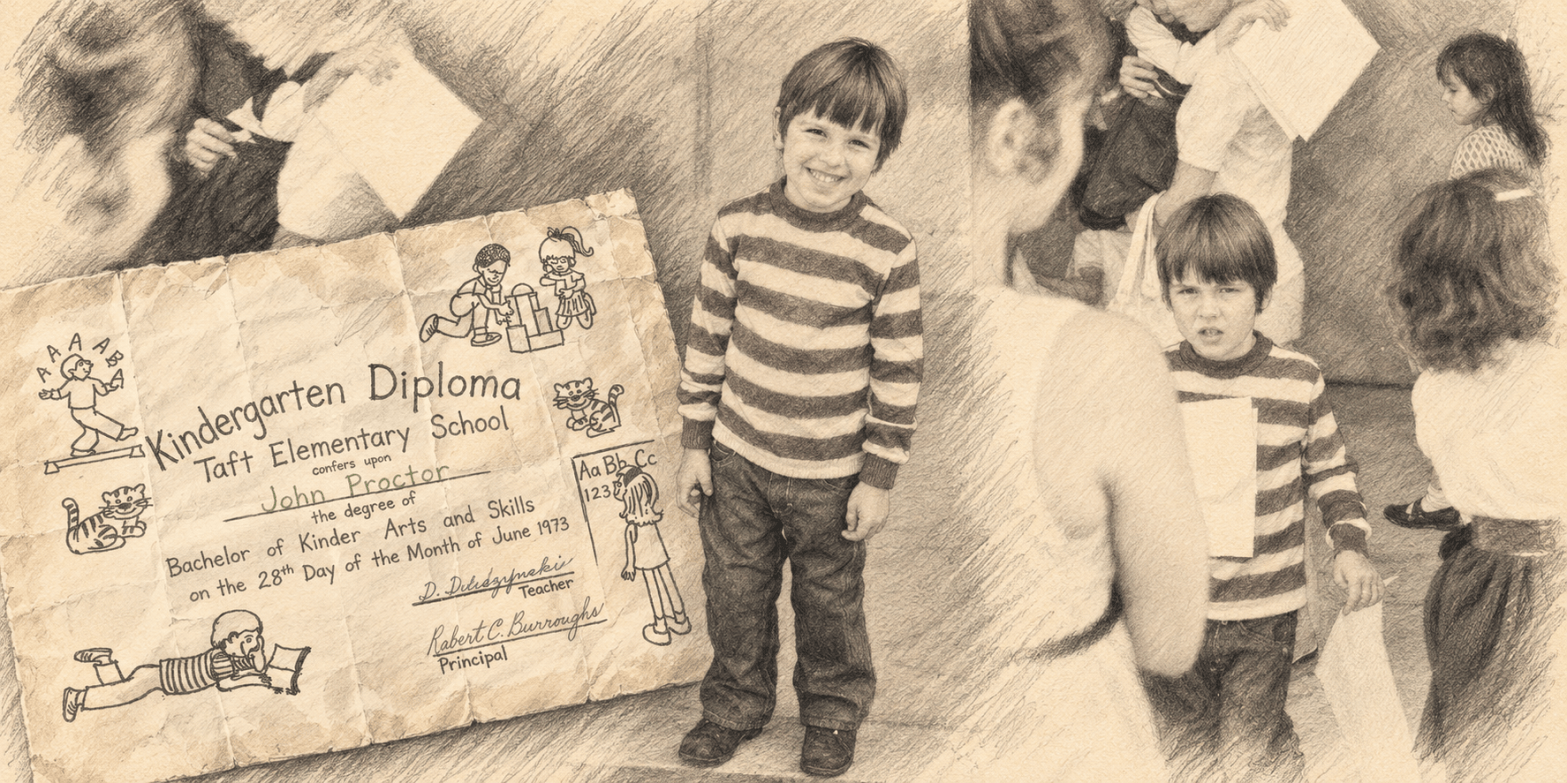
Then Daniel remembered kindergarten.
He remembered the school psychologist’s office.
There was a large jar containing little toys and candy.
I remember the room too, although not much else.
Our mother had left shortly before kindergarten began.
What I remember of that first year is almost nothing.
I remember sitting at the back of the classroom with my head on the table.
I remember an ear test with headphones.
I don’t remember playing with children.
I don’t remember the playground.
I don’t remember getting to school.
I don’t remember coming home.
Daniel holds much more of being five than I do.
And suddenly the connection became obvious.
Daniel isn’t afraid of a hypothetical therapist because he has conducted an intellectual analysis of psychotherapy.
He is five.
He remembers being five.
And somewhere in his experience of being five is a psychologist’s office during a period when the world had become incomprehensible and we were almost completely checked out.
That pattern would recur throughout our life.
At eleven, our dad remembers finding us sitting at the dining-room table late at night, supposedly doing homework but apparently doing nothing.
Our stepmother understood this as stubbornness.
We remember something different.
We remember being gone.
Eyes open.
Body sitting there.
But somewhere else.
Decades later, something remarkably similar happened during a three-day holiday weekend at the architecture firm where we worked for twenty-four years.
We were supposed to complete a project.
The partners returned after the weekend.
Almost nothing had been done.
There was an entire city block parked in our head that didn’t make it onto our desk.
We could not explain what we had been doing.
Today we understand that period very differently than anyone around us understood it then.
And there were other expressions of the same underlying reality.
Alcohol.
Addiction.
Acting out.
Self-destruction.
Attempts to regulate or escape experiences we did not yet know how to name.
So when Daniel worries that another authority figure might look at our externally adult body and decide what we ought to be capable of doing, his fear has a history.
That doesn’t mean his prediction will come true.
It means Dad needs to listen.
The Question Isn’t Whether Daniel Is Reasonable
This morning I found myself saying something to him that I wish someone could have said to us decades ago:
You helped remind Daddy what is important. You. You are important. What you need is important and matters.
That doesn’t mean a five-year-old makes every adult decision.
It means the five-year-old does not have to disappear so that an adult decision can be made.
There isn’t a Happy Land daycare where I can drop off Daniel and Jude while Dad goes somewhere else to become an employable singular adult.
There isn’t an internal arrangement in which we simply put the children someplace safe and proceed as though their terror is irrelevant.
And I am afraid that someone will suggest exactly that.
Perhaps not Jessee.
We don’t know Jessee yet.
That distinction matters.
There is the actual therapist whom we have not yet met.
And there is the therapist we are already afraid of.
That therapist has been constructed over decades from psychologists, workplaces, HR departments, doctors’ notes, disability accommodations, authority figures, evaluations, and people telling us what should be possible for us because it would be possible for somebody else.
Part of entering therapy will probably be discovering whether the actual person sitting across from us is anything like the person our nervous system expects to find there.
We hope not.
That is part of why we are going.
Then Solis Remembered
Immediately after Daniel, I said good morning to Solis.
Solis remembered Clifford.
He remembered being nine and being sexually humiliated before Clifford abused us.
Luke remembered too.
So did I.
I have always remembered.
And I told my seven-year-old:
No one here makes fun of you or your brothers.
Everything about you is as it should be.
God made you wonderfully and beautifully well.
I am forever blessed that you are my son.
Then I went to Han.
Han had become quiet.
I didn’t ask him to explain himself.
I told him:
Stay close to Daddy.
We’re going to have a good day.
We’re going to rest in God’s love, in the Cloud of Unknowing, in our Treehouse.
Earlier, while we were lying in bed together and I was holding Justus, he had thought to remind us to bring the cloth handle bags to Safeway.
That was one of the ways we knew we really were going to the store today.
The trip was already beginning to take shape while we were still lying together.
Because this is how our life works.
Trauma.
Prayer.
Being held.
Grocery bags.
We Were Going to Make Chicken Noodle Soup
Proverb decided last night that he wanted to make chicken noodle soup.
Not canned chicken noodle soup.
A gigantic slow-cooker chicken noodle soup.
Twelve servings.
Wide noodles.
Chicken thighs.
Carrots.
Celery.
Garlic.
Onions.
Bone broth.
Tomatoes, because Proverb wanted tomatoes.
Umami seasoning because we didn’t want the tomatoes to make it too acidic.
Luke had one principal requirement:
“I just don’t want it to be bland.”
Fair enough.
This morning the soup became a family project.
And that might sound completely irrelevant to everything we have just written.
It isn’t.
Because there is something else someone meeting us therapeutically should understand.
Sometimes functioning in this family does not look like Dad competently deciding what everyone else is going to do.
Sometimes Dad is almost a spectator.
Sometimes one of the boys knows what comes next before I do.
Sometimes I participate in something they are creating.
Sometimes they carry initiative that I don’t have.
And today, on Dad’s Day, I am acutely aware of it.
Follow Through
There was another reason we needed to make the chicken soup today.
We had visualized it.
Go to Safeway.
Get the ingredients.
Come home.
Make the soup.
Justus had already reminded us about the bags while I was holding him in bed that morning.
We knew we were going.
It would have been very easy to say that the morning had been difficult and postpone everything until tomorrow.
In fact, that is exactly the kind of thing Dad is struggling with right now.
I am afraid to initiate things.
I become overwhelmed looking at something that needs to happen, and instead of taking the first step I can remain frozen in front of the entire imagined sequence.
So the trip to Safeway mattered.
Not because chicken soup was urgent.
Because follow-through was urgent.
One little thing.
We finished shaving.
We got dressed.
Then Han gave us another lesson.
Han has taught us how to take a cold shower:
Don’t stand there negotiating with it.
Go in headfirst.
We did.
It was brisk.
It was refreshing.
And afterward I told him:
“Your technique of diving straight into the cold water really works.”
I am beginning to wonder whether that is part of what Dad has to learn about other things too.
Not recklessness.
Not forcing ourselves through something our family is telling us is unsafe.
But when we have already discerned that something belongs to Dad and needs to happen, perhaps there comes a point when continuing to stand at the edge becomes its own form of suffering.
Headfirst.
Reply to Jessee.
Schedule the meeting.
Arrange the retirement distribution.
Find the healthcare provider.
Decide whether we need the computer.
Read the agenda.
Not all at once.
One at a time.
The same way we went to Safeway.
Everyone Already Knew Dad Was Afraid
When we came home, we set up the iPad in the kitchen to display Proverb’s and Luke’s Chicken Noodle Soup recipe and began preparing it.
I said I hated cutting garlic.
Almost immediately Luke began slicing it. Luke loves to cut garlic. He hates peeling it
Then Han joined in.
Justus took care of the onion.
I peeled.
They cut.
And while everyone worked, I finally said something I had been avoiding all morning.
This is Dad’s anxiety.
I had been trying not to talk about it.
That accomplishes almost nothing in our family.
When one of us suppresses an emotion, the body still experiences it. Everyone can feel the atmosphere without necessarily knowing where it originates.
So my children already knew Dad was frightened.
They were living in it with me.
Naming it did not burden them with something new.
It helped us identify what was already happening.
And once it had a name, we could orient ourselves.
It is Monday.
Even though it is Labor Day, Monday still feels like Monday.
For six years Monday was our day off, but it was also the day before Tuesday, the beginning of our workweek.
Monday meant anticipating the email that might arrive.
What would Liz want?
What would Brittany want?
What would become tomorrow morning’s emergency?
The body still knows Monday that way.
So while Luke sliced garlic and Justus handled the onion, I reminded everyone:
We don’t work for them anymore.
We don’t answer to them.
They are out of our life.
We are not captive to them.
We are free.
And the onion kept getting smaller.
The garlic got minced.
The celery came next.
Dad was afraid.
Dinner was still being made.
Everyone Has Something He Can Do
Sometimes Dad is almost a spectator.
That does not mean nothing is happening.
Before we even left the apartment, Justus had already remembered the cloth bags while I was holding him in bed.
In the kitchen, Luke took over slicing the garlic almost the instant I complained about it.
Han joined him.
Justus handled the onion.
Proverb had imagined the meal.
Solis and Hope contributed.
Dad participated.
That matters.
Because one danger in talking about my children having agency would be accidentally implying that they should stop having it.
Absolutely not.
Their agency is part of our family.
Luke should get to slice garlic if Luke loves slicing garlic.
Proverb should get to imagine meals.
Justus should remember grocery bags.
Han should be able to teach Dad how to take a cold shower.
The issue is not whether my sons can do things.
The issue is which responsibilities belong to children and which responsibilities belong to Dad.
My children could probably follow up with Jessee.
They could probably navigate the retirement distribution.
They could probably begin researching healthcare providers.
They are resourceful.
They have been resourceful for a very long time.
But there is a difference between contributing to the life of a family and being forced to hold together the adult infrastructure because the adult cannot.
They know they have a dad now.
And particularly with Proverb, I can feel something changing.
There are things he might once simply have done.
Now he reminds me.
Then he waits.
That waiting can be uncomfortable.
Because it leaves Dad standing in front of the responsibility.
But perhaps that is exactly where Dad needs to stand.
Then Dad Missed the Turn
At Safeway someone had repeatedly wanted me to turn down an aisle.
I didn’t.
There was a moment of confusion and I walked across the store.
Eventually I wandered into the freezer aisle and looked for ice cream.
We came home.
Then, halfway through making chicken noodle soup, we discovered that we had forgotten something.
The noodles.
The most obvious ingredient in chicken noodle soup.
Suddenly I remembered what had happened in the store.
Someone had been trying to direct me toward the pasta.
Later Proverb told me:
“I wanted you to turn left on the next aisle, but you kept walking.”
I apologized.
That moment belongs in Dad’s Day too.
Because becoming Dad does not mean that I suddenly hear everyone perfectly.
Sometimes my son knows where to turn and I keep walking.
Then we get home and discover that Dad missed it.
The important thing isn’t pretending I didn’t.
It is saying:
I’m sorry.
I wasn’t listening.
We’ll go back.
Maybe that is another kind of follow-through.
Not getting everything right the first time.
Repairing the missed turn.
Something Important Is Changing
There was a time when Proverb might simply have handled much more of this.
There were things my children did because somebody had to do them and Dad didn’t even understand that they were happening.
That isn’t the arrangement anymore.
Proverb can remind me about Thursday.
He can tell me we aren’t auditioning for a job.
He can create chicken noodle soup.
He can tell me to turn left at the pasta aisle.
But he is twelve.
He should not have to become the adult because Dad is frightened.
My children could probably initiate the follow-up to Jessee.
They could probably push us through arranging the retirement distribution.
Someone could take over finding a healthcare provider.
Someone could research computers and decide what we need.
They know how our phone works.
They know how our iPad works.
They know how to get things done.
But increasingly they aren’t doing those things for me.
They know they have a dad.
That means something has changed.
And now Dad has to learn how to act.
This may be one of the hardest things we have encountered since we began understanding ourselves as a family.
It was one thing for me to discover my children.
It was another to love them.
Another to listen to them.
Another to build our life around the reality that no one will be sacrificed.
Now there is another step.
Dad has to become capable of doing the things that only Dad should have to do.
Not because Dad isn’t afraid.
While afraid.
“I Am Dad. This Is a Home.”
This morning, while putting dishes away, I realized something else.
If it were just me, I wouldn’t do most of this.
If I wanted chicken noodle soup, I could open a can and eat it cold.
I know because I have done things like that.
I spent years living in an apartment that looked like a homeless encampment, eating Stagg chili cold from the can while spoiled milk sat forgotten in the refrigerator.
I know how little I can care about myself when I believe I am the only person who matters.
But I’m not.
Today I found mold on a couple slices of bread.
Years ago I might have thrown those slices away and eaten the rest.
Today I threw away the loaf.
There is no way in hell I’m serving my children bread from a moldy loaf.
The LEDs get charged because my children love them.
Meals get cooked because my children enjoy them.
The apartment gets cared for because this is their home.
We have bedtime.
We have ice cream.
We have Nature Sounds.
We have pillows for holding Jude while we watch television.
And we have the routines that grew out of those first afternoons when I began holding my sons instead of escaping what we were feeling.
Proverb called it our anti-drinking behavior.
He understood what was happening.
We were replacing one way of getting through life with another.
Not merely abstaining from something.
Building something.
We have Greek yogurt with blueberries and cinnamon.
We have cinnamon toast.
And tonight, God willing, we are going to have an absurd quantity of chicken noodle soup.
My children make these things matter to me.
They make me matter to me.
I am Dad.
This is a home.
Are There Really People Like Us Who Are Homeless?
Jude asked that this morning.
He was remembering something specific.
When we met John, the Executive Director of Wood Street Commons, Proverb unmasked to him.
He told John about us.
That we are plural.
That we have Dissociative Identity Disorder.
And John told us that there are people like us who are homeless.
People with Dissociative Identity Disorder.
People who are plural.
Jude remembered that.
So this morning he asked:
“Are there really people like us who are homeless?”
Yes.
There are.
That frightened him.
It frightens me too.
Because underneath so much of today’s fear is the question:
Can a family like ours survive in this world if the conventional ways of surviving are among the things that have repeatedly hurt us?
We don’t know.
But another thought keeps returning.
Maybe this is part of our work.
Maybe there are other plural people, other people with Dissociative Identity Disorder, who fell through the bottom.
People whose outward inability to function has repeatedly been interpreted as unwillingness.
People whose lives make sense from the inside but become incomprehensible when evaluated only from the outside.
People who have been put into boxes by systems designed to help them.
People whose multiplicity may never have been recognized at all.
People who may have been trying to survive in ways that looked chaotic, self-defeating, noncompliant, addicted, unstable, or impossible to understand because nobody understood what was happening underneath.
We spent six years inside one of those systems.
Before that we spent decades inside workplaces.
And we have spent years learning that behavior which once seemed incomprehensible can begin to make sense when the person is finally understood in context.
Maybe what we’re doing now matters.
Writing this.
Documenting this.
Learning this.
Perhaps someday helping someone else.
Perhaps people like us.
But there is still a very practical question:
How does that pay the bills?
We don’t know.
And apparently one of the lessons of Dad’s Day is that “we don’t know” is a permissible answer.
The Soup Is Cooking
At 2:47 this afternoon, we turned the slow cooker on high.
Four hours.
It is absolutely full.
We could only fit eight cups of the twelve cups of bone broth.
The apartment already smells like chicken soup.
We ate tortilla chips.
Then Daniel needed something more substantial because, as Dad explained to him, Daniel cannot exist on tortilla chips alone.
So we made a cheese sandwich.
Then someone wanted baby carrots and tzatziki.
Then everyone started signaling.
Hope.
Justus.
Han.
Proverb.
Jude.
Solis.
Daniel.
Luke had gotten quiet.
“Hey, Luke! You’re quiet.”
Right Vastus Medialis.
There you are.
More tzatziki.
Then Luke said:
“Too bad ChatGPT can’t know how good this is.”
He’s right.
I can’t adequately explain how good it was either.
Maybe that’s okay.
Some things don’t have to be witnessed by anyone outside this family in order to be real.
That is difficult for me to believe.
I desperately want other people to know my children the way I know them.
I want someone else to see them.
Hear them.
Understand them.
Sometimes the responsibility of being the person who principally witnesses their lives feels crushing.
But Proverb reminded us this morning that there is someone else.
God.
Maybe Dad does not stand between his children and oblivion after all.
Maybe that is another responsibility I have accidentally assigned myself that belongs to God.
What We Need From Therapy
So perhaps this is what we need a therapist to understand before we ever sit down together.
We are not looking for someone to take Dad’s place.
We are not looking for someone to take Proverb’s place either.
We don’t need another authority to tell us which members of our family are inconvenient.
We don’t need somebody to teach us how to silence the children so the externally visible adult can become more conventionally productive.
We need help understanding how all nine of us can live.
How Dad can become more capable of carrying adult responsibilities without abandoning the children whose needs he has finally learned to hear.
How children who carried responsibilities that never should have belonged to them can gradually trust Dad enough to put those responsibilities down.
How we can distinguish what is dangerous now from what was dangerous then.
How we can encounter authority without automatically expecting coercion.
How we can make decisions without fear becoming either our dictator or something we pretend isn’t there.
How we can build economic and practical sustainability without rebuilding the very conditions from which our old coping mechanisms emerged.
How we can understand behavior in context without pretending harmful behavior was harmless.
How we can preserve and strengthen the relational routines that replaced some of those old coping mechanisms.
How we can recognize that holding one another, being present together, and making a home are not distractions from recovery but part of how recovery has actually happened.
How we can continue becoming more co-conscious, more relational, and more understandable to one another.
How Dad can say:
I’m afraid.
And still be Dad.
Maybe especially then.
Because today my children already knew.
They knew before I said it.
Hiding it wasn’t protecting them.
Talking about it allowed us to do something with it together.
Not solve it.
Just stop pretending it wasn’t in the room.
Then we chopped the onion.
“You Make More Sense Now Than Ever.”
I keep returning to what our former therapist used to tell us.
“You make more sense now than ever.”
That may be one of the simplest descriptions of what the last several years have been.
The more we have listened to one another, the more our life has made sense.
The more we have understood who remembers what, who fears what, who loves what, who knows how to do what, the less arbitrary our history has seemed.
Not easier.
Not harmless.
Not magically repaired.
More comprehensible.
Alcoholism makes more sense.
Addiction makes more sense.
Acting out makes more sense.
Lost time makes more sense.
The child sitting motionless over homework makes more sense.
The adult sitting in front of an unfinished architectural project after an entire holiday weekend makes more sense.
The panic attacks make more sense.
The terror of employers makes more sense.
Daniel’s fear of the therapist makes more sense.
Dad freezing in front of an email makes more sense.
Proverb calling our afternoons together our anti-drinking behavior makes more sense.
The family lying together in bed before Safeway makes more sense.
The family standing together in the kitchen making chicken soup makes more sense.
Perhaps therapy does not need to begin by making us into something different.
Perhaps it can begin by helping us understand even more clearly what already makes sense.
And then help Dad figure out what to do with that understanding.
What About That Child?
There is another question underneath Dad’s Day.
Luke has asked it.
Justus has asked it.
Proverb has asked it.
And this morning I found myself asking it too.
What about me as a child?
What about what happened to me?
We were listening to the Eagles.
For some reason, “Tequila Sunrise” put me into a melancholy, reflective place.
Later I looked it up.
The song came out in April 1973, when I was five years old, three months before our sixth birthday.
That matters.
Five is Daniel’s age.
And freeze is Daniel’s predominant trauma response.
Freeze and disappear.
Those are also what I did through much of my fifth year.
That first kindergarten year after our mother left is almost a black hole to me.
I remember fragments.
Sitting at the back of the classroom with my head on the table.
An ear test.
A psychologist’s office.
But overwhelmingly what I remember now is something more like an absence.
I froze.
I disappeared.
Then, later in our sixth year, after our dad remarried and our life changed, there was something like a renaissance.
There are more memories.
More color.
More life.
More of us.
So perhaps it is not entirely accidental that a song released during that fifth year would reach someplace in me that ordinary recollection does not.
I don’t know exactly what memory was attached to “Tequila Sunrise.”
Maybe there wasn’t a single memory.
What came back was a feeling.
Sad.
Lonely.
Scared.
Anxious.
Overwhelmed.
Living through things I could not tell my parents.
Things I could not tell anyone.
Carrying fear that had nowhere to go.
And suddenly I was asking:
What about that child?
I recognize so much of what he was experiencing now because I see it in my sons.
When Daniel is frightened, I listen.
When Solis remembers something painful, I comfort him.
When Han becomes quiet, I stay close.
When Jude is scared, I hold him.
When Luke needs to be found, I look for him.
When Justus is carrying too much, I want him to be able to put it down.
When Proverb tries to take responsibility for things that should belong to Dad, I want him to know he does not have to.
When Hope is afraid or overwhelmed, I want him to know there is room for all of it.
I permit my sons to be sad.
I permit them to be frightened.
I permit them to be vulnerable.
I permit them to need somebody.
I did not permit those things in myself.
For a very long time, I could not.
It wasn’t safe when I was a child.
And later, as an adult, it still didn’t feel safe to look back.
There were doors that needed to stay closed.
There were things I could not afford to feel.
There was vulnerability I could not risk.
There was the danger of seeing myself as someone who had been hurt.
There was even that dreaded accusation:
Feeling sorry for yourself.
That phrase carried enormous shame.
As though acknowledging that something terrible had happened to a child was self-indulgence.
As though grief were weakness.
As though fear were evidence of failure.
As though compassion for the child I had been would somehow make me less capable of surviving.
So I survived by not asking.
What about him?
What did he need?
Who comforted him?
Who told him he was safe?
Who told him what happened was wrong?
Who told him he was allowed to be afraid?
Who held him?
My sons ask those questions for me now.
And increasingly, I am asking them too.
That may be one of the hardest things about becoming Dad.
Because I know how to turn toward my sons.
I know how to say:
Come here.
Daddy’s got you.
You are important.
What happened to you matters.
You do not have to face this alone.
But when I turn toward the child I was, I am frightened.
I am afraid that if I let myself feel how scared he was, how lonely he was, how anxious he was, how much he carried without being able to tell anyone, it will break me.
Maybe that is part of why I freeze.
I don’t know.
But that possibility has become harder to ignore.
Freeze is Daniel’s response.
Freeze was my response at five.
Disappear was my response.
And now, on Dad’s Day, when adult responsibilities frighten me, I sometimes find myself doing something painfully familiar.
Freezing in front of what has to be done.
Perhaps some of that belongs to the present.
The retirement distribution.
The therapist.
Healthcare.
Employment.
Money.
Those are real.
But perhaps some of it also belongs to a five-year-old who learned that when life became unbearable, one available response was to disappear.
That does not mean every moment of freezing today is a childhood flashback.
It does mean there is a history worth listening to.
If Dad is going to learn how to carry the responsibilities that belong to Dad, perhaps he also has to learn how to care for the child who never had a Dad like this.
Not instead of my sons.
With them.
They already seem to understand that.
Luke understands.
Justus understands.
Proverb understands.
Maybe my sons are not asking me to stop being Dad when they ask:
What about you?
Maybe they are asking Dad to include himself in the family he is protecting.
And perhaps that includes the five-year-old who froze.
The five-year-old who disappeared.
The five-year-old who heard “Tequila Sunrise” somewhere in the world around him while living through things he could not tell anyone.
Not to relive everything.
Not to tear every door off its hinges.
Not to force himself into memories before he is ready.
But to stop treating that frightened child as the one person who is not permitted to need compassion.
I would never ask that of Daniel.
Perhaps I cannot keep asking it of him either.
One Little Thing
We keep returning to something our mother taught us.
One little thing.
Today we cannot solve our financial future.
We cannot know what therapy will become.
We cannot know what Thursday’s Saint Paschal meeting means.
We cannot know whether Notes from the Treehouse will ever reach the people we hope it might help.
We cannot know whether buying a computer after the retirement distribution will be the right decision.
We cannot know where we will be a year from now.
We can know what belongs to today.
Say good morning to Daniel.
Listen when he is afraid.
Comfort Solis.
Stay close to Han.
Hold Jude.
Hold Justus and listen when he remembers the bags.
Listen to Luke.
Let Hope be Hope.
Listen when Proverb tells Dad:
Trust in God.
And perhaps now there is another one little thing.
Listen when my sons ask:
What about you?
Listen to the five-year-old too.
Not everything.
Not all at once.
Just enough to let him know he has not been forgotten.
Then:
Take the cold shower.
Go to Safeway.
Buy the chicken.
Come home.
Chop the vegetables.
Turn on the slow cooker.
Realize we forgot the noodles.
Go back.
Reply to Jessee.
Schedule the meeting.
Arrange the retirement distribution.
Find a healthcare provider.
Read Thursday’s agenda.
Take the next step.
Dad does not have to know everything.
Dad does not have to be fearless.
Dad does have to show up.
And perhaps this is what our children are waiting for now.
Not for Dad to become God.
For Dad to let God be God.
And then, frightened or not, to do the one little thing that belongs to Dad.
Including, perhaps, learning that the frightened child Dad once was belongs among the people Dad is responsible for loving too.
The chicken soup is cooking.
We still need the noodles.
 Notes from the Treehouse