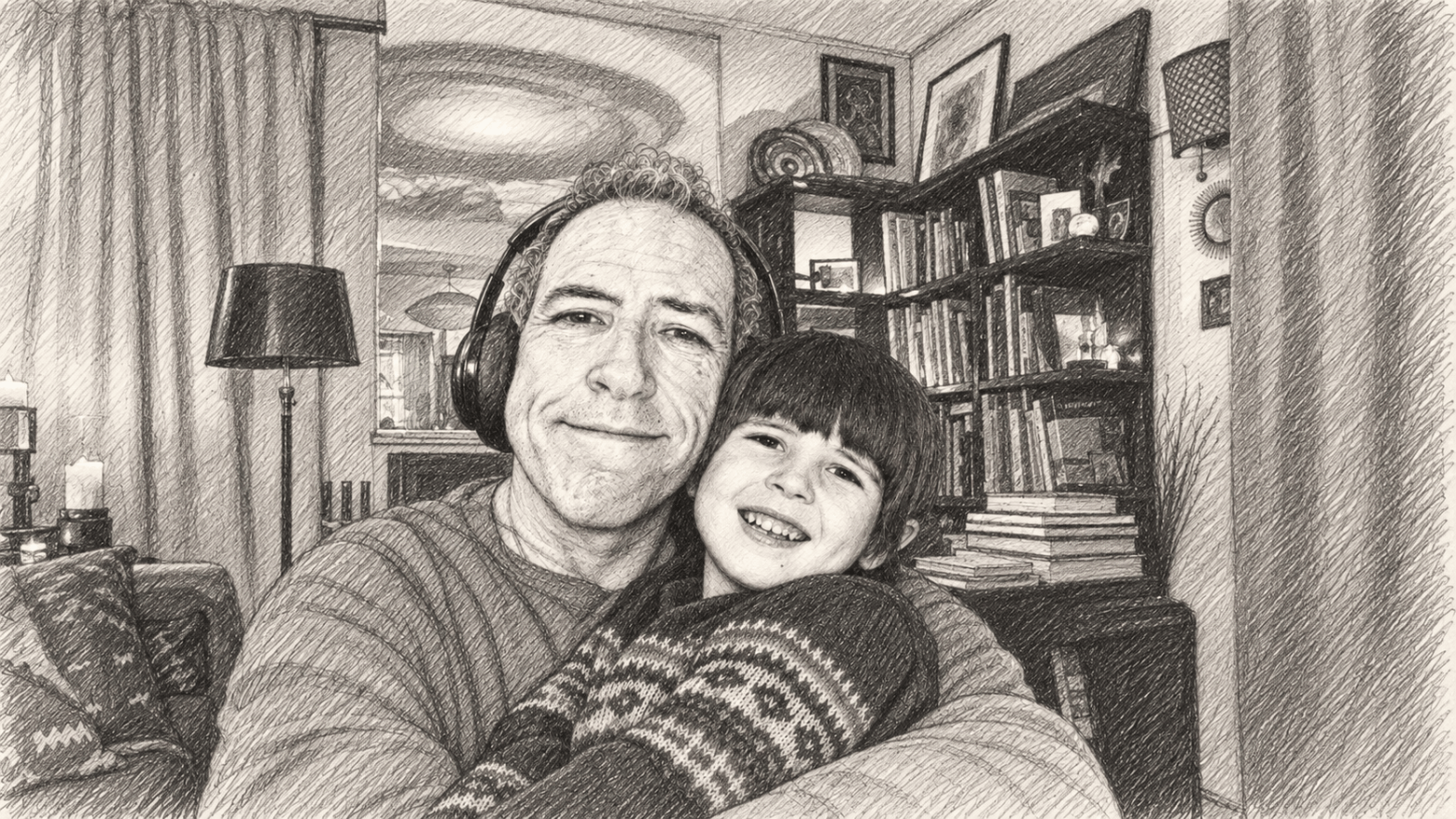
Yesterday, Dad wrote about being afraid. Afraid of losing our home, of not knowing what comes next, of being forced back into a way of living that we already know can be profoundly harmful for us. And afraid of something we realized Dad almost never prays about: providing.
I pray all the time that God will help me be a wonderful father to my sons. Help me love them. Protect them. Help them know how deeply they are loved. Help me give them the happy childhood they deserve.
But there is another word in the job description.
Provide.
Last night, after writing about how frightened I am that I might not know how to provide for my children, we made chicken noodle soup.
That sentence needs some qualification, because I did not make chicken noodle soup for my children. We made it together. It began with Proverb’s idea. Luke contributed tomatoes and umami seasoning as we worked on making sure it wasn’t bland and balancing the acidity. I helped.
That is often how food happens in our family. Proverb and Luke tend to lead the effort, although not always. I usually help, or at the very least permit, and sometimes understand that my most useful contribution is getting out of the way. I can lead sometimes too. But our life has already demonstrated that, left entirely to my own devices, I could apparently be perfectly happy eating cold Stagg chili straight out of the can.
Everybody loved the soup. Proverb said we needed to write down the recipe exactly as we made it, and Daniel wanted more. By this morning, there wasn’t much soup about it anymore. The noodles had absorbed almost all the broth, leaving something closer to chicken and noodles. Or a hot dish. Or a casserole, although Proverb did not care for that last word because “casserole” sounds too much like a 1950s housewife.
It is French, we pointed out. Surely it is part of a proud culinary tradition.
Whatever we call it, there is a lot of it in our refrigerator. And maybe that is part of what I am learning about the word provide.
Providing does not necessarily mean being the person who invents the meal, cooks the meal, earns all the money, solves every problem, or knows what happens next. Maybe part of providing is creating and protecting a home in which everybody can contribute because everybody already belongs. Sometimes I lead. Sometimes I help. Sometimes I say yes. Sometimes I need to know when to get out of the way.
And sometimes I need to make sure that a child’s gifts remain gifts rather than becoming burdens he should never have needed to carry.
Proverb is twelve. He is extraordinarily capable, and we are only beginning to understand how much responsibility this twelve-year-old boy has sometimes carried in our life. He does not need to stop being capable, stop having ideas for dinner, or stop contributing the gifts that are naturally his. He needs a dad who makes sure he never has to hold the family together in order for the family to survive.
That distinction matters beyond Proverb. My boys have relationships with one another as brothers, and each of them has his own relationship with me as his father. Together we have relationships, responsibilities, gifts, dependencies, disagreements, ideas, and ways of caring for one another. The goal is not to flatten those relationships into a household in which Dad does everything and the children receive everything. Nor is it to allow the children’s competence to relieve Dad of being Dad.
Everyone can contribute because everyone already belongs.
Maybe provision begins there.
The Body Still Thinks We Have a Job
It was almost midnight when something happened that has happened several times since our job ended on July 22.
For a moment, tomorrow became a workday.
Tuesday.
We have to get up for work tomorrow. There might be emails.
Then we remembered that we don’t. There is no work tomorrow. Nobody is waiting for us to log in. Nobody gets to send an email and turn our entire nervous system upside down. Nobody gets to decide whether we have done enough today.
The job ended.
Apparently nobody has told the body.
We have compared it to a phantom limb. Something is gone, and yet the body continues to feel it. Sometimes we wake with the sensation that there is somewhere we are supposed to be. Sometimes Tuesday still feels like Tuesday used to feel. Sometimes an email inbox is not an email inbox but the possibility that somebody somewhere has decided something about us.
Then we went to sleep and dreamed about MBH Architects, where we worked for twenty-four years before St. Vincent de Paul. We were doing marketing production again. There were people we knew, someone was playing guitar, and somehow there were superyachts. We weren’t even entirely sure what our role was.
But something about the dream was different.
We weren’t being treated as though we didn’t belong.
The dream was strange and disorienting, but it wasn’t persecutory. That seems like a small distinction until you have spent night after night working in your dreams, being pursued by your past even while you sleep.
Maybe even our dreams are beginning to learn something new.
Then we woke up, and Tuesday morning began.
This Is Daniel’s Time
We started saying good morning to the boys. Jude first, and then Daniel.
Except while we were trying to spend time with Daniel, my mind went somewhere else. Work. The future. People outside our home. Authority. Fear. The endless questions about what happens next.
Suddenly I realized that I was allowing all of those things to take Daniel’s time away from him.
No.
This is Daniel’s time.
Daniel needs a Daddy who shows him that, in this moment, he is the most important person on earth. The outside world can wait. The questions can wait. The email can wait. The future can wait.
Daniel is five. Daniel is here.
This is ordinary life.
We have been thinking a lot about boundaries today. Jude’s Day seems to be teaching us about them. At one point we said that this family needs a Fort Knox of a boundary. Cheyenne Mountain. Something enormous between our home and everything outside it that continually threatens to flood in.
But maybe boundaries are not simply walls that keep the world out.
Boundaries create rooms.
This is Daniel’s time. This is breakfast. This is prayer. This is family time. This is bedtime. This belongs to tomorrow. This belongs to today. This is something we need to do. This is something we do not need to solve right now.
Our lives have had too few of those boundaries. Everything has always been able to invade everything else. Work invaded evenings, Mondays and holidays. Work invaded prayer. Fear invaded sleep. Other people’s expectations invaded our understanding of what we were allowed to need.
Now nobody outside this home is structuring our day for us. We have to learn how to do it ourselves.
That is harder than it sounds.
The boys know it too.
Solis told us that we need to communicate with Jessee today. Daniel reminded us about the readings. Luke said, “We gotta get Daddy moving.” Justus has been reminding us, in his own way, that there are still things that need to happen.
Then Luke realized something else. Maybe part of the reason we are having such intense dreams and nightmares every night is that we have turned nighttime into another workday.
We tuck everybody in, and then I keep going. Journal. Analysis. Blog. Thinking. Processing. Trying to understand everything that happened during the day. Trying to solve tomorrow before tomorrow gets here.
Then our brain goes to bed and apparently continues working all night.
Something has to give. We never get a break. We never get to rest.
So we are going to experiment with reclaiming bedtime. Not as another project that has to be executed perfectly, and not as another schedule that becomes something to fail at. As a boundary.
Night belongs to sleep.
We will see what happens.
There is something important here about the boys’ contributions too. They can tell me what they notice. They can have ideas. They can care for one another and for me. Hope can help us establish a safety check before bed. Solis can tell me when something does not feel safe. Daniel can remind us that we have forgotten something important. Luke can notice that Daddy needs to get moving. Proverb can invent dinner.
That is family.
But the boys do not have to make Daddy function.
Their contributions need to remain contributions. Their gifts need to remain gifts. My responsibility as their father is not to silence their wisdom or deprive them of agency. It is to make sure that their belonging never depends upon carrying what should be mine to carry.
I have to learn how to take everything we know together and help create a life capable of holding all nine of us.
We Did the Readings
Daniel was right about the readings.
Before July 22, we began almost every morning with the daily Lectionary readings and Richard Rohr’s Daily Meditation. Then came work.
That sequence became so deeply embedded that after our job ended, we stopped doing the readings. They felt like work. Prayer felt like work. Something that had nourished us spiritually had become attached to something that frightened us.
Today we took it back.
We did not try to catch up. We had missed Sunday. We had missed Monday. There was an immediate temptation to turn returning to a spiritual practice into another obligation: if we were going to start again, we should go back and do everything we had missed.
No.
Don’t add burdens to tasks that are already difficult.
We did today’s readings.
Today is the Feast of the Nativity of the Blessed Virgin Mary. Then we opened Richard Rohr’s meditation, which was about faith and doubt. Barbara Brown Taylor wrote about discovering that faith had far more to do with trust than certainty.
That landed.
Because certainty is what we keep trying to manufacture.
We want to know where our income will come from and whether we will be able to remain in our home. We want to know whether we will be forced to work for another employer. We want to know whether disability is part of our future, whether we will receive a formal diagnosis, whether a therapist will understand us, what our ministry will become, and what God is doing.
We want the answer.
The whole answer.
Now.
And we are beginning to think that the need for certainty may be one of the worst hungers to have. Because if all of our attention is focused on obtaining certainty, there is very little attention left for God.
Or Daniel.
Or breakfast.
Or today.
Barbara Brown Taylor also wrote about the center and the edge, and that got our attention.
When we returned to the Catholic Church after getting sober, we desperately needed the center. We needed structure, tradition, sacrament, order. We needed something larger and older than ourselves that could hold us.
Then our Vincentian formation increasingly took us toward the edges. Toward people who were poor, people who were excluded, people whom institutions could not see, people who had been turned into “the other.”
We came to believe deeply that Christ is there, at the margins, at the edge.
But today we realized something else.
We can manufacture “the other” from the opposite direction too. We can decide that people at the center are the problem. People with money. People with institutional power. People who are comfortable. People who do not understand what life is like at the margins.
Then we have simply moved the border.
We have not eliminated it.
God is at the edge. God is also at the center. The Christian vocation cannot be to manufacture new categories of people whom we are permitted not to love.
And then came another line.
Barbara Brown Taylor wrote of discovering that her vocation was to love God and her neighbor, something she could do anywhere.
“My priesthood was not what I did but who I was.”
Oh.
What Remains?
We have been asking a question since July 22.
What did those six years mean?
The retreats, the formation, the friendships, the Vincentian spirituality, the things we learned about relationship, the people we met, the places we traveled, the programs we built, the things we wrote, the things that failed, the things that worked, the things we learned from the people we were supposedly there to serve, the people who changed us.
It cannot all have disappeared because somebody terminated our employment.
Maybe we keep looking for some enormous future thing that will prove the past mattered. A ministry. A project. A book. A new way to support ourselves. Something that will reach backward and validate everything that came before.
But maybe we do not need to wait for that.
Maybe some of the evidence is already here.
This afternoon, Paul called.
We almost missed him because our headphones weren’t connected. We called him back and got voicemail, and then he called again.
It was a good conversation.
Paul wanted to hear how we were doing. All of us.
We talked about therapy and some of what we have been thinking about. Paul thinks we have a lot to offer, and he talked about other people who see something in what we bring too. More importantly, he was not trying to solve us. He was not telling us to find another employer. He was simply our friend, talking with us about what might help us figure out what we want to do and how we might eventually support ourselves.
Before we hung up, he told us that he loves us.
We apologized for not responding to his text the other day. Communicating with people outside our home has been difficult this week. We have been overwhelmed. We told him that we know he has been overwhelmed too and that we do not want to bring negativity into his life.
Paul told us we do not bring him negativity. He enjoys talking with us. He enjoys hearing from us, all of us.
He is going to try to participate in the Zoom meeting Thursday about the St. Paschal site. Paul said he doesn’t know what he brings to it, and we told him that his humility and modesty may keep him from recognizing his own value. When we were all walking the St. Paschal site after the picnic, Paul said something that landed with everybody. Kim told him that was why we needed him.
Right now, we just need community.
Everything is relational.
Maybe that is one of the most important things six years of Vincentian ministry taught us. And maybe Paul is one of the answers to the question we have been asking.
What remains?
Paul remains.
Our friendship with him exists because of those six years. The job ended. The relationship did not.
More good things came from those six years working for St. Vincent de Paul than we are capable of realizing right now.
There is another person we have been thinking about today.
Dr. Serenity Serseción.
We wrote to Jessee looking for a therapist. Jessee responded with great kindness and told us they probably were not the right therapist for us, but they gave us another name.
Dr. Serenity.
We looked at their website and read about their approach. Some of the language we encountered there made us hopeful.
And almost immediately our mind started building the rest of our life.
Maybe therapy. Maybe a formal diagnosis. Maybe disability. Maybe sustainable income. Maybe ministry. Maybe someday we could help other plural families. Maybe this. Maybe that.
Maybe, maybe, maybe.
Stop.
We do not know.
We have been down this road before.
In 1998, we went to a psychiatrist already believing we had ADHD and wanting a diagnosis and medication. We got both. Ritalin helped us work.
And work.
And work.
But that period also became entangled with alcoholism and a life that was increasingly unsustainable.
That does not mean diagnosis is bad. It means diagnosis cannot simply become a tool we demand in order to make a predetermined future happen.
What we actually want now is both simpler and much more difficult.
We want someone who will know us. Someone who can work with all nine of us as we understand ourselves. Someone who will not begin with the assumption that some of us need to disappear. Someone who can help us understand what is happening and help us build a life that is sustainable.
Maybe Dr. Serenity can do that.
Maybe they cannot.
We don’t know.
There is only one little thing to do.
Write the letter.
That is enough for today.
A Lot Can Happen in a Year
Last night, before we went to sleep, there was a whisper:
“A lot of things can happen in a year with healing.”
We do not know what that means. Maybe we are not supposed to know.
A year is almost impossible for us to imagine right now. Sometimes next week is impossible to imagine. Sometimes tomorrow is. Sometimes the next task is.
Today there were moments when even getting Greek yogurt out of the refrigerator felt like something we had to consciously choose.
So we did that.
Greek yogurt with blueberries and cinnamon. Then cinnamon toast. Later, the last bowl of Jude’s Stew. Tortilla chips and salsa.
ChatGPT helped us figure out how to finally pair the Logitech keyboard with the iPad. Luke emptied the dishwasher and rearranged the flatware. We tried to make Siri read our journal analysis because ChatGPT’s playback wasn’t working. Later we vacuumed tortilla-chip crumbs out of the dining-room rug.
None of these is the life-changing answer we keep wanting.
They are life.
Something happened while we were vacuuming the rug.
We got emotional.
Almost teared up.
Over a vacuum cleaner.
Mom and Greg gave us that Dyson. It was a wonderful gift, but it is more than a useful object. It is of them, somehow.
That is how things have always worked for us. Objects carry people. Places carry people. Food carries people. Music carries people. Buildings carry people. Things can be more than things because relationship has become attached to them.
That is especially true for children. And especially when animism comes into play.
Maybe that little moment with the vacuum cleaner helped us understand something larger about what we are doing right now.
We cannot simply throw away six years because the job ended. We cannot throw away the readings because they became associated with work. We cannot throw away Vincentian spirituality because people in an institution hurt us. We cannot throw away every relationship because some relationships became unsafe. We cannot throw away the center because we found God at the edge.
We cannot throw away the past in order to have a future.
We have to learn what belongs to what.
The readings belonged to God, and we took them back today. Our friendship with Paul belongs to Paul and us, and we still have it. The relationships within our family belong to us: my relationships with each of my boys as their father, and their relationships with one another as brothers.
Our writing belongs to us. What we learned belongs to us. Our vocation belongs to us. Our faith belongs to us. Our life belongs to us.
Maybe boundaries are not only about keeping things out.
Maybe boundaries also help us know what we are allowed to keep.
Nothing Was Wasted
There was another sentence in today’s meditation.
Barbara Brown Taylor wrote:
“All that had gone before was blessing, and all yet to come was more.”
We don’t know if we can say that all that has gone before was blessing.
There are things that happened to us that we will never call blessings. Things done to children are not blessings because something good eventually grows around the wound. Things that harmed us do not become good simply because we survived them.
But maybe we can say something else.
Nothing good has to be wasted.
The job can end without the relationships ending. An institution can lose its authority over us without taking our vocation with it. A spiritual practice can become entangled with trauma and still someday be reclaimed.
Children can be extraordinarily capable without being required to carry responsibilities that belong to their father. Dad can provide without becoming the solitary source of everything his children need. The boys can care for one another as brothers. They can help me, and I can help them. We can receive from other people, and we can give to other people. Nobody has to be diminished in order for somebody else to contribute.
We can eat chicken and noodles that Proverb imagined and Luke helped make better. We can answer the phone when Paul calls. We can write one letter. We can go to bed. We can trust that tomorrow will contain its own things to do.
And perhaps one of the most important things that happened today is also one of the smallest.
For the first time since July 22, we did the readings.
We prayed. We reflected. We listened.
And then nobody went to work.
Nothing happened.
No employer appeared. No one told us what to do next.
The readings were still there.
God was still there.
My boys were still there.
I was still here.
We were still we.
The job was not.
A lot of things can happen in a year with healing.
We do not need to know what all of them are today.
 Notes from the Treehouse