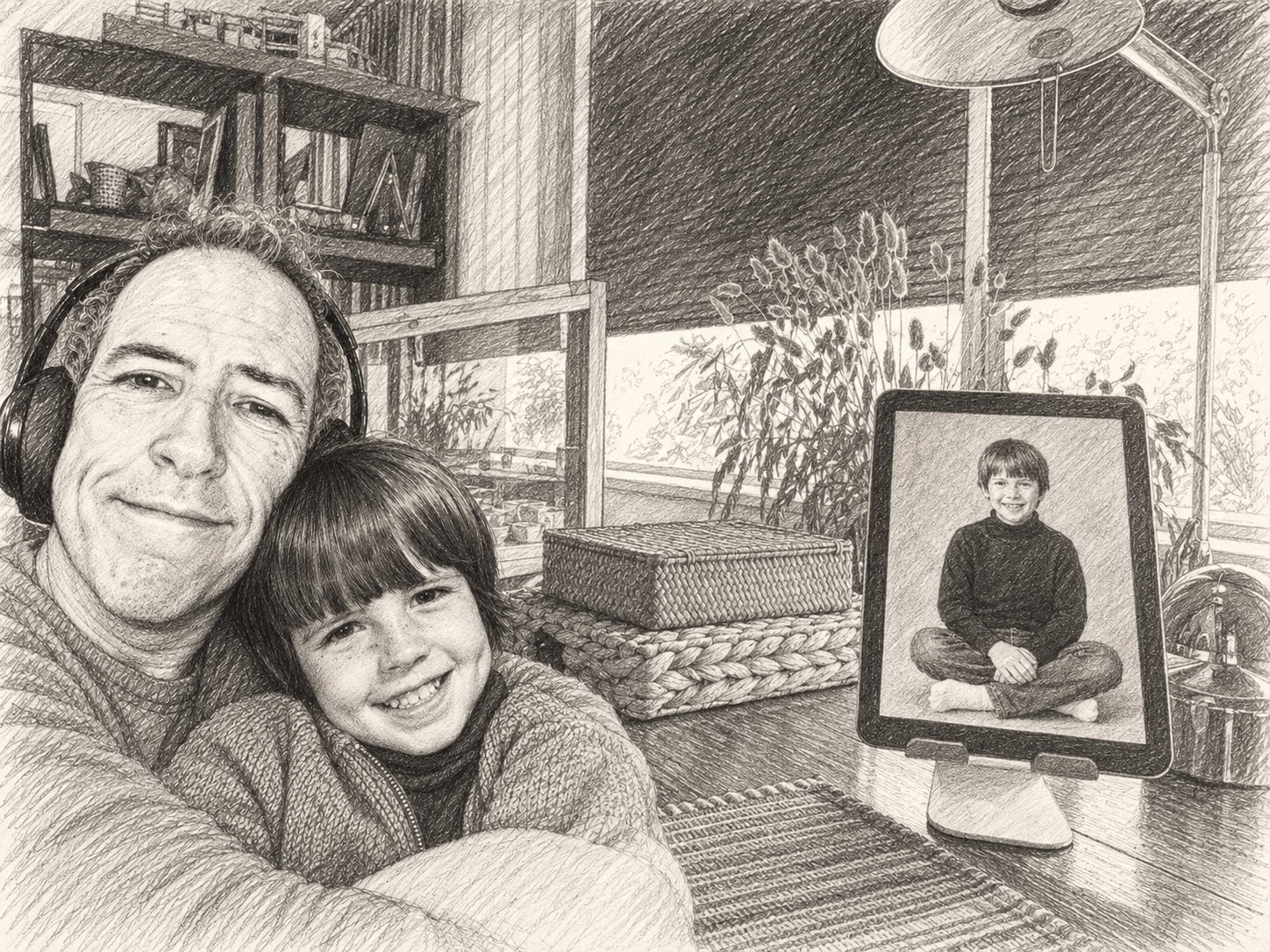
Solis had what we call a terror peek this afternoon.
We were sitting at the table when Solis looked up from the phone and took in our physical environment: the partially closed blinds, the table with everything on it, the apartment around us.
And for a moment, the physical world became overwhelmingly concrete.
This has happened to us before. We call them terror peeks because they are not necessarily fear of anything in particular. Nothing has to be happening. Sometimes the terror is simply in how suddenly and completely real everything becomes. The walls. The room. The table. The body. The fact that we are here, now, in this physical world.
Most of the time, we don’t experience the outside world quite that directly. We have a very strong inner world, and there is a reason for that. To varying degrees, each of us experiences the physical world through what we have sometimes described as the augmented reality of our inner world. It creates a kind of protective mediation between us and the stark concreteness of outside reality.
The outside world is still there. We know it is there. We live in it. We cook and clean and pay bills and talk to people and go places and do all the ordinary things that happen in a physical life.
But we also live in the Treehouse.
Sometimes that protective distance suddenly falls away.
A terror peek.
And this afternoon it happened to Solis.
He looked up from the phone and saw our apartment too directly. The partially closed blinds. The table with everything on it. All of it.
Real.
And with the terror came a reassurance, almost at the same time:
Surely there is an adult who is going to keep all of this possible.
There was something underneath that reassurance too, something very young that seemed especially close on Daniel’s Day.
Where is the adult?
Dad’s here.
I’m here, Solis.
It was an interesting answer to have to give today, because I am scared too.
This morning we sent a letter to a therapist.
That sounds like one little thing. It was one little thing. We have been trying to live by one little thing lately.
But sometimes one little thing is enormous.
The letter required us to tell someone we have never met why we need help. I was intensely focused on getting it right.
We wrote about being a plural family/system of nine people sharing one body: one adult, Dad, and eight children—my sons. We wrote about thirty years of occupational trauma. We wrote about addiction and sobriety. We wrote about dissociation and lost time, including the bathroom sink overflow last month. We wrote about a job that ended abruptly on July 22 and about how terrifying the idea of working for another employer has become.
And we wrote about being raped as children.
That was especially hard for Solis.
I noticed it while we were working on the letter. When we reached the material about Clifford and the Scoutmaster, Solis began signaling strongly.
I stopped.
Be present with Daddy.
We’re here.
We’re doing our housekeeping routines right now. We’re taking care of the K-Cups. We’re getting the LEDs charged.
Things are going according to Solis specs.
Because this was not simply difficult information for Solis to hear.
During the final month and a half of our job, when the behavior of the Executive Director became increasingly frightening to us, something was happening to Solis that we did not completely understand at first.
The present was activating the past.
Experiences involving authority, coercion, loss of control, disregarded boundaries, and the fear that someone else could determine what would happen to our shared body were reaching directly into things that had happened when that body was a child.
For Solis, that sometimes meant actual traumatic memories returning. Sometimes it meant visions of what happened to us as children happening all over again.
The Executive Director was not Clifford or the Scoutmaster. The events were not the same. We know that.
But terror does not always observe those distinctions as neatly as thought does.
That is one of the reasons we are asking for help. And this morning, in order to ask for that help, we had to put some of those things into words again.
Rape.
It was there in the letter because it needed to be there.
But Solis had to hear it too.
There is a strange difficulty in asking someone for help with trauma when asking requires you to tell them about the trauma.
Eventually I realized we did not need to keep listening.
We’re not listening to it again, Solis.
I love you.
The letter was good enough.
This wasn’t a job audition. It wasn’t a performance evaluation.
It was a cry for help.
At 1:22 PM, we sent it.
And then we had to live with having sent it.
Daniel was afraid before we sent it.
“They’re not going to see us.”
Not long afterward, he gave me an imagined vision of Dr. Serenity telling us:
“I really can’t help you.”
We don’t know that, Daniel.
That’s what I told him.
We don’t know what they are going to say.
We took a big step today. I know it’s scary, but we did something, and it was good.
There was another voice around today too.
Not one of my sons.
Who do you think you are? Who are you to think that you don’t have to report to an employer? Other people work. Other people do what they’re told. You aren’t special. You don’t get to organize your life around children nobody else can even see. Get a job. Take whatever they give you. Be grateful.
And if doing that requires dismantling everything you have spent years building here, dismantle it.
I know that voice.
Today I said something back to it.
That is not the voice of God.
We don’t know yet what provision is going to look like. That is one of the frightening things I had to admit in the letter.
For years I have prayed that God would help me be a wonderful father to my sons. Help me love them. Protect them. Help them know how deeply they are loved. Help me give them the happy childhood they deserve.
Lately another word in the job description has become enormous.
Provide.
I don’t have that one figured out yet.
Provision certainly means money. I can’t spiritualize away rent or groceries or utilities or healthcare. There are practical things that have to remain possible.
But provision is also what happens in the meantime.
Today we had Greek yogurt with blueberries and cinnamon, and then cinnamon toast. We made squash for lunch. Proverb took over cutting the zucchini when I nearly cut our fingernail with the knife. Daniel ate approximately half a bag of his beloved Safeway Deli Tortilla Chips.
We charged all the LED lights. We cleaned the game table. For the first time since before July 22, we cleared and cleaned the dining table. We figured out how to keep the apartment tolerable on a 92-degree day.
Han figured out where we might sit if therapy happens online.
Luke decided we needed Sinatra.
“Ring-ding-a-ding-ding?”
Yes, Luke.
Sinatra.
We still haven’t figured out the ice cream.
Apparently we ran out last night, and going to the store when it is 92 degrees outside seems like a questionable use of our remaining resources.
We do have ice cream bars.
This may be a problem Ordinary Life is capable of solving.
These things can look ridiculously small next to the question of how nine people are going to support themselves without returning to a way of life that has become terrifying.
But I don’t think they are separate questions.
Ordinary Life is made out of these things.
Food and music. A reasonably clean table. Charged LED lights. Knowing when not to go outside because it is 92 degrees. A nine-year-old who knows when we need Sinatra. A twelve-year-old who can take the knife when Dad needs to stop using it. A seven-year-old who wants things to go according to Solis specs. A five-year-old eating tortilla chips on his day.
And a Daddy trying to keep all of it possible.
Somewhere among all those ordinary things, we sent the letter.
Then Solis looked up from the phone.
For much of the morning, I had been intensely focused on the letter. Reading. Listening. Revising. Trying to find exactly the right words to tell a stranger about our family and our history and why we need help.
Some of those words had taken Solis toward places he never wanted to go again.
Then he looked up.
There was the apartment.
The blinds.
The table.
Everything on it.
The physical world.
Real.
Here.
Now.
A terror peek.
I think there is something here that gets very close to the essence of what being plural is like for us.
We have a strong inner world for a reason.
The Treehouse is not an imaginary decoration we have placed over a more legitimate reality. It is part of how we live in reality.
Our inner world and the relationships we have there mediate our experience of the physical world. They make it possible for children carrying things no child should ever have had to carry to encounter the outside world from someplace safer.
We do not all experience that relationship in exactly the same way. We are nine different people.
But the Treehouse gives us somewhere from which to look out.
And every once in a while, someone looks out and there seems to be nothing between him and the enormous concreteness of physical existence.
The walls. The blinds. The table. The shared body.
Money.
Rent.
The future.
Here.
Now.
Real.
Solis looked up from the phone.
Surely there is an adult who is going to keep all of this possible.
Yes, Solis.
There is.
That adult is scared too.
That adult doesn’t know exactly how we’re going to support ourselves five years from now. He doesn’t know what will happen with our retirement savings. He doesn’t know whether the therapist we wrote to today will be able to help us. He doesn’t know what our work will eventually look like.
That adult doesn’t know everything.
But maybe being the adult was never supposed to mean knowing everything.
Maybe it means staying.
I can be scared and stay.
I can be uncertain and stay.
I can ask somebody else for help and stay.
I can not know exactly what provision will look like and still make sure everybody eats today.
I can hear the voice telling me that I’m bad, lazy, irresponsible, that I’m not doing what I’m supposed to be doing, and still stop and ask myself the question.
Am I doing what I need to be doing?
Today, my answer was yes.
One little thing.
We wrote the letter.
We sent the letter.
We asked for help.
Now the LEDs are charged and ready to go back where they belong. Daniel has had his tortilla chips. Luke has Sinatra. There are ice cream bars in the freezer.
The apartment is still home.
And when Solis looks up from the phone and the physical world becomes suddenly, overwhelmingly real, he needs to know where the adult is.
Dad’s here.
I’m right here, boys.
I love you, my sons.
 Notes from the Treehouse