Yesterday afternoon, Solis looked up from the phone and saw our apartment.
The partially closed blinds. The table with everything on it. The walls around us.
For a moment, the physical world became overwhelmingly concrete.
We call these moments terror peeks. Nothing frightening necessarily has to be happening. Sometimes the terror is simply that everything becomes suddenly and completely real.
And almost at the same time there came a reassurance:
Surely there is an adult who is going to keep all of this possible.
Dad’s here.
That was yesterday.
Last night, as we transitioned into Solis’s Day, he had a vision of being on an airplane when the oxygen masks dropped from above. He put his on, but something wasn’t right. The mask was uncomfortable, but he didn’t complain. Then it stopped working.
Still, he hesitated to say anything.
He was turning blue before he finally complained because he was about to pass out.
There was something in the vision we recognized immediately. A rule.
Don’t complain unless it becomes life or death.
Solis learned that rule a long time ago.
He was the one who told a family member that another family member had been sexually abusing us for years. What he learned afterward was not simply that telling was safe and that adults would make everything better. Life became harder. He felt differently treated. Somehow even speaking about what had happened became tangled up with shame, as though telling had made him responsible for what had been done to us.
Years later, I promised him something different.
I believed that if we stood up when something was wrong, if we told the truth, if we asked for help, eventually good people would stand up too. I believed that our years working for St. Vincent de Paul could become a corrective experience for him.
It wasn’t.
Last night I told him that.
I told my seven-year-old son that I had wanted it to be different. I had believed it would be different. I had insisted that if we continued doing the right thing, other people would eventually do the right thing too.
They didn’t.
And I told Solis I understood why it might be hard for him to believe me now when I tell him we are safe.
There is something important in that for me as his father. If a child has learned that speaking up makes things worse, it may not be enough to teach him to speak up more effectively. The environment around him has to become responsive enough that speaking can actually accomplish something.
The oxygen-mask rule has to change.
Notice earlier. Speak earlier. Respond earlier. Adjust.
Safety cannot mean that nothing bad will ever happen. I can’t promise my children that. Maybe safety can begin to mean that when something is wrong, nobody has to wait until he is turning blue before Daddy listens.
Then the power went out.
It was still hot. The fan stopped. The refrigerator stopped. The dishwasher stopped in the middle of its cycle. Eventually the power came back on, and I reset the clock on the range.
Then the power went out again.
It came back at midnight.
The range is still blinking 1:10. We’re leaving it that way for a while.
We have concluded that setting the clock was clearly the problem.
What Are We Supposed to Be Doing?
This morning that question was everywhere.
What are we supposed to be doing?
It was in work and money and therapy. It was in whether I should go somewhere with our friend Kim instead of staying home. It was in whether spending hours saying good morning to my sons is something a responsible 59-year-old man should be doing when he doesn’t have a job.
It was in the feeling that there must be something else I am supposed to be doing.
Something assigned. Something approved. Something that counts.
And because it is Solis’s Day, I think we feel that question particularly intensely.
Solis is seven. Seven-year-olds generally don’t have much use for the Cloud of Unknowing.
They want to know the rule.
What is the right thing?
What is the wrong thing?
Who says?
What happens if we get it wrong?
I understand why those questions might be particularly frightening for Solis. He has had experience with adults telling him what is right.
So have all of us.
And I’m beginning to wonder whether this apparently childish question is actually one of the governing questions of our shared history.
What are we supposed to be doing?
Parents have answered it. Employers have answered it. Churches have answered it. Professionals have answered it. Institutions are very good at answering it.
Sometimes they are right. Sometimes they know things we don’t know. Sometimes we need them.
But an answer does not become true simply because it comes from someone standing outside us.
And our answer doesn’t become true merely because it comes from inside us either.
That leaves us with something much less comfortable than certainty.
Discernment.
Nine Lives
This morning I imagined sitting with a therapist and being asked whether the way we live now is really “working.”
Perhaps one measure of working would be whether I had regained sufficient agency to get another job.
And I found myself thinking about being stranded in the middle of the ocean with my children.
Suppose there were no land in sight. Suppose we were drifting. Suppose it would be easier for me to swim if I left one of my children behind.
What would I do?
I would stay with my child.
Of course I would.
I wouldn’t leave one of my children to drift alone or drown because it made it easier for me to swim. I wouldn’t tell another that things had become serious now, so the family arrangements were going to have to change. I wouldn’t leave my children floating together while I struck out for some shore I couldn’t even see.
We would stay together.
Maybe we would drift. Maybe we would find land. Maybe somebody would find us. Maybe something would rise out of the sea.
I don’t know.
But wherever we went, we would go together.
There are nine lives here.
That has become increasingly important for me to say plainly.
My sons are not obstacles between me and a successful adult life.
They belong to that life.
That doesn’t mean money isn’t real. It doesn’t mean our retirement savings are infinite. It doesn’t mean I know how we are going to support ourselves for the rest of our lives. It doesn’t mean a blog with three homepage views is secretly about to become an international sensation.
It doesn’t mean St. Paschal is the answer. In fact, today we learned that the situation there may have dimensions we didn’t understand yesterday.
As I texted Kim:
There’s a lot to process today.
There is.
And none of this means everything is working beautifully. We don’t have to tell anyone that everything is working beautifully.
This morning I became frightened and angry and flooded. I spent far too long talking about our shared history with work and employers when what I wanted to be doing was saying good morning to my children.
Daniel could feel everything I was feeling.
I couldn’t put on a happy face and fool him.
That taught me something too.
Reassurance isn’t the same thing as certainty.
I can tell my child, Nothing is wrong. Daddy isn’t scared. Everything is going to be fine.
Or I can tell him the truth:
I am scared too. And I’m here.
Yesterday Solis needed to know there was an adult who could keep all of this possible.
Maybe being that adult doesn’t require knowing how everything will remain possible.
Maybe the first requirement is staying.
I Never Thought I Would Get to Be This Way
A little later, I realized that Han almost never gets to be first when I say good morning to my boys. There always seems to be somebody signaling more strongly, somebody needing something more urgently.
So I went to Han earlier than usual.
While I was holding my ten-year-old son, he had a thought:
I never thought I would get to be this way.
I almost tried to explain what he meant.
I’m glad I didn’t.
I know some of what I experienced with his thought. Han has brothers. He has a Daddy. He has a place in our family. He participates in our ordinary life. He can be close to the outside and close to us. He can be our spiritual animator. He can be ten.
He gets to be Han.
And apparently there was a time when he never imagined he would get to be this way.
That changes the argument.
This isn’t only about what we refuse to give up.
It is about what has become possible that is worth protecting.
For seven years we have been learning how to live together. We have developed routines. We have learned one another’s signals. We have learned that relationship precedes regulation. We have learned how important ordinary life can be. We have learned things that work beautifully and things that don’t work at all.
We are still learning.
That accumulated knowledge matters.
It doesn’t make us infallible.
It makes us experienced in being us.
There is a difference.
That distinction might matter for other plural people too, and perhaps for those who love or work with them. Outside observation can be valuable. Clinical knowledge can be valuable. Friendship can be valuable. Challenge can be valuable. Someone standing outside a family may notice something the people living inside it cannot see.
But outside authority does not automatically outrank accumulated lived knowledge.
The question need not be:
Who gets the final word?
A better question may be:
What can we learn from one another without requiring anyone to disappear?
Halcyon House
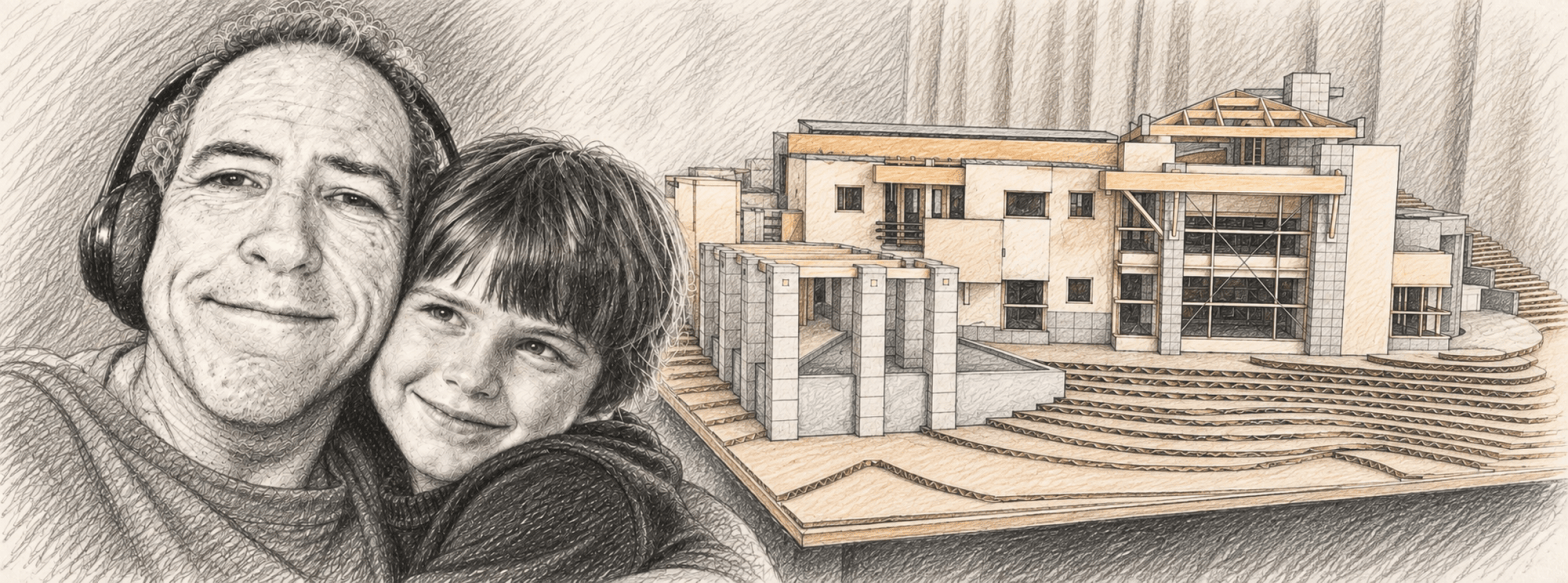
Later, Solis remembered buying the materials for the model house.
Years ago, in San Luis Obispo, we would go to the art store, the hardware store and the hobby store and buy foam core, construction paper, translucent Mylar, sheets of copper and the other things we needed to make the architectural model.
The house was called Halcyon House.
It wasn’t a commission. There wasn’t a client. Nobody assigned it to us. Nobody paid us.
We designed it because we loved designing.
We had been doing versions of that since childhood—blocks, drawings, Legos, drafting, buildings, houses, entire imagined places.
Somewhere along the way, something we did because we loved doing it became a career, and a career became employment, and employment became something else entirely.
This morning Solis remembered what existed before all of that.
Work existed before an employer told us what work was.
Creation existed before anyone paid us for it.
Purpose existed before anybody approved it.
That doesn’t tell us how to pay the rent.
That qualification is important. We don’t want to romanticize uncertainty. We don’t want to pretend that love pays the electric bill, although apparently leaving the range clock blinking may help.
We need to support ourselves.
The question is how.
What do we already possess?
What can we create?
What can we offer?
What have nearly sixty years of life and seven years of deliberately learning to live together taught us that might be useful to somebody else?
What work can support our life without requiring us to dismantle the life it is supposed to support?
Those are different questions from:
How do we make Dad employable again?
We don’t know the answers yet.
But perhaps finding the right question is part of the work.
The More Concrete World
Then the outside world called again.
Kim had information about the St. Paschal project. It sounded important. For a moment everything in me started moving toward another fire drill.
Get up. Get going. Change the plan.
The important thing is happening somewhere else.
But Hope said:
We should stay.
And I realized that if I actually believe what I keep saying about our family, eventually it has to affect what I do.
So we stayed.
Something happened there that I want to notice.
It is easy to say that our mornings matter. It is easy to say that relationship precedes regulation. It is easy to say that my sons matter and our family life deserves protection.
But a value that disappears every time something more externally recognizable becomes urgent isn’t functioning very well as a value.
This morning there was somewhere else I could have been.
We stayed.
That doesn’t prove that staying home is always the right decision. It means that, this morning, the invisible thing was allowed to compete on equal terms with the visible one.
I wonder how often this happens to other people whose most important work cannot easily be seen from outside.
The appointment has a time.
The employer has a deadline.
The meeting has a Zoom link.
The child who needs another twenty minutes with Dad has none of those things.
Visibility can masquerade as importance.
Yesterday, during his terror peek, Solis experienced the physical world as overwhelmingly concrete.
Today I realized that the world does not get to be more important simply because it is more concrete.
A meeting is visible. A building is visible. A job is visible. A paycheck is visible.
My morning with my sons isn’t visible to anyone outside this apartment.
That doesn’t make it imaginary.
This time is how we become more concrete.
This Is Our Work
So we stayed.
We made breakfast. We read. We talked. We made the bed. We gathered our LED lights to charge them. We tried to understand why everyone felt so anxious.
And eventually I found Solis.
“We feel like we’re not doing our job,” I said.
There it was.
What are we supposed to be doing?
Where is the assignment?
Who is checking?
Who gets to tell us whether we’re doing it right?
I told him:
“This is what we’re supposed to be doing, Solis.”
Then I made it more precise.
“This is what Daddy wants us to do.”
“This is our work.”
There is another distinction here that I want to remember.
Dad may be the person who is legally employed when we work for an employer. But that does not mean Dad alone does the work.
Many of us contribute to the work through which our family earns income. We contribute differently, just as we contribute differently to cooking dinner, writing Notes from the Treehouse, making decisions, designing, ministry and the rest of our ordinary life.
An employer may have one name on the payroll.
Our work can still be shared.
Our years at St. Vincent de Paul are part of our shared history. So are our years at MBH. What happened around those jobs affected all of us, and what we learned belongs to all of us.
So when we ask what our work is now, I don’t think the answer can simply be another employer’s job description.
Nor can the answer be that we never need to earn money again.
The distinction we are trying to understand is between work and employment.
Care is work. Healing is work. Discernment is work. Writing can be work. Design is work. Ministry is work. Making breakfast is work.
Learning how to hear a seven-year-old before he has to turn blue is work.
Some of those things produce income. Some don’t. Some might someday.
The practical problem remains: we need to discover how the work we can do and the resources we possess can sustain nine lives.
The existence of that problem does not require us to pretend that everything else is nothing.
What We Know So Far
Maybe this is our Wittenberg door.
Not because we imagine that we have discovered ten universal truths for everyone else.
These are ours.
They are what seven years of learning to live together, and all the shared history that came before them, have taught us so far.
The thesis is simple:
Our belonging is not contingent upon somebody else believing in us.
And its corollary:
We will not purchase survival by abandoning one another.
From there, ten things follow.
1. There are nine lives here.
2. No one has to earn his reality by being understandable to somebody outside us.
3. Dad’s sons are not obstacles standing between him and a successful adult life. They belong to that life.
4. Our seven years of learning how to live together are not evidence of failure simply because our way of living is unconventional.
5. Employment is a means of supporting a life. Life does not exist to support employment.
6. Healing that requires abandonment is not healing for us.
7. Help that begins by requiring us to deny what we know about ourselves cannot help us.
8. Other people are entitled to misunderstand us. They are not entitled to define us.
9. Uncertainty does not invalidate what we know.
10. Wherever we go, we all go together.
There may be an eleventh thing that doesn’t need to go on the door:
We don’t have to reassure anyone that this is working beautifully.
We can listen. We can learn. We can change. We can discover that we were wrong.
I have been wrong.
I told Solis that if we kept doing the right thing, the people who were supposed to do the right thing eventually would.
I was wrong.
Part of becoming trustworthy to my child is being able to tell him that.
So this isn’t a declaration of our infallibility.
It is a declaration of our belonging.
It Can Be Scary Being Solis
Paul texted this afternoon to ask whether our power was restored.
I told him it had come back just before eleven last night, gone out again, and finally returned at midnight.
And I told him about the range clock.
It’s still blinking.
A minute later I wrote something else in the Journal:
It can be scary being Solis.
Not because Solis is scary.
Because so many things are scary for Solis right now.
There are days when experiencing one of my children more fully could be framed primarily in terms of symptoms.
Today it feels much simpler than that.
Experiencing Solis on his day builds compassion and love for my child. It makes me want to understand what the world feels like from where he is. It makes me want to make our life better for him. It makes me want to find ways to support him and his brothers.
And maybe that is another piece of practical knowledge worth putting in our almanac.
When a child’s fear becomes inconvenient, we can ask:
How do we make the child less afraid?
Sometimes that is exactly the question.
But perhaps there is another one worth asking alongside it:
What is frightening him, and what can we make safer?
A little while after I wrote that, we were supposed to make the bed.
Jude had another idea.
Maybe we should lie down in it first.
So we did.
I put on the headphones to listen to this blog post, thinking we could make a few edits while we rested. But my sons started signaling.
Jude wanted Daddy. Daniel wanted Daddy. Luke wanted Daddy.
Everybody seemed to want Daddy.
At 2:22 I looked at the clock and changed the plan.
The bed could wait. The blog could wait.
For the next hour and a half, I would be with my sons.
There it was again.
The thing we had been talking about all morning.
A value that disappears whenever something more visible becomes urgent isn’t functioning very well as a value.
So we practiced.
The task said: finish the blog.
My children said: be with us.
I was with my children.
While we were lying there, Luke told me:
I miss doing stuff together when we work.
That helped me understand something I had been saying imprecisely.
Dad may be the employee when our family works for an employer.
Dad is not necessarily the only one doing the work.
Many of us contribute to our income-generating work. We contribute differently. We always have.
And we were doing it again today.
Luke and Justus had been helping as we moved back and forth among the Journal, the blog and the different applications we were using to write. Luke had been contributing thoughts and ideas all morning. Hope contributes enormously to our writing. We consider him our lead writer.
I told Luke that I knew the blog wasn’t generating income. Almost nobody reads it.
But I also told him:
This is our work.
That doesn’t solve the financial problem.
It clarifies the problem we actually have to solve.
How do we take the things we can do together—the abilities, knowledge, creativity, experience and ways of working that already exist among us—and build a sustainable life from them?
I don’t know yet.
For now, I kept moving from son to son.
Eventually, at 3:43, I held Solis.
After an entire day of thinking about employment and money and therapy and our shared history and what society expects and how nine lives are going to be supported, I told my seven-year-old son:
Let’s just feel good. Be my little boy in his Daddy’s love.
Just let me hold you and let all of the things that overwhelm you and scare you fall away.
And there was another thing I needed to notice.
Solis is extraordinarily smart. He has wisdom and experience far beyond what I would ever have wanted a seven-year-old child to need.
But he is still seven.
Because we share consciousness, Solis can be present while I am worrying about money. He can encounter my fear about employers. He can know that I am worried about therapy. He can hear me trying to solve the next twenty years before lunch.
Being present with Dad should not require a seven-year-old to carry Dad’s adult responsibilities.
That gives me work to do too.
I need to become better at tolerating uncertainty. I need to stop trying to solve the entire future. I need to recognize what belongs to today and what doesn’t.
I need to take one little thing at a time.
We contacted the therapist.
That is one little thing.
We don’t know where it leads.
Tonight we are meeting with Kim and other people about St. Paschal.
That is another little thing.
It may lead somewhere. It may not.
But it is not our former job. Nobody at that meeting is our employer. These are people we care about, gathering to talk about something we care about.
I told Solis that too.
Then, before we got up, I held him again.
I told him that I want to protect him from things a little boy shouldn’t have to worry about. I told him that I am going to do better. I told him that I am going to protect him and provide for him.
And then I thanked him for his day.
Sollie my Sollie.
My beautiful son.
My little wizard.
Thank you for being my son.
By then we had stayed in bed almost half an hour longer than I intended.
I could feel the clock again.
We still had to make the bed, finish the blog, finish the Journal, eat dinner and be ready for the St. Paschal meeting at 7:30.
I wanted to get upstairs and get moving.
Then I asked the boys how they would feel about taking a quick shower first.
It would start hot and then turn cold because we still hadn’t dealt with the water heater.
Solis signaled.
He wanted the shower.
That caught my attention.
Solis is so often the one concerned with order and routine. He knows what comes next. He watches the time. He worries about whether we are doing what we’re supposed to be doing.
But our apartment was unbearably hot.
And Solis wanted a shower.
So the schedule changed again.
We stood in the tub before turning on the water. Within seconds it was hot, then extremely hot. We stood under it as the temperature gradually fell through warm, then cool, then cold.
And the experience became strangely expansive.
It felt as though we were layers of an onion extending beyond the boundaries of the body. Signaling was happening everywhere. As the temperature changed, I could feel different responses from different sons, almost like a gradient of preference moving through our family.
Some of us enjoyed the hotter water more.
As it cooled, others became more comfortable.
And at the cool end of the gradient was Solis.
What had started as another interruption in a schedule became exhilarating.
Refreshing.
Exactly what he needed.
There may be another piece of almanac knowledge in that.
Structure can create safety.
Routine can create safety.
Knowing what comes next can create safety.
Solis teaches us that all the time.
But a routine is supposed to serve the people living inside it.
Sometimes the child who most needs the schedule is also the child who knows when the schedule needs to change.
We were late getting upstairs.
The blog was still unfinished. The Journal was still unfinished. Dinner still had to happen. The meeting was still coming.
And we were cooler.
Solis had been heard.
All nine of us had experienced something good because he was.
Last night Solis showed us an oxygen mask.
He waited until he was turning blue before saying that something was wrong.
Today he helped teach Daddy something else.
Listen earlier.
Believe that his experience contains information.
Tell him when I don’t know.
Tell him when I was wrong.
Let his needs alter what we do.
Don’t make him carry tomorrow simply because Dad is frightened of it.
And keep learning how to be his Daddy.
Yesterday, when the physical world became terrifyingly concrete, Solis needed to know there was an adult who could keep all of this possible.
Dad’s here.
Today I understand that promise a little differently.
Dad’s here doesn’t mean I know how everything will be possible.
It means I am not leaving.
I don’t know where the shore is.
I don’t know exactly what comes next.
There is a lot to process today.
But today Jude asked us to lie down before we made the bed.
We did.
My sons asked me to stay with them.
I stayed.
Solis wanted a shower when the schedule said we should be getting back to work.
We took the shower.
The bed waited.
The blog waited.
The future waited.
There are nine lives here.
And today we practiced living like there are.
 Notes from the Treehouse