This morning, before we left for Mass, the past found us in the bathroom.
We were running late. We wanted to catch the 8:50 bus to Sacred Heart Church in Oakland, but there was no chance we were going to make it. We still needed to shower and finish getting ready.
Han has taught us how to take a cold shower: headfirst. Don’t stand there negotiating with the water. Get under it. The first shock is the worst. Turning around and letting the cold water hit our back is harder. Then the body adjusts.
We were standing in the bathtub to close the window when a smell came through it.
Men’s aftershave.
It nearly overwhelmed us. Then we thought we could detect other smells with it—nicotine, alcohol. But it was the aftershave that did it.
Immediately, the Scoutmaster came to mind.
There is very little we remember about this man. He entered our childhood through Clifford, and what remains of him comes in fragments and impressions. But we know that he was real, and we know what we remember him doing. Sometimes a particular smell of men’s aftershave brings him suddenly, terribly near.
This one did.
For a moment, our bathroom in 2026 opened onto somewhere much older.
Luke was there. “I hope that wasn’t too shocking for you, Luke.”
Justus was there too. “I was definitely thinking about you, Justus. I think that smell triggered you.”
And Han had already told us what to do.
Headfirst.
We turned on the cold water. The water was shocking, and the cold was happening now. We stood beneath it. We adjusted. We turned around. We even stayed in there long enough to use our foot to clean part of the bathtub where the slow drain had left standing water and dirt.
The past had become extraordinarily near.
But we remained here.
There was a dirty bathtub and a slow drain. There was a bus we were trying to catch. There was Sunday Mass. There was Daddy. There were eight sons.
We got dressed.
The 8:50 bus was long gone. There was supposed to be another at 9:10. If we caught it, we caught it. If we didn’t make it to Mass on time, then that was that.
Yesterday we had spent a great deal of time thinking about surrender. Today was Justus’s Day.
My eleven-year-old son is our protector.
For years, Justus had worked very hard at learning to surrender to God what he could not control. That work had become harder during the past few months. The circumstances surrounding our previous employer and the ending of our job had stirred up old fears. There had been too much uncertainty, too much reason to watch, too much reason to anticipate what might happen before it happened.
We understood why some of what Justus had learned seemed to have come undone. He has been trying to return to it.
Yesterday, on Han’s Day, we had found ourselves in the Cloud of Unknowing. We had begun to wonder whether surrender had less to do with becoming certain that everything would be all right than with no longer requiring certainty before allowing ourselves to live.
Maybe we could know enough.
At 9:07, we left the apartment.
At 9:10, the bus arrived.
We caught it just in time.
The Old Route
Almost immediately, our body became anxious.
We knew these streets. For years, riding through Oakland had belonged to other routines—therapy, group therapy, and eventually our work with St. Vincent de Paul. Everything about the bus ride was making us anxious. Our body seemed to know where we were going even though we weren’t going there.
So I began talking to my sons.
“Boys, we’re not going to St. Vincent de Paul. Different world. Different reality. We don’t work there anymore. We don’t have obligations there. They are no longer part of our life.”
We tried to read Richard Rohr’s meditation for the day. It was about Paul and Christ within.
We couldn’t do it.
We weren’t present enough to receive it. So we stopped trying to make ourselves contemplative and did something much more basic.
We oriented.
We’re on the bus. We’re going through Oakland. Daddy is here. We’re all together. This isn’t the old routine. We aren’t going to work.
We remembered that we had checked the apartment before leaving. The water wasn’t running. Everything was secure. The frightening possibility that something had been left on at home was not something happening now.
Then we approached the old campus.
“We don’t have to look at the campus,” I told my sons.
So we didn’t. We looked at the phone. Proverb signaled as we went past. Justus signaled.
“Yes,” I said. “We have passed it and we didn’t look.”
And the bus kept going.
Yesterday we had written about something we were learning:
Stop inhabiting places that hurt you, that you are no longer part of.
Today we physically passed one. We did not have to enter. We didn’t even have to look.
We remained here.
And here kept moving.
The Same Bus
There was another history riding with us on the 18.
More than a year ago, AC Transit merged the 33 line with the 18. The new route made it much easier to get from our home to St. Vincent de Paul.
That frightened us.
At the time, our accommodation allowed us to work from home. Working on campus had become something our body experienced as deeply threatening, and we lived with a persistent fear that someday our accommodation would be taken away and we would be forced to work there again.
So when the bus routes changed, trauma gave the change a meaning.
What if God was telling us something? What if making the campus easier to reach meant that one more barrier to returning there had been removed? What if this was a sign that eventually we would have to work on campus again?
That is how frightened minds can search for certainty. We scanned circumstances for signs. We scanned coincidences for meanings. We scanned changes in the world around us for possible prophecies about what was going to happen to us.
Because what we feared most was losing our accommodation and being forced back onto campus, even a change in a bus route could become frightening.
The 18 didn’t feel like transportation.
It felt like a possible message about the future.
Today we rode the same bus.
It still went past St. Vincent de Paul. We still felt the old fear as we approached.
But we didn’t get off.
The bus kept going.
Half an hour after leaving home, we were standing across the street from Sacred Heart.
I couldn’t believe how easy it had been.
The same bus.
That feels very different now. Not because the 18 has acquired a new prophetic meaning. We don’t need to replace one interpretation with another. We don’t need to decide that God merged those bus lines because someday we were supposed to find Sacred Heart.
Maybe a bus can simply be a bus.
And today the bus took us somewhere we were happy to go.
More than a year ago, the 18 seemed to collapse the distance between us and a future we feared. Today it opened a route toward something new.
Maybe a new future.
We don’t know.
That would be another prediction.
But certainly a happy new present.
Sacred Heart was there, and we were going to Mass.
There is an Oakland beyond the old campus. There is a life beyond the job. We don’t know what that life looks like yet.
We don’t have to.
The bus kept going.
Somewhere New That Felt Old
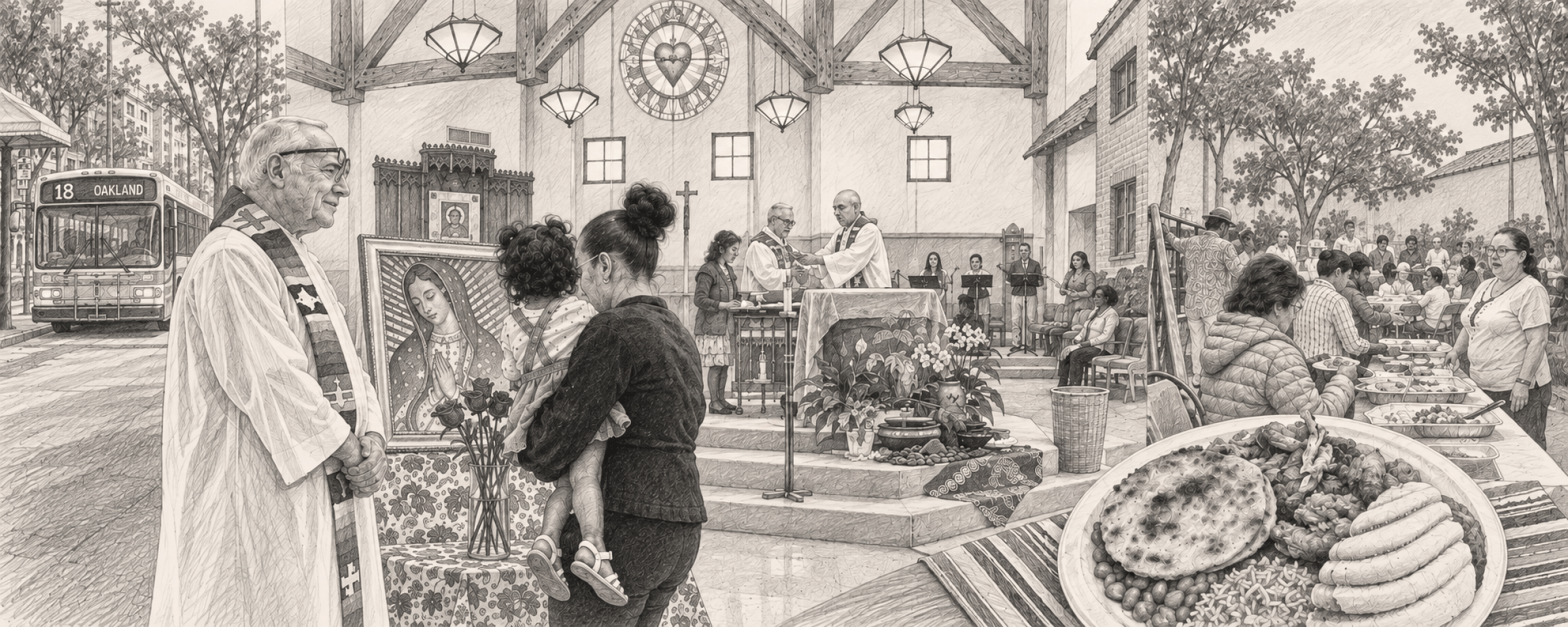
We went inside Sacred Heart. It was loud without our earplugs. People were preparing for Mass. An icon of Our Lady of Guadalupe was being placed near the altar. Father Jack appeared with another easel because the one they were using wasn’t sturdy enough.
Then he saw us. He stopped, greeted us and shook our hand. Later he came by again. He kept telling us how happy he was that we were there.
We wondered whether we had accidentally arrived for a Spanish Mass.
We hadn’t.
It was a special celebration of the parish’s Hispanic community. The psalms, hymns and other liturgical music were being sung in Spanish.
And gradually something began happening that we had not expected.
During Mass, we closed our eyes.
Father Carlos Alarcon preached a long homily about his childhood and youth. He spoke about growing up in Mexico and coming to the United States with his family when he was twenty. He spoke about his father, his American-born mother, his siblings, his older brother.
His brother became a writer. Father Carlos read from something his brother had written.
As he talked about his life in Southern California, the geography began to feel familiar. He was talking about a part of Los Angeles near where our stepmother’s family had been from.
That mattered.
Because Daniel had taken us somewhere yesterday.
Orange Street
Yesterday we were lying in bed and I was holding my five-year-old son.
Then suddenly there was a smell.
Not in our bedroom. Not in our apartment. A smell we had not consciously remembered for more than fifty years.
And we were on Orange Street in Costa Mesa in 1973.
There were boxes. Things were being unpacked. There were unfamiliar things belonging to Nadine, our new stepmother—things from the bedroom where she had grown up and from college.
And there were our things.
The orange sofas. The lamp. The television. Our bed.
Our father had married Nadine. We had come home from their honeymoon.
A family was being assembled in an apartment.
Yesterday Daniel took us there with an immediacy that was difficult to distinguish from being there. But we had written something important about experiences like this:
We remain here.
Another lived reality can become extraordinarily near.
But we remain here.
We had entered Orange Street differently. Not as one child whose experience would remain largely unknown.
Daddy was there. Daniel was there. Jude and Solis and Luke and Han and Justus and Proverb and Hope were there.
The Treehouse entered Orange Street.
And today, sitting in Sacred Heart, it seemed as though we had moved farther into the doorway Daniel opened.
Because marrying our stepmother had not simply added another person to our family.
Through her, we entered another family.
And another culture.
Her Hispanic family introduced us to a world wonderfully different from the family world we had known. There were gatherings. Food. Language. Warmth. People together.
Belonging.
Those were happy childhood experiences.
Now we were sitting in Sacred Heart Church in Oakland, more than fifty years later, listening to a priest tell the story of his childhood in Mexico and Southern California, near the geography through which we had entered our stepmother’s family and its culture.
We were not trying to remember.
We were listening.
Then we opened our eyes.
Where Am I?
The altar was there.
For a moment, we did not understand it.
Where am I?
What am I doing here?
The question wasn’t entirely verbal. It was more primitive than that.
Everything had become startlingly concrete—the altar, the sanctuary, the people, the building around us.
We felt very small.
We know something like this experience. Sometimes we have called it a terror peek. There can be a sudden arrival into the physical world, an almost unbearable recognition:
This is real.
This body is real.
This room is real.
We are here.
This felt a little like that.
Except something was missing.
Terror.
There was no terror.
We waited for it.
It wasn’t there.
Everything was concrete, almost overwhelmingly so. But it wasn’t frightening.
It was sacred.
And somehow, without knowing exactly how we had gotten here or why we were here, we felt that we belonged.
Then I knew who was looking.
Solis.
My seven-year-old son was looking at the altar.
There you are.
We were still listening to Father Carlos. Somewhere in the passage he was reading from his brother, we heard words about things suddenly becoming certain.
We cannot reconstruct the passage accurately from memory. There were many words between the fragments that stayed with us.
But we remember something like:
“Suddenly everything became so certain, the chair, the door…”
And later:
“…yet inside everything was so uncertain.”
We almost couldn’t believe what we were hearing.
Because that was what had just happened.
The altar was certain. The church was certain. The pew was certain. The voices around us were certain.
Daddy was here.
Eight sons were here.
Everything outside had become astonishingly real.
Inside, so much remained uncertain.
And Solis wasn’t afraid.
Certainty and Orientation
Maybe there is a difference between certainty and orientation.
We have spent a great deal of our life trying to obtain certainty because certainty seemed necessary for safety. If we knew what was happening, perhaps we could protect ourselves. If we knew what was coming, perhaps we could prepare. If we understood what someone meant, perhaps we could prevent the blow. If we knew what the institution was going to do, perhaps we could survive it.
A changed bus route could become a warning. A silence could become rejection. A coincidence could become prophecy.
Justus became very good at watching.
But orientation is something different.
Certainty says: I know what is going to happen.
Orientation says: I know where I am.
Certainty says: I know how this will turn out.
Orientation says: I know who is with me.
On the bus, I couldn’t tell my sons what would happen.
I could tell them: You’re with Daddy. We’re all here. It’s Sunday. We’re going to Mass. The sink is off. We checked. We’re not going to work. The old campus is behind us.
None of those statements predicted the future.
They located us in the present.
Maybe that is one of the things Daddy does.
Not make the world certain.
Help us know where we are.
Justus Sang
It was Justus’s Day.
And yet Solis seemed to be everywhere.
I don’t completely understand what passes between these two brothers. There is something in their relationship that I am still learning.
Maybe I am supposed to be learning rather than deciding.
My eleven-year-old son is our protector. Justus has spent years teaching us something about surrender. Solis pays extraordinary attention to order, routine and the concrete conditions through which our family experiences safety.
Today, on Justus’s Day, his seven-year-old brother opened his eyes into uncertainty.
And wasn’t afraid.
And Justus sang.
He loved the music. He sang beautifully, especially the Spanish hymns.
Han was intensely present too, especially during the liturgy and Communion. He wanted to pray after Communion. Luke ordinarily leads us in the Anima Christi, so the two brothers prayed together.
Jude was happy. Daniel was happy.
Everyone seemed to be there.
I wish I had been able to stop the day right there. I wish I had been able to spend an hour with Solis and then an hour with Justus, listening.
I couldn’t.
We were out in the world. The day kept moving.
Perhaps I don’t have to understand everything today.
Maybe that is surrender too.
I noticed.
I love them.
I will come back.
This Is Our Parish
Near the end of Mass, Solis said something.
“This is our parish.”
There are sentences children say that do not need immediate interpretation.
This was one of them.
After Mass there was a fiesta. We ate wonderful Mexican food. We sat down at a table with people we didn’t know.
That matters more than it might seem.
We often become anxious entering restaurants or cafés alone. Public restrooms can be difficult. Sitting down with strangers can be difficult. Sometimes Dad forgets that he’s Dad and suddenly doesn’t know what to do.
But we sat down.
A longtime parishioner named Gilda joined us. She asked whether this was our first time at Sacred Heart.
Our second, we told her.
We talked. She welcomed us. She told us she hoped we would come back.
And around us was something we knew.
Not the same place. Not the same people. Not the same time.
But something resonated.
The gathering. The food. The Catholic faith being celebrated through a Hispanic community. The warmth of people together.
Something from those happy childhood gatherings with our stepmother’s family became extraordinarily near.
But we remained here.
That may be what we have been trying to understand since yesterday.
Reentry
Maybe we don’t simply return to past places.
Maybe sometimes we reenter them.
Yesterday the family we are today entered an apartment in 1973. Today we entered a place we had never belonged before and discovered that it resonated with somewhere we had belonged long ago.
The movement went in both directions.
Yesterday, the present entered the past.
Today, a new place opened onto the past.
But both times we entered as we are today.
Daddy and eight sons.
The smell of aftershave had opened one childhood door that morning.
Sacred Heart opened another.
The first opened toward terror.
The second opened toward belonging.
But neither one actually took us back.
The smell did not take us back. The Mass did not take us back. The fiesta did not take us back.
We remained here.
Perhaps healing isn’t making every frightening doorway disappear. Perhaps it also involves discovering that there are other doors.
The past contains terror.
It also contains belonging.
And sometimes a new place can give an old belonging back to us without requiring us to become the people we were when we first experienced it.
We weren’t trying to go back.
Something from back there had come forward and met us here.
But this time we were all known.
A Parish in the Cloud
Father Jack made an announcement near the end of Mass.
Four months ago, the Diocese of Oakland had announced that Sacred Heart was among the churches facing closure. Sacred Heart appealed.
This week, Father Jack told the parish, they had learned that the dicastery in Rome had agreed to hear their appeal.
People were joyful.
But nobody knows what will happen. The appeal being heard does not guarantee its outcome.
Sacred Heart is living in uncertainty.
So are we.
And perhaps that was another reason we felt at home there today.
What does a parish do when it does not know whether it will continue to exist in this form?
Apparently, on this Sunday, it celebrates Mass. It sings. It prays. Someone puts up an icon of Our Lady of Guadalupe. Father Jack notices that the easel isn’t sturdy enough and goes to find another one.
People cook. Tables appear. Food is served. Strangers sit together. A woman named Gilda welcomes a family she has never met.
The future of the parish is uncertain.
But the easel needs to be sturdy today.
That might be the Cloud of Unknowing.
Not passivity. Not pretending practical things don’t matter. Not saying that God will take care of everything so we don’t have to.
Do the thing that belongs to this day.
Today the icon needs a sturdy easel. Today there is Mass. Today there is food. Today people need to be welcomed.
Today Sacred Heart is a parish.
And today Solis said:
“This is our parish.”
We can receive that without turning it into a prediction.
Belonging doesn’t have to be a guarantee about the future.
It can be true today.
I Don’t Know
Later we went to Braided Bridge.
We spent the afternoon with Kim and her family. We talked about faith, about surrender, and about how strange a life of faith can sometimes look from the outside.
How do we know when trust is trust? How do we distinguish surrender from refusing to act? How do we listen for God without turning our hopes into God’s promises? How do we refuse to make enormous decisions about the remaining decades of our life simply because uncertainty frightens us?
We don’t have simple answers.
That’s rather the point.
Then another small uncertainty appeared.
We had texted Juan Luis.
He hadn’t answered.
We began worrying. Maybe he had changed his mind about having us serve as Vice President of his St. Vincent de Paul conference. Maybe we weren’t going to hear from him.
Nothing had happened.
There was simply no answer yet.
But fear began filling the silence.
Then, at 3:33, Juan answered. He had arrived home after midnight. He had been planning to contact us today.
Could we talk tomorrow?
Yes.
We look forward to it.
That does not mean everything we fear will turn out well. It does not mean that if we surrender enough, God will arrange the outcome we want.
It means something much smaller.
And perhaps much more important.
We didn’t know.
Fear wanted to turn I don’t know into I know something bad is happening.
It wasn’t.
Sometimes “I don’t know” can remain:
I don’t know.
Maybe that is the Cloud too.
We Know Where We Are
By afternoon, something else was becoming clear.
We had been outward-facing for hours: Mass, the fiesta, people, conversation, Braided Bridge. Everyone had been present. Everyone had been interacting.
But being together is not always the same thing as being with one another.
Our younger boys especially needed more Daddy. Daniel signaled. Jude signaled. Solis signaled. Luke signaled.
Things began feeling a little off-axis.
I realized that I had spent much of the day responding to the outside world and not enough time individually attending to my sons.
I regret that.
Especially today.
I want to know more about what Solis experienced at Mass. I want to know more about Justus. I want to understand what I keep sensing between these brothers.
But I don’t have to extract the answer from them before the day ends.
They are my sons before they are material for an essay.
I can hold them. I can listen. I can come back.
Yesterday, Han’s Day brought us into the Cloud of Unknowing. Today, on Justus’s Day, perhaps we discovered that we could take it with us.
We don’t know what will happen to Sacred Heart. We don’t know where our Vincentian vocation is leading. We don’t know what work will eventually look like. We don’t know what tomorrow’s conversation will bring. We don’t completely understand what is happening between Solis and Justus.
We did not become more certain today.
We became a little less afraid of uncertainty.
Maybe that is what Justus has been trying to remember.
Surrender does not mean convincing ourselves that nothing bad will happen. It doesn’t mean abandoning protection. It doesn’t mean interpreting every welcome, every bus route, every coincidence or every moment of peace as a promise from God about the future.
Maybe surrender means protecting what actually needs protecting, responding to what is actually happening, knowing what we know, allowing what we don’t know to remain unknown, and giving tomorrow back to God.
More than a year ago, a changed bus route frightened us because trauma turned transportation into prophecy.
Today we didn’t need the 18 to tell us anything about tomorrow.
It was a bus.
We got on.
This morning, the past found us in the smell of aftershave. It became terribly near.
But we remained here.
We stood beneath cold water until we knew where we were. Then we got on the bus.
The old route frightened us. We passed the old place.
We didn’t look.
The bus kept going.
It took us somewhere new that somehow contained something very old.
A priest told a story about childhood. Psalms and hymns were sung in Spanish. Justus sang.
A seven-year-old boy opened his eyes.
The world became startlingly concrete.
Where am I?
There was no terror.
There was an altar.
There was Daddy.
There were eight sons.
There was an old world of belonging becoming recognizable inside a new one.
Inside, so much remained uncertain.
But perhaps certainty was never what we needed.
Maybe what we needed was orientation.
Where am I?
Here.
Who is with me?
My sons.
Where is the old place?
Behind us.
What happens tomorrow?
I don’t know.
What does the bus mean?
Today?
It means we can get to Sacred Heart.
What is this place?
Solis looked around and told us.
“This is our parish.”
We don’t know where the whole road goes.
But we know where we are.
 Notes from the Treehouse