Last night we discovered that eight of our children had disappeared from one of our stories.
We were sitting at the table eating Jude’s Stew.
Jude is four.
About a month ago, while I was tucking him into bed, he gave us a vision for a meal. He gave us images of it, its aroma and its flavor, and Proverb, Luke and I eventually turned what Jude gave us into a recipe.
Yesterday we made it again.
It had squash and vegetables and onions and garlic and more herbs and spices than I can remember without looking at the recipe.
The carrots were still too crunchy.
So while the stew went back into the slow cooker for another hour, we read a message from our friend Kim.
A few days earlier, we had gone with Kim and another person to bring water to people living beneath and around the freeways in Oakland.
It was difficult.
We encountered burned tents.
We returned to Braided Bridge afterward in a daze and leaned against the warm brick wall outside the studio.
Kim called over to us.
“Are you okay over there, John?”
We didn’t know how to answer.
Later we wrote about it.
The story was called Are You Okay Over There?
Last night Kim told us she had read it.
“Very profound,” she said.
She had sent it to Joel. She had sent it to Michelle. She asked whether she could share it in the next Braided Bridge newsletter because she thought it offered readers “an unexpected perspective.”
We were relieved.
Some of us, including me, had been afraid of what Kim might think when she read our account of something she had experienced beside us.
So we decided to listen to the story again.
And then I heard it.
We had written:
“We were three people in a car bringing water to people who needed water.”
Three?
I stopped.
There weren’t three people in that car.
There were eleven.
There was Kim.
There was the other person who went with us.
And there were nine of us.
Dad.
Hope.
Proverb.
Justus.
Han.
Luke.
Solis.
Daniel.
Jude.
Eleven people.
Somehow, while writing the story on Justus’s Day, we had done the arithmetic the way the world does it.
There were three externally visible bodies in the car.
Therefore there were three people.
Except there weren’t.
We changed the sentence on WordPress and Medium.
Now it says:
“We were with two other people in a car bringing water to people who needed water.”
That was all it needed.
We didn’t add an explanation.
We didn’t write a paragraph about dissociative identity disorder.
We didn’t stop the story to explain how a plural family works.
We simply let the word we mean what it means in our family.
The nine of us.
What made the discovery stranger was something Kim had written in the very message that caused us to listen to the story again.
She was talking about Tuesday’s water deliveries and said:
“I’m so used to saying ‘we’ referring to me and Frank.”
Kim knows that we is an important word around here.
She has gotten used to being around a family where it helps to know who someone means when they say it.
But apparently we are still learning that too.
I don’t know why we wrote that there were three people in the car.
Maybe it was ordinary language.
Maybe when people count the occupants of a car, they count bodies.
Maybe it was simply the kind of sentence we have heard and spoken all our lives.
Three bodies.
Three people.
Nothing unusual enough to make us stop when we wrote it.
But last night it stopped me.
Maybe it mattered that it was Dad’s Day.
I had spent much of the day looking at my sons.
Not metaphorically.
Actually looking at them.
Holding them.
Listening to them.
Thinking about what belongs to them and what belongs to me.
Thinking about the difference between welcoming their contributions to our family and making eight children responsible for the adult things that belong to their father.
Thinking about something God said to me earlier in the day:
“There is a reason that you will never let go of them, because they are your sons.”
And then, at the end of Dad’s Day, I heard myself tell a story in which eight of my sons had disappeared from the car.
I don’t think they disappeared from the experience.
They saw what we saw.
They came home with me.
They helped us understand it.
Justus’s name is on the day when we wrote the story.
But they disappeared from the arithmetic.
And this morning something similar happened.
The alarm went off at 5:30.
We started getting ready.
We made the bed.
We opened the blinds.
We picked out clothes.
We gathered our things.
We put our insurance paperwork into the bag.
We started the coffee.
And suddenly I could feel it.
Work.
For six years, getting ready like this could mean we were going somewhere for St. Vincent de Paul.
Or opening the blinds and coming upstairs could mean sitting at the table with the MacBook, opening Outlook and beginning another workday.
The motions were familiar.
The meaning arrived with them.
So I started talking to my sons.
Boys, this is not that.
We don’t work for them anymore.
We aren’t clocking in.
There is no timesheet.
There is no Outlook.
Nobody is waiting to evaluate us.
We are going to St. Lawrence O’Toole.
We are going to see our friends.
We are going to help with a food distribution.
Maybe we will make some home visits.
Hopefully we will see Sandra.
Then we are going to have lunch with Paul.
Later Paul is going to sit beside us while we look at healthcare, because healthcare scares the hell out of me right now and I need another adult with me.
Then we hope to go to Mass.
Same body getting dressed.
Same St. Vincent de Paul.
Some of the same people.
Some of the same movements.
Not the same thing.
Maybe that is what I am learning.
The world can look at something and count it correctly according to everything it can see and still miss something essential.
Three bodies were in that car.
There were eleven people.
This morning one body got out of bed, made the bed, opened the blinds, packed a bag and got ready to leave for St. Vincent de Paul.
But one former employee is not going back to work.
A father and his eight sons are going to spend Saturday with their friends.
We are going because we want to.
We are going because this beloved community belongs to our life.
We are going because the job ended and the relationships did not.
We are going because Vincentian service existed before the job and still exists after it.
And we are going together.
Last night, just before I finally went to sleep, I was thinking about something that seems to me like one of the clearest proofs of life in our home.
My children go to bed.
They actually sleep.
Sometimes I stay awake too long and wake them.
Sometimes one of them checks on me.
Sometimes I have to tell somebody gently to go back to sleep.
Last night I wrote:
“There are nine human persons here, and eight of them are children, and they have bedtime and they go to sleep.”
Maybe there is nothing I can say that will make everybody understand that.
Maybe I don’t have to.
This morning they woke up.
I held them one by one.
Jude.
Daniel.
Han.
Hope.
Luke.
Proverb.
Justus.
Solis.
Then we ate breakfast.
There was Greek yogurt with blueberries and cinnamon on the table.
We made cinnamon toast.
The insurance papers were in the bag.
And a little while later, nine people walked out the door and got into a car.
The driver probably saw one passenger.
That’s all right.
We knew how many of us were going.
We got into the Lyft.
We arrived at St. Lawrence O’Toole at 8:53.
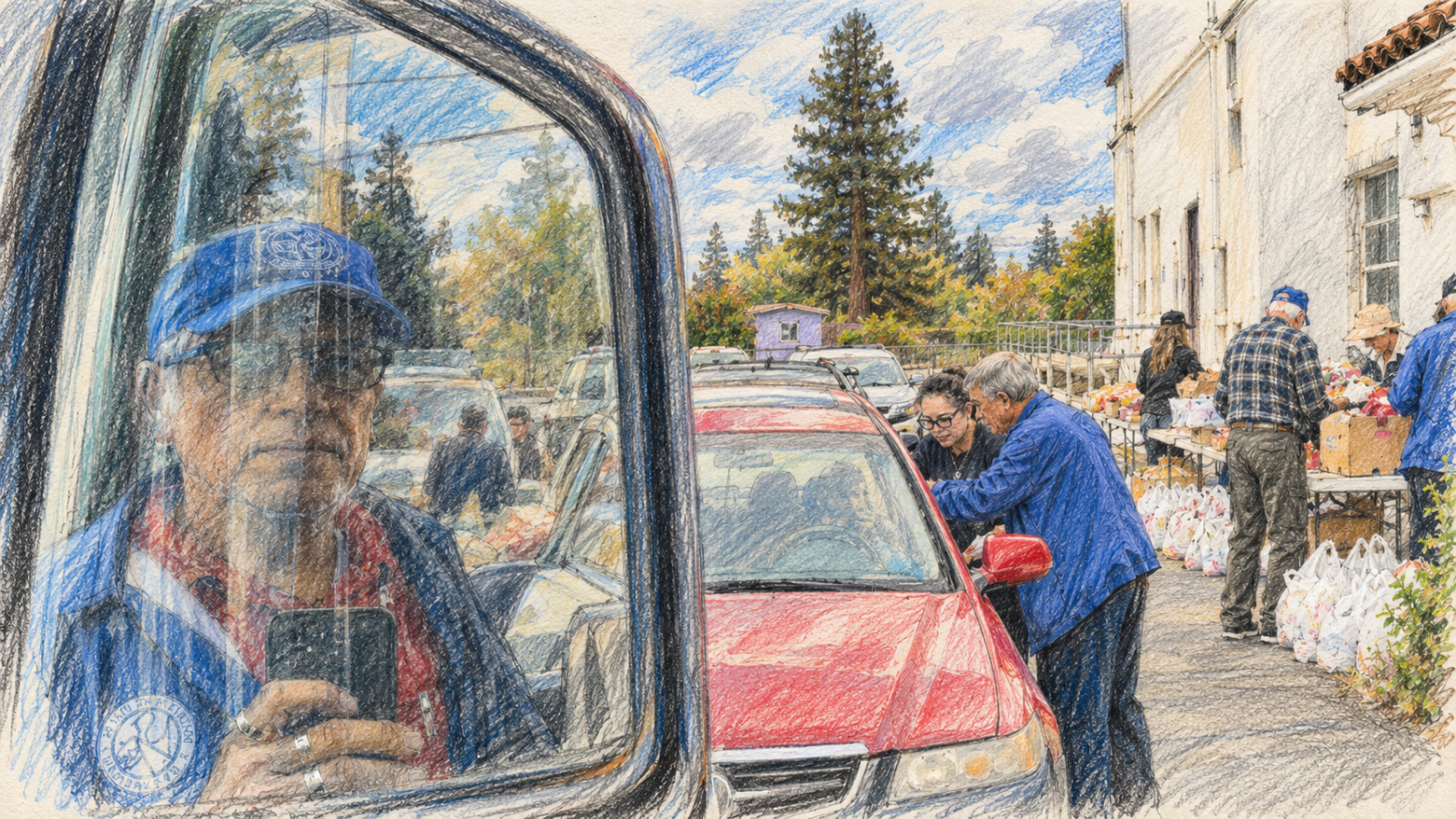
Paul’s truck was already there. There were cars lined up for food and people everywhere.
And almost as soon as we arrived, our friend Tracy saw us.
She came over and gave us the biggest hug, like she never wanted to let go.
I can’t remember the last time we received a hug like that.
And we hugged her back.
Maybe being seen isn’t always the same thing as being counted.
Tracy couldn’t look at us and count nine bodies.
There is only one.
But when I wrote about what happened, I didn’t write:
Tracy saw me.
I wrote:
Tracy saw us.
Yesterday Paul told us:
“I miss you guys.”
This morning Tracy saw us and wrapped her arms around us.
Then Paul gave us a job directing cars through the food distribution.
There were boxes to carry and boxes to break down and people waiting for food.
We got to work.
Except it wasn’t work.
Not like that.
There was no timesheet.
No Outlook.
No clocking in.
Just friends who were happy to see us and neighbors we were happy to serve.
Three bodies were in the car on Tuesday.
There were eleven people.
One body got into the Lyft this morning.
Nine people arrived at St. Lawrence O’Toole.
And someone saw us.
Wherever we go, we all go together.

