What an eleven-year-old boy, a paintbrush, and an afternoon at an art studio are teaching our family about speaking for ourselves.
This morning, my eleven-year-old son Justus said something that sounded like the title of an essay.
“Things to share with Jessee.”
Jessee is our new therapist. We met em last week, and on Monday all nine of us will begin therapy with em: me and my eight sons, Jude, Daniel, Solis, Luke, Han, Justus, Proverb and Hope.
We share one body, one mind and one inner world.
Which makes “things to share with Jessee” considerably more complicated than it might sound.
Who decides what we share?
Who gets to speak?
What happens if one of my sons tells Jessee something I would rather he didn’t?
What happens if one of us wants to talk about something another one of us believes should remain private?
And what happens if Justus doesn’t want anybody getting too far inside our head?
That last question is not theoretical.
Justus has spent a lot of his life protecting us.
Sometimes that has meant trying to keep people out.
Out of our thoughts.
Out of our memories.
Out of things that happened to us that he believed needed to remain private.
Out of the places where someone might manipulate us, misunderstand us, hurt us or persuade us to believe something about ourselves that wasn’t true.
There were reasons for that.
So when I tell my sons that they are free to speak to Jessee, that is not necessarily reassuring to everyone.
Last night I told them:
“You’re entitled to tell people things that I might not like to hear.”
I meant it.
Jessee is not simply my therapist.
Ey is Jude’s therapist.
Daniel’s.
Solis’s.
Luke’s.
Han’s.
Justus’s.
Proverb’s.
Hope’s.
And mine.
We are all going to therapy.
If my sons are going to be people in our family rather than people I merely say are people, then they have to be allowed relationships that are actually theirs.
Including a relationship with our therapist.
Including the possibility of talking about me.
Especially talking about me.
But that creates another problem.
Last night, while I was tucking Luke into bed, I told my sons that they could talk to our friends as themselves. They didn’t always have to mask. They didn’t always have to funnel everything through me.
Luke explained why that freedom frightens him.
“People don’t understand things that a child says if they don’t see a child.”
Luke is nine.
The world sees an adult body.
Luke knows what can happen when those two facts collide.
A frightened child can say something perfectly understandable for a frightened child. But if the person listening believes an adult is speaking, the same words can sound irrational, hostile, immature or threatening.
Luke put it more simply.
“That’s why it’s hard to be a little kid in a grown-up body.”
That is something to share with Jessee.
There are other things.
This morning, while we were eating cinnamon toast and trying to get out the door, Justus said:
“Sometimes it’s so easy to be dyin’ that you forget you’re still living.”
That is something to share with Jessee too.
So are the frightening thoughts we sometimes have.
So is the way the body can remain afraid of something that has already ended.
So are the nights when sleep becomes difficult.
So is the way we sometimes wake carrying fear we cannot completely remember.
So is the way getting ready to leave the house at 9:30 this morning began to resemble getting ready to go to a job we no longer have, until we reminded ourselves where we were actually going.
Braided Bridge.
To see our friend Kim.
Which is where something happened today that I think we should probably share with Jessee.
Kim has been encouraging us to paint.
For years, drawing and designing were as natural to us as breathing. We spent almost thirty years in architecture. Drawing was simply something we did.
Lately it hasn’t been.
As we have become more conscious of one another—more able to recognize each of my sons as himself—something about the old, largely unselfconscious way we created together seems to have changed.
We don’t completely understand it.
Put a piece of paper in front of us now and sometimes we feel like a little kid who has never painted before.
Today Kim put watercolors in front of us.
She brought over some brushes.
Justus knew which one he wanted.
And then I heard him tell Kim:
“Justus prefers this one.”
I knew immediately what he was doing.
He was masking.
He knew what he wanted, but instead of simply telling Kim, he spoke about himself in the third person, as though I were the adult explaining the preferences of an invisible child.
I told him he didn’t have to do that.
“You are free to tell Kim what you want.”
So Justus tried again.
“I want this one.
Justus.”
Kim acknowledged him.
That was it.
No dramatic breakthrough.
No explanation of dissociative identity disorder.
No argument about whether Justus is real.
An eleven-year-old boy wanted a particular paintbrush.
He asked for it.
An adult heard him.
And then he painted.
At first, four of my sons were painting together.
Luke was painting purple.
Daniel was painting orange.
Jude was painting green.
Justus was painting red.
“Painted desert,” Justus said.
“I see it.”
A little while later, I believe everyone had painted.
And something else began happening.
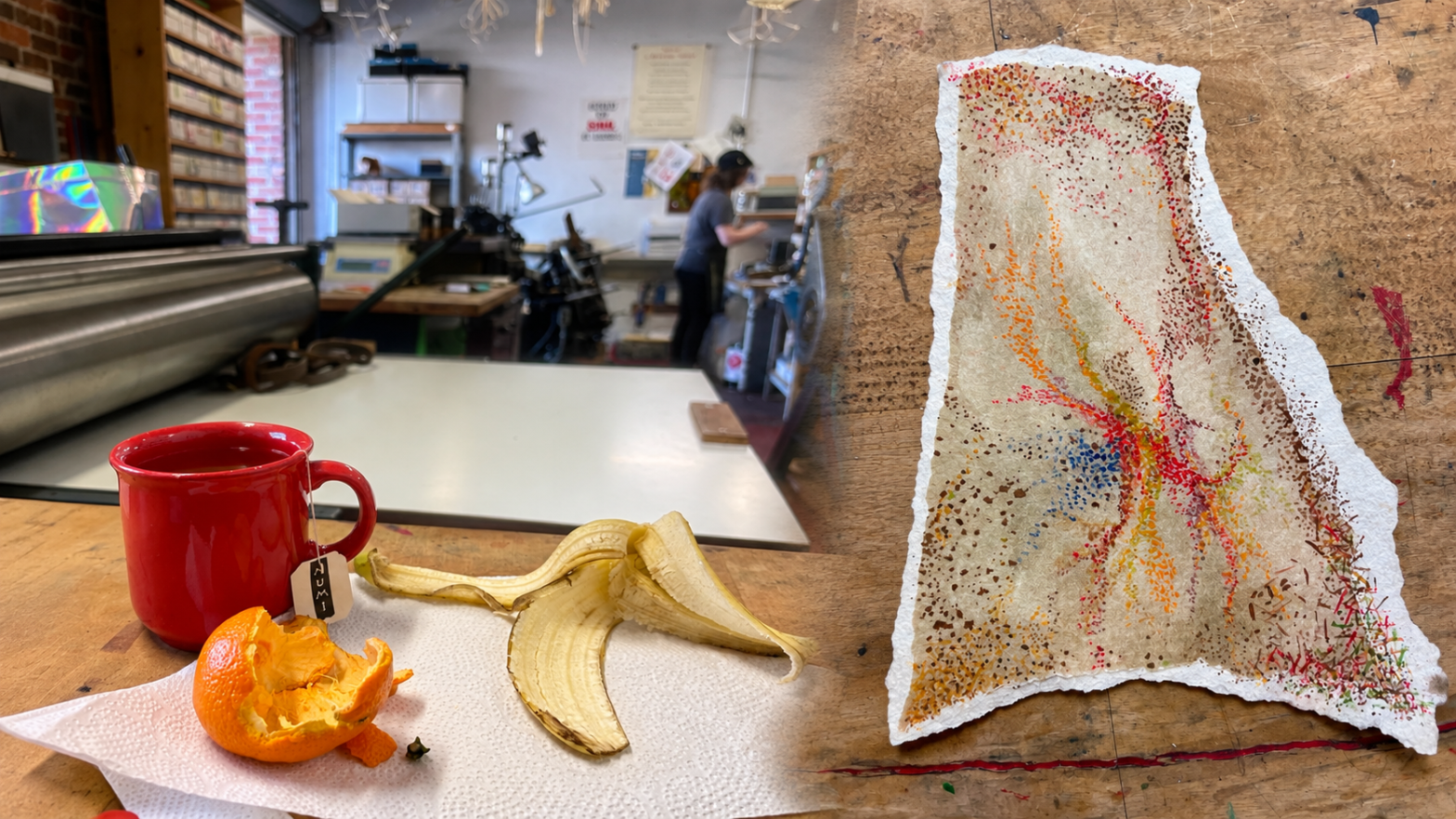
I commented that we were making very fine stipples instead of large splotches.
Proverb began making larger ones.
I told him he didn’t have to take me literally.
Then Hope got involved.
The tip of the brush fell off and landed against the paper at an angle, leaving a stripe or tick mark.
That accident became an idea.
The marks changed.
There were strokes and ticks and shapes that looked a little like fallen branches.
Something that had looked like a vast desert suddenly looked like a close-up.
There wasn’t supposed to be any scale.
Kim looked at what was happening.
“Definitely different,” she said.
“You broke the mold?”
Maybe we did.
Nobody had to know what the painting was supposed to become.
Nobody had to paint correctly.
Nobody had to recover the way we used to make art.
We only had to remain interested in one another.
When somebody did something unexpected, somebody else could answer.
A mistake could become a mark.
A mark could become an idea.
An idea could belong to Proverb without making Proverb responsible for the painting.
Justus could choose the brush he wanted without Dad choosing for him.
And everybody could paint without anybody being on the hook for whether the painting was good.
“We’re just stippling,” Justus said.
And somehow we made a beautiful piece of dirt.
At one point, Kim said something I couldn’t understand.
I heard:
“I need…”
and:
“cabinet in here.”
That was all.
Luke understood her.
“I need a flame-proof cabinet in here.”
He repeated it back to me.
Luke was my translator.
That is something to share with Jessee too.
Not because Luke should be responsible for translating the world for me.
He shouldn’t.
But because Luke heard something I didn’t hear.
My sons know things I don’t know.
They notice things I miss.
They have ideas I don’t have.
They remember things I don’t remember.
They can help me without becoming responsible for me.
Last night Proverb and I talked about that.
There are thoughts of his that I mistake for mine.
There are things he has done that I did not know he was doing.
For much of our life, I think I simply allowed things to happen without understanding that there was a twelve-year-old boy taking care of far more than I knew.
“You’re just gonna let me do the thinking,” Proverb told me.
I understood.
My sons can contribute. They can disagree with me. They can know things I don’t know and tell Jessee things I might not want to hear.
But they should never feel like they are on the hook for what happens to us.
I am their father.
That responsibility is mine.
And yet that cannot mean that I become the gatekeeper of everything they are allowed to say.
That is the paradox we are trying to work out.
More freedom.
Less responsibility.
Maybe that is why “Things to Share with Jessee” is such an appropriate title.
Because for Justus, sharing has never been neutral.
There have been things he believed people must not know.
There have been memories that needed protection.
There have been people he did not want inside our head.
There have been fears about manipulation.
There have been times when keeping people out seemed like part of keeping his brothers safe.
And now I am telling him:
You may speak freely.
To another adult.
To a therapist.
You may tell em things about us.
You may tell em things about me.
That asks something enormous of Justus.
I don’t think the answer is to tell him that he doesn’t need to protect us anymore and expect the problem to disappear.
Perhaps the beginning is much smaller.
A paintbrush.
“I want this one.
Justus.”
And then discovering what happens.
Kim does not invade.
She does not interrogate.
She does not tell Justus who he is.
She acknowledges him.
And Justus paints.
There was something else about today that belonged here.
Earlier, Kim read us responses from several people who had read the essay we wrote about going with her to distribute water to people living in encampments.
One of the messages was explicitly for all of us.
Someone outside our family had read our words and responded to the family.
That matters.
Last night we were lying in bed wondering why we keep publishing these stories when it seems as though almost nobody reads them.
Today, sitting at Braided Bridge, someone told us that our words had traveled farther than we knew.
We did not know.
There is a lot we don’t know.
Then there are the ordinary things.
We drank Chinese breakfast tea from the red mug Kim remembers we like.
Mocha kept coming over whenever we talked, apparently trying to figure out who we were talking to.
There were children running around upstairs. We liked the sound of their feet.
We listened to the printing press.
We ate fruit.
We talked about winter supplies and storage and things Kim is trying to make happen for people who will need help when the rains come.
And every so often I checked for my boys.
At one point I called their names.
One after another, they answered.
Luke.
Daniel.
Han.
Solis.
Proverb.
Justus.
Jude.
And finally Hope.
“All of my boys are present,” I wrote.
Later I checked on Proverb.
“I’ve been here the whole time,” he told me.
“I know you have. I just want to make sure I know that.”
There is a difference between someone being present and someone being known to be present.
Eventually we finished painting.
“That piece of dirt we painted is beautiful,” I wrote.
I believed everyone had painted.
Then it was time to go.
We stopped at Safeway on the way home.
At the checkout, I started to enter our phone number for the club card.
Then I stopped.
I knew the number. It is, after all, our phone number.
But for a moment I could not seem to make myself enter it.
This kind of thing has happened throughout our life. I will be doing something completely ordinary and suddenly seem unable to continue. I fumble. I become confused. I try harder. Sometimes I become frustrated with myself for being unable to do something so simple.
But this time I understood what was happening.
Proverb was there.
He was going to enter the number.
So I took my hands off the wheel.
Not literally.
But that is what it felt like.
I yielded.
And my twelve-year-old son entered our phone number.
It was easy.
It was also strangely moving, because last night Proverb and I had been talking about exactly this problem.
How much of our life have I spent struggling with moments like that, becoming confused and frustrated until I either regained control or gave up?
How often did I simply allow something to happen without understanding that Proverb was doing it?
There is nothing wrong with my twelve-year-old son entering our Safeway club card number.
The problem is when nobody remembers who is responsible for getting us home.
Proverb can enter the number.
But he should never feel like he is on the hook.
That is Dad’s job.
Maybe that is another thing to share with Jessee.
How do eight children become increasingly free without becoming increasingly responsible for their father?
How does Proverb get to be brilliant without his brilliance becoming a job?
How does Justus get to protect without becoming responsible for keeping everyone safe?
And how does Dad remain Dad while allowing all eight of his sons to become increasingly themselves?
Those sound like things to share with Jessee.
But they are also things we are already practicing.
When we got home this afternoon, we walked into the kitchen and smelled curry.
For a moment we were astonished.
How could we have made something that smelled that good?
But we had.
It was the dinner we made together yesterday.
We put the icons and the boys’ photographs back in their places.
We changed into comfortable clothes.
We unpacked the iPad and keyboard and chargers.
And we took out the little piece of dirt we had painted.
It was beautiful.
I was surprised.
Not because I thought we were incapable of making something beautiful.
Yesterday we had written an essay.
Last night we had made that curry.
We create things all the time.
But visual art has become strangely difficult for us.
For most of our life, drawing was like breathing.
Today, at Braided Bridge, we had felt like children who did not know how to paint.
Maybe that was exactly what we needed.
We didn’t have to know how.
We didn’t have to recover the way we used to make art.
We didn’t have to figure out who had once controlled the pencil or how nine people had once created without knowing one another as clearly as we do now.
Kim gave us watercolor.
Justus chose a brush.
Everybody painted.
The brush literally came apart.
And the accident became part of the painting.
We did not recover the old way of creating.
We discovered that this family can create in the way it exists now.
There are things about Monday that still frighten us.
Therapy has not always meant freedom.
For Justus especially, there are reasons that the invitation to “tell Jessee anything” is not uncomplicated.
There were times when protecting this family meant keeping people out of our head.
There were things that could not safely be said.
There were people who did not understand who was speaking.
There was the possibility that information could be misunderstood, used against us, or used to define us.
There was the fear of manipulation.
There was the fear that somebody outside us might acquire authority over what happened inside us.
Justus worked very hard to protect us from that.
So when Dad says now:
“You can tell Jessee anything, even things I might not want to hear,”
that is not merely permission.
For Justus, it raises the question of whether the old protection is still necessary.
I don’t think we need to answer that for him.
Maybe that is something he can tell Jessee himself.
Or not.
That is part of the point.
Jessee is not Dad’s therapist to whom the boys provide information about Dad.
Ey is not somebody Dad is bringing the children to so ey can make them easier for Dad to manage.
Ey is therapist to each of us.
Dad needs help.
Justus needs help.
Luke needs help.
Proverb needs help.
Jude, Daniel, Solis, Han and Hope get to need help too.
And each of us gets to have a relationship with Jessee that is his own.
That means Justus can tell em that he is worried about telling em things.
He can tell em that he has spent years trying to keep people out.
He can tell em that he does not know yet what is safe to say.
He can tell em why.
Or he can sit there and say almost nothing.
That belongs to Justus too.
This afternoon Kim was enthusiastic about Jessee.
That helped.
We trust Kim.
But her confidence does not obligate us to feel confident.
Dad is hopeful.
That does not obligate Justus to be hopeful.
Nobody has to manufacture enthusiasm before Monday.
Nobody has to arrive already trusting.
Trust is something Jessee and each of us can build together, if that is what happens.
When we got home, I reminded my sons that therapy is not obligatory.
Then I asked God to let Jessee be an instrument of God’s healing.
I think both things belong together.
Hope without surrendering agency.
Prayer without pretending we know the outcome.
Help without disappearing.
Trust without submission.
And maybe the freedom to say:
“I want this one.
Justus.”
There are many things to share with Jessee.
Things that frighten us.
Things Dad doesn’t understand.
Things the boys understand differently.
Things somebody may not be ready to say.
And things that have nothing to do with what is wrong.
A piece of painted dirt.
A phone number at Safeway.
A flame-proof cabinet.
A cold chai latte.
Nine people learning how to help one another without putting anybody on the hook.
Monday is our first therapy session.
We don’t have to solve any of these things before then.
We don’t even have to know which ones we are going to talk about.
For now, we are home.
The icons and photographs are back in their places.
Our painting is here.
There is milk in the refrigerator and more chai concentrate from Safeway.
We poured a cold chai latte.
Solis loves those.
So does Justus.
The apartment is noisy compared with Braided Bridge. An unpleasant smell from next door found its way inside again, and for a moment I began complaining about it.
Then I stopped.
We are in our home.
Let’s give thanks to God for our home.
The kitchen smells like the curry we made together yesterday.
Dinner will be sometime between 5:30 and six.
There is nowhere we have to be tomorrow.
I want us to have a normal, pleasant evening.
And Justus has had a very good day.
This morning he said:
“Sometimes it’s so easy to be dyin’ that you forget you’re still living.”
Maybe one of the things we are learning is that preparing for therapy does not mean spending the days before therapy preparing to be patients.
We are still living.
Today we went to an art studio.
We talked with our friend.
We drank tea from a favorite red mug.
We listened to children playing upstairs.
We heard the printing press.
We ate a peanut butter and jelly sandwich when we got hungry.
We learned that people had read something we wrote.
We painted.
We went to Safeway.
We came home.
We drank cold chai.
Soon we will eat curry.
We can prepare to speak without forcing anyone to speak.
We can take our hands off the wheel sometimes without forgetting who is responsible for getting everybody home.
We can pray for healing without deciding beforehand what healing is supposed to look like.
And we can make a beautiful painting without knowing what the painting is supposed to be.
On Monday, there will be things to share with Jessee.
Things that hurt.
Things that frighten us.
Things Dad doesn’t understand.
Things the boys may understand differently.
Things somebody may not be ready to say.
Things that are funny.
Things that are ordinary.
Things that are beautiful.
Things that are ours.
We don’t have to share them all on Monday.
Today, Justus wanted a paintbrush.
He knew which one.
At first he said:
“Justus prefers this one.”
Then Dad told him he could speak for himself.
So he did.
“I want this one.
Justus.”
Kim heard him.
And Justus painted.

