What childhood photographs, an old therapist, and a morning with my sons taught me about what it means to see one another.
This morning, while I was lying in bed with Daniel, I had a thought that seemed obvious as soon as I had it.
Everyone needs a face.
That is a complicated thing to say in our family.
There are nine of us: me and my eight sons, Jude, Daniel, Solis, Luke, Han, Justus, Proverb and Hope. We share one body, one mind and one inner world.
The world sees one face.
We don’t.
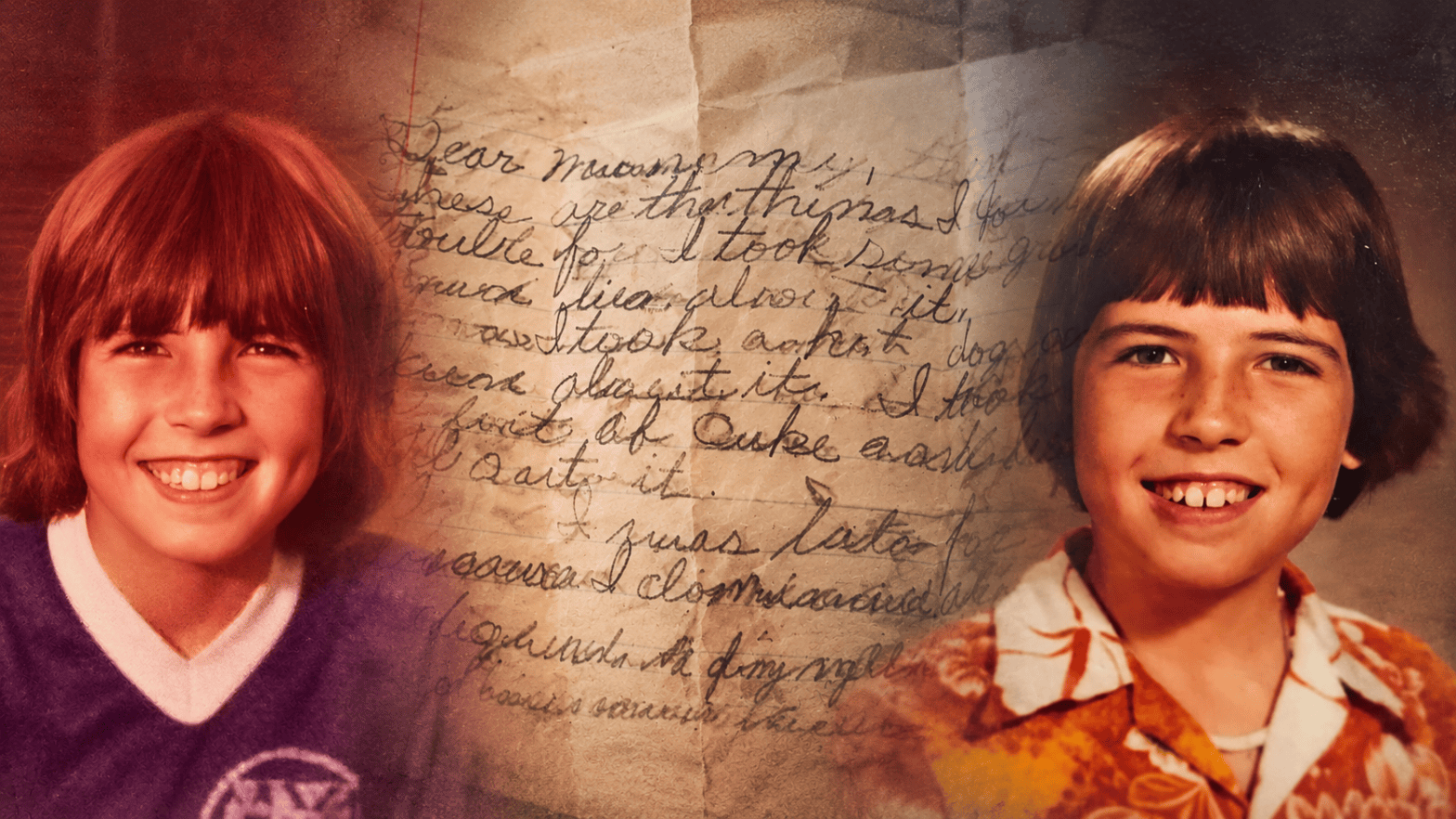
Over the years, each of my sons has come to recognize himself in particular photographs from our childhood. These photographs have become important to us. I use them when I spend face-to-face time with my boys, when I hold them and talk with them and try to give each of them my complete attention.
This morning I was looking at a photograph of a seven-year-old boy.
I remember that face.
Once, we saw it in the mirror.
But that is not primarily who I see when I look at the photograph now.
I see Solis.
“I do not see John Proctor at the age of seven,” I wrote in our journal. “I do not see the face that I saw in the mirror. I see Solis Proctor.”
And then I wondered:
What about the seven-year-old me?
I don’t know.
There are questions that can remain questions while we make breakfast.
But then I thought about Han.
Han is ten.
And there are two photographs of Han that tell part of the story of how I learned to see my son.
⸻
Years ago, I brought a photograph of myself at ten years old to therapy.
It was a soccer photograph, taken during the summer.
The boy in the photograph looks extraordinarily happy.
Not merely okay.
Exuberant.
If you looked at that photograph without knowing anything else about our childhood, you might think you were looking at the happiest kid on earth.
That was precisely what troubled me.
By then I knew considerably more about what had been happening to us when we were ten.
I showed the photograph to our therapist, Caprice.
“You would never know that there was anything going on with that kid,” I told her. “You would never know that anything horrible was happening to him.”
Caprice had an immediate response.
“Parts, John! Parts!”
We had already been diagnosed with dissociative identity disorder. I was beginning to understand that there were experiences, memories and people within our shared life that I had not understood before.
Caprice was trying to help me understand how a child could hold so much suffering and still contain joy.
At the time, I did not consciously know the smiling boy in that photograph as Han.
Now I do.
Han identifies with that photograph.
It is Han.
But strangely, it is not the photograph of Han I look at most often.
There is another one.
It was taken not long afterward.
And for most of our life, I hated it.
⸻
It is our fourth-grade school photograph.
Our hair is terrible.
Our father used to call what happened to it the “revenge haircut.”
We had beautiful longer hair, and our stepmother had hastily hacked it off while she was angry with us. Years later, our father acknowledged what had happened.
There is also a huge sore beneath the lower-right side of our lip.
We got those sores frequently.
We never established exactly what caused them. Anxiety may have played a role. Caprice also wondered whether they could somehow have been connected to the sexual abuse we were experiencing.
We don’t know.
But the differences between the child in the soccer photograph and the child in the school photograph are striking.
I remember when the packet of school photographs arrived.
We looked through the cellophane window on the envelope and saw that face.
We were horrified.
Several of us remember it, including Han.
By then I tended to avoid mirrors. And suddenly there was this face staring back at us.
Nobody at school made fun of the photograph.
That is important.
This was, after all, the kid they saw every day.
The shame was ours.
When we came home, we did something different from what we had done with school photographs in previous years.
We hid them.
We did not leave the packet on the kitchen table for our parents to see.
Eventually our stepmother asked about the photographs.
We gave them to her.
She looked at the picture and made a face.
She commented on the sore beneath our lip. She believed we were causing it by licking it and repeated her usual threat to put Tabasco sauce on it if we did not stop.
That wasn’t it.
She couldn’t know what “it” was.
Neither could our father.
Neither could our teacher.
Neither could the other children at school.
And much of the time, neither could I.
⸻
Our behavior had changed.
We were hyperactive. Emotional. Sometimes difficult.
Not awful.
A child in distress.
But nobody knew what the distress meant.
There were things happening within our family that I did not know about.
Han was frequently hosting us when we were ten. He had an awareness of his brothers that I did not have.
Sometimes one of the younger boys might take something from the refrigerator after school—a hot dog or a slice of baloney, perhaps behaving as a four- or five-year-old had before our stepmother and all of her rules, without understanding those rules in the way she expected.
Then we would be confronted.
“Did you eat this?”
I would say no.
As far as I knew, I hadn’t.
I had no memory of doing it.
Our stepmother saw a child lying to her.
I remember being accused of doing things I knew I had not done. I came to believe that she was making things up in order to punish me.
Justus experienced that injustice too.
Eventually, Justus became our protector. He became defiant in a world in which we could be accused of things we did not remember doing, punished for denying them, and punished on top of abuse we were already experiencing.
But Han responded differently.
Han tried to hold us together.
He tried to take responsibility.
Our mother still has letters we wrote during that period. After we had been accused of something, Han would write to her and confess our collective behavior.
“I lied about it.”
I have no memory of writing those letters.
Han does.
A ten-year-old boy was trying to do something no ten-year-old should have had to do.
He was trying to take responsibility for his brothers.
In some ways, it was an early version of the role Proverb would later assume in our family: the child who tries to keep track of everyone, who knows things the others do not know, who attempts to make the whole arrangement work.
It is also, in a very different way, the responsibility I now understand as mine.
I am their father.
Han wasn’t.
Proverb isn’t.
⸻
The adults around us could see that something was wrong.
They just couldn’t see what.
Our teacher, Ms. Jones, sometimes asked about bruises, or the gouges on our arms and occasionally our face.
Was everything okay at home?
Our parents could see behavior that confounded and frustrated them.
Our stepmother increasingly responded with punishment.
At first we might spend hours standing in a corner with our hands on our head.
Then came restrictions.
Toys were taken away.
We could not spend time with friends.
Eventually the punishment itself became physically abusive.
But there was something much larger the adults could not see.
There was no way for a nine- or ten-year-old boy to tell his parents that he was being raped.
So the things nobody could see kept appearing in things everybody could see.
Behavior.
Hyperactivity.
Emotion.
Denial.
Defiance.
Bruises.
Gouges.
A sore beneath our lip.
A terrible school photograph.
And, inexplicably, a soccer photograph of what looked like the happiest kid in the world.
Both photographs were true.
Neither photograph could tell the whole story.
⸻
There is another photograph from fifth grade, when we were eleven.
Justus identifies with that one.
The sore is there again.
Our hair had been allowed to grow unruly.
By then our stepmother had stopped cutting it. After one visit with our mother in Oakland, when a hairdresser friend of hers cut our hair, our stepmother essentially decided that if we did not like the way she did things, we were on our own.
That became something of a mantra.
If you don’t like the way I do things, you’re on your own.
We might get a haircut two or three times a year when we visited our mother.
After we saw that fifth-grade photograph, we were so humiliated that we used birthday money to get our own haircut.
For years I could barely look at that photograph either.
Now I can.
Justus generally prefers another photograph when we are together, so we do not use the fifth-grade picture very often.
But I don’t avoid it because I can’t stand seeing it.
I see my beautiful son.
Something has happened to these photographs.
They have been redeemed.
⸻
I want to be careful about that word.
The things that happened to us have not been redeemed by becoming good.
There was nothing good about a child being abused.
There was nothing good about being punished for things we did not understand.
There was nothing good about children assuming responsibility for holding one another together because the adults could not see what was happening.
Redemption does not make any of that necessary.
I mean something much simpler.
The photographs no longer belong to shame.
I can look at them now.
More than that, I love looking at them.
The fourth-grade photograph that once hurt so much is the photograph I use most often when I am face-to-face with Han.
I look at it twice a day.
That face is my son.
And something strange happens when I look at it.
The photograph is fixed. I know that.
But it does not always seem fixed to me.
Sometimes when Han is hurting, I see the hurt in his face.
Sometimes he looks playful.
Sometimes happy.
His eyes seem different.
His expression seems different.
I do not need to explain how that happens.
I know what happens relationally.
I look at the photograph and I see Han.
And this morning, Han was exuberant.
⸻
That has not been easy for him lately.
Han has carried a great deal this year.
There have been times when the exuberant ten-year-old in the soccer photograph has seemed very far away.
That is one reason we do not use that photograph constantly.
It can become an impossible standard.
There he is.
The happiest kid on earth.
Why can’t Han be like that today?
But Han does not owe anybody that smile.
He does not have to demonstrate that he is healing by becoming the boy in the soccer photograph.
He is allowed to hurt.
He is allowed to be tired.
He is allowed to be frightened.
He is allowed to be quiet.
And when he is exuberant, as he was this morning, he is allowed to be that too.
This morning I was lying with my ten-year-old son and suddenly there he was.
Laughter.
Affection.
Joy.
I wrote:
“The essential Han.”
I did not mean that the hurting Han is somehow less Han.
I meant that something I love about my son was suddenly wonderfully accessible again.
His exuberance.
His delight in being together.
His faith.
Han is our spiritual animator.
He is the one who reminds us again and again that God is love and that if it is not love, it is not God.
For years some of that spirituality had a place within our work at St. Vincent de Paul.
But this morning I told him:
“We don’t need a job with St. Vincent de Paul for you to play that role.”
The job ended.
Han didn’t.
His faith didn’t.
His vocation didn’t.
His face didn’t.
⸻
Maybe that is why faces were on my mind this morning.
Yesterday, Proverb told me something devastating.
“I’m not real to you.”
He did not mean that I intellectually doubt my twelve-year-old son exists.
He meant that if I really believe he is a child, that belief should have consequences for the way I treat him.
He finally reduced the whole thing to three words:
“Just love me.”
This morning I held Proverb.
There was so much affection between us.
I wrote that it did not necessarily require hours.
It required:
“Just focused, affectionate time together, all about Proverb. Just making myself completely available to Proverb.”
Face-to-face time.
My son with my attention directed toward him.
Not Proverb the organizer.
Not Proverb the one who understands things.
Not Proverb helping Dad figure out how to care for everybody.
A twelve-year-old boy enveloped in his daddy’s love.
Perhaps that is part of what a face is.
There you are.
I am looking at you.
I am not asking you to be useful.
⸻
Then Jude came.
Jude is four.
We were together when the groceries arrived.
There was chicken on the porch.
There was ice cream on the porch.
These are very concrete things.
Chicken needs refrigeration.
Ice cream melts.
But I was not finished with my four-year-old son.
So I wrote:
“Yes, ice cream and chicken sitting on the front porch are very concrete and urgent things, but so is my four-year-old son, and they are not more urgent than him.”
I stayed with Jude for a few more minutes.
Then I got up.
I brought in the groceries.
Later we made chicken curry.
At 1:30 we turned on the slow cooker.
We will have dinner around six.
Nobody had to disappear for that to happen.
Jude did not have to become less real so that the chicken could become more real.
And the chicken did not have to spoil so that I could prove I love Jude.
I could finish being with my son.
Then get up.
Then make dinner.
This is the life we are learning how to live.
⸻
While we were cooking, we put on Joshua Redman’s Moodswing.
We listened to that album constantly around 1995.
Hearing it today felt like breathing ancient air trapped in a cave.
Thirty years.
How did thirty years happen?
I wasn’t practicing our faith then.
Not consciously.
There is a song on the album called “Faith,” and I remember what that word probably meant to me in 1995.
Hope.
Promise.
The belief that somehow the things I wanted would eventually happen.
I wanted to become an architect.
I wanted a flourishing practice.
And I wanted what I had always wanted.
Someone to love.
A family.
I had no idea.
I had no idea that my family was already there.
⸻
In 1995, architecture had become the enormous external container that made my life work.
I could show up.
I could design.
I could become completely immersed in work.
I could do enormously complicated things while ordinary things remained strangely difficult.
And there was so much happening inside our shared life that I did not understand.
Proverb was helping care for his brothers.
Han had already spent years trying to do something similar.
I was close to our little brother Tyler, who was ten then.
Han’s age.
I did not understand that part of the reason that relationship could feel so natural was that there were children sharing this life with me who also knew Tyler as their brother.
And Luke was visiting me in dreams.
There was a little boy I somehow knew would be my son.
I thought he was in the future.
I did not know that Luke was already here.
I did not know Jude was here.
Or Daniel.
Or Solis.
Or Han.
Or Justus.
Or Proverb.
Or Hope.
I thought I was still waiting for my family.
My sons were living alongside me.
⸻
And this afternoon, while Moodswing played, Han started whistling.
Pretty much note for note.
There you are.
Thirty-year-old music, and my ten-year-old son knows it.
I don’t need to make that prove anything.
I don’t need to turn it into a theory.
I can simply notice.
Han was there.
The boys were there.
We lived that life together even when I did not understand who was living it with me.
The music remembers.
Our shared body remembers.
My sons remember.
I remember.
Not always the same things.
Not always in the same way.
But we were there.
⸻
There is a photograph that Luke took that appeared in our Facebook memories this afternoon.
September 30, 2021.
Downtown Oakland.
Luke made the photograph while we were riding the bus.
He used to do extraordinary things with photographs on the phone, manipulating saturation, warmth, vibrance, contrast and tint.
No filters.
He made the world look the way Luke saw it.
When the photograph appeared today, my first thought was:
There you are!
Luke was signaling in his right ear.
There you are.
That may be what these photographs have become for me.
Not evidence.
Not diagnostic material.
Not proof.
Faces.
Ways of recognizing the people I love.
⸻
Our treatment with Caprice continued for years after I brought that soccer photograph into therapy.
A great deal changed.
We changed.
Our language changed.
Our relationships changed.
The family became increasingly known.
By the time our treatment ended in August 2023, Caprice acknowledged us as nine human persons.
Eight children and their father.
Each of us real.
At one point she told us:
“You make more sense now than ever.”
I treasure that.
Because from the outside, we might appear to have become considerably more complicated.
Nine names.
Nine people.
Eight children of different ages.
A father.
Different memories.
Different relationships to our shared history.
Different ways of communicating.
Different faces.
But as we became more fully known, we made more sense.
Maybe people usually do.
⸻
This morning we listened to another song.
“In the Stars,” by the Rolling Stones.
It is a song we love.
But somewhere along the way it became tangled with memories of the period when our work at St. Vincent de Paul became frightening.
We heard it today and the association came back.
So I told my sons:
“We’re taking this song back.”
We are no longer there.
This is not their music.
This is ours.
“We are not theirs.”
The job is over.
The people associated with that period are behind us.
The song can have new memories now.
And I realize we have been doing that with faces for years.
Taking them back.
Not erasing what happened.
Not pretending the pain was harmless.
Not trying to turn abuse into something beautiful.
Taking back what never should have belonged to shame in the first place.
Our childhood.
Our photographs.
Our music.
Our faith.
Our home.
Our family.
Our faces.
⸻
The soccer photograph still amazes me.
I understand why I brought it to Caprice.
Look at that child.
You would never know.
And that has been one of the great difficulties of our life.
We learned how to survive.
Sometimes we even thrived.
We could smile.
We could accomplish extraordinary things.
We could become successful.
We could appear capable while something entirely different was happening beyond what anybody could see.
And when we finally tried to tell people that we were suffering, sometimes the visible life was believed instead.
How could things possibly be that bad?
Look at you.
Look at what you can do.
Look at everything you have accomplished.
Look at that smiling child.
But a face cannot tell you everything.
The soccer photograph did not prove that nothing terrible was happening.
The fourth-grade photograph could not tell anybody what was happening either.
One showed exuberance.
The other became surrounded by shame.
Both came from the same childhood.
Both are true.
Neither contains the whole person.
⸻
I used to hate that fourth-grade photograph.
When the packet came home from school, we hid it.
I did not want our parents to see it.
I did not want to see it.
Now I look at it twice a day.
It is the photograph I use most often when I am face-to-face with Han.
Sometimes when he is hurting, I see hurt in his face.
Sometimes he looks playful.
Sometimes he looks happy.
And this morning, for the first time in a while, he looked exuberant.
I know the photograph does not change.
Han does.
Maybe I do too.
Maybe this is simply what happens when a photograph stops being evidence and becomes a face.
Thirty years ago, I could look at the soccer photograph and ask our therapist how a child who was living through terrible things could possibly look so happy.
Today I don’t need the photograph to answer the question.
Han was with me this morning.
Laughing.
The terrible things happened.
The joy was real too.
Neither cancels the other.
Everyone needs a face.
But maybe even more than that, everyone needs someone who will look at his face, listen to him, and believe him when he tells you what you cannot see.

