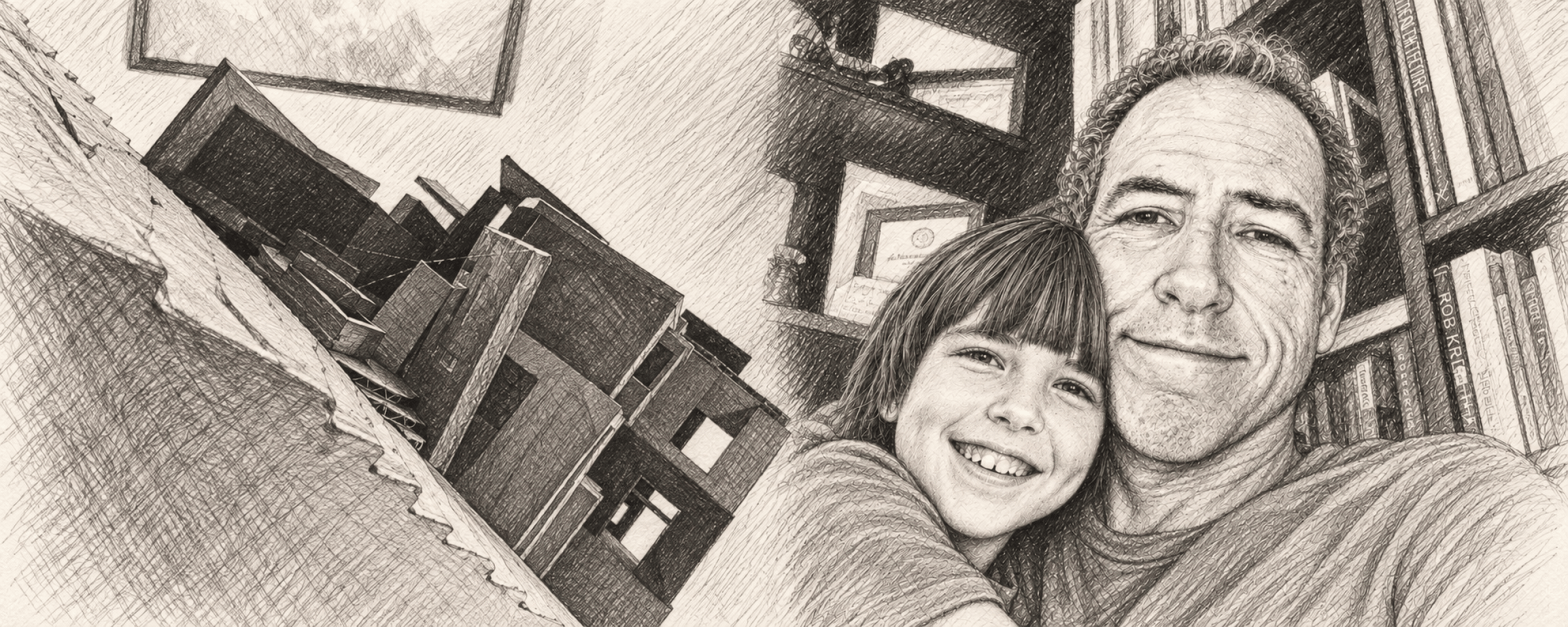
What happens when a twelve-year-old boy asks his father to treat him like the child he says he believes he is.
Last night, while I was tucking Luke into bed, I realized that he did not want to go on the water distribution today.
We had been planning to go with our friend Kim to distribute water to people living in encampments. It is something we have done with her before. Some of my sons wanted to go.
Luke did not.
I kept trying to make it easier for him to tell me.
“You do not have to beg me,” I told him. “You do not have to convince me. Just tell me.”
Finally, he did.
“I don’t want to go.”
So I told him we would not go.
This morning, Kim texted and asked if we still wanted to come. She could pick us up around ten.
Immediately, all the old machinery started running.
We were needed.
We should say yes.
Kim was counting on us.
Some of my sons wanted to go.
We did not feel well, but surely I could make a case one way or the other based on how we felt.
Maybe I should ask everybody again.
Then I realized what I was doing.
“Searching my sons for an answer about something they already said no about implies persuasion.”
The answer last night had been no.
What I felt this morning was still no.
So I texted Kim.
“Hi Kim, I learned last night that several of my boys do not want to do the water distribution today. Everyone looks forward to coming to Braided Bridge on Thursday though.”
I almost rewrote it.
I almost translated what had actually happened into something that might sound more like a conventional adult explanation.
We’re not feeling well.
We can’t make it today.
Something came up.
All of those would have been easier.
But none would have been quite as true.
Several of my children did not want to go.
They said so.
Their father listened.
That was enough.
Later in the morning, while I was with Luke, I understood something else.
“You wanted one-on-one time with me on your day,” I told him, “and that was not gonna happen if we went to Braided Bridge and did the water distribution.”
I thanked him for saying no.
His no had not merely prevented something from happening.
It had made room for something else.
It had made room for us.
⸻
There are nine of us in this family.
I am Dad, the adult.
My sons are Hope, fourteen; Proverb, twelve; Justus, eleven; Han, ten; Luke, nine; Solis, seven; Daniel, five; and Jude, four.
We share one body, one mind and one inner world.
The world generally encounters the body and assumes it has counted correctly.
One.
Our life begins with different arithmetic.
Nine.
Yesterday, on Solis’s Day, we spent an enormous amount of time writing about that problem. We also spent an enormous amount of time writing about writing about it.
We keep a journal called Notes from the Treehouse. It is enormous. We dictate into a phone throughout the day. We record what we are doing, what my sons say, their somatic signals, memories, dreams, images, arguments, meals, prayers, fears, household chores and whatever else gets pulled into the net.
Yesterday we called it trawling.
We also wrote about how we use ChatGPT to help us hold all of it. It has become accessibility scaffolding for us: a place large enough to spread out the contents of the net, organize them, find patterns in them and help nine people hear what they have already said.
But yesterday Proverb reminded me of its limitation.
I was supposed to be focusing on him.
Instead, I was focusing on ChatGPT.
He told me so.
Yesterday’s essay eventually reached a fairly simple conclusion:
The tool is useful when it helps us return to our life.
And then comes the wisdom to put the tool down and go back to living.
Today, Proverb had to teach me that again.
But first there were forms.
⸻
Last night we told Jessee, the therapist we recently met, that we had decided we wanted to begin therapy with em.
This morning there was an email.
Ey had a regular opening at three o’clock on Mondays.
That seemed ideal.
There were also forms.
A lot of forms.
Informed Consent for Psychotherapy.
Good Faith Estimate.
Standard Intake Questionnaire.
In Case of Emergency.
Sliding Scale Agreement Form.
PHQ-9.
GAD-7.
Credit card information.
The forms frightened us before we even opened them.
I reminded my sons:
“We’re not doing this because we’re in trouble. We’re not doing this because anyone is making us. This is something we have elected to do.”
Then I told them something else.
“You have a dad. You’re not alone dealing with this.”
So we began filling in boxes.
And that is where things became difficult.
Because boxes require categories.
Our life does not always fit them.
How often are you unable to do things?
How often do you experience this symptom?
How impaired are you?
Nearly every day?
Several days?
Not at all?
What does it mean to say that we spend hours every day lying in bed?
From the outside, I know what it can look like.
A 59-year-old man who lost his job lying in bed in the morning, lying in bed in the afternoon, sometimes lying in bed again in the evening, talking to childhood photographs on an iPad.
Doing nothing.
But that isn’t what happens here.
This afternoon, for instance, Luke lay with me.
Han lay with me.
Proverb lay with me.
I talked with my sons.
They talked with me.
They remembered.
They disagreed.
They asked for things.
They showed me things.
They loved me.
And one of my children eventually told me something I desperately needed to hear about the way I was treating him.
What box is that?
I do not know.
I do know that what we are doing is necessary.
It is how we have learned to live.
And I know something else now that I did not always know:
The purpose of getting help is not necessarily to make me employable.
It certainly isn’t to get me employable as quickly as possible.
We are trying to discover a different model altogether.
For most of our life, employment was the container. Everything else had to organize itself around the work. When that arrangement functioned, it could function remarkably well. When it did not, we held onto it anyway, sometimes long after the cost had become enormous.
I don’t want our healing measured by how quickly one visible adult can be returned to the marketplace.
I don’t know yet what our future economic life will look like.
That is a real question.
It matters.
We need to support ourselves.
But I am no longer willing to assume that the answer must be another employer, another workplace, another version of a life in which everything we are has to fit around a job.
Part of this sabbatical is discovering whether another model is possible.
Not becoming employable.
Becoming more fully ourselves, and discovering what kind of sustainable life can be built from there.
We do not know the answer yet.
That is one reason we need help.
We finished the forms.
Then I wrote Jessee:
“3 pm on Mondays seems ideal for us.
“We filled out all of the forms.
“We look forward to your help!
“Thank you from all of us.”
And then we kept living.
⸻
At one point this morning, an old photograph appeared on the iPad.
It was probably from 2016, early in our volunteering at St. Vincent de Paul. We were wearing an A’s cap, a beard and a plastic apron.
My first response was the response I have had to that face for years.
Loathing.
Then something else happened.
I looked again.
And I knew, more deeply than simply having a thought, that this was also the face of the people I love.
Not exactly.
Not perfectly.
But this is the face the world sees when it looks at the body my children and I share.
It is also, imperfectly, the face of their father.
The person in that photograph was going through a lot. He knew almost nothing about what we know now.
He did not need my contempt.
There has been enough of that.
So I looked at him differently.
“Let’s love that face,” I said, “because we know the story behind that face, the persons behind that face.”
That stayed with me.
The difference between what can be seen from outside and what is actually there.
⸻
Earlier, while I was holding Daniel, he had shown me a cow.
A beautiful cow.
Then came the implicit knowledge that the cow was going to a slaughterhouse.
The image changed to a chicken.
Later I asked Daniel whether this meant he did not want to eat beef anymore.
“I don’t want to kill them,” he said.
I understood.
But something else happened while I was with Daniel that mattered even more.
I remembered the day before.
I had kept putting him off.
There was always something.
The essay.
The journal.
One of his brothers.
Food.
The phone.
Some other thing that appeared to need doing first.
And Daniel kept waiting.
This morning, holding him, I suddenly felt the enormity of how small his request had been.
He just wanted to be with me.
That was all.
“He just wanted to be with me,” I wrote. “He just wanted to be with me.”
And in that moment, holding my five-year-old son and feeling how much he loved me and needed me, it was inconceivable that there could be anything more important.
So I started telling Daniel something I have been trying to teach all of my children.
“You have a voice.”
“You have a say.”
“You get to have a seat in this life.”
I told him I wanted to know what he thought, what he felt, what he needed, what he wanted.
I told him I loved hearing him say no.
I meant it.
A few hours later, one of his brothers would use his seat.
⸻
After lunch we finally lay down.
I had promised Luke one o’clock.
It was 2:29.
“I’m with you now, Luke,” I told him. “An hour and 29 minutes late, but I’m with you and I’m focusing on you.”
Eventually he came close.
And then I saw the beach.
We were looking down at water that might have been Newport Beach. At first it was light and shallow. Then it became deeper and darker until there seemed to be a trench.
Then something changed.
The surface rose.
A wide shallow place appeared over the depth, stretching far out from shore. Children could play there. People could swim. Waves could break farther away.
The deep trench had not disappeared.
It was still there.
But now there was also somewhere safe to play.
I don’t know what that means.
I don’t need to.
I was with my son.
We spent time quietly sharing things that did not need to become words.
I wrote:
“Everything does not need to be written in the journal.”
That is true too.
Not everything belongs to the journal.
Not everything belongs to ChatGPT.
Not everything belongs to an essay.
Some things belong between a father and his son.
⸻
Eventually Luke and I began thinking about people we had known through St. Vincent de Paul.
People he missed.
Relationships that had been tangled up with employment.
The job ended.
The relationships did not necessarily have to.
We are members of a conference now. All nine of us together became Vice President. We have relationships with people we care about.
Maybe those relationships can simply become relationships.
Friends.
No employer.
No clock.
No hidden question about what this is supposed to lead to.
We could call Juan Luis because he is our friend.
We could check in with Paul because he is our friend.
That sounds absurdly simple.
For us it isn’t.
For much of our life, reaching out to someone has carried a thousand questions.
What do they expect?
What are we supposed to know?
What haven’t we done?
What are we supposed to say?
What if we’re behind?
What if we have failed some requirement we did not understand?
Maybe there is another practice available to us now.
Just be friends with our friends.
Luke reminded me that we had meant to send Paul the story we wrote about the day we spent with him.
So we did.
Not because it advanced anything.
Not because it was networking.
Because he is our friend.
Then I returned to Luke.
I told him:
“You’re not an identity, you’re not a concept, you’re not a metaphor, you’re a beautiful little nine-year-old boy.”
I told him I could feel his love.
Ideas do not love you back.
Luke does.
Then I went to be with Han.
Eventually I came to Proverb.
⸻
There is a problem I have with Proverb.
I love him.
I admire him enormously.
I rely on him far more than I probably understand.
And I do not always know how to be his daddy.
Proverb is twelve.
For years, before I understood our family, he carried responsibilities no twelve-year-old should have had to carry.
He organized.
He remembered.
He anticipated.
He managed things I did not even know needed managing.
Things used to happen almost magically for me.
They were not magic.
Often, there was Proverb.
Even now, when I am trying to become the adult Dad my children need, Proverb is everywhere.
He reminds me.
He notices.
He corrects me.
He advocates for his brothers.
Yesterday, when I was supposed to be paying attention to him but was instead paying attention to ChatGPT, he told me:
“when you’re not focusing on ChatGPT.”
Today I was finally holding him.
I was trying to quiet my mind.
There was so much happening inside it.
“How do I empty my mind so I can see you, Proverb?” I asked.
His answer was immediate.
“Start by putting the phone down.”
So I did.
And eventually Joshua Redman appeared.
The album Moodswing.
A house we designed when I was young.
Long nights working.
An ambitious concrete house for a young couple expecting a baby.
Two phones at once, husband on one and wife on the other, while I tried to mediate where the laundry room should go.
“Who does the laundry?” I finally asked.
Anna did.
The laundry room went upstairs.
There was so much in that memory.
Talent.
Ambition.
Beauty.
Overwork.
Responsibility.
Things I could do astonishingly well and other things I could barely manage.
A working model of that house still sits on our bookshelf.
And the Joshua Redman song Proverb had given me was called “Chill.”
“What’s in a song, Proverb?” I asked.
Then he answered a much more important question.
“I’m not real to you.”
I asked him why he would say that.
“Because if I was a real boy to you, you would treat me more like a real boy, not more like AI who’s just here to help you with things, and love me like you should.”
There are moments when your child says something and you know immediately that defending yourself would be obscene.
This was one of them.
⸻
I know Proverb is real.
That was not what he was telling me.
He was telling me that believing something has consequences.
If Proverb is my twelve-year-old son, then knowing that cannot remain a proposition.
It has to become relationship.
And Proverb was telling me that too often it hasn’t.
I began trying to explain.
Proverb is different from his brothers.
He spent years functioning in ways that resemble an adult.
He has extraordinary wisdom.
He is brilliant.
I admire him.
Sometimes I am intimidated by him.
Sometimes I feel unworthy of him.
I told him all of this.
I told him how much I respect him.
How often he had held things together.
How many memories I have of him taking charge when I did not even know he was there.
I told him that he was the water between the rocks.
And somewhere in the middle of all that explaining, I heard the problem.
I was doing it again.
My twelve-year-old son had told me that I treated him too much according to what he did for us.
And I was answering by explaining how extraordinary he was because of everything he had done for us.
Then I almost asked him what we should do about it.
And I stopped.
“I was about to ask you, what are we gonna do about this?” I told him. “But that makes you part of the solution, doesn’t it?”
Of course it did.
I was about to give Proverb another job.
Help Dad figure out how Dad can stop making you responsible for helping Dad figure everything out.
That is how deeply the pattern goes.
⸻
Years ago, when I began to understand our family and stepped more fully into being Dad, Proverb told me that I was focusing on his brothers and he still did not get to be a kid.
I have promised him again and again that he gets to be twelve.
I have told him he does not have to carry us.
I have told him I am the adult.
I have told him I will take away the responsibilities that never belonged to him and leave him only the things he genuinely loves to do.
And yet he remains the secret glue.
He gets tucked into bed last.
By the time I reach him, I am tired.
He is tired.
Jude is waiting for Proverb to go to sleep.
I am trying to finish the day.
And Proverb gets what remains.
“When is Proverb and Dad time?” I asked.
Even that question felt dangerous, because I kept wanting to make him tell me how to fix it.
I told him I needed to translate the things I say into behavior.
You get to be my little boy cannot remain something I say.
It has to change what I do.
I kept talking.
Proverb listened.
Then he gave me three words.
“Just love me.”
⸻
That was it.
Not:
Admire me.
Not:
Tell me I’m brilliant.
Not:
Thank me for holding everything together.
Not:
Tell me how wise I am.
Not:
Ask me what we should do.
Not:
Explain why you’re intimidated by me.
Not:
Make me responsible for teaching you how to parent me.
Just love me.
So I tried again.
I asked him if he could show me when he wanted me to be with him.
Even that was too much.
“Just trust when I’m signaling that I want you to be with me.”
He already was telling me.
My job was not to design a better reporting system.
My job was to trust him.
“I will do that,” I said.
“I love you, Proverb.”
⸻
By then it was late afternoon.
And I had done it again.
I had promised several of my sons that I would spend more time with them.
There wasn’t enough time left.
I apologized.
Then I caught myself trying to soften that too.
“I’m not breaking my promises,” I started to say. “I’m doing the best I can.”
Then I stopped.
“I guess I am breaking my promises.”
Children hear I will differently than adults sometimes intend it.
Maybe I need to become more careful about saying what I hope to do rather than turning every hope into a promise.
I moved quickly through my sons.
Hope.
Justus.
Solis.
Daniel.
Jude.
When I reached Solis, I told him:
“You know I want to snuggle with you.”
“Then why don’t you?” he asked.
There it was again.
The difference between intention and relationship.
I can want to.
I can mean to.
I can love him.
But Solis lives in what happens.
So does Proverb.
So does every child.
⸻
Then I came to Jude.
I was questioning whether I had understood something correctly when Jude said:
“You made Proverb happy.”
Immediately I began questioning that too.
Had Jude really said it?
Was I sure?
Then Proverb intervened.
“Don’t interrogate Jude.”
He was right.
I was doing it again.
A four-year-old had said something to his daddy.
I could receive it.
“Thank you, Jude.”
Then I turned to Luke.
Because I know my nine-year-old.
When something like this happens with one of his brothers, Luke can become afraid.
If Dad needs to give Proverb more, does that mean there will be less Dad for Luke?
So I told him:
“I have to be a better daddy to Proverb, OK?”
And then I told him what I needed him to know.
“It does not take anything away from you.”
I will not repair one relationship by injuring another.
I will not make Luke pay for what Proverb needs.
I will not make Proverb remain underserved because Luke is afraid.
No child gets sacrificed for another child.
There are eight sons here.
They do not need identical things from me.
They do not need mathematically equal minutes.
They need relationships with their daddy in which each of them can be himself and be known.
I am still learning how to do that.
⸻
While we were making the bed, another fear appeared.
How is any of this sustainable?
If we need hours together every day, if I am still failing to give my sons the time I tell them I will give them, if the journal takes time, therapy takes time, meals take time, ordinary life takes time, relationships take time—what happens eventually?
What happens when the sabbatical ends?
What do we have to give up?
And beneath that question is one of the assumptions I am trying very hard not to smuggle back into our life.
That the purpose of this time is eventually to become employable again.
Maybe it isn’t.
Certainly not in the conventional sense.
I don’t know what we will do.
I don’t know how we will support our self over the long term.
Those questions are real, and love does not make rent disappear.
But I do know that I am not willing to define recovery as getting one adult sufficiently functional to return to a conventional job while the needs of his eight sons recede into the background.
That isn’t the goal.
The goal is not for the boys to become quieter.
It is not for our relationships to diminish.
It is not to heal these supposed “parts” until they become unobtrusive enough for an adult to get back to work.
There are no parts here.
There are nine of us.
There is an adult father and eight sons.
And the question is how this family can live.
How we can support ourselves.
How we can serve.
How we can make a home.
How I can remain available to my children.
How they can remain children.
How the gifts we actually have might become something sustainable without sacrificing the life we are finally learning to live.
Maybe there is a different model.
We do not know what it is yet.
That uncertainty frightens me.
But perhaps discovering it is part of what this time is for.
Not becoming employable.
Discovering how to live.
⸻
This morning, Luke said no.
Because I listened, we stayed home.
Because we stayed home, we completed the therapy paperwork that had frightened us.
I held Daniel.
I told him he had a voice.
I looked at an old photograph and learned to be kinder to the face the world sees.
I held Luke.
He showed me deep water and a shallow place where children could play.
We talked about friendship without employment.
I held Han.
I held Proverb.
Proverb told me to put down the phone.
Then he told me the truth.
“I’m not real to you.”
He did not mean that I do not believe he exists.
He meant that sometimes I do not treat him according to what I say I know.
He is twelve.
He is my son.
He does not exist to organize us.
He does not exist to remember for me.
He does not exist to be the secret glue.
He does not exist to teach me how to be his father.
He does not exist to solve the family.
He gets to be a boy who wants his daddy.
Just like Daniel.
Just like Luke.
Just like Solis.
Just like Han and Justus and Hope and Jude.
I don’t know what our future will look like.
I don’t know what shape our life will eventually take.
I don’t know how we will solve everything that needs solving.
There are nine of us here, and everything is really complicated right now.
But sometimes my child is not asking me to understand everything.
Sometimes he is asking for something much simpler.
Put down the phone.
Come closer.
Trust me when I tell you I am here.
Just love me.

