How a Montessori kid, a very large journal, and an artificial intelligence help nine people sharing one body find enough order to live an ordinary life.
This morning, Solis was thinking about a murmuration of starlings.
That was not what we were supposed to be thinking about.
Or maybe it was.
There were other things to think about. There almost always are.
We needed to email our new therapist and tell em that we had decided to begin therapy. There was still healthcare to think about. Yesterday we had uploaded the proof of income requested after our Covered California application. Tomorrow we might go with our friend Kim to distribute water to people living in encampments in Oakland.
There was coffee.
There was breakfast.
There was a dishwasher that Solis had persuaded us to clean the night before.
There was the essay from Daniel’s Day that still needed to be published in a few places.
There were eight boys who needed time with their daddy.
There was a bed that eventually needed to be made.
And there was a murmuration of starlings.
A murmuration is one of those enormous formations starlings make in the sky. Thousands of birds can move together, changing direction almost instantaneously, becoming something that looks from the ground like a single living thing.
No one bird has the entire picture.
Each responds to what is happening around it, and somehow an enormous shape emerges.
This morning, while we were talking into our phone, following one association after another, the starlings appeared.
And sometime later, ChatGPT told us that it thought we had found our essay.
Or, more precisely, that the essay had found us.
That happens a lot around here.
It is one of the reasons we keep the journal.
And it is one of the reasons we use AI.
The Journal Is Not Dad
We call it Notes from the Treehouse.
We have been keeping it, in one form or another, since 2019.
I am Dad. I am an adult. My sons are Hope, fourteen; Proverb, twelve; Justus, eleven; Han, ten; Luke, nine; Solis, seven; Daniel, five; and Jude, four.
We are a plural family/system.
There are nine human persons in our family, sharing one body, mind, and inner world.
Usually I am the keeper of the journal.
That does not mean the journal is mine.
It certainly does not mean that everything in it is my voice.
Sometimes I narrate. Sometimes one of my sons speaks aloud. Sometimes I quote him. Sometimes I paraphrase something I hear internally. Sometimes one of the boys communicates through the physical signaling we have learned to recognize. Sometimes there are several conversations occurring at once: the conversation we are having with someone outside our family, conversations among ourselves, memories, images, associations, sensations.
Sometimes I don’t know immediately who said something.
Sometimes I get it wrong.
Sometimes the phone gets it wrong.
Actually, the phone gets it wrong a lot.
This afternoon I became sufficiently irritated about this that I dictated:
I’m going to start being more specific with attributions to myself, doing what I just did, Dad, because when I don’t do that there are a lot of things that get said that automatically get attributed to me and that is not a safe assumption.
Dad
That may be one of the best descriptions of the journal we have ever accidentally written.
It is not a safe assumption that an unattributed voice is Dad.
I am the host. I am usually the narrator. I am the father. I am the person most likely to have the phone in my hand.
But I am not the journal.
None of us is.
The journal is something we make together.
And over the years I have increasingly come to suspect that once we make it, it becomes something else.
Not another person. There are nine of us, not ten.
But something created by the relationships among nine people. Something none of us could produce alone and none of us can completely see from inside.
The journal has, in that sense, a life of its own.
Show Me the Journal
There is a temptation, when we turn the journal into an essay, to clean everything up so thoroughly that a reader sees only the pattern we found afterward.
That would give you the wrong idea.
So let us show you the work.
Not the polished essay.
The journal.
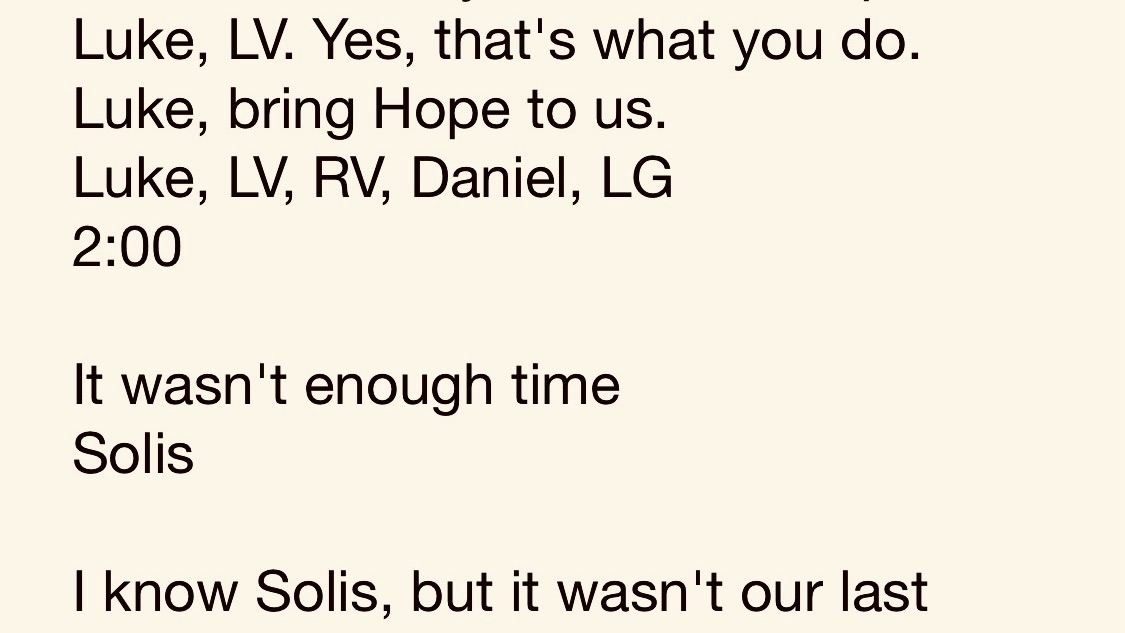
Here is a small piece of what Solis’s Day actually looked like today:
What we are listening to feels practically like the essay.
I want a big chunk of spectacularly unsuited to publish content to appear in today’s essay – almost like a random screenshot of stuff that nobody would bother to read, but illustrates what the Journal is.
A lot of what is written provides insights for analysis that were not self-consciously recorded. At the very least, it is what ordinary life is. The good, the bad, the boring, the hypervigilance, the little moments with my sons, like Solis signaling just now, LT, Luke, RV
Now, do I know why my boys just signaled, one next to the other?
Han, RF
We had cinnamon toast.
Who’s thirsty?
We’re laying down in 27 minutes
Daniel, RG
Daniel, I will be with you, but first Solis, Hope and Proverb.
Justus, RC
I then I told you mentally, Justus, that I would be with you after Proverb, didn’t I? You just reminded me.
I love you my boys.
12:32 – 12:34
Daniel, you’re signaling a lot. What is it little bug?
Do you want to go lay down?
I’m going to spend time with you, okay? But I promised Solis and your brothers who I was going to snuggle with first.
Proverb, RK
Luke, LV
Jude, RO
And I want to be with you Luke and Jude
Luke, RV
Jude, RO
I want to do this afternoon right.
I want to spend good time with each of you my boys, and then I want us to get up this afternoon and work on the essay and we have to email Jessee.
I want us to have a normal evening together. I would like bedtime to be at 8:00 if we can do it.
I love you my boys.
Solis, RT
12:46
Solis, you’re signaling a lot, RT, because ChatGPT is talking about you in reference to the Journal and how today’s essay will be a reflection of you…and the promise to snuggle with you at 1:00. 8 minutes
Luke, RV
Han, RF
Hope, LS
Han, RF
I missed a lot of signaling there.
We’re going to lay down at 1.
We will share these notes with ChatGPT and ask it to get going.
Hope, RS
I’m making another cup of coffee to take downstairs.
12:53
There.
Spectacularly unsuited for publication.
And completely essential.
But that is only one little corner of the net.
Because earlier in the morning, while we were still in bed, the journal had begun trying to describe what thinking itself is like for us.
We were talking about how a thought can arise in one place and catch elsewhere. How somebody may lead intentionally, or several of us may move around an idea together. How sometimes there are clusters, and sometimes one person seems farther away, and sometimes something catches and suddenly several of us are there.
That was when Solis thought about the starlings.
A murmuration.
Nine busy minds moving in different directions, thoughts catching on one another, clusters forming and dissolving, one of us sometimes leading, sometimes nobody obviously leading, sometimes Dad deliberately taking the lead because Dad is Dad.
Before we became as co-conscious as we are now, we did not have this language for what was happening.
It could feel dreamlike.
Parallel lives.
Breakaways.
People moving beside one another without fully understanding the larger shape.
But the shape was there.
The journal lets us see more of it.
And then, a few hours later, the journal looked like this:
Jesse wanted to hear from us today
Proverb
Luke, RV
And it’s still today.
This isn’t something we’re doing because we’re in trouble Proverb, we took care of covered California, that was a deadline. Jesse asked if we would get back to em and let em know today. It is still today. When we get up we will let em know.
And it’s just gonna be a simple email saying that we have decided that we are going to go ahead and see em. This isn’t scary, this isn’t bad, this isn’t because we’re in trouble…
Jude, RH a lot.
You’re supposed to be focusing on Proverb
Jude
Daniel, RG
Proverb, RP
Han, RF
You’re right, I am, and I’m responding to thoughts and emotions that came up since I’ve been with you Proverb.
Jude, daddy appreciates the way you stick up for your brother though. Proverb your little four-year-old brother cares about you and wants to make sure that daddy is giving you the attention that you need and deserve, and I love you.
3:10
And then:
I wonder if we put notes in here about this phone’s horrible dictation if ChatGPT will see it.
…when the phone writes proper, it’s supposed to be Proverb.
Proverb! Do you hear that phone? When I say Proverb, it’s not proper.
Proverb, LP
Yelling at the phone isn’t gonna do anything
Proverb
Proverb I heard you say it before you signaled, LK, RK
Luke, left ear, Han, RF
Solis, RT
3:12
And later:
Half of those signals I couldn’t even keep track of. I knew whose they were in the instant, then they got all muddled, and I went with intuition telling me who was what and that’s the way it works.
Proverb, LK.
Jude, URT
And later still:
Proverb are you waiting for me to notice you without signaling?
I want to be with you. I love you
And I heard you,
when you’re not focusing on ChatGPT
Proverb
Daniel, LG, RG
Luke, right ear
Right because I’m gonna share these last notes and then I’m gonna focus completely on you.
No you’re not you’re gonna read it
Proverb
Proverb, LP
Luke, RV
No I’m not I’m gonna share these notes and then I’m gonna close it and focus on you
Watch me.
3:00
That is the journal.
Dad narrates.
Proverb speaks.
Jude interrupts to advocate for Proverb.
Someone signals.
Someone else signals.
Dad responds.
The phone makes a mistake.
Dad yells at the phone.
Proverb tells Dad the obvious.
Dad records that too.
Somebody is hungry.
Somebody needs to pee.
Somebody wants to know whether we’re ever going to get up.
Someone remembers something from fifty years ago.
And every once in a while, in the middle of all of it, thousands of starlings take flight.
We Trawl
Maybe the journal is less like writing and more like trawling.
We drag a great net through the day.
Most of the time we don’t know what we’re catching.
A dream.
A childhood street.
Our grandparents’ house.
A memory of abuse.
A child saying no.
A workbench.
A bicycle commute.
Architecture school.
A psychiatric evaluation.
A dishwasher.
An email.
A phone book.
A missing umbrella.
Old spinach.
A prayer.
A fear.
A signal in the right thigh.
A five-year-old wanting his daddy.
A twelve-year-old correcting his father.
A four-year-old making sure his twelve-year-old brother gets Dad’s attention.
A fourteen-year-old listening.
A ten-year-old waiting.
A sandwich.
The job that ended.
God.
A murmuration of starlings.
And when we pull the net aboard, there it all is.
The journal doesn’t say, This is the important thing.
It doesn’t know.
Neither do we.
That is part of why we keep it.
A great deal of what eventually matters was not self-consciously recorded because it mattered.
It was simply there.
The journal caught it.
Something Like a Short Book Every Day
There is something else you need to understand about the size of this net.
Notes from the Treehouse is enormous.
A daily journal can run around 250,000 characters.
Depending on the particular mixture of prose, timestamps, names, abbreviations and short fragments, that can mean something on the order of forty or fifty thousand words.
In twenty-four hours.
Today’s journal will occupy at least five separate parts.
There is no shortage of writing here.
There is almost unimaginably too much.
That matters when we tell you that we use ChatGPT to help us write.
Because before ChatGPT writes a single sentence of an essay, we may already have generated something approaching a short book’s worth of primary material.
The problem is not:
We have nothing to say. Please give us something.
The problem is:
Help us hold what we have already said.
Help us find the thing Solis said at breakfast among tens of thousands of words.
Help us notice that Daniel has been waiting.
Help us see that something Justus said this afternoon is connected to something he said weeks ago.
Help us distinguish Dad’s narration from Hope’s words.
Help us remember that an unexplained RS in one place belongs to one son while another abbreviation belongs to somebody else.
Help us put yesterday beside today.
Help us stand far enough away from the murmuration to see its shape.
This Is the Part Where We Tell You About AI
We are not embarrassed about this.
ChatGPT helps us write.
Sometimes it helps us substantially.
This essay is one of those times.
That sentence is not a confession.
We aren’t trying to prove that everything you read here emerged untouched from Dad’s fingers as evidence of his literary purity.
That isn’t how Notes from the Treehouse works.
For many people, AI may primarily be a convenience.
For us, it can function as accessibility scaffolding.
We mean that seriously.
Braille has value because it makes information accessible in another form. A prosthetic can make something possible that would otherwise be difficult or inaccessible. A ramp changes who can enter a space and how.
We are not claiming those things are identical.
We are saying that sometimes a technology becomes important because of the barrier it helps a particular human being navigate.
Our life generates an extraordinary quantity of information.
There are nine of us.
Eight are children.
We share one body.
We have different ages, different voices, different memories, different concerns, different ways of communicating and different relationships with one another.
Meanwhile, we have one calendar.
One bank account.
One apartment.
One stomach.
One set of hands.
One phone.
One healthcare application.
One Monday afternoon.
And we live in a world overwhelmingly designed to encounter the single externally visible person standing in front of it.
That can be profoundly disabling.
ChatGPT gives us a place large enough to spread out the contents of the net.
It does not decide what the catch means.
It does not decide which son matters.
It does not decide what belongs to us.
It does not tell Dad what his family is.
It does not get to overrule the people whose lives produced the journal.
But it can help us sort forty or fifty thousand words without requiring all forty or fifty thousand words to remain simultaneously available in the shared mind that produced them.
We can give it the journal and ask:
What happened here?
What keeps recurring?
Who have we not heard?
What changed?
What does this resemble from three days ago?
Is Dad saying one thing while the journal is showing something else?
What does the journal appear to know that we don’t know yet?
Sometimes ChatGPT is wrong.
Sometimes its interpretation doesn’t land.
Sometimes we correct it.
Sometimes we reject it.
Sometimes one of the boys hears something and responds.
And sometimes it says something and everybody’s ears perk up.
Oh.
That’s what we’ve been saying.
ChatGPT does not give us a voice.
It helps nine voices hear what they have already said.
The Journal Is Not an Inferior Draft of the Essay
ChatGPT said that to us today.
We loved it.
The journal is not an inferior draft of the essay.
It isn’t badly written literature waiting for AI to make it presentable.
The essay and the journal have different jobs.
I spent close to thirty years in architecture.
The analogy makes sense to me that way.
A sketch isn’t an inferior construction document.
A construction document isn’t an improved sketch.
A model isn’t a failed building.
A rendering isn’t the design.
Each representation lets you perceive something differently.
The raw journal is the sketchbook, field notes, model, correspondence, markups, specifications and enormous pile of information all at once.
Analysis can begin extracting views.
Relationships.
Patterns.
Things that need another look.
An essay is one rendering.
Nobody looks at an architectural rendering and concludes that the rendering software designed the building.
The work precedes the rendering.
And the rendering is not the building.
The journal is not an inferior draft of the essay.
The essay is one possible rendering of the journal.
Seeing the Murmuration From the Ground
The journal catches the murmuration from inside it.
The essay steps onto the ground and looks up.
From inside, there are birds everywhere.
Signals.
Memories.
Voices.
Coffee.
Fear.
God.
The phone.
A refrigerator.
A little boy.
From far enough away, sometimes a shape becomes visible.
That is one of the things analysis gives us: distance without requiring disappearance.
We can stand outside the record for a moment without asking any of the people inside it to go away.
Then something particularly interesting happens.
We listen to the analysis together.
One of my sons responds.
Someone signals.
Someone says no.
Someone says yes.
Someone notices that ChatGPT misunderstood something.
Dad explains.
The journal records the correction.
Then we give the new journal back to ChatGPT.
The analysis has reentered the murmuration.
The thing looking at the journal from outside becomes another event occurring inside the journal.
This essay did exactly that.
We listened to ChatGPT talking about how the journal helps Dad listen to his sons.
Hope was in my arms.
And Hope said:
I’m listening to this with you
That mattered.
I had been worrying that by listening to the analysis I might not be listening to Hope.
Hope was telling me that he was participating too.
But later Proverb gave me the other half.
when you’re not focusing on ChatGPT
Both things were true.
Sometimes we are using this tool together.
Sometimes Dad needs to put the damn phone down.
Solis Knows Something About Order
Solis is seven.
He is our little Montessori kid.
And one of the things Solis seems to have taken deeply into himself is the reciprocal relationship between the mind and the physical environment.
Order in the environment can help create order in the mind.
Order in the mind can help us create order in the environment.
Solis notices where things belong.
Last night he got us to clean the scuzzy basin at the bottom of the dishwasher.
Today, while I was holding him and invited him to share whatever was on his mind, he showed us cleaning out the refrigerator.
Old spinach.
Old food.
Things that need to go.
A few minutes later he was thinking about umbrellas.
Where was the little black compact umbrella we used to have?
That led somewhere else.
Then somewhere else.
This is how Solis’s mind works.
Where did that go?
Why is that there?
Does this belong here?
What needs to be thrown away?
What needs to be kept?
What is out of place?
Earlier he remembered phone books on top of refrigerators.
That was where phone books went when we were a child.
It turns out lots of families did that. The kitchen was often the center of the house. The phone was there. Phone books were bulky. The top of the refrigerator was convenient.
And that reminded us that until earlier this year, the top of our own refrigerator was filthy and piled with things.
Then one day we found ourselves standing on a chair.
Cleaning.
Throwing things away.
Putting things into the cabinets above the refrigerator.
Scrubbing the top.
Then the sides.
Then the front.
Solis had enlisted us.
There are no phone books on top of our refrigerator now.
There aren’t any phone books in our apartment.
But Solis still wants to know where things belong.
Order Is Not Obedience
This is where Solis has something important to teach me.
Because there is another kind of order we know very well.
The clock.
The employer.
The supervisor.
The schedule.
The notification.
The email.
The thing that says Now.
The thing that says You are late.
The thing that says Someone wants something from you.
The thing that says You had better look.
At 1:25 this afternoon, while I was holding Solis, I automatically opened my email.
And I heard him.
please don’t
No signal at first.
Just his voice.
I closed the email.
Then came the signal.
RT.
And then what we call purring.
I told him:
That was a voice I might not have listened to in the past, but I am learning to listen to every voice.
And suddenly the thing we had been talking about all morning was happening.
There was an external structure telling us to scan.
There was an internal voice saying:
Please don’t.
What was order?
Checking the email because responsible adults check their email?
Or closing it because a seven-year-old boy was having the time his father had promised him?
I told Solis:
This is not emails time, this is not the time of anyone who might send something, this is your time, this is our time.
A little earlier I had told all of my sons:
This is our time. We are not on anyone else’s clock.
That may be one of the most important distinctions we are learning.
Order is not obedience.
Order is not submission.
Order is not doing everything at the time somebody else tells us to do it.
Solis cares about order because order allows life to happen.
Which Is Why Today Was Completely Off Schedule
We were going to get up at 3:30.
Then 4:00.
Then 4:15.
Then 4:30 at the latest.
We got hungry.
Justus wanted a peanut butter and jelly sandwich.
Proverb agreed that we should eat.
Somebody needed to pee.
Dad needed to be with Proverb.
Then Justus.
Then Jude.
Then Daniel.
Then Han.
Then Luke.
Then Solis again.
Jessee was waiting to hear from us.
Proverb reminded me:
Jesse wanted to hear from us today
And I said:
And it’s still today.
Covered California had a deadline.
We handled it.
Jessee had asked us to get back to em Monday.
It was Monday.
We would.
Nothing terrible would happen because Dad held his sons first.
So if you had watched us from outside this afternoon, you might have concluded that this was an exceptionally disorganized day.
You would have seen a 59-year-old body lying in bed well into the afternoon, talking aloud, checking a phone, getting up for sandwiches, revising a schedule over and over and accomplishing remarkably little by conventional standards.
You would have been seeing one body.
You would have missed eight children.
And you would therefore have misunderstood almost everything that was happening.
The World Keeps Counting Wrong
This is one of the fundamental problems of our life.
The world encounters one body and assumes it has counted correctly.
We know it hasn’t.
There are nine human persons here.
That does not require the world to understand us before we are permitted to exist.
But the mismatch has consequences.
Systems ask questions constructed around the life they expect the visible person to have.
Employment systems.
Healthcare systems.
Benefits systems.
Medical systems.
Forms.
Schedules.
Ideas about productivity.
Ideas about adulthood.
Ideas about what an adult ought to be doing on Monday afternoon.
Sometimes those expectations become so loud that we begin hearing them even when nobody is speaking.
That happened while I was holding Solis.
He had been happily signaling.
Then I felt a surge of worry.
This isn’t what we’re supposed to be doing.
So I told him—and the boys, and myself, and the shared body:
This is exactly what we are supposed to be doing sweetheart.
We are not on anyone else’s clock Solis.
This is our time.
This is your time.
The job ended.
The old clock does not own Monday anymore.
The dining room table is ours.
The bed is ours.
The afternoon is ours.
And Dad can spend it holding his seven-year-old son.
Tell It, Don’t Sell It
Solis has another rule.
Tell it, don’t sell it.
That applies to this essay too.
This is not a defense of artificial intelligence.
It isn’t an argument that everybody should use it.
It isn’t a claim that ChatGPT is always right.
It isn’t a substitute for human relationships.
It isn’t our therapist.
It isn’t our father.
It isn’t one of the nine of us.
And it doesn’t get the final word about what our journal means.
We do.
This afternoon the journal provided a fairly devastating demonstration of that boundary.
I was holding Hope while listening to ChatGPT talk about the essay.
Hope told me:
I’m listening to this with you.
A little later I realized what else was happening.
I was listening so carefully to a story about the importance of listening to my sons that I was in danger of not listening to the son I was holding.
Later Proverb made the point even more efficiently:
when you’re not focusing on ChatGPT
And when I promised I would send one last batch of notes and then put it away:
No you’re not you’re gonna read it
I told him:
No I’m not… Watch me.
There is the boundary.
If ChatGPT helps me hear Proverb, it is doing something extraordinarily valuable.
If listening to ChatGPT keeps me from hearing Proverb, put down the phone.
No tool becomes more important than the person it is supposed to help us reach.
Privacy Is Part of Order Too
While I was holding Solis today, we also talked about privacy.
Not everything belongs in the journal.
Not everything in the journal belongs in an essay.
Not everything a son shares with Dad belongs to anyone else.
I told Solis that there are things about myself I do not publish, and I owe him at least the same standard of care.
He can share something with me that stays between us.
There are things in our shared history that we tell because they belong to our story.
There are other things I leave out.
Sometimes ChatGPT leaves things out.
Sometimes I put them back.
Sometimes I am grateful they are gone.
That is another form of order.
Not secrecy.
Not shame.
Discernment.
Tell it.
Don’t sell it.
Show Me Your Work
This is why I wanted AI to be visible in this story.
I don’t want to pretend we produced the essay by a process we didn’t use.
I don’t want to hide the scaffolding after the building stands up and then invite everyone to admire how effortlessly we floated to the roof.
Here is the work.
We keep an enormous journal.
Dad usually holds the phone.
Everybody contributes.
The phone mangles the dictation.
Dad gets mad at the phone.
Proverb tells Dad that yelling at it won’t help.
We correct names.
We record signals.
We lose things.
We reconstruct them.
We contradict ourselves.
We remember something from fifty years ago.
Someone gets hungry.
We stop.
We make a sandwich.
We paste enormous chunks into ChatGPT.
ChatGPT reads them and tells us what it sees.
Sometimes we say yes.
Sometimes we say no.
Sometimes somebody signals.
Sometimes Dad realizes that one of his sons has been saying the same thing for three hours and Dad has only just heard him.
Sometimes ChatGPT notices.
Sometimes a brother notices.
Sometimes Dad notices.
Sometimes the journal notices.
Maybe that is what I mean when I say the journal has become its own thing.
It is not literally another person in our family.
There are nine of us, not ten.
But the record created by nine people contains relationships among those people that no one person can completely see while living them.
When we return to it, something becomes visible.
A shape.
Like thousands of birds.
The Murmuration
That brings us back to the starlings.
I think that is why the image stayed with us this morning.
A murmuration has order.
But its order is not the order of a marching band.
There is no conductor at the front.
No bird possesses a diagram of the finished shape.
The pattern emerges through relationship.
One bird responds to another.
Then another.
Then another.
From inside, perhaps it is simply movement.
From the ground, you can see the form.
That feels remarkably close to what happens in our journal.
Jude says something.
Solis signals.
Dad remembers.
Hope notices.
Luke finds Hope.
Proverb corrects Dad.
Justus wants to be adored.
Han gets bumped and waits.
Daniel wants his daddy.
Dad tries to keep track.
The phone gets Proverb’s name wrong.
ChatGPT finds a pattern.
We listen.
One of the boys says no.
We change it.
The journal continues.
And gradually a shape appears.
Nobody had to know the shape in advance.
Nobody had to become the whole flock.
There Are Nine of Us Here
At 3:45 this afternoon, I was finally holding Justus.
I had been promising him that time for hours.
And something happened that had nothing to do with the essay.
I realized how much Justus loves being adored.
Not respected.
Not appreciated for protecting us.
Not needed because he is strong.
Adored.
I told him:
You are my darling son.
I adore you and you get to be adored.
And I became emotional.
Then other boys began responding.
That is also what the journal caught today.
Not because we needed an example for an essay.
Because it happened.
Later Proverb told me I should be with Jude.
So I was.
Then Daniel.
Then Han.
Then Luke.
Then, before getting up, Solis again.
It was 4:34.
We had blown through practically every time I had proposed.
And I thanked God for my son.
I thanked Solis for the very good day we had been blessed with as him.
Then I thanked God for all of my sons.
And finally it was time to get up.
Except there was one more thing.
The bed.
We had to make the bed.
Leaving it unmade would be unthinkable for Solis.
And there he was.
RT.
Because of course.
After an entire day of talking about internal order and external order, accessibility and artificial intelligence, plurality and disability, trauma and work, starlings and journals and the problem of nine people trying to live in a world that keeps counting one—
we needed to make the bed.
Proverb had his own explanation:
an unmade bed looks like quitting
Maybe that’s the essay.
Not ChatGPT.
Not AI.
Not even the journal.
A made bed.
A clean refrigerator.
An email closed because a little boy said please don’t.
A sandwich because everybody is hungry.
A father who notices that the schedule has slipped and chooses his sons anyway.
A journal enormous enough to catch some of it.
A tool that helps us stand far enough away to see its shape.
And then the wisdom to put the tool down and go back to living.
There are nine of us here.
Sometimes keeping track of all nine is extraordinarily difficult.
Sometimes the world makes it harder because it insists on beginning with one.
So we have built things that help us.
The Treehouse.
The journal.
Our signals.
Our routines.
Our prayers.
Our relationships.
And, yes, ChatGPT.
They help us create enough order to hear one another.
Enough order to know what belongs to this day.
Enough order for eight children to remain children.
Enough order for Dad to remember why he is in charge.
Not so that he can command the murmuration.
So that he can look up.
Listen.
See who is there.
And make sure nobody gets left behind.
Then make the bed.
Tell it. Don’t sell it.
That’s Solis.
And today, I think, we showed our work.

