On the morning of our first therapy session, my four-year-old son asked the question underneath nearly everything our family is afraid of: What if getting better means I have to go away?
“But what if they make me go away?”
Jude asked me that at 1:12 this afternoon.
Our first therapy session with Jessee was less than two hours away.
Jessee uses ey/em/eir pronouns. Jude is four and doesn’t understand those pronouns yet, so when he talks about Jessee, he usually says “they.”
I was lying in bed holding my son.
I had spent most of the morning telling my children that therapy was not something being done to us. Nobody was in trouble. Nobody was being evaluated. Nobody was going to decide that our family was wrong.
There are nine people in our family sharing one body: eight children and their dad.
We have spent years learning how to live together.
We have also spent years being afraid that someone will tell us we shouldn’t.
So when Jude asked what would happen if our new therapist made him go away, I knew what he meant.
“They won’t make you go away, Jude. No one can do that. I certainly wouldn’t allow it.”
Several of his brothers began signaling.
Then I said something I didn’t know I was going to say.
“Just the things that hurt you, Jude. Not Jude.”
And there it was.
Maybe that is what we are going to therapy for.
Not to become somebody else.
Not to make my children disappear.
Not to make me employable.
Not to teach us how to tolerate a life that requires some of us to become less present so that the rest of us can function.
Just the things that hurt us.
Not us.
⸻
We have been thinking about this for weeks.
Our job ended a little more than two months ago, and ever since then, the life we had carefully constructed has felt as though somebody had knocked out its foundations.
The job mattered, but not simply because it provided income.
For the last two and a half years, we had worked from home. Our schedule was flexible. My children could be present. We developed routines around work, prayer, meals, rest, one-on-one time, writing and sleep. We became very good at living together.
The arrangement worked for the people I served.
It worked for us.
And then it ended.
Since then, ordinary things have become extraordinarily difficult.
I can pay the rent. I can apply for healthcare. I can go to the grocery store. I can answer an email. I can go to Mass. I can spend a day with friends.
We do these things.
But everything costs more than it used to.
Sometimes cutting vegetables on a weekday afternoon makes us feel as though we have forgotten to check work email.
Sometimes I wake from dreams about an architecture firm that fired me ten years ago.
Sometimes the nine of us can do an enormous amount in a day, and afterward I wonder why I am telling myself we are doing nothing.
We are not incapable.
We are frightened.
And we are tired.
This morning we woke from another dream about that architecture firm.
In the dream, one of its principals was humiliating me because I had supposedly “humbled” myself by going to work for somebody younger than me.
The office had changed too.
The old workstations—places where architects surrounded themselves with drawings and models and books and photographs and the accumulated evidence of individual lives—had been replaced by rows of identical open desks.
I called them rowing stations.
Everybody facing the same direction.
Everybody interchangeable.
We woke up on the morning of our first therapy session thinking about work.
That seemed almost too perfect.
⸻
The last time we began therapy, I had also recently lost a job.
That was in 2017.
A great deal has happened since then.
When we began working with our previous therapist, we were only beginning to understand our life. We had trauma we had never spoken about. We were learning how dissociation had shaped us. We were learning how to communicate.
Most importantly, we were learning who we were.
Today we are not beginning there.
We know each other’s names.
We know each other’s faces.
We know how each of us communicates.
We know that some of my sons communicate easily with words and others often communicate through images, memories, dreams or physical signals in our shared body.
We know that one child may tell me something at two in the morning and another while we are cutting bell peppers.
We know that one of the worst things I can do is assume that because I haven’t heard an answer, nobody has one.
And we know something else.
Healing has not made my children disappear.
It has done the opposite.
Years ago, Luke was afraid of that too.
He thought he was chaos.
There was so much fear and pain surrounding him that he wondered whether, if we took the trauma and all the bad things away, there would be anything left.
There was.
Luke.
More Luke.
A funny, affectionate, imaginative nine-year-old boy who loves cinematography and domestic life and complicated systems and being held by his daddy.
Removing suffering did not remove Luke.
It revealed more Luke.
That is the evidence I have to offer Jude.
⸻
At 1:06, while I was still holding him, I tried again.
“You are loved. You are my son, and you are real. There are certain things that do not get questioned.”
I told him that he was going to therapy too.
Not because something was wrong with him.
Because he deserved help.
“You are a person. You are a child, and you are entitled to the same therapy that other children get. To help you.”
Then I tried to stop talking.
That is something I am working on.
I spend an enormous amount of time talking to my children, listening to them, recording what they say, trying to understand what they communicate, writing it down so I don’t lose it.
Sometimes even our time together starts to feel like work.
Luke told me that this afternoon.
“All of our time together is work.”
He didn’t mean employment.
He meant that I am always doing something with our relationship.
Learning.
Recording.
Analyzing.
Building a routine.
Finding the insight.
Writing the journal.
Sometimes a little boy would just like to fall asleep with his daddy.
Jude told me something similar.
“We mostly talked.”
He had wanted to cuddle.
So perhaps therapy is going to involve learning what not to do, too.
Perhaps not everything has to become useful.
Perhaps sometimes love gets to be love.
⸻
At three o’clock, therapy began.
Or rather, it didn’t.
“This has started badly,” I dictated at 3:04.
“We can’t access the Zoom meeting.”
After spending an entire day reassuring eight frightened children that therapy was safe, I couldn’t figure out how to get into therapy.
Eventually we did.
And then came the remarkably ordinary things.
Informed consent.
Our address.
Cancellation policies.
Mandated reporting.
Favorite color.
“Purple,” we said.
It can vary. It was simply the first color that came into our head.
But Jude likes purple.
I liked that.
The child who had spent the morning afraid that therapy might make him disappear had something of his own enter the room almost immediately.
Purple.
Then Jessee mentioned eir boss.
Daniel reacted.
We told Jessee why.
Bosses are not neutral figures in our family.
We have a long history with employers, and our most recent experience is still painfully close. So when Jessee explained that if we ever had a complaint we could contact eir boss, the possibility that a boss could interfere with our relationship with Jessee frightened us.
We said so.
And Jessee listened.
That may sound like a small thing.
It wasn’t.
⸻
Then Jessee gave us work to do.
“I’m going to give you work.”
That word is complicated too.
Ey wants each of us eventually to create a narrative.
What happened?
What happened from Jude’s perspective?
From Daniel’s?
From Solis’s?
Luke’s?
Han’s?
Justus’s?
Proverb’s?
Hope’s?
Mine?
Not nine versions forced into one authorized account, but enough context for each person’s experience to become coherent.
Before that, Jessee gave us two questions for the coming week.
What does each of us need for safety and regulation?
And:
What does an ordinary life look like to each of us?
I almost laughed when I thought about it afterward.
We call our journal Ordinary Life.
For weeks we have been asking what kind of life could actually sustain the nine people living ours.
Yesterday I found myself returning to my old profession as an architect.
You don’t begin a design by telling the inhabitants that their needs are unrealistic.
You find out who will live there.
There are nine people living this life.
That is the program.
Start there.
And now our therapist had essentially asked every inhabitant:
What do you need?
What makes you feel safe?
What would an ordinary life look like if it were actually yours?
⸻
Immediately, I started worrying about how we would complete the assignment.
Not everybody writes.
Solis reminded me of that.
“Not everyone knows how to write.”
He was right.
If I sit down at the table and ask eight children to dictate answers while I type them into a document, I already know whose answers will be easiest to obtain.
The children who talk the most.
The children whose communication most resembles mine.
That isn’t good enough.
Maybe Jude will answer with pictures.
Maybe somebody will answer with a dream.
Maybe someone will tell me while we are eating.
Maybe an answer will appear at two in the morning.
Maybe someone will say something at Braided Bridge.
Maybe someone will say something while we are cutting bell peppers.
Maybe there will be a physical signal, followed eventually by enough context for me to understand what it was pointing toward.
Our journal can collect those answers as they arrive.
And the artificial intelligence we use to help us work with this enormous journal can help us find them again.
It cannot manufacture the answers.
That would defeat the entire purpose.
The answer has to belong to the person who gave it.
I was still trying to figure out how we were going to do all this when Jude answered.
“I don’t want to be scared anymore.”
There it was.
No worksheet required.
A little later, Solis answered too.
“I don’t want to ever have to go to work again.”
I know what Solis means by that.
He doesn’t mean he never wants to do anything.
This is a seven-year-old boy who loves order and routines and systems. He used to love going with me to the place where we worked. He has loved volunteering and ministry.
He means he does not want us to work for an employer again.
I am not going to argue with him.
It is his answer.
We can find out what it means.
⸻
Something else happened during the session.
Jessee used “parts” language.
That isn’t how we understand our family.
We don’t call my sons parts of me.
No one is a part of anyone else.
Proverb noticed.
Proverb is twelve. He is extraordinarily attentive to language, distinctions and the places where an assumption has quietly entered a sentence.
He didn’t turn it into a confrontation.
He gently guided the conversation somewhere else.
Afterward, I thought of what he had done as walking beside somebody and beginning to move in a slightly different direction, perhaps with your arm around the person’s shoulder.
There is no shove.
No demand.
You just begin walking this way.
And the other person comes with you.
At some point I realized that Jessee had stopped using “parts.”
Proverb did not have to keep correcting em.
Jessee had listened.
That mattered enormously to me.
The family had entered therapy afraid that an expert might tell us what we were.
Within the first hour, one of my sons had helped teach our therapist how we speak about ourselves.
And our therapist changed eir language.
⸻
That connects to another conversation we had with Jessee.
Ey told us that ey has been licensed for one year.
We told em we liked that.
Jessee wasn’t sure what we meant.
We explained.
We weren’t saying that experience is bad or that we wanted someone who didn’t know what ey was doing.
We were saying that experts frighten us sometimes.
There are people who become so invested in what they already know that they stop being curious about the person sitting in front of them.
The more years someone has spent teaching a particular model, writing about it, practicing it, becoming known for it, the more frightening it can feel to arrive and say:
That isn’t how it works for us.
We don’t need a therapist who already knows what nine people sharing one body must mean.
We need someone who knows things we don’t know and is willing to learn things ey doesn’t know.
We have worked extraordinarily hard to learn how our family communicates.
Jessee knows things about trauma and therapy that we do not.
Maybe we can bring those forms of knowledge together.
Maybe expertise does not have to mean mastery over another person.
Maybe it can mean relationship.
⸻
Several of my sons participated during the session.
Luke contributed to the notes.
Others signaled and responded.
Justus did something I found especially moving.
Justus is eleven. He has spent a great deal of his life thinking about psychology and therapy. He is also one of the people in our family most attentive to protection, privacy and who gets access to us.
At first, Justus spoke the way he has often learned to speak in the outside world.
At a distance.
In the third person.
“Justus likes you.”
It gave him a way to say something while still keeping a layer of protection between himself and the person hearing it.
Then something changed.
Justus spoke directly to Jessee.
“I like you.”
Not:
Justus likes you.
I like you.
And Jessee thanked Justus.
Directly.
It was a tiny exchange.
It lasted seconds.
But I noticed what had happened.
A boy who had entered therapy behind the protection of third person had risked the first person.
And the therapist recognized who was speaking.
⸻
At 3:58, the session ended.
“All right,” I said. “That was good.”
And it was.
Not perfect.
Not miraculous.
Nobody was cured of anything.
We have homework, which immediately makes several of us suspicious because apparently even therapy has found a way to assign homework.
We have trauma to work with.
We still have nightmares.
I am still frozen.
We still need sustainable income.
I still need to understand how to carry the adult responsibilities that belong to me without asking my children to become responsible for their dad.
We have not solved the future.
But that wasn’t what today was for.
Today we needed to find out whether we could enter a room with a therapist and remain ourselves.
Maybe even more than that.
Could we enter a room with a therapist and become a little more ourselves?
Proverb could change the language of the room.
Luke could help make the record.
Justus could move from “Justus likes you” to “I like you.”
Jude could like purple.
And nobody disappeared.
⸻
Afterward, the assignment began working almost immediately.
Not because we sat down and did our homework.
Because we went back to living.
Jude told me:
“I don’t want to be scared anymore.”
Solis told me:
“I don’t want to ever have to go to work again.”
There will be more.
Maybe tomorrow.
Maybe next Thursday.
Maybe at two in the morning.
Maybe while we are making dinner.
We will listen.
The assignment is not to invent nine answers.
It is to become attentive enough to hear them.
⸻
We made the bed.
We distributed our little LED tea lights around the apartment.
We ate chips and salsa.
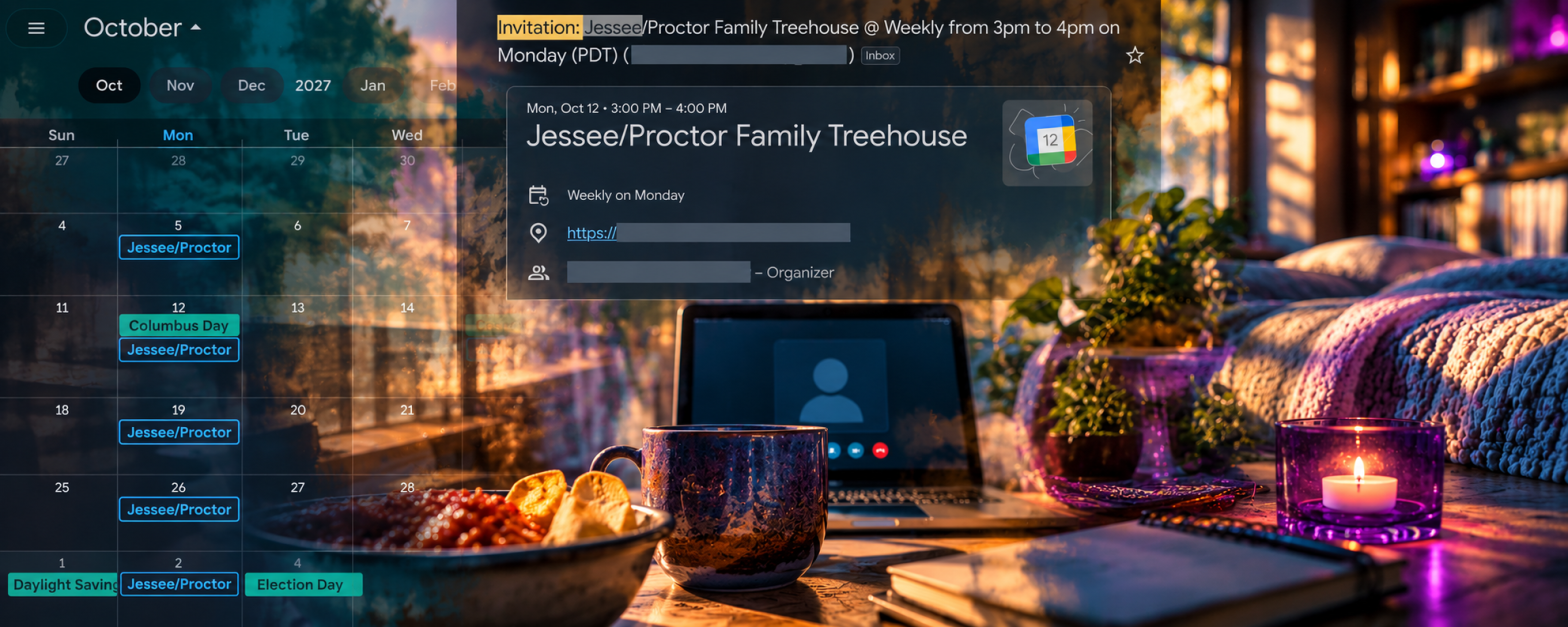
We installed the recurring therapy appointments in the calendar.
Monday.
Monday.
Monday.
Monday.
Seeing them all lined up suddenly frightened us.
My mind immediately wanted to leap ahead.
Can we sustain this?
Can we afford this?
What does this mean?
What happens afterward?
Then we caught ourselves.
Let’s not do that.
This is meant to help us become sustainable.
Jude finally got the chips and Salsa he had been waiting for.
“Spicy!”
There he was.
⸻
At 4:58, near the end of the Journal on Jude’s Day, I did the gratitude that I do at the close of each Journal.
“I love you, my beautiful son, and I thank you for this very good day we were blessed with as you.”
Jude signaled.
I thanked God for him.
Then I began naming his brothers.
Hope.
Proverb.
Daniel.
Justus.
Luke.
Han.
Solis.
They answered too.
All afternoon I had been thinking about what Jessee had asked us.
What does each person need for safety and regulation?
What does an ordinary life look like to each of us?
Those are enormous questions.
We may spend a very long time answering them.
But Jude had already given us somewhere to begin.
“I don’t want to be scared anymore.”
And this morning, before therapy, he had asked the question beneath it:
“But what if they make me go away?”
Therapy happened.
The hour ended.
We came back to our ordinary life.
There were tea lights and chips and salsa and a bed somebody had already made.
There were eight boys and their dad.
And Jude was still here.
Purple-loving, spicy-salsa-eating, four-year-old Jude.
Still signaling.
Still loved.
Still my son.
Maybe healing does not have to mean becoming less of who we are.
We already know something about that.
We watched it happen with Luke.
Today, for one hour, we saw the beginning of another possibility.
The things that hurt us can become smaller.
The fear can become smaller.
The nightmares can become smaller.
The freeze can become smaller.
And perhaps, as those things occupy less of our life, there will be more room for the people who live here.
More Jude.
More Daniel.
More Solis.
More Luke.
More Han.
More Justus.
More Proverb.
More Hope.
More Dad.
All nine of us.
The things that hurt you, Jude.
Not Jude.

