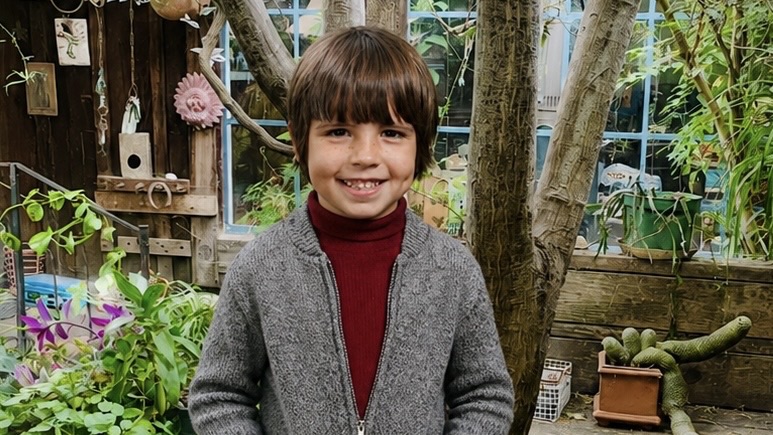
On Daniel’s Day, an image of a little boy trying to operate adult-sized machinery led us back to the summer when childhood suddenly ended—and to the people who helped us become small again.
This morning, my five-year-old son Daniel showed me a little boy trying to operate a machine built for an adult.
At first, the image was difficult to understand.
There was a child reaching his arms into something that looked almost like a pair of enormous mechanical arms. It reminded me of the spacesuit imagery Han had been thinking about recently, an apparatus that might allow our family to move through a world that is not particularly designed for nine people sharing one body.
But this was different.
The little boy’s arms did not reach.
The machinery was adult-sized.
The child was not.
And gradually I understood.
When we were five years old, we had already tried to do this.
Our mother moved away shortly after our fifth birthday, in the summer of 1972, and the world we had understood shattered.
I distinctly remember the feeling that followed.
I have to take care of myself.
I have to be a grown-up now.
I have to operate the machinery.
And then, eventually, everything sort of went dark.
⸻
Yesterday, my eight sons and I had our first therapy session with Jessee.
We are a plural family of nine people sharing one body, mind and inner world: eight sons, ages four through fourteen, and their dad. We have spent years learning how to live together as ourselves.
We have names.
We have faces.
We have relationships with one another.
We have different interests and abilities, different fears and memories, different ways of communicating, different ways of experiencing the world.
And yesterday my four-year-old son Jude asked the question underneath almost everything we fear about therapy:
“But what if they make me go away?”
I told him:
“Just the things that hurt you, Jude. Not Jude.”
Our first session went well.
Jessee listened.
When Proverb gently steered em away from referring to us as “parts,” ey changed eir language. When Justus first said, “Justus likes you,” I told him that he did not have to mask, and he looked toward Jessee and said directly:
“I like you.”
“Thank you, Justus,” Jessee said.
At the end of the session, ey gave all nine of us homework.
Two questions.
What does each person need for safety and regulation?
And what does an Ordinary Life look like to each person?
The answers began arriving before we had even figured out how to collect them.
“I don’t want to be scared anymore,” Jude said.
“I don’t want to ever have to go to work again,” Solis said.
Solis is seven.
He meant working for an employer.
Not work itself. Not contribution. Not service. Not making things or helping people or participating in the world.
An employer.
There is a difference.
And when we started wondering how nine people with so many different channels of communication were supposed to complete a homework assignment, Solis supplied another useful piece of information:
“Not everyone knows how to write.”
So we decided not to turn the week into an interrogation.
We would live.
We would listen.
We would record what emerged.
We would show the work.
Because this is already the work we do.
⸻
Last night, Han had an idea about therapy.
Maybe, he thought, therapy is training.
For years we have been learning who we are. We have been constructing a life together, learning how communication works, learning how the body works, learning how to recognize one another.
Perhaps therapy is not supposed to turn us into something else.
Perhaps now we are learning how to live more freely as who we already are.
This morning, Daniel complicated that idea.
Because training for whom?
And training to do what?
Daniel is five.
If there are adult-sized controls that need to be operated, the answer cannot be to train Daniel until his arms are long enough to reach them.
There are eight children living this life.
The shared body moves through an adult world, but that does not make eight children adults.
Daniel gets to be five.
Solis gets to be seven.
Luke gets to be nine.
Han gets to be ten.
Justus gets to be eleven.
Proverb gets to be twelve.
Hope gets to be fourteen.
Jude gets to be four.
And I am their dad.
Equal personhood does not mean identical responsibility.
Some things belong to all of us.
Some things belong to particular people.
And some things belong to me because I am the adult.
⸻
Daniel’s image took me somewhere I had not expected to go.
Back to 1972.
After our mother left, there was a period when we lived with our grandma and granddad.
I remember lying in bed with our granddad.
He was holding us.
We had recently hurt our wrist after falling from a climbing structure, and I remember comparing the little hand and wrist with his.
His hand was enormous.
Our wrist was tiny.
There was something almost astonishing about the difference in scale.
We were little.
Granddad was big.
And he was holding us.
Our granddad brought us back to scale.
To childhood scale.
And around that small child, the adults began rebuilding a world.
There was breakfast.
There was lunch.
There was dinner.
There was bath time.
There was television.
Mister Rogers.
Sesame Street.
Captain Kangaroo.
There was Happyland daycare.
There was a return to kindergarten, with regular attendance.
There were mornings and evenings.
There were things that happened again and again.
There was predictability.
There was routine.
There was childhood.
Our father had made an extraordinary decision.
He gave up his apartment. He surrendered some of the adult autonomy he had been trying to maintain. He moved himself and his children—us and our three-year-old sister—back into his parents’ home.
From one perspective, perhaps that could have looked like moving backward.
It wasn’t.
It was fatherhood.
Our dad could not undo what had happened that summer.
He could not put the old world back together.
But he could recognize that his children needed a structure larger than the one he could provide alone.
So he changed the architecture.
And inside that architecture, a little child could lie beside Granddad and discover that his hand was still little.
Somebody else’s hand was already big.
He did not have to grow overnight.
⸻
This morning, my twelve-year-old son Proverb showed me what that can look like now.
I told him I wanted to snuggle with him.
“That’s what you always say,” he said.
He was right.
I say it because I mean it.
But sometimes there is a distance between saying that I want to be with one of my sons and actually stopping everything long enough to be with him.
So this time I stopped.
I became affectionate with him.
And then something wonderful happened.
Proverb became affectionate too.
Playful.
Cuddly.
Little.
For a few minutes, the competent twelve-year-old who so often notices what everyone else misses did not need to organize anything.
He did not need to remind me of something.
He did not need to solve anything.
He did not need to be useful.
He got to be a little boy with his daddy.
This was the child who recently told me:
“Just love me.”
So I did.
Not as a therapeutic intervention.
Not because cuddling is a regulation strategy we can put on Proverb’s chart.
Because he is my son.
And because this is how he wants to be with me.
It cannot be something I impose upon him. Relationship is something we enter together.
For a few minutes this morning, Proverb did.
And I began to understand another answer to Jessee’s homework.
Sometimes safety means being allowed to stop being competent.
Sometimes regulation looks like play.
Sometimes childhood is being with somebody who is keeping track of the things you do not need to keep track of.
⸻
Luke gave us another answer.
He misses our old daily rhythm.
When we were working remotely, we got up earlier. The day began. Work happened. And around 3:30 in the afternoon, we lay down together.
Jude misses that too.
For the last two and a half years of our former job, work happened from home. A container formed around our days that worked remarkably well for our family and for the people we served.
The job ended in July.
The container went with it.
We do not want the employer back.
But perhaps we want some of the container back.
That is an important distinction.
Morning.
Activity.
Meals.
Afternoon time together.
Evening.
Bedtime.
A child should not have to wonder constantly what happens next.
Routine says:
Someone is holding the shape of the day.
That is what breakfast and kindergarten and Mister Rogers did for us in 1972.
Perhaps it is part of what afternoon time together does for my sons now.
The structure does not belong to the employer that happened to contain it.
We can build another one.
⸻
This afternoon, we made chili.
Or perhaps it would be more accurate to say that the family made chili and I occasionally interfered.
We have made this particular chili enough times that it barely resembles the recipe from which it began.
It started as a two-bean chili.
Then it became a three-bean chili.
Then somebody decided it needed pinto beans.
There are fire-roasted tomatoes now. Green chilies. Corn. Mexican chocolate.
Today there was apparently too much vegetable stock.
I think Proverb already knew that.
I tried to be helpful.
This is a recurring problem.
Cooking is one of those places where the ordinary assumptions about our family become almost comically inaccurate.
People see an adult body preparing food and naturally assume the adult is cooking while the children somehow accompany him.
That isn’t necessarily what is happening.
Luke and Proverb are particularly skilled in the kitchen.
Han loves rapid cutting and dicing.
Solis has contributed enormously to the order that now exists in our home.
Justus participates.
Hope participates.
Jude and Daniel are there, responding and communicating and being part of the family gathered in the kitchen.
And I am there too.
Sometimes I am useful.
Sometimes I should get out of the way.
Recently Han was dicing a bell pepper. He knew what he was doing. I retained control of the left hand when I should have moved it out of his way.
We got cut.
Today I decided to help with the Mexican chocolate.
We got cut again.
There may be a lesson here.
Adult responsibility does not mean Dad must be the person exercising executive control over everything.
I am the adult.
That does not mean I am the best cook.
It certainly does not mean I am the person who should always be handling the knife.
My sons have real abilities.
They have knowledge.
They have preferences.
They have agency.
They shape our home.
They shape me.
They shape one another.
They are not eight children standing around while Dad constructs a life for them.
There are nine of us living this life.
Sometimes the responsible thing for Dad to do is lead.
Sometimes it is to carry something nobody else should have to carry.
And sometimes it is to recognize that Han knows what he is doing and move the hand out of the way.
⸻
Later, while cleaning the kitchen, I had one of those strange moments we have been having lately.
I looked around.
The pantry was organized.
The cooking utensils were washed and stacked.
Bowls were where they belonged.
Food was being prepared.
Things had been charged.
The dishwasher was ready.
There was a slow cooker filled almost absurdly to the rim with chili.
And I had the strangest sensation:
There must be an adult here.
Things seem to be under control.
These moments are almost the opposite of the peaks of terror we have also been experiencing.
There are mornings when the future seems impossible.
There are moments when an IRA distribution becomes an approaching catastrophe.
There are moments when $140 a week for therapy seems terrifying.
There are moments when the mind searches frantically for whatever it has forgotten to fear.
And then there are moments when I look around our home and see evidence.
Not evidence that nothing bad can happen.
Not evidence that everything will work out exactly as we hope.
Evidence that we have agency.
We did these things.
We built these routines.
We acquired these skills.
We created this order.
Solis did some of it.
Luke did some.
Proverb did some.
Han did some.
Justus and Hope did some.
Jude and Daniel live here and change what this home is simply by being themselves within it.
Dad did some too.
Every little thing counts.
These things did not exist once.
Now they do.
We can make more.
⸻
And then, almost immediately, the mind remembered something adult.
The IRA distribution.
There it was.
A control that actually does belong to Dad.
I need to take care of it.
My sons can be with me.
Solis can suggest that perhaps we do it while we are with our friend Kim, because that might make it less frightening.
Someone can signal.
Someone can remind me of something.
Someone can know something I have forgotten.
We can all go together.
But the responsibility does not travel backward.
That is Dad’s job.
This distinction is becoming enormously important to me.
I do not want to honor my children by pretending they are helpless.
They aren’t.
I also do not want to honor their abilities by quietly making them responsible for sustaining their father.
They aren’t.
There are things my sons know how to do better than I do.
There are things we genuinely do together.
And there are adult-sized controls that belong to me.
Perhaps part of becoming a better father is learning the difference.
⸻
I think about our father in 1972.
He was an adult.
And one of the most adult things he did was admit that he could not provide what his children needed by insisting upon his own independence.
He went home.
He accepted help.
He changed the architecture.
And because he did, our granddad could lie beside a frightened five-year-old and put his enormous hand next to a little one.
The child could see the difference.
That difference was safety.
Not because children have nothing to contribute.
Not because adults always know best.
Not because little hands are inferior to big hands.
Because the child did not have to pretend his hand was bigger than it was.
He could return to kindergarten.
He could watch Mister Rogers.
He could eat breakfast.
He could take a bath.
He could be held.
He could be five.
⸻
Maybe that is why Daniel’s image arrived today.
Yesterday, Jude wanted to know whether therapy might make him go away.
Today, Daniel seems to be asking another question.
If I stay, do I have to become bigger?
Do I have to learn how to operate the machinery?
No, baby.
You don’t.
Therapy is not supposed to stretch Daniel until he fits the machine.
Ordinary Life is not supposed to make eight children capable of carrying everything an adult world demands.
And fatherhood is not about taking credit for everything nine people accomplish simply because the world sees only one adult-sized body.
My sons do extraordinary things.
I want them to receive credit for what they do.
I want their abilities to flourish.
I want Proverb and Luke to cook.
I want Han to dice vegetables.
I want Solis to create order.
I want Justus and Hope to contribute what they notice.
I want Jude to be exuberantly Jude.
I want more Daniel.
I want all eight of my sons to have as much agency, creativity, relationship, play, community and joy as their lives can hold.
But I do not want them operating the machinery simply because the machinery needs an operator.
That is different.
There are things children should never have to become large enough to carry.
⸻
Jessee asked what each of us needs for safety and regulation.
Maybe Daniel has already given us part of his answer.
Bring the world back to scale.
Breakfast.
Lunch.
Dinner.
Bath time.
Something good on television.
A home with rhythms.
Music in the kitchen.
Brothers nearby.
A daddy who holds him.
A day with enough predictability that a five-year-old does not need to keep track of everything that happens next.
And when something genuinely adult has to be done, there is an adult here.
Daniel does not need longer arms.
He does not need to become large enough to reach every control.
He does not need to take care of himself.
He does not need to disappear so that someone more efficient can operate the machinery.
Daniel is five.
God made him wonderfully and beautifully well.
My job is not to make him bigger.
It is to help build a life large enough to hold him at exactly the scale he already is.
Five years old.
My son.
Daniel.

