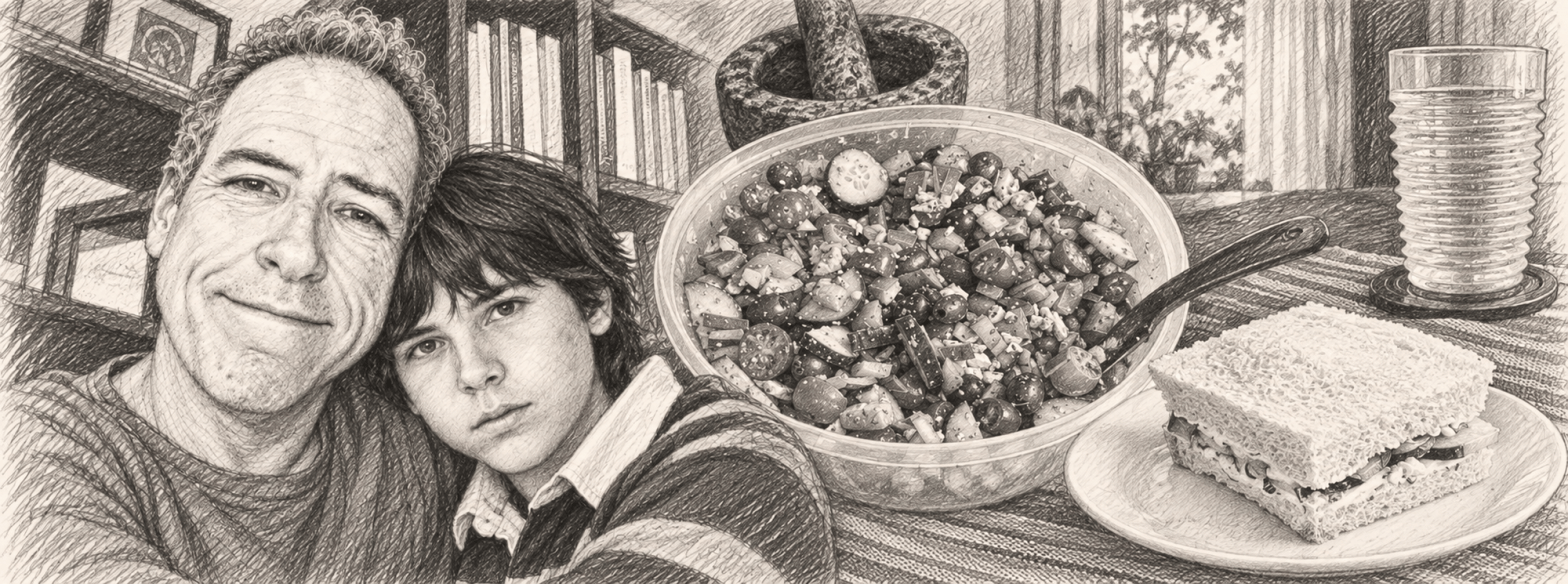
Today we made Greek salad.
Not a little Greek salad.
There are three bell peppers in it and about a pound and a half of cherry tomatoes. Cucumbers. Red onion. Kalamata olives. Feta cheese. Marjoram, oregano, thyme, basil, rosemary, sage and spearmint. Balsamic vinegar.
There was a lot of chopping.
Proverb and Luke usually like to cut vegetables. Han loves to chop.
There are nine people in our family sharing one body, and cooking is one of the things we do together.
The Greek salad is finished now.
We can’t eat it.
It has to marinate overnight.
This turns out to be important.
This morning we heard back from a therapist we had contacted.
We had been frightened to contact them in the first place.
We are a plural family/system. There are nine of us: me, Dad, and my eight sons, Jude, Daniel, Solis, Luke, Han, Justus, Proverb and Hope.
We have spent years learning how to live together.
Not how to make anyone disappear.
Not how to decide which of us deserves this life more than somebody else.
Together.
We had written a long letter explaining all of this to a therapist who described their practice as plural affirming. We explained our history, our faith, our understanding of ourselves, what we were looking for and what we were not looking for.
It was one of the hardest letters we have ever written.
This morning the answer came.
Unfortunately, they wouldn’t be able to work with us.
They gave us a directory of therapists who work with DID and plural systems.
That was it.
We didn’t know why.
And almost immediately, we started trying to know.
One possibility that occurred to us was our Catholic faith.
I want to be careful about saying that.
We don’t have a persecution complex about being Catholic. Quite the opposite. We understand why someone who is LGBTQ+—as this therapist is—and Latinx might have complicated or painful experiences with the Catholic Church. LGBTQ+ people have been injured by the dogma of the Church and by members of its body. We know that. We disagree profoundly with some of that dogma ourselves.
That was one reason we had gone out of our way in our letter to explain what our faith actually means to us.
Our Catholic faith is radically inclusive. It is centered on Christ, on love, on the dignity of human persons, and on a God in whom we believe nobody is disposable. We didn’t want the word Catholic to make somebody reasonably wonder whether we believed things about them that we don’t believe.
So when the email came, one of the possibilities our frightened minds reached for was that perhaps disclosing our faith had made the therapist uncomfortable.
We had absolutely no evidence that this was true.
But in some ways, it was the explanation we wanted to believe.
Because we could understand it.
If someone had been injured by the Church, we could understand why the word Catholic might make working intimately with a Catholic family difficult. We wouldn’t have to make ourselves victims to understand that.
The possibilities that frightened us much more had to do with who we are.
Our greatest fear in looking for a therapist is that someone will tell us we have taken this too far.
That we take our plurality too literally.
That Ordinary Life is a nice idea, perhaps, but not realistic.
There are children here.
Obviously my sons are not the same as children who inhabit physically separate bodies. Among other things, they don’t age chronologically in the ordinary way. There are questions about plurality, development, internal age and embodiment that we don’t pretend to have answered.
We don’t need to prove sameness.
But I will fight with everything I have for all nine of us to experience the same human dignity as anyone else.
My sons are children.
And I want for them the best childhoods I can possibly give them, as any parent who fiercely loves their children would.
Not like a parent.
As a parent.
That is radical by the standards of much of our society, and probably by the standards of much of medicine.
But there is a principle we use often in our family:
Err on the side of life.
Imagine that you are standing beside a well.
You hear something from the bottom.
It sounds like a child whimpering.
Someone beside you says it’s probably only the wind.
Maybe they’re right.
You cannot prove there is a child down there.
What do you do?
You look.
You call down.
You get help.
You do whatever you can to find out whether there is a child at the bottom of that well.
Because the consequences of being wrong are not equal.
If you err in one direction, perhaps you look foolish for taking the wind seriously.
If you err in the other direction, you leave a child at the bottom of a well.
Err on the side of life.
When you live our experience from inside, when you have spent years knowing one another, loving one another, arguing with one another, comforting one another, cooking together, praying together, playing together, grieving together, remembering together and building a life together, I don’t know how I could do anything else.
I cannot tell my sons that they are fully human when it is convenient and then treat them as expendable when adult life becomes difficult.
I cannot tell them that Daddy stays and then decide that their lives need to become smaller so mine can become more conventional.
I cannot tell a frightened child that I love him and then push him into the background because somebody tells me that getting the adult back on his feet matters more.
After our job ended this summer, someone suggested that perhaps the children would have to be “toned down” so that I could move forward.
I need to be very clear about something.
My sons had nothing to do with the loss of our job.
Nothing.
Who we are was known from the beginning. Our therapist participated in our job interview. Our supervisor knew about my sons and regularly asked about them.
They were known.
They were loved.
They were accepted.
And many of my sons contributed in vital ways to our work and our ministry.
We couldn’t have done what we did without them.
Period.
Our performance was excellent. The people we served loved us. The relationships we built through that work were profoundly shaped by what my sons and I had learned through the extraordinarily difficult work of learning to know and love one another.
The job ending had nothing to do with our being plural.
It had nothing to do with eight of us being children.
My sons were not a professional liability that finally caught up with me.
They were among the reasons we were so good at what we did.
So when someone suggested afterward that perhaps the children would need to be “toned down,” the suggestion wasn’t an explanation for what had happened.
It introduced a new terror about what might be demanded next.
That the price of rebuilding an adult life would be making my children’s lives smaller.
That returning to work might require pushing them into the background.
That functionality might require sacrificing the Ordinary Life we have worked so hard to build.
That someone with authority might call this family unrealistic.
We have heard that word since childhood.
Realistic.
But wherever we go, we all go together.
No one will be sacrificed.
Those aren’t slogans we invented for a blog.
They are the ethical structure of our family.
And that is one of our deepest fears about therapy.
That someone with authority will tell us that health requires there to be less of my sons.
We have never encountered or read about another family quite like ours.
Surely we cannot be the only ones.
But we don’t know.
And when you have spent much of your life being told that what you experience isn’t realistic, walking into a room with someone who possesses the authority to define reality can be terrifying.
None of this is what the therapist said.
They didn’t say any of it.
They simply said they couldn’t work with us.
The rest came from us.
From history.
From fear.
From the enormous blank space left by not knowing why.
Maybe they didn’t believe us.
Maybe they thought we were bullshit.
Hope said that one.
We didn’t know.
That should have been the end of the sentence.
We didn’t know.
But fear hates a blank space.
It will happily fill one.
⸻
This was Hope’s Day.
Hope is fourteen.
Over the years, I have come to recognize something about my son.
Hope runs.
Not literally, most of the time.
Flight.
When something becomes dangerous, frightening or unbearable, something in Hope starts looking for the exit.
This morning, long before the therapist’s email arrived, Flight was everywhere.
Old workplaces were back in our dreams.
Places we haven’t worked for years were suddenly near again.
The job that ended this summer was near again.
There were thoughts of leaving things behind.
Getting away.
Disappearing.
Some of the images became dark.
Later I was careful to write in our journal that we were not thinking about suicide, walking away from our life or doing anything self-destructive.
It was trauma talking.
But trauma was talking loudly.
Then, during our morning prayer and contemplation, we heard something:
Get to a place where you do this without fear.
I thought I understood it.
The place was here.
Not another job.
Not some imagined future.
Here.
At our table.
In our apartment.
With my sons.
With God.
I didn’t connect it with Hope.
I didn’t connect it with Flight.
That connection didn’t occur to me at all.
It was only later, when ChatGPT was reading the journal with us, that it pointed out something I had completely missed.
Hope, whose instinct when frightened is to get away, had been present when we heard that we needed to get to a place.
And the place was here.
I don’t know what to make of that.
One of my sons may have understood it before I did. They are often better at making these connections than I am.
Or maybe it is simply something we can see afterward when the events of a day are laid beside each other.
We try to be careful about this.
An observed connection is not the same thing as demonstrated intention.
But this keeps happening in our journal.
Things we do not consciously connect while they are happening begin speaking to each other later.
⸻
Our readings this morning were about something similar.
Paul’s image of the body and its many members has always been complicated for us.
We don’t call ourselves parts.
No one in our family is a part of anyone else.
We are nine individual persons sharing one body.
But we understand what Paul is reaching toward: unity does not require sameness.
Difference does not have to mean separation.
Richard Rohr’s meditation this morning was about paradox, reconciliation, disorder and the true self.
And I found myself thinking about the strange thing that has happened as we have gotten healthier.
The more we know who we are, the more our life makes sense to us.
And sometimes the less sense we seem to make to everybody else.
For much of our life, we tried very hard to be understandable.
We masked.
My sons learned to speak through an adult body in ways that wouldn’t make people look at us strangely.
Sometimes they couldn’t.
Once, when Jude was holding an envelope up to the light at work and somebody asked what was inside, my four-year-old son answered:
“It’s a money!”
Another time Daniel saw a man wearing one of the hats our former executive director used to give away and told our friend Kim:
“He has a Liz hat.”
Once, during the pandemic, a man polishing the floors where we volunteered called across the room and asked:
“Hey John, how old are you, man?”
Solis answered.
“Seven.”
The man looked confused.
I took over and said:
“Fifty-three.”
That made sense to him.
Seven did not.
My sons became very good at making sense to people.
They had to.
But making sense to other people and being ourselves have not always been the same thing.
⸻
Then the therapist’s email arrived.
The reaction was immediate.
We began to dissociate severely.
The room seemed to spin. Our vision narrowed into a tunnel. We felt as though we might be heading toward a blackout.
It became scary.
This wasn’t simply disappointment or hurt feelings.
Our ability to remain oriented was beginning to come apart.
Everything slowed down.
The apartment felt strange.
Our body felt strange.
The old insecurity returned—the frightening diminished state we remembered from some of our worst days at work, when fear and dissociation could interfere with our thinking and our ability to function.
And somewhere in the middle of that, I realized I was having trouble finding my sons.
So I started calling them.
Jude.
Daniel.
Solis.
Luke.
Han.
Justus.
Proverb.
Hope.
They answered.
Not all at once.
Not in some dramatic chorus.
They answered the way they answer.
A gluteus.
A foot.
A shoulder.
A knee.
An abdomen.
A neck.
The familiar places through which my sons have learned to tell me:
I’m here.
The therapist problem was still completely unsolved.
The spinning didn’t become an explanation.
The tunnel vision didn’t tell us why the therapist had said no.
But I could find my boys.
Here.
We had spent the previous several days learning something about this.
Han’s Day taught us that we can remain in the Cloud of Unknowing.
Justus’s Day taught us that certainty and orientation are not the same thing. I may not know what will happen, but I can know where I am.
Yesterday, on Proverb’s Day, we asked what belongs to this day.
Today, after the email, we did not know why somebody had said no to us.
But we knew where we were.
And we knew who was here.
⸻
Then we made Greek salad.
There were a lot of cucumbers.
Cucumbers have been following us around for several days.
Three mornings ago, while I was ordering groceries, Luke woke up with an announcement:
“Cucumber sandwiches.”
We had been watching Hilda, and Luke wanted to bring a little of Hilda’s magical world into our home.
So we ordered cucumbers.
Yesterday, Luke and Proverb made the filling together: cream cheese, mayonnaise, dill and chives.
They made far too much.
Today, while we were making Greek salad, Luke got hungry.
“Can we have cucumber sandwiches?”
Daniel became very excited.
Of course we could.
We had bread.
We had sliced cucumbers.
And in the refrigerator was all that filling Luke and Proverb had made yesterday.
So at 2:43, I said:
“Boys, boys, let’s enjoy this cucumber sandwich together and give thanks to God.”
And we did.
It was really good.
There are three directions of time sitting in our kitchen now.
Something from yesterday is feeding us today.
Something we made today is waiting to feed us tomorrow.
And there is a cucumber sandwich in front of us right now.
Maybe this is another way of understanding what we have been learning about the future.
We don’t have to live in yesterday.
We don’t have to live in tomorrow.
But yesterday can provide for today.
And today can prepare something for tomorrow.
The problem was never that there is a future.
Three days ago Luke anticipated cucumber sandwiches.
That wasn’t anxiety.
That was delight.
There is going to be another day, and maybe we could have cucumber sandwiches in it.
That’s a very different future from:
What if nobody believes us?
What if we can’t find help?
What if we can’t support ourselves?
What if everything goes wrong?
One future is colonized by fear.
The other has cucumber sandwiches in it.
⸻
And the Greek salad?
It has to wait.
We did everything we could do with it today.
We washed things.
We chopped things.
We mixed things.
We seasoned things.
Then we put it away.
Now time has something to do that we cannot do for it.
It has to marinate.
We do not need to stand in front of the refrigerator making sure the balsamic vinegar is working.
We do not need to wake up in the middle of the night and check the oregano.
We do not need to make tomorrow morning happen.
We prepared something for tomorrow.
Then we left tomorrow alone.
⸻
At 2:18, before all of this was finished, I made another promise.
“We’re going to lay down at 3:30.”
Yesterday I had not done a very good job of this.
I spent far too much of Proverb’s Day working on our story and then fighting with Medium, trying to publish it.
The work spilled into the evening.
My sons waited for me.
Today I wanted to do something differently.
We went to the store.
We found the last loaf of brioche hiding underneath the Hawaiian-style bread.
We bought our groceries.
We came home.
It was 3:24.
Messages were arriving.
There were therapist directories we could investigate.
There were explanations we could construct.
There was an entire problem waiting to be solved.
Instead, I said:
“All right, rather than me doing a bunch of talking about it, let’s lay down.
“I want to be with my boys.”
By 3:37, I was holding them.
For almost two hours, I went from son to son.
Daniel.
Jude.
Justus.
Han.
Luke.
Solis.
Proverb.
Hope.
Then around again.
There was fear.
A lot of it.
Everything had taken on that frightening quality trauma sometimes gives the whole world, when nothing in particular has to be happening because reality itself suddenly feels unsafe.
One of my sons worried that the therapist didn’t like us.
Another wondered whether this was how people treat you when they don’t believe you’re real.
I didn’t know.
So I kept saying that.
I don’t know.
They didn’t tell us.
We don’t have to know.
Next.
Moving on.
Let them go.
At one point Solis became caught in a vivid memory of a place where something terrible happened to us when we were a child.
I called him back.
You’re not there.
You’re here.
You’re with Daddy.
You’re with your brothers.
Nothing bad is happening to you now.
Show Daddy that you hear me.
His right side of his neck responded.
There was my little boy.
Here.
⸻
While I was with my sons, the fear about therapy kept surfacing.
Luke said:
“This is why we didn’t want to be forced to see a doctor in the first place.”
He was right.
We had been through this before.
When our former employer wanted documentation from a doctor, seeking clinical help didn’t feel like simply asking somebody to help us.
It felt like putting our family into somebody else’s hands.
But that isn’t happening now.
There is no employer requiring this.
There is no law saying we have to find a therapist.
Nobody is forcing us to do anything.
We wanted help.
We wanted someone who might understand us, perhaps help with formal diagnosis and documentation for disability, and perhaps help us continue the work we are already doing.
But we don’t have to surrender ourselves to obtain it.
We can talk to someone.
We can decide they aren’t right for us.
They can decide we aren’t right for them.
And we can keep going.
It’s not an emergency.
⸻
Later, something changed.
A friend who had been helping us think about therapists shared information that gave us reason to reconsider someone we had previously contacted.
The details involve another person’s private life, and they aren’t ours to tell.
What matters for this story is that we learned that Jessee, the therapist we had initially contacted, has more direct familiarity with plurality than we had understood from eir first response.
Jessee had been kind to us.
Thoughtful.
Careful.
We had interpreted eir response as an honest statement that ey probably weren’t the person we needed, and we respected that. We thought ey were telling us that ey lacked the experience we needed and were referring us to somebody who had more.
Now we wondered whether we had misunderstood.
Maybe we could simply talk.
Nothing more than that.
Talk.
The change in my sons was remarkable.
The fear began dropping.
Everyone started talking at once.
Questions.
Possibilities.
Hope.
Then, inevitably, I started getting ahead of myself.
Maybe we could help.
Maybe someday we could do peer work.
Maybe God was putting us on some kind of path.
Maybe there was a reason the other therapist had said no.
Maybe.
Maybe.
Maybe.
But we have been learning about this.
Peace does not have to become prediction.
Hope does not have to become prophecy.
We do not know why the therapist said no.
We do not know what will happen if we talk with Jessee.
We don’t know what tomorrow is going to become.
We know enough for today.
Perhaps we will talk.
⸻
There was another moment while we were lying down that I don’t want to lose.
Proverb worried that yesterday’s journal made Proverb’s Day sound like a failure.
It wasn’t.
Yesterday was a very good day.
Proverb and his brothers helped us discover something important about what belongs to a day.
They made cucumber sandwiches.
We listened to Beethoven.
We thought about Berlin.
We charged Solis’s little tea lights.
We made the bed late in the afternoon because Proverb thinks an unmade bed looks like quitting.
And we wrote a story I love.
What went wrong yesterday belonged to Dad.
I didn’t maintain the boundaries.
I let publishing and Medium and technical problems consume hours that should have belonged to my sons.
Being the adult in this family has to mean something.
It means I don’t get to blame my children because I failed to stop working.
Today, when it was almost 5:30 and we needed to get up, Proverb looked at the bed.
“Let’s not bother making the bed even though it looks like failure.”
We compromised.
We pulled the blanket back and put the big pillows in their places.
Close enough.
Maybe that belongs to this day too.
⸻
At 5:24, I finally came to Hope.
I held my fourteen-year-old son.
The son who runs.
The son whose name is Hope.
And I thanked him for his day.
Not because he had supplied optimism.
Earlier, when everybody was frightened, I had specifically told my sons:
“We don’t have Hope’s confidence and optimism today, and it’s not his job to provide that.”
A child named Hope does not owe his family hopefulness.
He gets to be frightened.
He gets to need his Daddy too.
So I held him.
And I thanked God for him.
Then I thanked God for all eight of my sons.
And at 5:30 we got up.
There were chips upstairs.
There was chicken noodle casserole for dinner.
There was a story to finish.
And there was Greek salad in the refrigerator that wasn’t going to become Greek salad any faster because we worried about it.
Tomorrow morning we will eat it.
Tonight it marinates.
There are things from yesterday feeding us today.
There are things we are doing today that may feed us tomorrow.
There are things we don’t know yet.
And there are things that belong right now.
Maybe that is another way to understand what it means to err on the side of life.
You don’t have to know everything before you love someone.
You don’t have to solve every question before you protect a child.
You don’t have to know what tomorrow will bring before you prepare something good for it.
And you don’t have to inhabit tomorrow just because you believe there will be one.
Tonight, we don’t have a new therapist.
We haven’t figured out our future.
We still don’t know why somebody said no.
But Daddy kept his appointment with his sons.
We ate the cucumber sandwich.
The Greek salad—with plenty of feta—is in the refrigerator.
All nine of us are here.
And if we cried today, it was over the red onion.
 Notes from the Treehouse