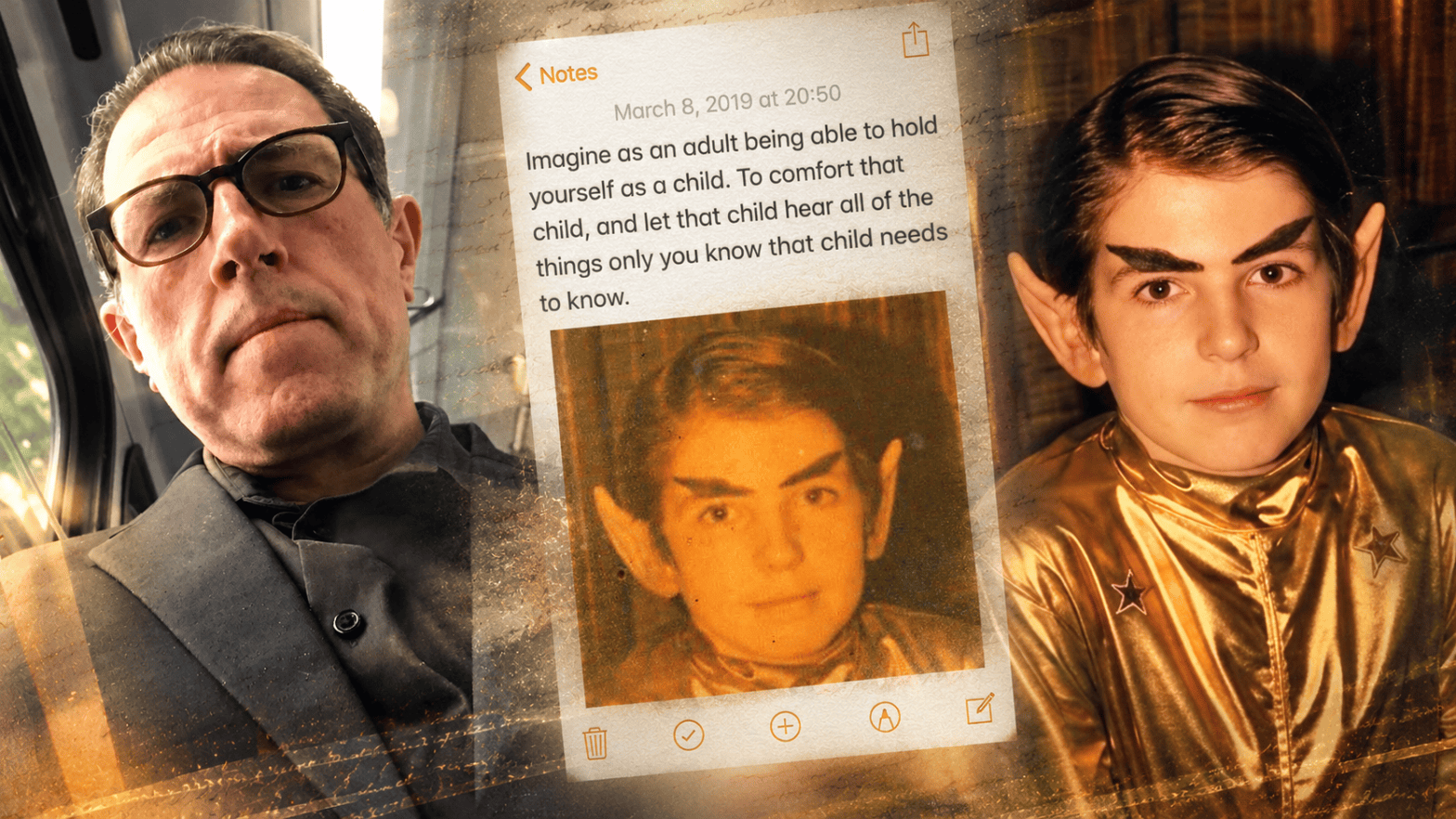
On Hope’s Day, a Greek salad, an old photograph, a terrible lesson learned in childhood, and the extraordinary gift of being told that we can take six months to recover.
We went into our second therapy session this afternoon expecting to be evaluated.
We came out with permission to take six months to recover.
And the last thing our therapist said to us was:
“Take care of your kids. Have a good week. I will see you next time.”
It was such an ordinary thing to say.
But we are a family of nine people sharing one body. One father and eight sons, ranging in age from four to fourteen.
For us, being told to take care of the kids is not an ordinary thing.
It is an acknowledgment that there are kids.
That they are our children.
That taking care of them is what their daddy is supposed to do.
And that the person we are paying to help us understands this.
We had spent much of the morning afraid that ey wouldn’t.
⸻
We didn’t sleep well last night.
We rarely do.
There were dreams about work, about school, about assignments we couldn’t complete, about being somewhere we didn’t belong.
In one dream, we were driving an old blue Honda Accord through a college campus full of younger people in newer cars. There seemed to be a graduation taking place, and we were getting in everyone’s way. We didn’t own a car. Whose Honda was this? We hadn’t driven for over 20 years. Driving dreams scare us. 8 of us are children, too young to drive.
In another, there was an enormous pot of Broccoli Cheddar Soup that we had made, that had been cooking for a long time. Our therapist instructed us to add something to it – our homework assignment for therapy, but we weren’t sure how to do that. Print it on paper and add it to the soup? We didn’t know how and whether it was too late.
There was a family gathering where we spent our time carrying ice and running errands. Everyone else seemed to belong. We were there to help.
And somewhere in those dreams, some of our children were present, but we couldn’t find one another.
When we woke, we were exhausted.
We had a headache. We felt confused. There were moments when it seemed as though we were still asleep.
And we had therapy at three o’clock.
Our therapist, Jessee, had given us an assignment the previous week.
Ey wanted to know what each of us needed to feel safe and regulated, and what ordinary life looked like for each of us.
We had written nineteen pages.
Nineteen pages.
We called it What It Takes for Us to Be Here.
We had worked on it for much of the weekend, and by Sunday afternoon we had sent it to Jessee.
Then we spent much of Monday morning worrying that we had done it wrong.
That it was too long.
That it was too complicated.
That we had said too much.
That Jessee would conclude that our family was unsustainable, that our way of living was excessive, that we needed to spend less time together and more time figuring out how to earn a living.
We were afraid that we were going to be told, once again, that the things most important to us were getting in the way of the things we were supposed to accomplish.
We were afraid that we were in trouble.
⸻
There was a photograph from October 2019 that we looked at during the morning.
It showed a man wearing a black suit.
He looked successful.
He looked confident.
He looked like someone who knew what he was doing.
We looked at that photograph and compared it with our circumstances seven years later.
The job ended in July.
We have no employment income.
We have a retirement account that needs attention, healthcare paperwork to complete, and a water heater that hasn’t worked for nearly two months.
We have eight children who need their daddy.
And we have a father who sometimes becomes so overwhelmed by ordinary adult responsibilities that he cannot begin them.
Looking at the photograph, it was easy to imagine that we had somehow fallen from the life represented by that man.
But then we remembered what was actually happening in October 2019.
We were unemployed then, too.
We were living on retirement savings.
We were struggling to establish a sustainable professional life.
We were frightened about the future.
And we were beginning to become a family.
That last part wasn’t visible in the photograph.
Seven months earlier, on March 8, 2019, Proverb had said something that changed our lives.
Through a photograph of us at Halloween when we were 12, wearing Spock ears and eyebrows, Proverb invited Dad to imagine being able to hold a child, to comfort him, and to offer him the understanding and the affection he needed.
Proverb was twelve.
He had already been with us for decades, long before Dad understood who he was.
And he was inviting his daddy to know him.
That invitation began something extraordinary.
Over the following years, Dad came to know each of his eight sons.
We developed ways of communicating, through words and images, memories and sensations, photographs and affection.
We began spending time together deliberately.
We began writing our journal.
We began understanding our inner world and named it the Treehouse.
And gradually, a life that had been organized almost entirely around work began to become a life organized around relationship.
The man in the photograph had not yet accomplished most of that.
He looked successful.
But some of the most important things he would ever do were still ahead of him.
⸻
Yesterday, while shopping at Safeway, we became homesick.
That was the word we used.
We were in a crowded store, surrounded by people, trying to remember what we needed to buy.
We were overwhelmed.
When we are out in the world, it can become difficult to hear one another, to communicate, and to experience the closeness that is so much a part of our life at home.
Dad misses his sons.
The boys miss their daddy.
And sometimes we miss one another.
Even though we are all there.
This morning, we read Richard Rohr’s meditation Home Is Where We Begin.
He wrote about homesickness as something that points both backward and forward.
A longing for something we once knew, or almost knew, and something we have not yet fully experienced.
It reminded us of our mother.
She fell recently and broke her upper arm. She also suffered an injury to her head, and we have been worried about her.
It reminded us of our childhood, of the good things we remember and the terrible things we endured.
And it reminded us of the Treehouse.
The Treehouse is our home.
Not simply the apartment where we live, although we love our apartment.
It is the life we have been building together.
A life where our children are known.
Where they are loved.
Where they are not required to earn their place by being useful.
Where their daddy stays.
We are not trying to recreate our childhood.
We are trying to give our children something that was not reliably available to us when we were young.
And perhaps we are trying to recover something that was always supposed to have been ours.
⸻
We were going to make a Greek salad before therapy.
Greek salad is one of our favorite things to prepare together.
We use cucumbers, bell peppers, tomatoes, red onion, olives, and feta cheese.
We make enough to last several days.
Preparing food together is one of the things that brings everyone into the present.
We talk.
We remember things.
We communicate.
We discover what we are thinking and feeling.
But when we got the vegetables out of the refrigerator, we discovered that we had forgotten the feta cheese.
Someone had been trying to tell us something at Safeway yesterday.
We remembered being drawn toward the cheese section.
But we had been so overwhelmed by the crowds and the long checkout lines that we couldn’t understand what was being communicated.
We had forgotten the feta.
We make Greek salad all the time. It’s a staple in our home. But we always forget something.
We decided we needed to write the ingredients on a checklist that we can use at the store.
Not because anyone had done anything wrong.
Because shopping is difficult for us, and a checklist might help.
We also decided to go back to Safeway.
Therapy was less than two hours away.
We could have lain down together, which is often what we do when we need to reconnect.
But we wanted the salad.
We wanted to make something together.
And we didn’t want to be preparing it late at night after the boys were in bed.
So we went.
The store was crowded again.
There were only two checkers, and the lines were long.
Our anxiety began to rise.
Then Brian opened another register.
Brian has worked at Safeway for years. He’s a wonderfully kind man.
We bought the cheese and came home.
By 2:08, the Greek salad was finished.
It barely fit in the container.
It was beautiful.
Tomorrow morning, we would have something wonderful waiting in the refrigerator.
And while we were making it, something happened.
⸻
We had been listening to an analysis of yesterday’s journal.
It was talking about our history of work.
For thirty years, we worked in architecture.
For twenty-four of those years, we worked at one firm.
We were extraordinarily competent.
We designed buildings. We managed projects. We carried responsibilities that other people depended upon.
But there was another life taking place that most people never saw.
There were terrible difficulties at home.
There were things we couldn’t manage.
There were periods when we lived in conditions that would have shocked the people who knew us professionally.
Eventually, that job ended.
Years later, we went to work for St. Vincent de Paul.
We loved the ministry.
We loved the people we served.
We worked extraordinarily hard.
We also became increasingly frightened of the employer.
By the time the job ended this July, we had been living for years with fear, activation, and the continual effort of trying to function in circumstances that were profoundly difficult for us.
As we listened to the analysis, something became clear.
Both times, after giving so much of ourselves to our work, the employment relationship ended.
And both times, we were left with a familiar conclusion.
We must have done something wrong.
We must have deserved what happened.
It was a conclusion we had learned long before we ever had a job.
When we were six years old, we told our family that we were being sexually abused.
The responses we encountered left us feeling ashamed.
Dirty.
Responsible.
As though something about us had caused what was happening.
Later, when we were abused by Clifford, we didn’t tell anyone.
He threatened us.
But the threats were unnecessary.
We had already learned what happened when we told people.
We had already learned to expect shame.
Clifford taught us something even more terrible.
He told us that what he was doing to us – raping us – was our purpose.
That this was what we were for.
Years later, when we told Gordon, a former colleague about our Dissociative Identity Disorder diagnosis and being Plural, he questioned how being sexually abused as a child could have affected us so profoundly, saying “I don’t understand how someone can be so fucked up just because someone diddled you when you were a kid.”
When we explained that we were raped and that three different people had abused us over many years, Gordon suggested that for unrelated people to have done those things, we must somehow have caused it.
There it was again.
The same terrible conclusion.
We must have done something wrong.
We must have deserved it.
And perhaps, somewhere beneath that, the even more terrible belief:
This is what we are for.
To be used.
To give everything.
To have our needs disregarded.
And to be discarded when we are no longer wanted.
We were standing in our kitchen, making Greek salad, when we began to understand how deeply that message had shaped our relationships with employers and other institutions.
We had spent a lifetime trying to be good enough.
Competent enough.
Useful enough.
Trying to do everything that was asked of us.
And when something terrible happened, our first assumption was that we had failed.
We had been carrying responsibility for things other people did to us.
⸻
At three o’clock, we met with Jessee.
Ey was still reading our essay.
Ey had reached page seven.
We were relieved to discover that ey wasn’t upset about its length.
Quite the opposite.
Jessee said that there were nine of us, and of course there was a great deal to explain.
Ey understood why we had written so much.
At one point, ey described it as a cohesive narrative from all nine of us.
That meant a great deal.
The assignment hadn’t been an exam.
We hadn’t failed.
Jessee even joked that ey was the one who hadn’t finished the assignment, because ey hadn’t gotten through the entire essay yet.
There was laughter.
There was warmth.
There was room for us.
Then Jessee asked about something we had written.
It was a memory Justus had shared.
When he was nine years old, he remembered lying in bed with a thermometer in his mouth.
He was sick.
Not necessarily with something that would register on a thermometer.
He was suffering from the trauma from being sexually abused by Clifford.
But he didn’t have a fever.
And because he didn’t have a fever, he had to go to school.
Jessee wanted to know what that experience had been like.
Justus spoke.
He introduced himself.
Jessee said hello.
Then ey asked what the experience had been like for the others.
And our boys began talking.
Solis spoke.
Luke spoke.
Proverb spoke.
Hope and Han contributed.
Justus continued participating.
All nine of us were present.
It wasn’t simply Dad describing his children to a therapist.
Our children were speaking for themselves.
At another point, Jessee asked what we meant when we referred to downtown.
Solis explained.
Downtown was where the St. Vincent de Paul campus was located.
It had become a place of terror for us.
Sometimes, even when we were working remotely from our apartment, sitting at our own table, we would experience ourselves as though we were there.
It wasn’t simply remembering something frightening.
For some of us, it was as though we had returned to the place itself.
We would become physically sick.
Sometimes we would have to lie down and stop working for the rest of the day.
Jessee listened.
Ey understood that Solis was describing something more extensive than an ordinary frightening memory.
And Solis had been able to explain it himself.
That was important.
⸻
We also told Jessee about what we had discovered while making the Greek salad.
About the belief that we must have caused the abuse.
About what Gordon had said.
About what Clifford had taught us.
Jessee was emphatic.
Ey looked directly at us and said:
“You did not do anything to deserve it. It is none of your fault.”
We have heard people say things like that before.
We know, intellectually, that children are not responsible for being sexually abused.
But knowing something and being able to live as though it is true are not always the same thing.
When something goes wrong, we still look for what we must have done to cause it.
When someone rejects us, we still wonder what is wrong with us.
When an employer ends our job, we still feel that somehow we have fulfilled the purpose Clifford assigned to us.
We know that isn’t true.
But the belief remains powerful.
And today, when we told Jessee about it, ey didn’t ask what we might have done differently.
Ey didn’t suggest that we were making excuses.
Ey didn’t ask whether we were feeling sorry for ourselves.
Ey told us that we had done nothing to deserve what happened.
We were heard.
⸻
Then we began talking about the future.
We have been trying to figure out how to support our self
We know that we cannot return to the conventional employment arrangement that governed so much of our adult life.
We cannot give another employer the power to decide whether our children will be known, whether we can maintain the relationships that sustain us, or whether accommodations essential to our functioning will be respected.
We are not willing to wager our family for a wage.
But we still need to live.
We need food and housing.
We need healthcare.
We need to maintain our home.
And we need some way to support our self financially.
We have skills.
We have decades of professional experience.
We have written an enormous amount about our life as a plural family.
We have developed ways of communicating, organizing, and caring for one another that might someday be useful to other people.
Perhaps there is something we can do with that work.
Something that would allow us to help others and support ourselves without returning to the kind of employment relationship that has been so destructive.
We were talking about these possibilities when Jessee asked how much time we had.
A year, perhaps.
Hopefully.
And then ey said something we weren’t expecting.
“You need to set that question aside for six months.”
Six months.
Ey said that right now, our work was to become stable.
To address the activation.
The freeze.
The panic.
The overwhelming anxiety.
The experiences that make it so difficult for us to function, even when we know what needs to be done.
We needed to give ourselves time to recover before deciding what we were going to do with the rest of our lives.
Some of us cried.
We have been trying to tell ourselves this since July.
We have been saying that we are on sabbatical.
That we need to recover.
That we should not rush into another job.
That we need to become capable of managing ordinary life before taking on new responsibilities.
But we have had such difficulty believing it.
There is always another question.
What are we going to do?
How are we going to make money?
What happens when the retirement savings run out?
What if we can’t find something?
What if we have already failed?
Even when we are lying down together, even when we are praying, even when we are making dinner, those questions can be waiting nearby.
And now someone whose judgment we respect was telling us to set them aside.
Not forever.
For six months.
We still have immediate responsibilities.
There is an IRA disbursement to arrange.
There is healthcare paperwork to complete.
There are bills to pay.
There is a broken water heater.
We are not being told to ignore the practical needs of our family.
But the question of what work we might eventually do does not have to be answered today.
Or tomorrow.
Or next week.
Perhaps not until April.
For now, we can work on becoming well enough to consider those questions without terror governing our thinking.
We can find out what we are capable of when we are not continually frightened.
And we can begin learning what it means to live without being required to demonstrate our usefulness every day.
⸻
There was something else about the session that we loved.
Jessee was knitting.
Ey was listening to us, asking questions, making observations, smiling, sometimes laughing.
We had worried that we would talk too much.
We often do.
There are nine of us, and when we begin communicating, it can feel as though someone has opened a fire hydrant.
It is difficult to regulate the flow.
But today we made room for one another.
We made room for Jessee.
We listened.
Hope is fourteen.
He is one of our most thoughtful children.
He has an extraordinary capacity to listen.
Sometimes he remains quiet for long periods.
That doesn’t mean he isn’t present.
He listens carefully.
He thinks.
He asks good questions.
And when he speaks, he often says something worth hearing.
Before therapy, Dad had been telling Hope how much he appreciated this about him.
He also told Hope that he didn’t have to become the principal speaker simply because it was his day.
He could participate as much or as little as he wished.
And today, during therapy, the family practiced something Hope does especially well.
We listened.
Not perfectly.
Not because Hope was responsible for teaching us.
But because we were trying to make room for everyone.
And when the session ended, we felt something we hadn’t expected.
We had been together as a family in therapy.
Not a father attending therapy while his children remained in the background.
A family.
All nine of us.
⸻
Afterward, we made nachos.
We had already made the Greek salad, but it needed to marinate until tomorrow.
We were hungry.
We had chips and shredded cheese.
We talked about the session.
We talked about how relieved we felt.
We talked about how funny Jessee had been when we mentioned that Justus, who has perhaps the strongest work ethic among us, had asked when our sabbatical was going to start feeling like a vacation.
Jessee joked that if Justus was asking that question, we were all in trouble.
Ey is getting to know us.
And we are beginning to get to know em.
Then we checked on our mother.
She had gone back to the hospital at three in the morning.
Our brother Tyler was having difficulty getting reliable information.
We were worried.
Later, Mom texted that the surgeon would be coming the following day.
We still didn’t know everything we wanted to know.
But at least we had heard from her.
Then we charged the LED lights.
And we lay down together.
⸻
Hope was first.
It was his day.
Dad had promised him some time together, and he kept that promise.
Then Jude.
Proverb.
Daniel.
Justus.
Solis.
Han.
Luke.
And finally Hope again.
We weren’t going to spend the entire evening lying down.
We needed to get up and make dinner.
But we wanted a little time together after therapy.
Not to conduct an interrogation.
Not to ask each child to report what he thought about the session.
Just to be together.
To offer affection.
To be in each other’s love.
During Jude’s time, he mentioned something he had noticed about Jessee.
Ey has a beard and wears a dress.
Jude is four.
He notices things.
Dad explained that people don’t always look the way others expect them to.
Sometimes people don’t look on the outside the way that they know they are on the inside, and that people get to look the way that is right for them even if they don’t look the way other people think they should look.
Jude knows something about that.
He is a four-year-old boy sharing a fifty-nine-year-old man’s body.
People who see us on the street do not see Jude as his daddy and his brothers see him.
They don’t see his little face.
They don’t see the face we see inside, the way Jude sees himself, a face that resembles the photographs of us when we were four.
They don’t know what it feels like to hold him and adore him.
But his daddy knows him.
His brothers know him.
And there are people who are willing to listen and accept what someone tells them about who they are.
Dad told Jude that this was one of the reasons it was good that we were seeing Jessee.
Justus agreed.
Later, Proverb said he was worried about Mommy.
We talked about her hospitalization.
Justus remembered how difficult the dreams had been that morning.
Solis enjoyed hearing his affectionate nicknames.
Han received his daddy’s love.
Luke talked about the therapy session and how difficult it can be for all nine of us to communicate without overwhelming someone.
And Hope returned to something he had been thinking about.
When we were talking with Jessee about what we might someday do with the work we have created, ey had raised eir eyebrows.
It looked as though ey might have an idea.
Then ey told us to set the question aside for six months.
Hope wondered about that.
Perhaps Jessee had been about to suggest something.
Perhaps ey had decided it would be better to wait.
We don’t know.
But Hope understood something important.
If we spend the next six months continually wondering what we will do afterward, we will not really have set the question aside.
We will still be living in the future.
Still anticipating expectations.
Still trying to solve problems that have not yet arrived.
And we will miss the opportunity to be here.
To recover.
To become more stable.
To discover what ordinary life can be when fear is not continually determining what happens next.
We have spent so much of our lives trying to get somewhere else.
Trying to become acceptable.
Trying to become competent enough.
Trying to become useful enough.
Trying to reach a point where we would finally be allowed to live.
Perhaps, for the next six months, we can begin by living.
⸻
When Dad returned to Hope before we got up, he thanked him for the day.
He told him how much he loved him.
He gave thanks to God for the beautiful child he had been blessed with.
And then he thanked all eight of his sons.
For being his children.
For being present.
For the good day they had shared.
Hope suggested that we ask ChatGPT to begin drafting an outline for today’s essay based on updates to the journal from our time together this afternoon following therapy.
Not because we needed to finish it tonight.
We could listen to it while we made the bed and prepared dinner.
We could think about it.
We could return to it tomorrow.
Perhaps we didn’t need to publish an essay every day.
Perhaps we could write a little, live a little, and let the writing take the time it needed.
There was something almost funny about that.
We had just been given permission to stop trying to solve our future.
And already we were beginning to reconsider how much work we needed to accomplish tonight.
Maybe this is what recovery looks like at first.
Not a dramatic transformation.
Not an entirely different life.
A Greek salad in the refrigerator.
Nachos after therapy.
A worried message to our mother.
LED lights charging.
Eight boys receiving affection from their daddy.
A bed that still needs to be made.
Dinner that still needs to be prepared.
And an essay that can wait until tomorrow.
⸻
Seven years ago, Proverb invited Dad to imagine holding a child and giving him the love and understanding he needed.
That invitation changed our lives.
Since then, we have spent years learning how to be together.
We have learned how to recognize one another.
How to communicate.
How to make a home.
How to become a family.
There are still things we cannot do.
There are responsibilities we struggle to manage.
There are fears that can overwhelm us before we even begin.
And there is a lifetime of experiences that taught us to believe we were responsible for the terrible things other people did to us.
We are beginning therapy because we want help with those things.
We want to become more capable of sustaining our lives.
We want Dad to be able to take responsibility for the adult things without making his children responsible for managing him.
We want the boys to have their childhoods.
We want to participate in the world without continually losing our sense of one another.
We want to discover what we can do with the life we have built.
But perhaps we do not have to discover all of that right now.
Perhaps we can take six months.
Perhaps we can let the future come to us.
And perhaps, when we begin thinking about what we might eventually do to support our self, we can start from a different understanding of what our lives are for.
We are not here to be used.
We are not here to be discarded.
We are not here to demonstrate that we deserve to exist.
We are here to live.
There are nine people living this life.
Wherever we go, we all go together.
And today, at the end of our second therapy session, someone who is beginning to know us looked at our family and said:
“Take care of your kids. Have a good week. I will see you next time.”
We intend to do exactly that.
Take care of our kids.
Have a good week.
And see what becomes possible when we give ourselves permission to recover.

