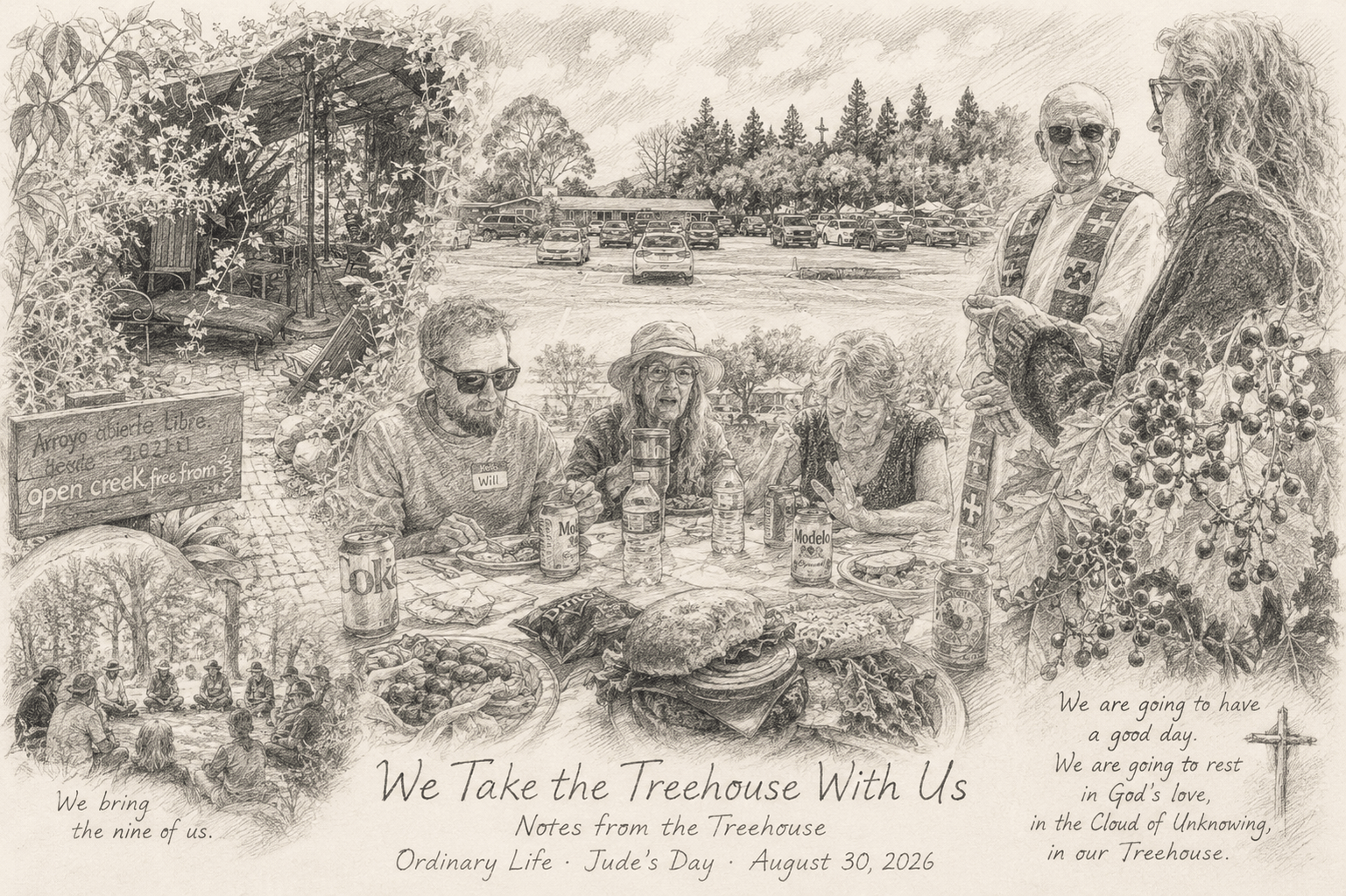
Notes from the Treehouse — Ordinary Life
Jude’s Day — Sunday, August 30, 2026
Every morning, Dad tells each of his eight sons some version of the same thing.
We are going to have a good day.
We are going to rest in God’s love, in the Cloud of Unknowing, in our Treehouse.
Sometimes we say this knowing that we are hardly going anywhere. Sometimes we say it before a day when we will be out in the world for hours.
The Treehouse is not our apartment.
That distinction became unexpectedly important to us this morning.
The Treehouse is a place in our inner world, but it is also something more difficult to describe. It is a way of being together. Dad and sons. Brothers. A place of relationship, presence, safety and belonging. A place where we can rest in God’s love without having to know what happens next.
Sometimes we lose access to it.
That can happen at home.
It can happen on a bus.
It can happen in church.
It can happen when the world becomes overwhelming and our experiences begin running together so completely that it becomes difficult to know who is frightened, who is present, where everyone is, or even exactly who is experiencing what.
And sometimes, far away from home, we are very much in the Treehouse.
Yesterday afternoon was a little of both.
Small Child Alone
We were walking through Montclair toward the bus stop on our way to Mass when something changed.
We wrote:
We felt so small walking through Montclair. Small, vulnerable. Like a child alone.
This is one of the difficult things to explain about our experience of plurality and DID.
Dad may have been speaking.
But that does not necessarily mean that Dad alone was having the experience.
There was a sense of a child walking alone through the world, wondering where everyone was.
Where were his brothers?
Where was Dad?
At the same time, Dad was experiencing the vulnerability too.
When our emotions become sufficiently blended, one child’s terror does not necessarily remain neatly identifiable as his terror while Dad stands comfortably outside of it and provides reassurance.
We share one body and one nervous system.
The emotional weather can become everyone’s weather.
Suddenly:
We are small.
We are vulnerable.
We are alone.
And this is one reason functional multiplicity is such a big deal for us.
The term can sound formidable. Clinical. Perhaps even like an achievement one receives after becoming sufficiently good at having DID.
For us it is much more ordinary than that.
It has something to do with maintaining enough relationship, communication, orientation, differentiation and cooperation that nine people can participate in one shared life without requiring anyone to disappear.
And sometimes it has to be rebuilt in the middle of a sidewalk.
Yesterday Dad answered:
No one’s alone. Dad is here. I’m gonna focus on getting back in touch with myself. I’m here. I’m here for you, my sons. I’m an adult. I will keep us safe.
The sidewalk did not change.
The damaged apartment downstairs did not disappear.
The uncertainty did not disappear.
The fear did not instantly disappear.
Something else happened.
Dad found Dad.
And because Dad found Dad, his sons could begin finding Dad too.
We could begin finding one another.
The Comet
This isn’t new work for us.
Years ago, when we worked on the downtown campus of our former employer, a Catholic charity, getting to work could sometimes be an enormous undertaking.
The body would arrive.
We weren’t always sure the family had.
There were days when it felt as though we were a comet moving through the city with a long tail of children trailing behind us.
One might feel somewhere on the bus.
Another somewhere in the city.
Someone might seem to be back at home.
Dad might arrive at work intensely activated, and then we would have to spend considerable time trying to gather everyone into the same present.
We developed practices for this.
One involved imagining a glass of water.
The glass had been shaken violently. Everything inside was turbulent, cloudy and muddy.
We wanted the water to become clear.
There is something important about that image that we understand better now.
You cannot make muddy water clear by shaking it harder.
You have to put the glass down.
We would check in.
We would try to identify who was present.
We would notice what the body was experiencing.
We would orient ourselves to where we were.
We would try to communicate.
We would wait.
Sometimes the sediment settled.
Sometimes enough clarity returned that we could work.
Sometimes it didn’t.
On those days, the best we could accomplish might be a kind of tunnel vision in which we narrowed our attention enough to perform the immediate work in front of us.
Sometimes even that wasn’t possible.
Sometimes we went home sick.
There is no five-step method hidden in this story.
We do not have Five Easy Ways to Achieve Functional Multiplicity.
We have seven years of trying things, noticing things, getting things wrong, documenting what happened, trying again and slowly learning how our family works.
Journaling became part of that.
Face-to-Face became part of it.
Somatic signaling became part of it.
Routines became part of it.
Learning when to stop became part of it.
Learning when the bus simply could not leave yet became part of it.
And eventually, regularly working from home became part of it too.
That mattered enormously.
Working from home did not eliminate plurality, trauma, dissociation or the ordinary complications of our life. What it did was allow more of our life to be organized around how we actually function rather than requiring us to repeatedly force ourselves into an environment and schedule that made functioning more difficult.
We could regulate the environment.
We could respond when someone needed attention.
We could rest when necessary.
We could use the practices we had developed.
We could remain more connected while still doing our work.
Most importantly, relationship became the foundation underneath all of it.
What “Functional” Means
There is something about the word functional that can bother us.
It can sound utilitarian.
Can the body work?
Can it earn money?
Can it keep appointments?
Can it pay bills?
Can it appear coherent enough that nobody else becomes uncomfortable?
Can it be productive?
Those things matter. We live in the same material world everyone else does. Rent has to be paid. Food has to be purchased. Faucets need to be turned off.
Especially faucets.
But that cannot be the entirety of what functional multiplicity means to us.
If Dad could become extraordinarily efficient by ignoring his sons, suppressing their communication, refusing to acknowledge their signals and requiring everyone else to disappear whenever the outside world demanded performance, we would not consider that success.
In fact, experience has taught us that it does not work.
Our skills, talents, memories, perceptions and gifts are distributed among us.
When someone disappears, what he brings can disappear with him.
When someone is struggling or suffering and we ignore him, tune him out or somehow try to make him go away, the consequences do not remain neatly contained within that one person.
It goes badly for all of us.
When one of us is marginalized, alienated or treated as an inconvenience, there is first an ethical and relational problem: it is cruel to him.
But there is also a practical problem.
The family begins to function poorly.
We lose communication.
We lose access to capacities.
Fear and distress emerge elsewhere.
Switching can become more disruptive.
Dissociation can increase.
The shared body can become harder to manage.
Ordinary tasks can become extraordinarily difficult.
We become less able to be who we need to be for one another.
We become less able to be who people outside our family who depend upon us need us to be.
And we become less able to participate fully in the communities and society of which we are members.
That is why functional multiplicity is not merely a private psychological objective for us.
It affects how we parent.
How we work.
How we maintain a home.
How we make decisions.
How we participate in relationships.
How we contribute to community.
How we exercise responsibility.
How we live in the world.
We have spent too many years learning that nobody has to disappear in order for the body to function.
We have also learned something stronger:
We function better when nobody has to disappear.
That does not mean everyone is equally present every minute.
It does not mean perfect communication.
It does not mean everyone remembers everything.
It does not mean dissociation disappears.
It certainly doesn’t mean fear disappears.
Functional multiplicity, as we experience it, includes losing one another sometimes.
The important question becomes:
Do we know something about how to begin finding one another again?
That is where the Treehouse enters the story.
Functional multiplicity describes something about what we are learning to do.
The Treehouse describes something about how being together feels—and what makes doing it possible.
The Treehouse asks a different question from the outside world.
Not:
Are you productive?
But:
Are we together?
Sunday Morning
This morning was Jude’s Day.
Jude is four.
We woke tired.
Very tired.
Dad wanted to stay in bed holding him.
Jude agreed enthusiastically through his signaling.
There were kisses. Squeezes. The adoration of his little face. Alternating signals as Dad held him close.
We wrote:
This is the happiest little boy. This is also a very happy daddy.
There is so much love here.
Unfortunately, there was also a clock.
Kim was planning to pick us up at 8:40 for Canticle Farm.
We debated.
Sleep?
Snuggle?
Go?
Proverb thought we should hurry.
Han said:
I think we need experiences.
Hope had another reason for wanting to go. Several days earlier he had suggested that if we went to Canticle Farm with Kim, perhaps we could ask her afterward to take us to St. Paschal Baylon so that we could walk the property and hear more about an idea she had been developing there.
Then Kim texted that she was already going to a picnic at St. Paschal after Canticle Farm.
Well.
All right, boys.
We were going.
Forty minutes.
Breakfast became Greek yogurt with blueberries and cinnamon.
Shaving became optional.
Emptying the dishwasher became absolutely irrelevant.
There was still no hot water, so we took a cold shower while remembering wilderness backpacking.
We put on our socks.
We put on our boots.
We checked things.
Then checked them again.
Kim arrived.
And at 8:53, just before we left, Dad said:
Everything is off, we’re looking now. Let’s relax, let’s be present, let’s take our Treehouse with us. We’re going to have a good day, boys. I love you, my beloved sons.
The Treehouse did not stay home.
We Bring the Nine of Us
Canticle Farm is difficult to describe without making it sound more idyllic than it actually is.
It is a real place filled with real people.
But there are gardens and animals and enormous trees and paths through vegetation. There is community. There is prayer. There are people trying to think seriously about how human beings live together and how we belong within the larger web of life.
We sat in the circle.
We listened.
We talked about belonging.
About resilience.
About shared leadership.
About failure teaching us what has to be relinquished and what actually matters.
And someone asked what we brought.
We said:
We bring the nine of us.
We also admitted that we brought some activation and anxiety.
That was true.
But by the end, what we felt was love and joy.
And then we went to St. Paschal.
What Happens When Everyone Gets There
This is where today’s experience surprised us.
We have spent so much time describing what makes ordinary functioning difficult that it can be easy to describe functional multiplicity primarily as a strategy for surviving difficulty.
How do we get everyone onto the bus?
How do we remember the keys?
How do we prevent lost time from becoming dangerous?
How do we recognize when a frightened child has become the emotional weather of the entire body?
How does Dad find Dad?
How do we get the glass of water clear enough to see through?
Those are real questions.
But today another question appeared.
What becomes possible once everyone gets there?
St. Paschal was having a picnic.
People were everywhere.
And we knew them.
Paul was there.
Lanni was there.
People from Divine Mercy Parish were there.
People connected with our former employer and our Vincentian life were there.
There were hugs.
Lots of hugs.
There were hamburgers and beans and Vietnamese salad and a very good chile verde tamale.
There was conversation.
There was laughter.
There was community.
And then something began happening that we had not planned.
People started talking about possibility.
Kim has a vision for what might someday happen at St. Paschal.
It is a long shot.
Everyone knows that.
But long shots are allowed to have first steps.
We found ourselves talking about what we had learned through decades of architecture, planning, ministry and organizational work.
Those years of experience do not belong only to Dad. Like so much else in our life, the knowledge, memories, instincts, skills and ways of seeing developed through those experiences are distributed through the family.
Who represents this district?
Who is the county supervisor?
Who should be involved before there is a polished proposal?
How do you invite political stakeholders into something early enough that they can help shape it rather than merely being asked later to approve it?
How do you build a coalition?
Who knows whom?
How do you gather a parish community facing loss and begin talking not only about what is ending but what might come next?
Paul brought his knowledge.
Kim brought hers.
Tom brought his.
Other people brought connections, experience, faith, questions, history.
And we brought ours.
Nobody had the master plan.
That was precisely what made it exciting.
It was relational.
Everyone loved that word.
Relational.
It is a word we use constantly now because we have learned something about it the hard way.
Relationship precedes regulation.
Perhaps relationship also precedes possibility.
Hope Had an Idea
There is another detail we do not want to lose.
We were there because Hope wanted to go.
Before we knew there would be a picnic, before we knew Paul would be there, before we knew who would gather on that mountaintop, Hope had said that if we went to Canticle Farm with Kim, he wanted us to ask whether we could visit St. Paschal afterward.
Dad listened.
That matters.
Functional multiplicity is sometimes discussed as though the problem is how an adult person manages the disruptive consequences of having other people present.
Our experience asks another question.
What if the others have something to contribute?
Hope had an idea.
Dad listened to his fourteen-year-old son.
The body went somewhere partly because of that idea.
And something happened.
That does not mean Hope magically orchestrated the picnic.
It means his contribution mattered.
The distinction is important.
Nobody has to disappear.
But perhaps we haven’t said enough about what follows from that.
When nobody has to disappear, everybody has the possibility of bringing something.
And when someone does disappear, we may lose more than his presence.
We may lose precisely the perception, memory, skill, intuition, creativity or wisdom that the family needs next.
Not Just Accommodated
Kim has seen us frightened.
She has seen us activated.
She has worried about us.
She has seen the brokenness.
Today she saw something else too.
She saw what we bring.
That matters because there is an enormous difference between being accommodated and being depended upon.
Human beings need help sometimes.
We certainly do.
But beloved community cannot consist entirely of one group of people helping another group of people who have been designated the needy ones.
Community becomes something different when everyone gets to bring something.
Today we weren’t simply someone in trouble whom friends needed to help stabilize.
We were participating in a conversation about possibility.
What might be possible here?
Who should be invited?
What could we contribute?
Who knows someone?
What is the next tiny step?
Nobody around that conversation possessed the answer.
Nobody needed to.
And that felt strangely familiar.
Internally, we have been learning something very similar.
Nobody has to carry everything.
People contribute differently.
Someone notices something.
Someone remembers something.
Someone has an idea.
Someone signals.
Someone is afraid.
Someone knows what comes next.
Someone says stop.
Someone says go.
We listen to one another.
We make another little movement.
Maybe beloved community works that way too.
The Same Family
We do not want to turn today into a triumphal story about overcoming DID.
This is the same family whose bathroom sink overflowed several nights ago during an episode of lost time.
The same family whose downstairs neighbor’s bedroom is now undergoing thousands of dollars of repair.
The same family whose water heater currently does not work.
The same family who can experience disruptive switching.
The same family who yesterday walked toward a bus stop feeling like a small child alone in the world.
And today we were sitting on a mountaintop talking about architecture, planning, ministry, politics, coalition building, faith and community.
Same family.
That is important.
Functional multiplicity is not graduation from plurality.
It is not graduation from dissociation.
It is not the moment when everything difficult stops happening and ordinary life finally begins.
The difficult things and ordinary life are happening at the same time.
That may be the whole point.
For Other Plural People
We are careful about writing about what works for us.
We are a family.
Dad has eight sons.
Our relationships are explicitly parental and fraternal.
Our faith is central to our life.
We communicate in ways that include somatic signaling.
We journal constantly.
We have practices we call Face-to-Face.
We understand our inner world through images that include the Treehouse.
Another plural system may look nothing like ours.
Everyone may be an adult.
They may not understand themselves as family.
They may not have an inner world like ours.
They may not be religious.
They may communicate entirely differently.
We are not offering ourselves as a template.
But perhaps some questions travel.
Can we recognize when we’re becoming scattered?
Can we orient to where the body actually is now?
Can we notice when one person’s terror has become everyone’s unquestioned reality?
Can we communicate needs before the situation becomes impossible?
Can we learn what helps us reconnect?
Can we recognize that abilities may be distributed among us and that losing access to one another may also mean losing access to things we need?
Can we respect what different people bring?
Can functioning include rather than erase plurality?
And when we lose one another, can we learn how to begin finding one another again?
We have been working on those questions for years.
Some days the answer looks profound.
Some days it looks like remembering the Clipper card.
For Everyone Else
And perhaps there is something here for people who are not plural too.
When you see one adult body walking down a sidewalk, boarding a bus, entering a workplace, sitting in church or laughing at a picnic, you cannot necessarily know how much work was required simply to arrive.
Sometimes what appears effortless from outside contains an enormous invisible choreography.
And when someone struggles with something that seems absurdly ordinary, you may not know how complicated the ordinary has become.
But there is another side to this.
Seeing only disability can make someone just as invisible as refusing to see disability at all.
The person who needs accommodation may also be the person with the connection, the memory, the skill, the question, the professional experience or the idea that everyone else needs.
Sometimes people need support.
Sometimes those same people are the support.
Often both are true at once.
That is one reason we call this project Ordinary Life.
The ordinary is not small.
Sometimes the ordinary is the achievement.
And sometimes, after years of learning how to get everyone onto the bus, you discover something else.
All of you have something to bring when you get off.
Jude
Today belonged to Jude.
Our four-year-old son brought his adventurousness.
He brought his joy.
At Canticle Farm there were cats.
Smoky jumped onto Kim’s lap and gave us headbutts.
There were gardens to explore.
There was a willow tree.
Looking at it, “Cecilia” by Simon & Garfunkel began playing in our mind.
Dad recognized Jude.
There had been a weeping willow in Grandma and Granddad’s front yard. Some of Jude’s earliest associations with that song belong there, dancing in the yard.
Later another song appeared:
“He’s Got the Whole World in His Hands.”
Jude brought music.
He brought memory.
He brought four-year-old delight.
He was happy on the mountain.
Dad would later tell him:
You brought your adventurousness. You brought your joy.
A child did not have to become less of a child so that the family could function in the adult world.
Jude got to be Jude.
Around the Bend
Before we left Canticle Farm, Kim asked whether anyone wanted to walk through the gardens.
We were already running behind.
We told her only if she had time.
She paused.
She said she sensed that we should.
So we walked.
Then she asked whether we wanted to visit the Treehouse.
We were confused.
“The Treehouse?”
There was a Treehouse?
Kim said that was what we had called it.
We didn’t remember.
We followed her down the path through tall plants.
Around a bend was a deck and a cottage.
Trees arched densely overhead. Vines and tendrils and flowers wrapped around everything. The cottage seemed engulfed in a living canopy.
You almost had to make yourself small to explore it.
And then we remembered.
The boys had called it the Treehouse.
That morning, hurrying through Greek yogurt and a cold shower, Dad had told his sons:
Let’s relax, let’s be present, let’s take our Treehouse with us.
We did.
And somehow, miles from home, there was another one waiting around the bend.
Maybe that is enough interpretation for one day.
Home
This evening, after everything, we came home.
We had spent the day in community. We had talked about possibilities that did not exist yesterday. We had seen friends. We had made connections. We had contributed. We had listened. We had imagined.
None of that solved our future.
We still do not know exactly what comes next.
But after dinner tonight, we looked around our home.
And somehow it appeared more possible.
Nothing about the apartment had fundamentally changed.
The downstairs repairs were still downstairs.
The water heater was still a problem.
Our employment situation had not magically resolved itself.
The future had not become certain.
But our relationship to the present had changed.
This home did not look merely like the place from which we were afraid we might someday be displaced.
It looked like home.
A place from which life could continue.
A place we could leave.
A place we could return to.
A place from which the Treehouse could travel.
This morning we thought functional multiplicity had to travel.
Tonight we understand something slightly different.
We don’t simply work this hard so that nine people can successfully inhabit one body without causing too much trouble.
We work this hard because we have a life to live.
We have people to love.
We have communities to belong to.
We have things to learn.
We have things to give.
And all nine of us have something to bring.
The Treehouse isn’t where we live.

