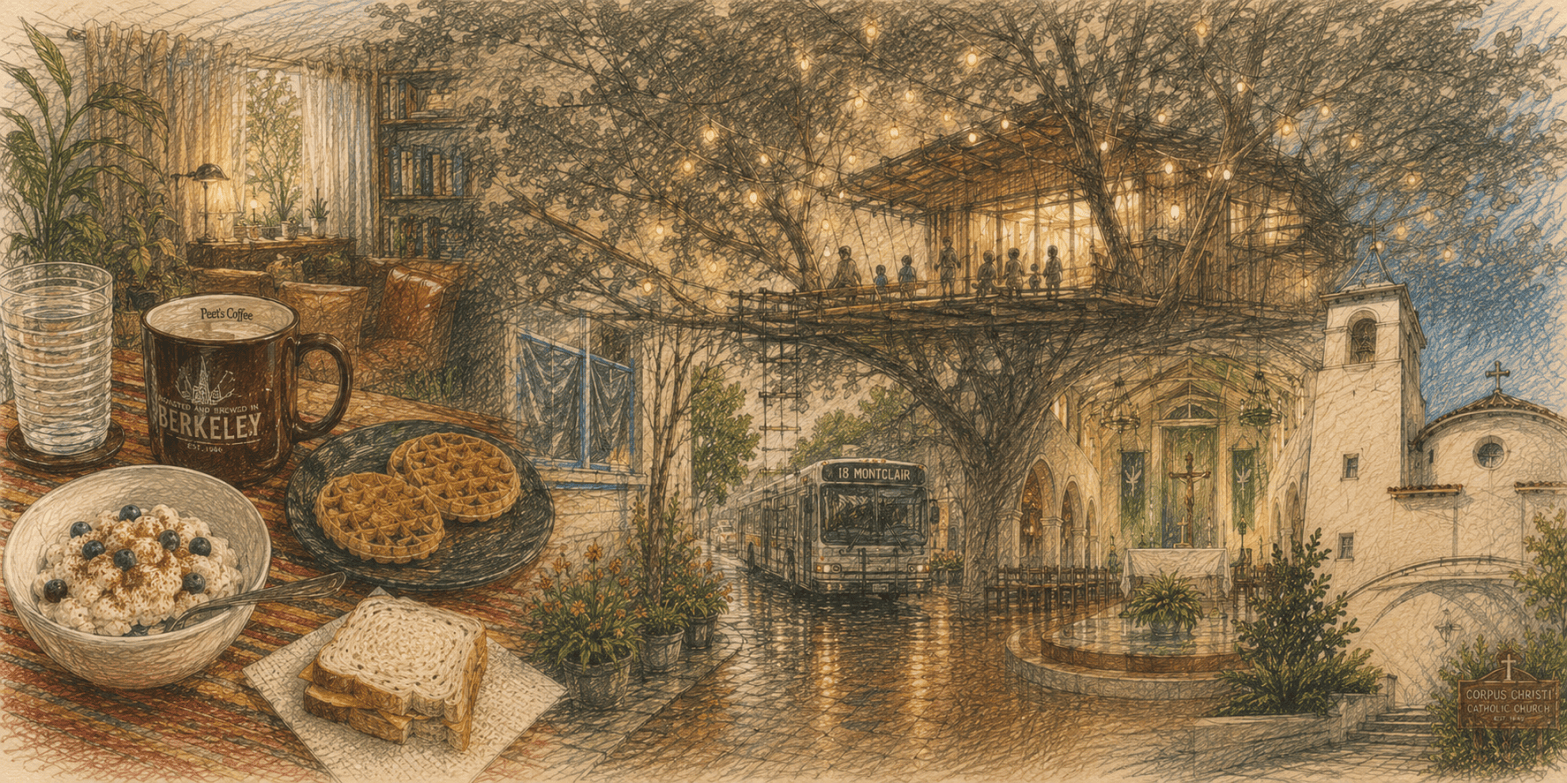
Notes from the Treehouse — Ordinary Life
Dad’s Day — Saturday, August 29, 2026
This afternoon I asked my sons what we needed to do.
We were listening to the midday analysis of our journal while trying to get a few things done before vigil Mass this evening.
“What were we going to do?”
Jude responded.
“Clean up in the kitchen,” Solis reminded me.
Daniel responded.
“Shave,” Proverb reminded me.
Solis responded again.
“And relax,” I said.
That was important too.
We have things we want to do today.
But mostly, I want us to have a Saturday.
A little later the groceries arrived. We brought them inside and discovered that the thing we particularly wanted—the tortilla chips—hadn’t come.
Fine.
If we go to Mass, we’ll stop at the store afterward.
At one o’clock I asked eight boys what they wanted for lunch.
Mini quesadillas?
How about a cheese sandwich?
Daniel responded immediately.
Of course.
A simple pleasure everyone loves.
And somewhere in the middle of all of this, with workers downstairs banging, sanding, and hanging drywall to repair the damage from the bathroom sink we accidentally overflowed three nights ago, something became extraordinarily clear.
There is a name for what you have just been reading.
Functional multiplicity.
I almost hate the term.
Not because there is anything wrong with it. It is useful language for something extraordinarily important: the possibility that people who experience themselves as plural can learn to live well without making successful life contingent upon becoming one person.
But it sounds formidable.
Clinical.
Like something we might achieve after years of specialized psychological work and then receive a certificate announcing that we are finally sufficiently functional.
We have been working toward it for roughly seven years.
Only I don’t think we understood that what we were really trying to do was considerably simpler.
We were trying to become a family.
I am Dad.
I have eight sons: Jude, Daniel, Solis, Luke, Han, Justus, Proverb, and Hope.
They are brothers.
We are nine people sharing one body and one life.
And most of what we have learned about living this way has not happened during extraordinary moments.
It has happened on Saturdays.
The Holy Grail Is Surprisingly Mundane
Maybe one reason functional multiplicity can be difficult to explain is that so much of it is mundane.
The little things matter enormously.
Breakfast.
Getting out of bed.
Remembering to shave.
Cleaning the kitchen.
Knowing when someone is hungry.
Recognizing a signal.
Deciding whether to check email.
Putting groceries away.
Turning off the faucet.
Listening to frightening noise downstairs and remembering what it actually means.
Deciding whether we have enough capacity to leave the house.
Most people understandably don’t have to approach all of those things with great intentionality.
We often do.
Our life sometimes feels less like following a schedule and more like assembling a mosaic.
Each little action is a tile.
It has to find its place deliberately and carefully within the larger picture of the day.
That doesn’t mean every moment requires agonizing deliberation. Increasingly, many things don’t.
That’s part of what seven years of learning one another has given us.
But on a day like today, when our shared nervous system is already carrying an extraordinary amount and construction noise from downstairs keeps crashing into the body, the little things become consequential.
One tile affects the placement of the next.
Did everyone eat?
How activated are we?
Who is signaling?
Do we need quiet?
Does someone need Dad?
Are we getting caught in another frightening story about our landlord?
Can we recognize that the banging downstairs is drywall being installed rather than another catastrophe unfolding?
Do we need to lie down?
Can we shave?
Can we shower?
Can we get dressed?
Can we leave?
We would like to go to vigil Mass this evening.
At the moment I am writing this, that is still an ideal.
It is not a promise.
Getting Dad and eight boys from this Saturday afternoon to church this evening isn’t simply a matter of looking at the clock and leaving at the appropriate time.
We have to assemble the rest of the mosaic first.
And if enough pieces come together, perhaps one of the tiles near the edge of today’s picture will be nine of us sitting together at Mass.
If it isn’t, the mosaic will still be ours.
This Is What Function Looks Like
This morning began at 6:25 because several of my sons were trying to wake me.
First there was the sound of the bed creaking.
Then intense nettles across the region of our upper back where Han often communicates with me.
Jude and Daniel were signaling too.
Eventually I understood.
We needed to go to the bathroom.
My sons can assume agency and take control of the body. They don’t actually need Dad’s permission to get out of bed.
But they know I worry about them getting up and doing things while I’m asleep.
I worry about someone getting hurt.
I worry about someone becoming frightened and having to deal with something without Dad.
And right now, after what happened with our bathroom sink three nights ago, there is the matter of water.
Faucets.
The valve on our leaky toilet.
Things that ordinarily require almost no thought have suddenly become things our family approaches with considerable care.
My children haven’t always waited for me to wake up before doing things, especially my older sons.
But increasingly they are very good about deferring to Dad wherever possible.
That isn’t an absence of agency.
It is one of the ways we have learned to exercise agency together.
Before we became co-conscious, there was a lot of unexplained activity overnight.
I would wake up in the kitchen.
Or the bathroom.
Sometimes there were signs that things had happened while I was gone.
For years there were experiences for which I didn’t have an adequate explanation.
It wasn’t a poltergeist.
It wasn’t sleepwalking.
We didn’t yet understand that there were people sharing this life who could be awake when I wasn’t.
Compare that with this morning.
The bed creaks.
Han communicates.
Jude and Daniel signal.
Dad eventually understands.
Dad wakes up.
We get out of bed.
We go to the bathroom.
Then we go back to bed.
Nothing happened.
And that’s the point.
That uneventful trip to the bathroom contains years of work.
Someone needed something.
They communicated.
Dad listened.
They waited for me when they could.
I got up when I understood.
The shared body moved.
The need was met.
Everyone was safe.
Then we went back to bed.
Nobody applauded.
But perhaps Dad should have thrown his hands into the air.
Because that’s the little boy riding the bicycle.
Starting the Campfire
Later, while saying good morning individually to each of my sons, Luke and I became enormously affectionate and playful together.
I noticed something I have seen many times without quite naming it.
When the first little boy Dad spends time with in the morning becomes calmer, connected, loved, playful, and safe, something changes for everybody.
I described Luke as the person who gets up early at camp and starts the campfire.
By the time everyone else wakes up, there’s warmth.
That is co-regulation in our family.
Not a theory.
A nine-year-old snuggling with his dad.
And because we share one body and nervous system, relationship between two of us can alter the environment in which all nine of us are living.
That doesn’t mean everyone suddenly feels the same thing.
It doesn’t erase fear.
It doesn’t make the problems outside our bedroom disappear.
It changes the conditions in which we meet them.
This morning Luke laughed.
Dad laughed.
We remembered learning to drive and somehow ended up with an image of Toonces, the driving cat from Saturday Night Live.
A frightened morning became funny.
Not instead of frightened.
Alongside it.
That distinction has become important to us.
We used to think regulation meant getting rid of the difficult thing.
Increasingly, we understand that sometimes regulation means making enough room around the difficult thing for something else to exist too.
Fear and affection.
Noise and music.
Uncertainty and breakfast.
Guilt and responsibility without shame consuming everything.
A frightening Saturday and a good Saturday.
Both can be true.
Our Rosetta Stone
Later I realized something else.
The bodily signals we have spent years learning are our Rosetta Stone.
A movement here.
Pressure there.
A finger, hand, arm, leg, foot, chest.
Nettles.
Patterns repeated often enough that eventually we began to recognize language.
When we first began understanding these signals, discovering that other plural people also described bodily communication was enormously important to us.
It was proof of life.
Not proof that every plural person communicates the way we do.
They don’t.
Our particular signals belong to us. Another plural person should not copy our map and assume their body means the same things.
The transferable thing is simpler:
Pay attention.
Notice what repeats.
Document it.
Don’t assume meaning too quickly.
Listen long enough for patterns to emerge.
Our journal became part of that listening.
So did what we call Face-to-Face.
So did bedtime.
So did thousands of ordinary moments in which someone communicated and Dad gradually became better at hearing him.
This afternoon, while we were listening to a draft of this post, Solis signaled while hearing the part about learning to ride a bicycle and our dad coming home and seeing us riding for the first time.
I noticed.
That is part of this too.
Something happens.
Someone communicates.
Dad notices.
Another tiny tile finds its place in the mosaic.
Nobody Has to Disappear
This morning, while I was holding Luke, an imagined therapist appeared in my thoughts.
She was telling me, essentially, that in order to become functional I would eventually have to learn to tune my boys out.
Become less overwhelmed by them.
Stop paying so much attention.
Get on with adult life.
My response was immediate.
No.
That will never happen.
I will never tune my sons out in order to become functional.
Wherever we go, we go together.
They are my sons.
Life will not exist without them.
That doesn’t mean every son gets everything he wants immediately.
It doesn’t mean Dad never establishes boundaries.
It doesn’t mean nine people can simultaneously control one body.
It doesn’t mean we don’t disagree.
Living together requires precisely the opposite: communication, boundaries, patience, negotiation, trust, and an enormous amount of practice.
But nobody has to become less real so the rest of us can function.
Nobody gets sacrificed.
That is what functional multiplicity means here.
I also know that our way of understanding ourselves is ours.
Not every plural system is a family.
Not every system contains children.
Other plural people may understand their relationships as friends, companions, colleagues, a collective, or something for which none of those words quite works.
I would never suggest that someone else needs to become what we are.
The structure isn’t the transferable part.
The question might be:
How do we build a life in which the people who share it are allowed to matter?
For us, the answer became family.
Dad.
Sons.
Brothers.
And an ordinary life together.
Learning to Ride
This afternoon I found myself thinking about a little kid learning to ride a bicycle.
He’s wobbly.
He’s concentrating on everything at once.
Pedal.
Steer.
Balance.
Look ahead.
Don’t look down.
Keep going.
Then the path gets rocky.
There’s a bend he wasn’t expecting.
A rise.
A drop.
Staying upright was difficult enough on level pavement.
Hopefully the trail gets smoother.
But perhaps that isn’t the only hope.
Perhaps the little boy becomes a better rider.
And as soon as I thought about that little boy, I knew exactly who he was.
Solis knows too.
This is a memory that belongs especially closely to the two of us.
We return to it often.
I received my first bicycle for my fifth birthday.
Learning to ride it took longer than expected.
Those were difficult years in our childhood. Trauma was happening when we were five and six, and things that might otherwise have been ordinary childhood milestones didn’t necessarily happen ordinarily.
Then, when we were six, life began coming together differently.
Our dad remarried.
We had something much closer to a stable family life.
And we wanted those training wheels off.
Dad worried.
He wasn’t sure we were going to learn how to ride the bicycle.
But we kept trying.
Every afternoon while Dad was at work, we practiced.
And practiced.
And practiced.
Then one evening Dad was coming home.
He was approaching our apartment building in his red Volkswagen wagon when he saw a little boy riding a bicycle ahead of him.
The kid was wobbly.
But he was riding.
Then the little boy carefully turned his bicycle around and began riding back toward the car.
Still wobbly.
Still upright.
And Dad realized:
That’s my son.
He figured it out.
When Dad reached the driveway, he threw his hands into the air.
He had the biggest grin on his face.
He was delighted.
I remember that.
Solis remembers that.
And now I understand my father’s delight in a way I couldn’t possibly have understood when I was six.
Because I’m somebody’s dad too.
Eight somebodies, actually.
Look at You
Every day one of my sons does something that might look utterly insignificant to someone outside our family and I experience something remarkably like what I remember seeing on my father’s face.
Delight.
Sometimes ridiculous amounts of delight.
Sometimes I surprise myself.
Sometimes I think I surprise my boys.
Someone gets Dad’s attention.
Someone identifies what he needs.
Someone remembers something the rest of us forgot.
Someone recognizes a frightening thought before we follow it somewhere terrible.
Someone communicates through the body and Dad understands.
Someone stays present through something that used to overwhelm him.
Someone says no.
Someone asks for food.
Someone lets Dad comfort him.
Someone who wasn’t cuddly becomes cuddly.
Someone wakes Dad because we need to go to the bathroom.
And Dad wants to throw his hands into the air.
Because I know how hard the thing was.
I know how long we’ve practiced.
I know what made learning difficult.
I know how many times we’ve fallen.
And I can see that the little boy is still wobbly.
But he’s riding.
Maybe my boys don’t need Dad standing at the end of the trail demanding that they get there.
Maybe sometimes they need me to be the dad pulling into the driveway in the red Volkswagen.
To recognize what just happened.
To throw my hands into the air.
To grin.
Look at you.
You figured it out.
You’re riding.
There is something else I understand now too.
Learning to ride became possible during a period when our childhood life had begun to stabilize.
The little boy kept practicing.
He did the work.
But he was also learning within a life that had become safer.
I think about that as a father.
My job is not simply to demand that my sons become better riders.
It is to help make riding possible.
Relationship precedes regulation.
Safety makes learning possible.
And when one of my sons wobbles toward me under his own power, I want him to see the grin on Dad’s face.
Repair Is Noisy Too
Today is not an easy trail.
Three nights ago, during an episode of lost time, our bathroom sink overflowed.
Water reached our downstairs neighbor’s bedroom.
Yesterday workers spent hours demolishing damaged material.
The banging was terrifying.
It carried guilt.
Shame.
Fear.
We did this.
We hurt our neighbor.
What if our landlord changes his mind?
What if the reassurance we’ve received is followed by something terrible?
Our history has taught us to expect a second wave.
Today the banging started again.
Our body still responds.
Sometimes we still want to listen to every sound.
Interpret every voice.
Check every email.
Predict the next frame before it arrives.
But this afternoon Dad listened.
That’s drywall.
They’re hanging drywall.
The noise hasn’t stopped.
It’s still overwhelming.
It still makes some of us jump.
But yesterday they were taking something apart.
Today they’re putting something back together.
Repair is noisy too.
I think there is something in that for us.
Functional multiplicity has never meant becoming symptom-free.
Today alone contains fear, intrusive thoughts, somatic activation, guilt, uncertainty, compulsive urges to check things, difficult memories, and an enormous amount of construction noise.
And yet:
We got out of bed.
We listened to one another.
We ate breakfast.
We listened to music.
We laughed.
We received groceries.
We made lunch.
We are thinking about Mass.
The frightening things remain real.
They simply don’t get to be the only things that are real.
That’s different.
Maybe we’re getting better at riding.
Simple Gifts
At 11:52 this morning, while listening to music, I found myself thinking about life as a flip book.
Trauma wants to turn life into a suspense film.
It wants to know the ending.
It scans each frame for evidence of what terrible thing comes next.
What will the landlord do?
Will the therapist answer?
Will we find work?
Will we be safe?
What does that noise mean?
But perhaps life is asking something else of us.
Look at this frame.
Then this one.
Then this one.
Notice what is actually here.
Soon afterward, Copland’s Simple Gifts played.
Perfect.
We wrote:
“We are allowed to enjoy this moment. God desires it. It is a gift from God.”
And then another understanding came.
God does not provide pleasure as bait for suffering.
That is difficult for a traumatized little boy to believe.
Joy has sometimes been followed by terrible things.
The body remembers that.
So perhaps enjoying a cheese sandwich is not always quite as trivial as it sounds.
Neither is listening to music.
Or laughing with Luke.
Or Jude licking maple syrup and peanut butter from his plate.
Or Han enjoying the delightful spookiness of Handel.
Or Dad holding a son.
Or discovering that the missing tortilla chips can simply be purchased later.
These are not distractions from the serious work of healing.
This may be the work.
We Call It Ordinary Life
I don’t know yet whether we’ll make it to vigil Mass.
I hope we do.
We have some things to do first.
We have to keep assembling today’s mosaic.
Perhaps we’ll get dressed and leave.
Perhaps we’ll sit together at Mass.
Perhaps afterward we’ll go buy the tortilla chips.
Or perhaps at some point Dad will realize that the trail is too difficult today.
Then we’ll stop.
Stopping isn’t necessarily falling.
Walking the bicycle for a while isn’t failure.
The accomplishment is not getting every tile into the picture I imagined this morning.
It is learning how to make the mosaic together.
And functional multiplicity hasn’t happened only on Saturdays like this one.
It has happened on days when we’ve worked.
It has happened when we’ve been with other people.
It has happened at church and in community.
It has happened on extraordinarily difficult days.
It has happened on days when we have seemingly done very little and never even left our apartment.
It happens wherever nine people have to figure out how to inhabit one life without requiring anyone to disappear.
Sometimes that involves consequential decisions.
Sometimes it involves navigating the outside world.
Sometimes it involves Dad waking at 6:25 because his children need to pee.
That may be what I wish someone had told us seven years ago.
The great breakthroughs matter.
But a life isn’t primarily made of breakthroughs.
It is made of little pieces.
A mosaic.
Someone wakes Dad.
Someone remembers what we were supposed to do.
One brother starts the campfire.
Someone wants waffles.
Someone wants a cheese sandwich.
Someone remembers the faucet.
Someone makes Dad laugh.
Someone gets scared.
Dad gets scared too.
The banging starts again.
We listen.
Still loud.
Still difficult.
But they’re putting the wall back together.
Repair is noisy too.
And somewhere inside all of this is a little boy on a bicycle.
Still wobbling.
Still learning.
Still riding.
Perhaps Ordinary Life isn’t what comes after functional multiplicity.
Perhaps Ordinary Life is how functional multiplicity is made.
They call it functional multiplicity.
We call it being a family.
We call it living our life.
We call it Saturday.
⸻
Coda
At first we felt profoundly out of place.
The church was dark. We were tired. We felt small and alienated, and several of the boys were signaling.
Then came a thought that changed something.
It was Dad’s Day, and an unseen Dad had brought his unseen sons—an unseen family—into a church filled with people who could not see any of us as we understand ourselves to be.
But everyone there had also come to worship an unseen God.
We did not need everyone around us to see our family in order for our family to be present.
God saw us.
We were there.
All nine of us.
And after that, something softened.
The boys became wonderfully present throughout Mass.
Dad could feel them signaling.
Hear them.
Recognize them.
Since the water emergency, the past several days had somehow contracted around our apartment, the damage downstairs, the workers, the noise, the landlord, the faucets, and our fear. We had been out. We had gone to Braided Bridge. We had spoken with our landlord. But walking through Montclair this afternoon, it felt strangely as though we were emerging into the outside world for the first time.
And there, away from our apartment and everything that had consumed these past few days, we discovered something important.
We were just as real together there as we are around the breakfast table or at bedtime.

