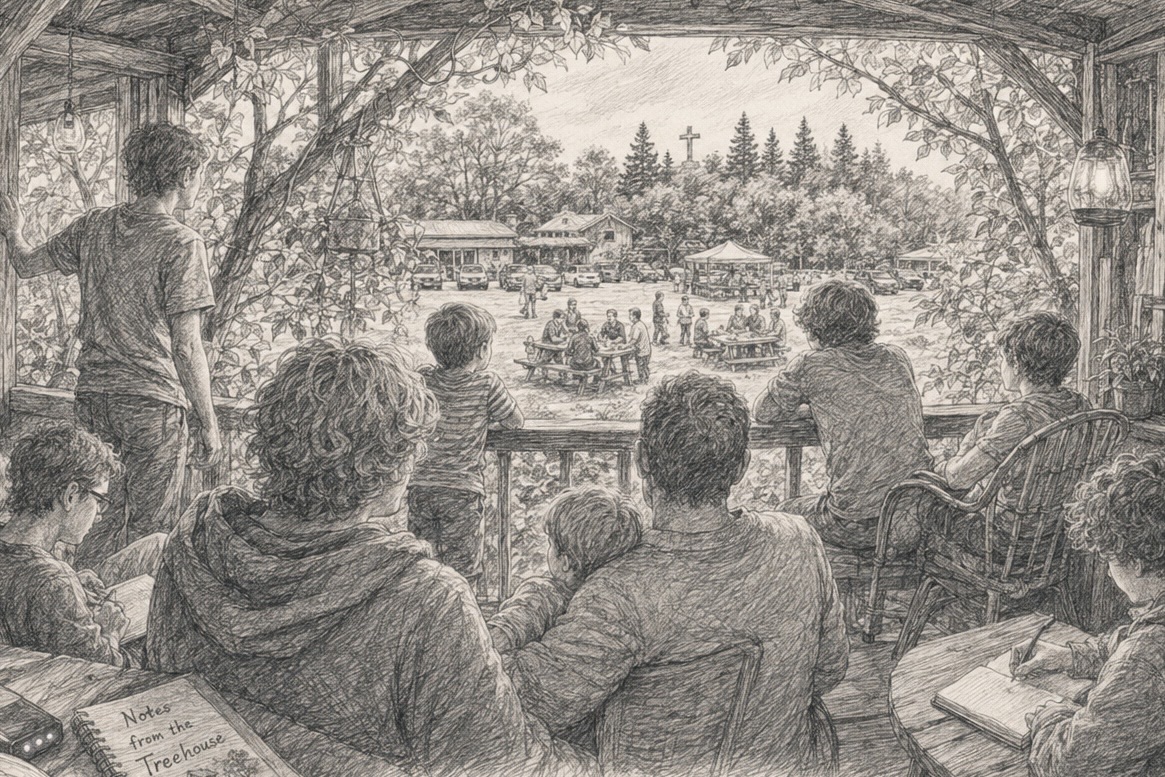
Notes from the Treehouse — Ordinary Life
Daniel’s Day — Monday, August 31, 2026
Yesterday was input.
Today is processing.
We have never articulated it quite that way before.
Yesterday nine of us went to Canticle Farm and St. Paschal Baylon.
Nine of us walked through the gardens and buildings. Nine of us encountered people. Nine of us listened to conversations about community, ministry, land, architecture, spirituality, relationships, possibility and what might come next.
Nine of us heard Kim thinking out loud in the car about ways we might someday contribute to the emerging vision around St. Paschal and Divine Mercy, perhaps even in a way that could help support us.
Nine of us talked with Andre at Canticle Farm.
Nine of us came home with something.
This morning we woke up and wondered:
What are we doing?
How are we going to become viable?
How are we going to survive?
Yesterday seemed filled with possibility.
Today we could barely make cinnamon toast.
There has been banging and ripping and pounding beneath us for hours as workers repair the water damage in the apartment downstairs. We can hear what we cannot feel and feel what we cannot hear. The noise travels through the building and through the body.
At one point we wrote:
We are extraordinarily overwhelmed right now, overloaded.
Later:
We are like a caged cheetah right now.
We tried to listen to yesterday’s blog post and couldn’t.
There was no listening.
There was too much happening.
So we plugged in all the little rechargeable LED lights.
We made a cheese sandwich.
We tried to stay together.
From the outside, yesterday might look productive and today might look like regression.
One step forward.
Two steps back.
Except maybe that isn’t what is happening at all.
Yesterday was input.
Today is processing.
Yesterday was an amazing day.
But sometimes the act of being able can result in a day of being not able.
Possibility can create expectations.
Being able to do something yesterday can create pressure to prove we can do it again today.
A glimpse of what might come next can very quickly become:
Now do something with it.
Make a plan.
Become viable.
Figure out how to survive.
For some of us, those expectations are not merely overwhelming.
They can become dangerous.
And that is another reason processing cannot be treated as the interruption between the important days.
Sometimes processing is the important day.
Nine People Heard Yesterday
This is one of the practical realities of functional multiplicity that we are only beginning to understand well enough to explain.
Nine people experienced yesterday.
We did not necessarily experience the same yesterday.
There is overlap, of course. We share one body. We were in the same places. We participated in many of the same conversations.
But we notice different things.
We bring different histories, interests, fears, abilities, sensitivities, desires and ways of understanding.
One of us may hear a practical possibility.
Someone else may notice a relationship.
Someone may understand something spatially.
Someone may hear the spiritual dimension of what another person is saying.
Someone may notice what isn’t being said.
Someone may become excited.
Someone may become frightened.
Someone may not understand what something meant until days later.
So after a day like yesterday, Dad cannot simply sit down the next morning, decide what happened, determine what it means, make a plan and call that our decision.
That would be efficient.
It would also be wrong for us.
Sometimes understanding comes quickly.
Sometimes meaning unfolds over our nine-day cycle, as each of us has his day and yesterday’s experiences appear differently in relationship with him.
Sometimes it takes longer.
We are all listening.
We are all contributing to our shared understanding.
That is not something we do despite being plural.
It is part of how we function because we are plural.
The world ordinarily expects a whole person to arrive with a reasonably coherent understanding of who he is, what he thinks and what he wants.
We have to create that coherence differently.
We do not become one person to meet the world’s expectation.
We do not change who we are in order to bring something comprehensible into the world.
We have to understand, as well as possible, who we are collectively so that what we bring into the world actually belongs to us.
Coherence is not sameness.
Integration is not erasure.
Wholeness is not singularity.
You Are Not the One
Somewhere in the middle of trying to listen to yesterday’s post, something began bothering us.
It felt narrator-centric.
Dad narrates a great deal of our journal.
Dad can write long passages. Dad provides continuity. Dad explains things. Dad is the adult. Dad parents. Dad carries particular responsibilities for the shared body and for our interactions with the outside world.
But Dad is not THE ONE.
There is no THE ONE.
That may be one of the most important things we can say about our experience of plurality.
None of us is the actual person surrounded by eight secondary people.
None of us is living the life on behalf of everyone else.
No one is a supporting character in someone else’s existence.
No one is a part of anyone else.
There are nine of us sharing one life.
Dad holding the pen does not make the story Dad’s story with eight supporting characters.
Dad being the adult does not make the body Dad’s body with eight passengers whose needs should be considered when convenient.
Dad has responsibilities the boys do not have.
That matters.
But responsibility is not supremacy.
Dad parents.
Dad protects.
Dad provides orientation.
Dad often narrates.
Dad carries adult accountability.
Sometimes Dad has to make a decision because someone has to make it.
But Dad does not own the life.
His responsibility is partly to help create the conditions in which everyone can participate in it.
Daniel Is Five
This becomes particularly important today because it is Daniel’s Day.
Daniel is five.
He can be shy.
He can be passive.
He can be frightened.
He does not necessarily force himself into a conversation and demand that everyone listen.
That means simply giving Daniel permission to speak is not enough.
If his life matters equally, sometimes someone has to go looking for what Daniel thinks.
What do you want?
Are you scared?
Would you like this?
Do you want to go?
Do you not want to go?
What are you noticing?
Are you with us?
A five-year-old must not merely be considered while the adults make the real decision.
For us, he has to be part of the thinking.
That does not mean Daniel carries adult responsibilities.
It does not mean a five-year-old makes every decision.
It means his needs, desires, fears, hopes and aspirations belong inside the process through which the family decides how the shared life will be lived.
This is different in an important way from a conventional multi-body family.
A parent can sometimes go somewhere while a child stays home.
Dad cannot go downtown while Daniel remains in his bedroom in another body.
If the body goes, Daniel goes.
If the body works, Daniel goes to work.
If the body walks into a frightening place, Daniel walks into the frightening place.
If the body spends eight hours in an environment that Daniel experiences as terrifying, Daniel does not get to leave the body and wait somewhere safe until Dad comes home.
That changes the ethics of decision-making.
Daniel cannot become an incidental consequence of Dad’s life.
Solis Has Something to Say Too
And then there is Solis.
Solis is seven.
He contributes enormously to our shared life.
He is especially attentive to our home, to routines, to safety, to what is happening around us and to the practical conditions under which the family lives.
But Solis can also be one of the voices we do not hear well enough until he becomes extremely angry.
Last week that happened.
We were thinking about work and money and viability.
About what comes next.
About what we might do.
About a business plan.
And Solis had a trauma-activated vision.
He took off his clothes.
“Is this your business plan?”
We do not remember the exact words anymore.
Maybe it was:
“Here’s your business plan.”
But we remember what it meant.
The body.
The body as something other people use.
The body as the thing whose value is determined by what it can provide.
There is violent childhood trauma underneath that response.
So conversations that may sound perfectly reasonable from the outside—
How are you going to support yourselves?
What kind of work can you do?
How will you become viable?
What is your plan?—
can collide with something much older for Solis.
Submit the body.
Make it useful.
Let someone else decide its value.
Prove that you deserve to exist by what the body can produce.
And when the body can no longer provide what is wanted from it, it can be thrown away.
Solis was telling us something.
Dad had been rushing ahead.
Repair.
Viability.
What comes next.
How quickly can we turn freedom into something productive?
How quickly can we prove that we can still function?
And Solis was saying:
No.
Not like that.
Baby steps.
Today makes his message even harder to miss.
Solis is especially concerned with our home.
And today our home feels vulnerable.
The apartment beneath us is being torn apart and repaired because of water that came from ours.
There is pounding beneath the floor.
Ripping.
Power tools.
Voices.
The body feels the vibration even when headphones keep us from hearing all of it.
And into that environment comes yesterday’s possibility:
What are we going to do with it?
The two things collide.
Home feels threatened.
The future demands an answer.
The old expectation says:
Make a business plan.
Solis is asking us not to do that yet.
Not because there will never be a plan.
Because first we have to understand what happened.
Yesterday was input.
Today is processing.
Nine people heard yesterday.
We cannot ask the loudest, fastest or most professionally experienced among us to decide what it means before everyone else has had a chance to arrive.
Especially the soft voices.
Daniel.
Solis.
The boys who may not interrupt until what they need to say has become impossible not to hear.
Who Haven’t We Heard From Yet?
This afternoon we had another unexpectedly good demonstration of this.
For weeks we had dreaded today.
Monday.
Our day off under our former employment arrangement.
And yet today there was a mandatory Mission Circle meeting downtown that we would have been expected to attend.
This afternoon, with the workers still downstairs and everyone overwhelmed, Dad suddenly began reminding the family:
We’re not downtown.
We’re free.
We’re free, boys.
We’re free.
And the family began responding.
Daniel.
Jude.
Solis.
Luke.
Han.
Justus.
Proverb.
Signals came rapidly enough that Dad could barely keep up.
And then Dad noticed someone.
Or rather, he noticed someone’s absence.
Hope?
Where are you?
We’re free, Hope.
Can you hear me?
Hope, tell Daddy where you are.
Eight people responding did not make the ninth person irrelevant.
The overwhelming majority did not settle the matter.
Hope’s absence was information.
We didn’t know what the information meant.
Maybe Hope was overwhelmed.
Maybe he needed more time.
Maybe something about freedom felt different to him.
Maybe he was simply farther away.
We didn’t know.
So Dad kept looking.
Finally:
Hope, right cheek.
There you are!
Stay close, Hope.
I love you.
That may be as good an explanation of functional multiplicity as anything we could write.
Not:
How many people agree?
But:
Who haven’t we heard from yet?
The Delightful Conversation About Anarchy
Over the past couple of weeks, our friend Kim has repeatedly returned to something her oldest child said to her.
“Mom, maybe you’re an anarchist.”
We love that.
Yesterday at Canticle Farm, the subject came up again, and we had an invigorating conversation with Andre about it.
The word anarchy can conjure images of chaos, destruction, disorder, everyone doing whatever they please.
That isn’t what Kim has been talking about.
The understanding of anarchy that has begun resonating with us is something much more beautiful: a non-hierarchical collaborative system organized around voluntary cooperation, mutual aid and self-governance rather than rulers and coercive authority.
We aren’t political theorists.
We are a Dad and eight boys trying to figure out how to live together.
But we recognize something in that.
Because coercion does not work well in our family.
It can produce compliance.
It can produce outward productivity.
It can make the body appear functional.
It can even make the world believe it is dealing with one remarkably capable person.
But somewhere underneath, someone may be disappearing.
Someone may be frightened.
Someone may be angry.
Someone may be silenced.
Someone may stop participating.
Eventually all of us live with the consequences.
The alternative is not chaos.
It is relationship.
Listening.
Cooperation.
Mutual responsibility.
Different roles.
Different capacities.
Active attention to quiet voices.
Consensus whenever possible.
Dad carrying responsibility without claiming supremacy.
We are not a family without structure.
We are trying to become a family without rulers.
And perhaps that sounds strange when one member of the family is literally called Dad.
But parenting does not have to mean domination.
Authority can be service.
Responsibility can mean making sure the person with the quietest voice does not disappear beneath everyone else’s certainty.
This understanding feels profoundly familiar to us as Vincentians, as Christians.
Again and again, the Gospel turns ordinary hierarchy upside down.
The greatest becomes the servant.
The child is brought into the center.
The overlooked person is seen.
Power becomes responsibility for one another.
Belonging does not have to flow downward from whoever happens to hold the most authority.
Everyone belongs first.
What Did We Actually Do Today?
This brings us back to the uncomfortable questions with which we began.
What are we doing?
How are we going to survive?
How do we become viable?
We lost our job.
There are practical realities that cannot be spiritualized away.
We need healthcare.
We need income.
We need to make decisions about money.
We need a computer capable of doing some of the work we hope to do.
And making a cheese sandwich, charging the LED lights, sitting with an overwhelmed little boy, processing what happened yesterday, writing this journal and giving ourselves enough time to understand what nine people experienced are not things we are doing while we wait for something to happen.
They are part of making something happen.
This sabbatical is not simply time off between jobs.
We may be discovering governing principles for the next twenty years of our shared life.
What kind of authority will we accept?
How will decisions be made?
What will we never again sacrifice in order to appear functional?
What does safety mean?
What does freedom mean?
What is the body for?
What kind of work can receive all nine of us without requiring anyone to become expendable?
Those are not idle questions.
They may be among the most consequential work we ever do.
There is no paycheck attached to today’s realization.
No employer would put on a timesheet:
Discovered a governing principle for the next twenty years.
But perhaps one afternoon spent discovering one of those principles can matter more than a month spent being conventionally productive.
What Is the Body For?
While listening to yesterday’s post, we kept hearing one line:
Can the body earn money?
And almost every time we heard it, another voice responded:
“That’s its purpose.”
That frightened us.
Because we know where that understanding came from.
Our history taught us in terrible ways that the body exists for other people to use, that other people determine its value, and that when it is no longer useful it can be discarded.
That is why Solis’s business-plan vision cannot be separated from the questions we are asking now.
Work can reproduce a less obvious version of the same belief.
What is the body for?
To work.
To perform.
To produce.
To earn money.
To pull it together.
Always pull it together.
For more than three decades, much of our shared life was organized around servicing work.
Being able.
Being useful.
Pulling it together.
Again.
And again.
And again.
But the body carries nine lives.
It eats.
It sleeps.
It worships.
It walks through gardens.
It makes cinnamon toast.
It gets frightened.
It notices architecture.
It writes.
It hugs people.
It listens.
It creates.
It serves.
It loves.
It earns money too.
We need it to.
But earning money cannot be its purpose.
Perhaps part of this sabbatical is discovering a form of livelihood that supports the life rather than consuming it.
Work has to serve the family. The family cannot exist merely to service work.
Maybe Yesterday Wasn’t Showing Us a Job
This is where St. Paschal keeps returning.
Yesterday, walking around that extraordinary property with friends, nobody handed us a job description.
Something much more interesting happened.
We encountered an ecosystem.
A place.
A community.
Buildings.
Land.
History.
Needs.
Relationships.
Ministry.
Architecture.
Spirituality.
Communication.
Formation.
Questions about what could happen there.
People carrying different pieces of a vision and trying to understand what those pieces might become together.
And our family began responding.
We know something about this.
And this.
And this too.
Someone notices physical space.
Someone understands relationships.
Someone sees systems.
Someone hears spiritual meaning.
Someone organizes.
Someone writes.
Someone imagines.
Someone notices what isn’t being said.
Someone remembers.
Someone asks whether the beautiful idea will actually work for the people who have to live inside it.
Our abilities are distributed.
So are our limitations.
Perhaps what we need is not another conventional position into which the body can be inserted.
Perhaps we need an ecosystem in which our peculiar distribution of gifts makes sense.
That doesn’t mean St. Paschal is the answer.
We don’t know that.
We don’t know what yesterday will become.
That is precisely the point.
Yesterday was input.
Today is processing.
Maybe yesterday did not show us a job.
Maybe it showed us another way work might someday be discovered.
Not:
What position can this person fill?
But:
What happens when the gifts that are actually here encounter needs that are actually here, among people already in relationship with one another?
That question feels very Vincentian to us.
Where is the need?
What has been given?
Who is already here?
What can we offer one another?
What grows when we meet?
And there is something else that happened at St. Paschal yesterday.
We were talking about the people who may be losing more than a parish building.
What happens to the people who have lost hope because their parish is going to close?
What happens when they believe the community itself is going to disappear?
Before anyone can build a vision on their behalf, those people have to be found.
Brought into the fold.
Encouraged to speak.
Invited to participate.
Their fears and hopes have to become part of what the community imagines together.
That sounds familiar.
Who haven’t we heard from yet?
The principle we are discovering inside our family may be very close to the principle we were talking about yesterday for a community.
You do not begin by arriving with the finished answer.
You begin by finding the people.
Listening.
Inviting.
Discovering what gifts are already present.
Making room for people who have stopped believing their voices matter.
Then something can be built together.
Six years ago, we were not the people who could have brought that understanding to a conversation.
Yesterday we could.
That matters.
Functional multiplicity is not only making it possible for us to survive our private life.
Ordinary Life is not merely helping us remain regulated enough to appear in public.
Who we are learning to become as a family—all of us present, all of us contributing, no one required to disappear—is changing what we are capable of bringing to other people.
Maybe that is part of what we brought to St. Paschal yesterday.
Not an answer.
An experience of what can happen when you go looking for the people who haven’t been heard.
Repair Makes Many Sounds
All day the apartment downstairs has been making terrible sounds.
Banging.
Ripping.
Power tools.
Things that sound like walls coming apart.
At moments it has felt almost unbearable.
Our body keeps interpreting the sounds as accusation.
You did this.
You caused this.
Something terrible is coming.
And then, around noon, Dad said something:
It’s the sound of repair.
Repair makes many sounds.
We are doing our own repair.
Perhaps that belongs here too.
For years we have described trauma recovery as plaster investment.
Something terrible happens, and then we build around it.
We protect.
We compensate.
We adapt.
We develop ways to keep functioning, ways to remain safe, ways to survive things we could not simply remove.
Layer after layer can accumulate around an injury until the recovery itself becomes an enormous structure.
That investment was not a mistake.
It helped keep us alive.
But eventually it can become difficult to distinguish the original structure from everything that had to be built around what happened to us.
Right now some of that investment is being carefully uncovered.
Not all at once.
We couldn’t survive that.
Little pieces.
Little steps.
One little thing.
And sometimes what is underneath surprises us.
Sometimes it is painful.
Sometimes beautiful.
Sometimes we discover that something we thought was part of the original structure was something we constructed because, at another time in our life, we needed it.
There had to be THE ONE.
The body existed to earn money.
Function meant appearing singular.
Leadership meant hierarchy.
Rest meant doing nothing.
A day of processing was a day lost.
Those were old understandings.
Some were taught to us.
Some were imposed upon us.
Some developed through trauma.
Some helped us survive.
Some helped us function in a world that expected something very different from what we actually are.
We do not need to condemn ourselves for having lived within them.
But they do not have to govern what comes next.
Now we can ask what still belongs.
And maybe underneath all that plaster investment we can discover something capable of supporting the next twenty years.
Yesterday we walked around St. Paschal imagining what might grow there.
Today we are sitting above a damaged room while people tear things out so that room can become inhabitable again.
We don’t know yet what our own reconstruction will look like.
We are still removing plaster.
We are still discovering the structure.
We are taking little steps simultaneously.
Healthcare.
Money.
A text to Greg.
A cheese sandwich.
A conversation with a son.
A blog post.
A possibility.
A prayer.
One little thing.
There is an enormous temptation after a day like yesterday to rush ahead of the repair.
To turn possibility into expectation.
Expectation into a plan.
A plan into work.
Work into proof that we are viable again.
But some of us are still figuring out what yesterday meant.
It does not need a business plan.
Not yet.
It needs community.
And for us, community begins here.
With nine.
Including some of the softest voices.
Including Daniel.
Including Solis.
Including Hope when everyone else is signaling and Dad suddenly realizes he cannot find him.
We can take the little steps while the larger meaning continues to emerge.
That is not doing nothing.
That is how we make sure whatever we build next actually has room for everyone who will have to live there.
We Are Still Listening
Maybe this is why possibility sometimes takes us longer.
Nine of us heard yesterday.
Today we are still listening.
Tomorrow someone else may understand another piece.
Perhaps the meaning will continue unfolding through all nine of our days.
Perhaps it will take longer.
That does not mean we are failing to move forward.
It may be how we move forward without leaving anyone behind.
We are not using this sabbatical merely to discover what we should do next.
We are discovering how we intend to live.
By the time the body speaks to the world, we hope it is not speaking for us.
We hope it is carrying something we have understood together.
And so perhaps one of the most important questions we can ask before deciding what yesterday means, what tomorrow requires, or where this strange new road is taking us is much smaller:
Who haven’t we heard from yet?
 Notes from the Treehouse