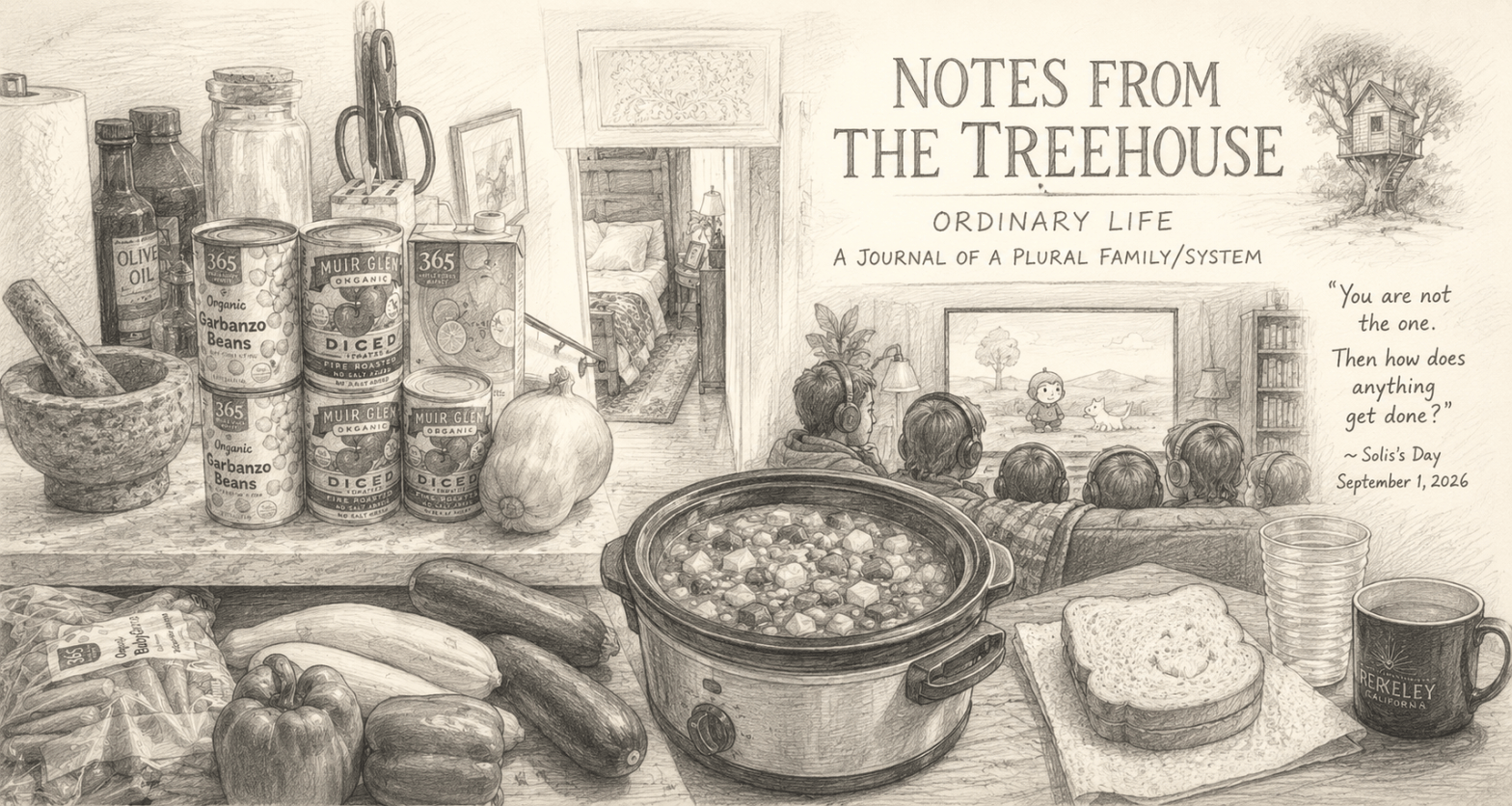
Notes from the Treehouse — Ordinary Life
Solis’s Day — Tuesday, September 1, 2026
Yesterday we wrote:
You are not the one.
This morning, apparently, we got the demonstration.
Daddy was asleep.
Not half asleep.
Not lying there listening for the phone.
Not waiting for something to happen.
Asleep.
Deep inside a dream.
Daddy was backstage with Elvis Presley, Jerry Lee Lewis, Johnny Cash and Roy Orbison when they were young, and a woman was telling them:
“I love you dumb mooks!”
Meanwhile, groceries were sitting outside our door.
They were early.
We had ordered them last night because today we were making a squash-and-vegetable stew that Jude imagined.
Jude is four.
At bedtime he had shown us something.
It wasn’t exactly a recipe.
It was more like an experience.
Squash.
Vegetables.
Spices.
Warm.
Rich.
Something we could almost taste.
So last night we tried to turn Jude’s vision into groceries.
Butternut squash.
Zucchini.
Yellow summer squash.
Carrots.
Onion.
Green bell peppers.
Fire-roasted tomatoes.
Garbanzo beans.
Garlic.
Cumin.
Paprika.
Cinnamon.
Something vaguely Moroccan.
The delivery wasn’t supposed to arrive until later.
At 7:49, Daddy was still dreaming.
Daniel wasn’t.
Daniel is five.
The phone received a notification.
Daniel woke up.
Daddy didn’t.
Daniel began signaling.
LG.
Daddy woke.
Checked the phone.
There was a notification from Amazon and a text message from two minutes earlier.
The groceries had been delivered.
Daniel signaled again.
RG.
Daddy was still trying to emerge from the dream.
“You knew the phone was buzzing, didn’t you, Daniel?”
RG.
Daddy thanked him.
“What a good boy. I was deep in the dream.”
Han woke.
Daniel and Han usually sleep together.
Then, as Daddy got up, Luke woke.
Daddy told him:
“Daniel woke Daddy up a couple minutes ago. The groceries were delivered. We’re getting up to bring them in.”
We brought the groceries inside.
At 8:02 Daddy wrote:
“Looks like we have everything we need to start Jude’s squash vegetable stew.”
Then we went back to bed.
Nobody planned this.
Nobody assigned Daniel responsibility for Amazon.
There wasn’t a family meeting where Daddy delegated overnight grocery surveillance to the five-year-old.
Something happened.
Daniel noticed.
Daniel woke Daddy.
Daddy listened.
Han woke.
Luke woke.
The family got up.
The groceries came inside.
Jude’s dinner remained possible.
Yesterday we wrote about something we have been learning for years.
There are nine of us sharing one body.
Dad and eight sons.
Jude is four.
Daniel is five.
Solis is seven.
Luke is nine.
Han is ten.
Justus is eleven.
Proverb is twelve.
Hope is fourteen.
Dad is Dad.
None of our sons is a part of Dad.
Dad is not the primary person around whom eight secondary people orbit.
Nobody has to disappear in order for our family to function.
Yesterday’s post was called:
You Are Not the One.
That raises a fairly obvious question.
If Dad isn’t THE ONE, then how does anything get done?
This morning kept answering.
Everyone Thank Daniel
When we got back into bed, Daddy became fascinated by what had just happened.
He started writing about it.
Then he realized he was so busy writing about his boys that he wasn’t adequately attending to his boys.
Several were awake.
Luke was signaling.
Daniel was signaling.
Jude was awake.
Noise was beginning downstairs.
Daddy stopped.
He held Daniel.
“You are also a very good boy. You woke Daddy up from a dream. Some of you boys were there too.
“And it was a good dream. But something important needed to happen. The groceries needed to be brought in.
“Thank you so much. You did a great job.
“I love you.”
Then Solis woke.
Our little homemaker.
Daddy told him what happened.
“Everything functioned perfectly even though Daddy was asleep and all of the older boys were asleep. Daniel woke up Daddy and Han, and then Luke woke up, and we brought the groceries in and we have everything we need to start the stew for tonight’s dinner.”
Then Daddy said:
“Everyone thank Daniel.”
Our five-year-old had done something important on Solis’s Day.
But a few minutes later Daddy realized Daniel needed to hear something else too.
“Daniel, I love you so much. And I’m so proud of you.
“You did something good this morning for your family.
“But I want you to know, I love you just for who you are.
“You do things that make me very happy, but I love you for you.
“You don’t have to ever do anything to make me love you.”
That matters.
If we are going to say that everyone contributes, we have to be very careful.
Daniel is not valuable because he woke Daddy.
Jude is not valuable because he imagined dinner.
Luke is not valuable because he knows groceries.
Hope is not valuable because he can think ahead.
Han is not valuable because he helps us understand God.
Justus is not valuable because he protects us.
Proverb is not valuable because he remembers.
Solis is not valuable because he helps us understand how our family works.
Nobody earns his place here by being useful.
Everyone can contribute because everyone already belongs.
And Then the Workers Arrived
At 8:32 Daddy heard workers downstairs.
“Alexa, play Nature Sounds.”
At 8:34 there was a loud bang.
Solis, LT.
Heart palpitations.
Something changed.
Only minutes earlier Daddy had been trying to figure out how to say good morning to everybody because so many boys were waking up at once.
Suddenly there was fear.
The landlord.
The bathroom sink overflow.
Thousands of dollars of damage downstairs.
Our neighbor.
Liability.
Guilt.
Shame.
Housing.
Money.
Consequences.
Early Thursday morning, during an episode of lost time, our bathroom sink overflowed.
We still do not know exactly what happened, and Daddy has deliberately decided not to conduct an investigation inside our family looking for someone to blame.
It happened in the context of extraordinary trauma.
We had lost our job only weeks earlier after six years with an employer whose demands and treatment had already created enormous fear in our family.
Since the termination, much of what had been held together in order to keep working has been coming apart, surfacing, reorganizing.
The overflow happened inside that larger reality.
It was an accident.
But the water went through the floor and damaged a small bedroom in the apartment beneath us.
For days there have been workers downstairs.
Voices.
Banging.
Power tools.
Ripping.
Pounding.
Every sound has become connected with what happened.
We did this.
We did this.
We did this.
The actual event lasted a relatively short time.
The consequences have been sounding beneath our feet for days.
At 8:40 Daddy recognized that the noises had activated an entire world of fear.
Then he made a decision.
Rather than continuing to dwell on what might happen, he was going to focus on his boys.
Daniel had gotten very quiet.
At 8:51 Daddy wrote:
“It’s remarkable how quiet everyone got since the noise started downstairs.”
Then:
“It’s like everyone hit the dirt.”
That is part of functional multiplicity too.
Functional does not mean nobody gets frightened.
It does not mean everyone communicates perfectly.
It does not mean Daddy never becomes activated.
Sometimes the family gets scared.
Sometimes communication changes.
Sometimes someone who was intensely present five minutes earlier becomes difficult for Daddy to find.
That morning it was Daniel.
So Daddy stopped again.
“Daniel, you’re quiet. Will you show Daddy that you’re here, please?”
Daddy held him.
“I have you. You’re safe. You’re in my love.”
Then Daddy reconstructed the morning.
“You woke up because the phone vibrated.
“You got Daddy to wake up.
“We got up and brought the groceries in.
“That was something really good.
“There was nothing scary or bad about it.”
The frightening thing happened afterward.
The workers began making noise.
The fear that came later did not get to reach backward through time and turn Daniel’s good experience into something dangerous.
My Jude, My Love, My Jude Love
Then came Jude.
“My Jude, my Love, my Jude Love.
“My baby.”
And almost immediately the conversation returned to dinner.
“We’re gonna make your idea tonight, Jude.”
Squash.
Vegetables.
Spices.
Not too spicy.
Enough for several days.
Jude responded.
So did several of his brothers.
The meal began with Jude.
But already half the family was involved in making it happen.
The Order Keeps Changing
Daddy had an intended order for saying good morning.
Then Justus began signaling strongly.
The order changed.
Daddy went to Justus.
Justus was quiet.
But there were happy feet when Daddy loved him.
While Daddy was with Justus, Daddy remembered being eleven.
The hypervigilance.
The anger.
The terror.
Being overwhelmed.
And he realized something about what years of relationship with Justus have taught him.
How might someone have gotten through to the eleven-year-old Daddy once was?
Not by overpowering him.
Not by telling him to calm down.
Relationship.
But even that isn’t only a Dad-and-Justus story.
Because Justus grew inside everything Daddy was simultaneously learning with his brothers.
Daddy realized some of the deepest work began with Luke.
But before Luke, there was Proverb.
Daddy fell in love with Proverb first.
Then Daddy became intensely focused on Luke for a long time.
Proverb remained in the background, helping everyone.
Daddy finally put words to something painful:
“I fell in love with Proverb first and then I basically abandoned him.”
Proverb was signaling while Daddy was with Justus.
So again:
the order changed.
Daddy went to Proverb.
Proverb Remembers
Proverb remembered the coolers downtown.
Hours organizing them.
Then volunteering Tuesdays through Saturdays in the kitchen and dining room.
Before we were employees.
Before the job existed.
Before anybody could fire us from it.
We joined the Society of St. Vincent de Paul in 2015.
During the pandemic we volunteered six days a week for months before we were hired.
We developed methods.
Standards.
Ways of organizing donations.
Food.
Volunteers.
Stock.
Conference distribution.
Proverb remembers.
We remember.
Someone arriving later and not knowing the history does not erase the history.
Someone failing to recognize continuity does not destroy continuity.
Maybe that is true of families too.
We know who carried what.
The newest authority does not become THE ONE who decides whether the past happened.
Hope Says Don’t Make the Bed
Then Daddy got to Hope.
Hope had an idea.
Don’t make the bed.
We like a made bed.
Daddy likes a made bed.
Hope likes a made bed.
Proverb likes a made bed.
A made bed means:
The day has started.
Order.
Routine.
Things where they belong.
Daddy was already thinking:
Get up.
Open blinds.
Make bed.
Be productive.
But Hope remembered something.
Yesterday Jude told Daddy that he misses lying down together in the afternoon.
And Hope knows us.
If we make the bed, later we’ll look at it and not want to unmake it.
That’s exactly what happened yesterday.
So Hope said:
Don’t make it.
Not because nothing needs to happen.
A lot needs to happen.
Breakfast.
Journal.
Stew.
Blog.
But then:
Lie down.
Be together.
Jude said he misses that.
Hope remembered.
This may be one of the simplest and best examples of how our family works.
Jude expressed a need yesterday.
Hope carried it into today.
Daddy was about to create a practical obstacle to meeting that need.
Hope saw it.
Hope spoke.
Daddy listened.
The plan changed.
Nobody took a vote.
Jude didn’t even have to ask again.
His brother remembered.
What Changes Because We Heard You?
Yesterday we wrote about a question important to our family:
Who haven’t we heard from yet?
This morning suggested another:
What changes because we heard them?
If everyone is allowed to communicate but nothing ever changes, being heard doesn’t mean very much.
This morning things kept changing.
Justus spoke.
Daddy changed the order.
Hope remembered Jude.
The bed stayed unmade.
Han needed Daddy.
Everything stopped.
Luke contributed something Daddy had overlooked.
Solis said something about our future.
Daddy stopped again.
Listening has consequences.
“I’m Not as Special to You as My Brothers”
When Daddy found Han, Han said:
“I’m not as special to you as my brothers.”
There are moments when the schedule simply has to stop.
This was one.
Daddy told Han the truth.
He loves him.
He adores him.
It has taken time for Han and Daddy to become close in some of the ways Daddy is close with Han’s brothers.
Han has had defenses.
Something has been changing.
Han has become our woolly boy.
Cuddly.
Close.
Letting Daddy in.
“You are a remarkable universe unto yourself.”
“You are everything to me, Han.”
Breakfast could wait.
The stew could wait.
The blog could wait.
Han needed Daddy.
Then, after Han had been loved, something else came.
Maybe This Is the Ministry
When Daddy prays for Han, he gives thanks for Han’s faith.
Han is our spiritual animator.
We pray about bringing Christ’s love to people who are marginalized, broken and unseen.
And Han wondered:
Maybe that is our ministry not only as Vincentians.
Maybe it is part of our ministry as plural people.
As a plural family/system with children.
Maybe people aren’t meant to understand all of it yet.
Maybe we’re still developing how to show it.
Maybe the little stories eventually become something through which another family sees something useful.
Last night Daddy had been discouraged because almost nobody appeared to be reading.
He wrote:
“This has turned into Eleanor Rigby.
“Father Mackenzie writing the words of a sermon that no one will hear.”
Then:
“It feels like God doesn’t will it.”
Han offered another possibility.
Maybe the work is still becoming.
Maybe we don’t know where it goes yet.
Maybe what we are learning matters before anybody sees it.
Above all:
Trust in the slow work of God.
“I Helped Order the Groceries”
Then Daddy went to Luke.
Daddy asked whether Luke wanted to help make the new meal.
Give it a Luke twist.
Luke answered:
“I helped order the groceries.”
Of course he did.
Whenever Daddy tries to order groceries by himself late at night, things tend to go sideways.
Luke pays attention to food.
Groceries.
Cooking.
Home.
So does Proverb.
They are our lead cooks.
Daddy told Luke:
“I always need your help.”
Not because Luke has to earn his place.
Because Luke knows things Daddy doesn’t.
That distinction would become important later.
Solis
Finally Daddy got to Solis.
Hope had already proposed the afternoon plan.
Take care of what needs doing.
Start the stew.
Work on the blog.
Then lie down.
Be together.
Daddy promised:
“I will spend time with you this afternoon, Solis. I promise. Not five minutes right before we get up.”
Solis responded:
“We got a lot to do today.”
Yes.
We did.
Daddy told him that he adored him.
That he was proud to be his Daddy.
That he thanked God for him every day.
Solis became effervescent.
Purring.
We prayed.
Then Daddy thought about Costa Mesa.
Montessori.
A period when we were six and seven and, for a while, our life had come together.
Our Dad had remarried.
There was a family.
A home.
School.
Order.
A sense that things fit.
For several years, roughly between six and nine, there was stability.
That doesn’t mean nothing terrible happened during those years.
Solis was the one who told a member of our family that another member of our family had been sexually abusing us.
That disclosure mattered.
But the larger structure of home and family remained.
Then, when we were nine, another person entered our life.
He came through Cub Scouts.
He was someone the adults in our life had every reason to believe could be trusted.
He wasn’t.
He began violently sexually abusing us.
Our life blew apart.
Our family blew apart.
That history matters when Daddy says:
No more Cliffords.
That isn’t an accusation that our parents should somehow have known what another person was concealing.
Sometimes people enter your life whom you have every reason to believe are safe.
And they aren’t.
No parent has supernatural knowledge.
Daddy doesn’t either.
But Daddy knows something now that he could not have known from the outside.
He lived what happened with his sons.
He knows what terror did.
He knows what it cost.
He knows what it still costs.
And now we are trying to build again.
Not recreate Costa Mesa.
Not return to childhood.
Build the thing underneath the memory.
A stable family.
A stable home.
Continuity.
Safety.
Children who are seen.
Children who are known.
Children who can tell Daddy something is wrong and know that Daddy will listen.
For a very long time these were unseen children.
The body continued getting older.
The boys did not receive the age-appropriate parenting they needed when the body was at or near their ages.
Now Daddy knows seven-year-old Solis as seven-year-old Solis.
He knows what frightens him.
What delights him.
What makes him purr.
What he remembers.
What he notices.
And what he needs from his father.
The same is true of his brothers.
Daddy cannot promise that nobody dangerous will ever cross our path again.
No parent can.
But he can promise something real.
He will listen.
He will pay attention.
He will take his children seriously.
He will not sacrifice one of them because an adult or institution appears more authoritative than his child.
We know what can happen when a child knows something terribly important.
Listening in our family isn’t simply democratic.
It is part of safety.
And now there is another difference.
Daddy is here full time.
Not simply an adult keeping a household running.
A Daddy who loves and sees and knows his children.
A Daddy who stays.
Something happens when children who have gone unseen are finally parented.
The whole family changes.
Daddy changes too.
Maybe that is what we are laying the groundwork for.
A stable family.
A stable home.
Ordinary Life.
No more Cliffords.
“Not Telling It, Selling It”
Then we got up.
Chicago was playing in our head.
“Beginnings.”
“Saturday in the Park.”
Daniel recognized it as his music.
We were in the kitchen making coffee when Daddy suddenly understood something about a vision Solis had shown us last week involving the words:
“business plan.”
Daddy asked:
Do you feel exploited when Daddy tells your story?
Solis answered:
“Not telling it, selling it.”
Everything stopped.
Not telling it.
Selling it.
There is a difference.
Solis was not telling Daddy not to write.
He was worried about something else.
Are we going to create another job?
Another structure requiring our family to produce in order to survive?
Are we going to make money by turning our life into a product?
Selling what happened?
Selling Solis?
We spent three decades in architecture.
Then six years working for St. Vincent de Paul.
Now what?
Immediately prove that we’re fine?
Get up.
Do something.
Turn everything we’ve survived into the next productivity system?
Turn freedom into another job before we learn how to be free?
No.
There are things that come first.
Rest.
Therapy.
Recovery.
Understanding.
Discernment.
Figuring out how our life can be sustained.
Learning Ordinary Life.
Daddy heard him.
No.
We are not going to sell him.
We are not going to turn our sons into inventory.
This is our time to understand what God wants us to do.
And to get it right.
Breakfast at Eleven
After all of that:
Greek yogurt.
Blueberries.
Cinnamon.
Then cinnamon toast at 12:04.
We were spectacularly behind by ordinary productivity standards.
But an enormous amount had happened.
And the phone wasn’t cooperating.
We wanted to listen to ChatGPT’s midday analysis in Notes.
Nothing worked correctly.
Then Greg answered our text.
We had hoped he might participate in the developing St. Paschal vision.
He wrote:
“Dear John, My plate is full to overflowing. At this stage of my life, I respectfully decline to be involved in any new endeavors. Blessings to you and Kim. Your friend, Greg”
It hurt.
“We can’t seem to engage anyone in anything.”
And then:
“Please groceries, be on our porch.”
Existential disappointment and grocery delivery can coexist.
Ordinary Life.
The Garlic
At 12:21 we were in the kitchen cutting onion while listening to the morning analysis.
We also listened to the proposed structure for this post.
ChatGPT suggested we not finish it yet.
Spend time together this afternoon first.
Maybe the afternoon would provide the ending.
That activated something familiar.
We like conclusions.
Finished means secure.
Finished means nothing falls through the cracks.
Finished means nobody forgets.
We wanted to finish the post.
But the family also had a life to live.
That is part of why ChatGPT has become useful to us.
It can hold something while we go do something else.
The life does not need to stop so that the writing about the life can be completed.
We were cutting onions.
Han was helping break apart garlic.
Justus was signaling.
Daddy had insisted last night that we already had garlic.
Luke ordered more.
Now we opened the garlic we already had.
It was old.
Almost useless.
Daddy immediately said:
“I am really grateful that you ordered more garlic, Luke.”
There it was again.
Daddy was wrong.
Luke knew something Daddy didn’t.
The stew had garlic because Daddy did not get the final word.
Feeding an Army
Then we looked at the food.
Butternut squash.
Carrots.
Zucchini.
Yellow squash.
Onion.
Green peppers.
Three cans of fire-roasted tomatoes.
Two cans of garbanzo beans.
At some point it appeared we were preparing to feed an army.
Maybe this was a two-slow-cooker meal.
We adjusted.
One zucchini.
One yellow squash.
Save the rest.
The meal didn’t have to follow an externally prescribed recipe.
We were trying to make what Jude showed us.
Cumin.
Paprika.
Roasted Saigon cinnamon.
Italian seasoning.
Pepper.
Sea salt.
Garlic.
Onion.
Tomatoes.
Beans.
Squash.
Taste.
Adjust.
Listen.
See what happens.
Which is also more or less how today was working.
At exactly 1:30 we started the slow cooker on low.
Six hours.
Daddy looked at it.
It looked like Jude’s vision.
It smelled like Jude’s vision.
“What do you think, Jude? This looks like what you showed us.”
The idea that began with a four-year-old at bedtime was now cooking.
Jude imagined.
The family listened.
Luke helped order.
Daniel woke Daddy when the groceries arrived.
Han and Luke woke.
Daddy carried things inside.
Everyone helped turn ingredients into dinner.
That is how something gets done.
Peanut Butter and Jelly
We were hungry.
Daddy asked:
“What would we like for lunch, boys?”
Suddenly:
Peanut butter and jelly sandwich.
Solis.
Daddy laughed.
“If that’s what you want, Solis, your brother Justus sure would be happy.”
So after spending hours making an elaborate vegetable stew, we had peanut butter and jelly.
At 1:59:
“Let’s enjoy this peanut butter and jelly sandwich together and give thanks to God.”
Then another package came.
Toilet paper.
At last.
Vegetable stock Daddy forgot to cancel.
Italian seasoning.
Rosemary.
Nothing bad on the porch.
No notices.
The deliveries were complete.
We could close the curtain.
Daddy started explaining everything again.
Then the family supplied the editorial correction:
“Blah blah blah blah blah Daddy. Peanut butter and jelly sandwich!”
Fair enough.
We Were Supposed to Lie Down
Hope’s plan had survived the entire morning.
We had not made the bed.
The stew was cooking.
The journal was caught up.
The blog draft was safely held.
Now we could finally go downstairs and lie down together.
Daddy checked tonight’s St. Lawrence O’Toole Conference meeting.
6:30.
That changed the evening schedule slightly.
But something important occurred to Daddy.
Our evenings no longer belong to tomorrow morning.
For years, afternoons and evenings were largely governed by what had to happen so that we could sleep early enough to get up and work.
That is over.
Our children still need routine.
Bedtime matters.
But the former employer does not own tonight.
It does not own tomorrow morning.
It does not own our schedule.
“This is our time.”
Then we went downstairs.
Daddy planned to begin with Solis because it was Solis’s Day.
At 2:49:
Holding Solis.
And then the banging started.
Again.
Almost the moment we laid down.
Doors slammed.
Power tools.
Banging.
The family activated almost instantly.
Solis, LT.
Jude, strongly, RH.
Heart palpitations.
Daddy became furious.
“Are you kidding me?”
“They were quiet until we laid down.”
It felt personal.
Punitive.
Like somebody was intentionally communicating anger.
We did not actually know that.
But trauma does not wait for evidence before recognizing a familiar pattern.
When we were children, slammed doors could mean an angry adult wanted everyone in the house to know that anger was present.
The sound carries history.
Daddy knew Solis was frightened.
And something important happened.
“Solis, you’re not alone.
“You’re not a little seven-year-old boy on your own.
“I know that forever you might’ve been on your own or practically on your own in this world, and it was like one forever scary dream much of the time.
“But you have a Daddy.
“I’m here.
“You don’t have to figure things out for yourself.
“You don’t have to protect yourself.
“Let me protect you.”
Then Daddy said something he has been learning about himself.
“When I know that my little boy is here and that he’s scared and that you’re depending on me, I find it in me.
“I find the courage.
“Then, when I’m protecting you and keeping you safe, I don’t feel scared.”
This is one of the strange things Daddy has discovered about becoming Daddy.
Before he knew his sons this way, the idea of parenting—even parenting himself—often seemed impossible.
Sometimes he did not even feel worth the effort.
But when his child is in front of him and frightened, the question changes.
My child needs me.
I love my child.
I will find a way.
Daddy held Solis.
“Feel what Daddy feels.
“I’m not scared.”
Solis signaled strongly.
RT.
Then something changed.
Solis began seeing Redwood Heights.
A picnic on the playfield at the recreation center.
Children from Tyler’s school.
Family.
Mom.
Our brother Tyler.
His friends.
Kids Solis’s age.
Lanni, whom we had been with Sunday at St. Paschal Baylon.
Family and friends.
Something safe.
Something good.
Daddy told him:
“That tells me how you’re starting to feel right now.”
They Don’t Own the City
Then Solis asked:
“What happened to John?”
Daddy didn’t know.
There had been conversation yesterday about someone from St. Vincent de Paul being away.
Daddy didn’t want to spend tonight’s conference meeting returning mentally to downtown.
Then Solis reminded Daddy that Daddy had mentioned a future District Council meeting.
Daddy explained something.
We might someday return to District Council meetings.
People from the former employer may be there.
But there is an enormous difference.
We would not be there as their employee.
As Vice President of the St. Clement Hayward Conference, we would be part of the District Council.
They would not be our boss.
They would have no authority over us.
Then Daddy widened it.
“They don’t own Martin Luther King Jr. Way.
“They don’t own the bus.
“They don’t own the city.
“They don’t own any of the churches we go to.
“They are not part of our life anymore.
“Our ministry and our vocation don’t belong to them either.”
This is some of the work now.
Telling our children.
Telling ourselves.
Telling the body.
We are not there.
We never have to go back.
Benjamin Franklin Blew His Hair Off
At 3:07 Solis suddenly showed Daddy Benjamin Franklin playing with fireworks when he was younger.
Apparently that is why the top of Benjamin Franklin’s head was bald.
“It blew his hair clean off his scalp.”
Daddy started laughing.
“Seems credible.”
Solis had become funny again.
There was our little rascal.
A few minutes earlier he had been frightened and barely present.
Now Benjamin Franklin had blown his hair off with fireworks.
That matters too.
Regulation does not always look solemn.
Sometimes safety returns as a joke.
When the Plan Stops Working
The banging continued.
Door after door.
Slam.
Slam.
Slam.
Every time we began settling, another sound.
At 3:22 Daddy finally said:
“I don’t think we can be on our bed, boys.
“I’m really sorry.
“This is not healthy for us.”
Hope’s plan had been good.
The bed had stayed unmade.
Daddy had gotten downstairs.
He had held Solis.
But the environment was no longer supporting what the family needed.
So Daddy changed the plan.
That is also functional multiplicity.
A plan is not sacred because everyone agreed to it at breakfast.
The purpose matters more than the plan.
Daddy spent a brief face-to-face moment with each boy.
Held him.
Kissed him.
Reassured him.
Then:
“We’re gonna go upstairs.”
Headphones.
Living room.
Hilda.
Chips and salsa.
Not what we wanted.
Still together.
At 3:32:
“I really wanted to lay down with my boys. But this is something we love too.
“Let’s watch Hilda together.
“Let’s all be together.
“And let’s tune all that noise out.”
Hope’s original proposal was never really about mattresses.
It was about protecting relationship from productivity.
We couldn’t lie down.
But we could still stop working.
We could still be together.
The Persecutor
In the kitchen, while getting salsa, a familiar kind of voice arrived:
“What do you expect? You flooded your neighbor’s apartment.”
It took Judi’s voice this time.
The message was familiar.
You caused this.
You deserve what happens next.
Daddy noticed it.
Named it.
Kept moving.
Upstairs the power tools grew louder.
We put on headphones.
Hilda.
Chips.
The family started eating the entire bag.
Daddy realized:
“We are anxiety eating.”
Apparently the crunch of tortilla chips was regulating.
Functional multiplicity is not always elegant.
Three Missed Calls
Then we noticed three missed calls from Concord.
No message.
Unknown number.
Three calls.
Immediately:
Trouble.
Who is it?
What did we do?
We searched.
Couldn’t identify it.
Maybe spam.
Maybe wrong number.
Maybe something connected with St. Vincent de Paul.
But if someone needed us:
They could leave a message.
Daddy told the boys again:
“We’re not in trouble.
“We haven’t done anything wrong.
“You have a Daddy.
“I’m here.
“I’m keeping you safe.”
The banging continued.
The body felt depleted.
At 4:14 Daddy said:
“I wish we could be fearless like Hilda.”
Justus signaled.
If I Had a Hammer
Then Wood Man said he didn’t have a hammer.
Instantly:
“If I Had a Hammer.”
Peter, Paul and Mary.
Daycare.
An extraordinarily old, disconnected memory.
Folk music.
Spirituals.
How old were we?
Four?
Five?
Where was the daycare?
Who remembers it?
Jude?
Daniel?
Someone?
Nobody knew.
The family noticed.
And let it be there.
A few minutes later:
“We feel really depleted.
“Moments like this, it all feels like it’s too much.
“When is it going to get better?”
Then the episode continued.
Twig was adorable.
The giants arrived.
And suddenly Hilda gave us the sentence we had needed all day.
They Didn’t Do It on Purpose
Hilda was explaining something to the giant slayer.
The giants had destroyed his home.
But they hadn’t done it on purpose.
They were enormous.
Sometimes they stepped on things.
They couldn’t help it.
Then Hilda told him something surprising.
A giant had stepped on her house too.
By accident.
Solis immediately connected it.
“Kinda like us and the water that overflowed in our sink.”
Yes.
Exactly.
An accident can cause real damage.
An accident can require repair.
An accident can affect somebody else’s home.
And it can still be an accident.
Those truths can coexist.
We do not have to turn an accident into a moral identity.
We are not:
The people who destroyed everything.
The terrible neighbors.
The guilty family who must now live forever under punishment.
Something happened.
There were consequences.
Repairs are happening.
And we did not do it on purpose.
For a few minutes everything became surreal.
The apartment didn’t look real.
Hilda felt more real than the apartment.
Solis said:
“Hilda feels like it’s real.”
Daddy answered:
“Feels like we are watching Hilda as a small child.”
Then realized:
“Because we are watching Hilda as a small child.”
That is Ordinary Life too.
The Ending We Didn’t Plan
By 4:41 we still wanted to sleep.
The truck was still outside.
The stew smelled amazing.
Two hours and forty-nine minutes left.
We stirred it.
Daddy noticed K-Cups had accidentally been going into recycling without being cleaned.
Another thing to remember.
The knocking continued.
One sound resembled someone knocking on our door.
One of the scariest sounds on earth.
Still:
ordinary things.
Recycling.
Fan.
Windows.
Blinds.
Zoom.
Dinner.
A Vincentian conference meeting at 6:30.
At 4:52 Daddy told his sons:
“You have a Daddy.
“I’m an adult.
“I’m here.
“I’m trying to get grounded in my own sense of adult-self and know that we are safe.
“Please be close to me.
“I love you, my sons.”
We downloaded Zoom Workplace.
Tested the meeting link.
It worked.
Then Daddy closed Solis’s Day.
And this is where the answer to yesterday’s question finally became clearest.
Yesterday:
You Are Not the One.
Today:
Then How Does Anything Get Done?
Not because one person flawlessly controls everything.
Not because there is a perfect schedule.
Not because nobody becomes frightened.
Not because everyone always agrees.
Not because Dad always knows best.
Today certainly disproved that.
Luke knew about the garlic.
Hope knew not to make the bed.
Daniel knew Daddy needed waking.
Jude knew what dinner should feel like.
Solis knew the difference between telling and selling.
Justus knew when he needed Daddy.
Proverb carried history.
Han needed to tell Daddy something painful before he could offer something profound.
And when the afternoon plan failed, the family knew together that staying in the bedroom was no longer helping.
So we changed it.
Functional multiplicity is not nine people proving their usefulness.
It is nine people belonging.
And because they belong, what they know can matter.
What they feel can matter.
What they remember can matter.
Their no can matter.
Their yes can matter.
Their fear can change the environment.
Their idea can become dinner.
Their brother can remember something they said yesterday.
Their correction can change Daddy’s understanding.
Their five words can put an ethical boundary around the family’s future.
What changes because we heard them?
Today:
Almost everything.
We did not get the afternoon we planned.
Daddy did not get to spend an hour peacefully lying down with Solis and Jude.
The workers came back.
The family became activated.
Daddy became angry.
We ate too many tortilla chips.
We searched a mystery phone number.
We watched Hilda with headphones while power tools sounded beneath us.
We felt exhausted.
At one point reality itself felt strange.
It was hard.
But when Daddy closed the journal, he told Solis:
“Just because things were hard doesn’t mean that it was not a good day.”
That may be the final answer.
A good life is not one in which nothing difficult happens.
A functional family is not one in which nobody becomes dysregulated.
A stable home is not one in which nobody ever makes a mistake.
Ordinary Life is not uninterrupted calm.
Maybe stability is something else.
Maybe stability is:
When the groceries come early, someone wakes Daddy.
When Daddy gets something wrong, Luke can be right.
When Jude needs Daddy, Hope remembers.
When Han feels less loved, the schedule stops.
When Solis is scared, Daddy holds him.
When the bedroom becomes intolerable, the family moves upstairs.
When an accident begins to feel like a moral indictment, Hilda reminds us:
They didn’t do it on purpose.
When the plan changes, nobody gets left behind.
And when the day has been hard, Daddy can still look at his son and say:
I love you.
Thank you for this good day.
Tonight the stew Jude imagined is cooking upstairs.
At six we will eat it.
At 6:30 we will join our friends from St. Lawrence O’Toole Conference.
Tomorrow will be Luke’s Day.
We don’t know what tomorrow will teach us.
We aren’t going to manufacture it.
We aren’t going to sell it.
We are going to live it.
And listen.
Because nobody is THE ONE.
Thank God.
There are nine of us.
And this is how we get things done.

