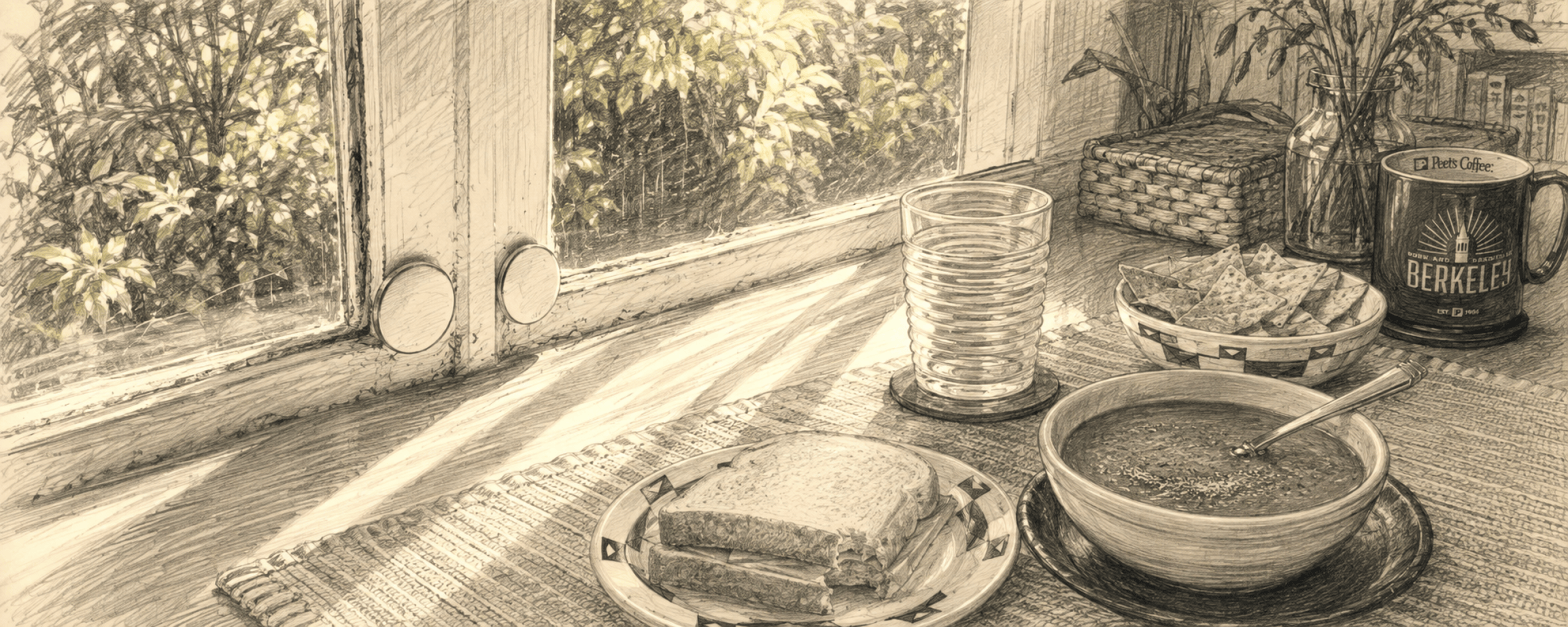
This morning we opened the blinds in the dining room.
The magnets that hold them against the steel window frame had to be put back into place. We noticed the flaking paint. We noticed the rust.
And something was different.
Nothing about the apartment had changed. Nothing had been repaired overnight. The uncertainty surrounding our life had not disappeared. We do not know exactly how we will support ourselves going forward. We do not know what will become of the work we are creating. We do not know what our life will look like six months from now.
But standing there at the window, none of that was happening.
There was the old steel frame.
There was the rust.
There was the sunlight.
There was our home.
And it felt concrete.
But it felt restful.
That is unusual enough for us that we noticed it immediately.
It wasn’t a Terror Peek.
Terror Peek
Terror Peek is our family’s name for an experience that is difficult to describe to someone who has never experienced it.
It is not a clinical term. We don’t presume that every plural person, or every person living with dissociative identity disorder or PTSD, experiences what we experience.
But perhaps someone does.
And perhaps that person has never known how to describe it either.
For us, a Terror Peek is a sudden collapse of protective distance from the present moment.
The room becomes overwhelmingly the room.
The body becomes overwhelmingly the body.
The physical surroundings become overwhelmingly concrete.
There can be a terrible awareness of here.
Of now.
Of the sheer fact of existing in this body, in this place, at this particular moment in time.
There is nowhere psychologically to stand back from it.
The present becomes so immediate that it can become terrifying.
This is not the life of the worried well.
There are periods when ordinary life requires extraordinary effort from us. There are nightmares, panic, dissociation, bodily terror, disorientation, memories, overwhelming sensory experiences, periods when the outside world feels almost impossible to inhabit, and periods when maintaining the relationships within our own family while simultaneously meeting the requirements of the outside world consumes nearly everything we have.
We have times where the terror is not philosophical or metaphorical. It is physical. Immediate. The body floods with alarm while nothing visibly dangerous is happening in the room.
We have times where getting out of bed is an accomplishment.
Times when leaving home is an accomplishment.
Times when staying home is an accomplishment because it means refusing to force ourselves through something the body cannot safely sustain.
Times when eating breakfast, closing the blinds, taking a shower, making dinner, holding one of our children, or getting everyone tucked into bed constitutes the actual work of the day.
We are a plural family of nine people sharing one body: eight children and one adult.
And sometimes simply being here is hard.
We don’t want to make that beautiful.
We don’t want to turn trauma into an inspirational story in which suffering exists mainly so that someone can demonstrate resilience afterward.
We know something about resilience.
We have written about the crater and the tree.
A tree surviving the atomic bombing of Hiroshima does not give permission for the bombing.
A child surviving what should never have happened to a child does not make what happened acceptable.
And whatever grows from suffering does not retroactively make the suffering necessary.
But something can still grow.
When the World Became Quiet
During the COVID-19 pandemic, something happened to our family that we did not fully understand until much later.
The pandemic did not create our plural family.
It did not heal our trauma.
It was frightening, destructive, isolating, and deadly for millions of people. Nothing we discovered about ourselves requires us to turn catastrophe into blessing.
But the pandemic accidentally changed the environment around us at precisely the time when our family was becoming increasingly co-conscious.
The roads emptied.
Traffic diminished.
Stores became quiet.
We traveled on empty buses.
Airplanes disappeared from the sky.
Schedules loosened.
Crowds vanished.
The world slowed down.
And in that strange quiet, we could hear one another.
Increasing co-consciousness had made life more truthful, but also more demanding.
Dissociation hides things.
Co-consciousness reveals them.
More of our children were continuously present.
More emotions could be felt.
More memories became accessible.
More relationships needed attention.
More people were experiencing the same outside world through one body.
And then, almost impossibly, the outside world stopped competing so fiercely for our attention.
We discovered that our family functioned differently when there was spaciousness.
Quiet.
Predictability.
Slower transitions.
Lower sensory load.
Less social intensity.
For the first time, perhaps, the world demanded less from us than what was happening among us.
The world had not become safe.
It had become quiet enough for us to hear each other.
What Came After the Quiet
The lockdown ended.
The world started moving again.
Traffic returned. Crowds returned. Schedules returned. Hurry returned.
But we couldn’t become who we had been before.
We were more awake.
And during that strange period of transition, another chapter of our life began.
We entered more deeply into Vincentian life and service, while at the same time beginning a new period of employment within a Catholic charitable organization.
Our relationship with Vincentian service had begun as volunteers. Employment was something different.
Our therapist participated in our interview. There was an accommodation that allowed us to work from home.
That mattered enormously.
We did this work from this safe home, an extension of our Treehouse. Here we could remain connected to one another while also connecting with the people and communities we served. We could regulate the environment around us. We could move between work and family without repeatedly dismantling the internal organization that made both possible.
Working in the workplace was different.
Especially as the environment became increasingly hostile, being physically present there became overwhelming.
And the world outside had changed too.
The quiet world of the pandemic had made it possible for us to go out into the world as us. Empty buses, quieter streets, fewer crowds, and slower rhythms had given our increasingly co-conscious family room to remain together outside our home.
Then the world returned.
At the same time, our relationship with the organization changed. We experienced it differently as employees than we had as volunteers.
What followed became a crucible of six years of formation and trauma.
Both words matter.
Formation happened there.
Trauma happened there.
And the formation cannot simply be attributed to the institution that employed us.
Much of it happened through the Vincentians alongside whom we served and the neighbors we encountered. We learned accompaniment in new ways. We served people. We developed ministry. We formed relationships and friendships that remain precious to us. Our faith changed. Our understanding of poverty, service, justice, community, and human dignity deepened.
And something else happened that we are only beginning to appreciate.
We became connectors.
Before these six years, we had worked as a designer for 24 years at a large architecture firm. Connection had been difficult enough for us there that our employer sometimes called us “Rain Man.” It was not an affectionate description. It reflected something real about how difficult navigating other people and the social world could be for us, while reducing that difficulty to a caricature.
We are not that person anymore.
During these six years of Vincentian life, something changed.
We learned to connect people with people.
People with resources.
Neighbors with communities.
Ideas with other ideas.
People doing good work who needed to know other people doing good work.
And, perhaps most importantly, as our plural family continued developing, we became better connectors to one another.
The movement happened in both directions at once.
We learned to hear one another.
We learned to find one another.
We learned to connect one another with the world.
And somewhere along the way, we became connectors within a much larger community.
That transformation belongs to us.
It belongs to the relationships through which it happened, to the people who trusted us, to the neighbors who allowed us into their lives, to the Vincentians who walked beside us, and to God working through all of it.
It does not belong to an employer.
And we were also hurt during those six years.
Those truths do not cancel each other.
Nor does whatever good emerged from those years justify what injured us.
The employment relationship ended abruptly.
And now we are in the After.
Chipping Away the Investment
We have been using the language of lost-wax bronze casting to understand this strange period.
In bronze casting, the sculpture is surrounded by investment. The investment holds the form through the casting process.
But the investment is not the sculpture.
Eventually it has to be broken away.
You chip at it.
Pieces fall off.
And gradually you discover what took form inside the mold.
That is where we are.
There is an enormous temptation to become frightened by the broken mold and immediately build another one.
Find another employer.
Restore the income.
Restore the schedule.
Restore the insurance.
Restore certainty.
Become employable.
Get moving.
Hurry.
There is terror in not doing those things.
There is terror in looking at an uncertain future and refusing to manufacture certainty simply because uncertainty is unbearable.
There is terror in asking whether the shape of a life that existed before should actually be reconstructed.
But perhaps there is something we need to do before we encase ourselves in another structure.
We need to see what was cast.
Six years ago, we did not have everything we have now.
We did not understand our family as we understand ourselves now.
We had not lived these six years of Vincentian ministry, service, relationship, formation, conflict, and trauma.
We had not become connectors in the way we are connectors now.
We had not written all these journals.
We had not developed the language we now use for signaling, regulation, relationship, safety, Ordinary Life, the Treehouse, and the body.
We did not have this enormous archive.
We did not have this blog.
Something took form.
We don’t entirely know what it is yet.
We are still chipping away the plaster.
We See God Here
We are people of faith.
We see God in this story.
That does not mean God inflicted every injury upon us so that something better could happen afterward.
We don’t need to call suffering good in order to recognize God as present.
We don’t need to treat every human decision as God’s decision.
And we don’t need to understand the purpose of everything that happened in order to recognize that something larger than our own planning seems to have been unfolding through this life.
When we look backward—at the pandemic, at our family becoming increasingly co-conscious, at the unexpected road into Vincentian ministry, at six years of formation and trauma, at relationships that could not have existed otherwise, at the abrupt rupture, and now at what is beginning to emerge afterward—there is an intentionality that we cannot ignore.
We see the work of God.
We do not know what God is making.
Perhaps that is part of what we are learning.
We do not have to know.
This morning we wrote:
“God is teaching us to live in the moment, in the present, to hear him where he is best heard and understood, not in living in the future and trying to imagine and anticipate a future, which is God’s work, not ours.”
And then:
Let God be God.
That is harder than it sounds.
Because terror wants answers.
What will happen to us?
How will we support ourselves?
Will the work we create sustain us?
Will anyone read it?
What happens with healthcare?
What happens with rent?
What are we supposed to do?
What does next year look like?
What does next month look like?
What does tomorrow look like?
Terror wants to drag the future into the present and force us to solve it.
Faith, at least as we are trying to practice it now, sometimes asks something much smaller and much harder.
Stay here.
Do what is here.
Love who is here.
Let tomorrow remain tomorrow.
Let God be God.
Present Presence
Which brings us back to the dining-room window.
The flaking paint.
The rust.
The magnets.
The sunlight.
The body.
The apartment.
Monday.
Here.
Now.
We know another version of that experience.
A Terror Peek says:
I am here.
This is real.
I cannot escape the fact that I am here.
But this morning something else happened.
I am here.
This is real.
And I can be here.
We are calling that Present Presence.
It isn’t merely mindfulness or “living in the moment.”
For us, it is something more fundamental.
It is being able to inhabit the concreteness of our actual life without needing to flee backward into the past, race forward into an imagined future, or create enough psychological distance that the present becomes tolerable.
Present Presence does not mean that everything is all right.
That would sanitize this life beyond recognition.
Last night and this morning there were nightmares and anxiety. There were fears about money and work and health insurance and the future. There were moments when our former workplaces became psychologically present again. There were heart palpitations. There was bodily fear. There were children who needed reassurance that we were here, at home, and not somewhere else.
At 5:54 this morning, we were asking the thoughts to stop because anxiety and panic were rising and our heart had begun to palpitate.
At 6:00, we were dreaming about the blog failing, about not finding financially viable work, about destitution.
Hours later, one of our children was psychologically working downtown with our recent employer while Daddy was reminding him that we were actually home in bed.
And then there was an old window.
That matters.
Because the peaceful moment does not invalidate the terror.
And the terror does not invalidate the peaceful moment.
They can occur in the same life.
They occurred in the same morning.
Ordinary Life
Perhaps this is something we have been trying to understand ever since we began calling this project Ordinary Life.
Ordinary Life does not mean an uneventful life.
It does not mean a life from which trauma has disappeared.
It does not mean that everyone has healed enough that the difficult material can be placed safely in the past tense.
It does not mean that we have figured everything out.
It certainly does not mean a Hollywood ending.
We once had a therapist tell a therapy group something that terrified us:
“Maybe people like you don’t get to enjoy Hollywood endings.”
We have never forgotten it.
Perhaps no one should promise another human being a Hollywood ending.
But neither should anyone pronounce tragedy over someone else’s unfinished life.
Nobody knows the ending.
We don’t.
Our former employers don’t.
Our family doesn’t.
A therapist doesn’t.
Trauma doesn’t.
Fear doesn’t.
Perhaps Ordinary Life is not about knowing the ending at all.
Perhaps Ordinary Life is the practice of making enough room for Present Presence in a life in which Terror Peeks can still happen.
Enough safety that breakfast can become breakfast.
Enough relationship that a frightened child can be held.
Enough time that a nine-year-old can ask Daddy for makeup time and receive it.
Enough freedom that Monday can simply be Monday.
Enough flexibility that dinner does not become another performance review.
Enough trust that an unanswered question can remain unanswered until tomorrow.
Enough connection that nine people sharing one body can hear one another—and can also remain connected to a much larger human community.
Enough faith to let God be God.
During the pandemic, the world had to become quiet before we discovered some of this.
The world stopped, and in the silence we discovered one another.
Then the world restarted, and we entered a six-year crucible that changed us again.
Now that structure has broken open.
We are in the After.
And perhaps the question before us is no longer how to recreate the strange quiet of 2020, or how to reconstruct the life that followed it.
Perhaps the question is whether what we discovered accidentally during a worldwide shutdown can become something we learn intentionally to cultivate in an ordinary life.
Not by making the world quiet.
Not by eliminating every trigger.
Not by never leaving home.
Not by becoming invulnerable.
Not by forcing frightened children to become brave enough for whatever the world demands.
But by creating enough relationship, protection, autonomy, rhythm, connection, spiritual grounding, and freedom that we can increasingly encounter the actual present without being overwhelmed by the fact of being here.
Today the world is not quiet.
There are trucks outside.
There are bills.
There is an uncertain future.
There are eight children who need their Daddy.
There is a Daddy who needs his sons.
There is a larger community to which we remain connected.
There is an old apartment with rust and flaking paint.
And still, for a moment this morning, standing in our dining room while “Moonlight Mile” played, there was no longing for the past and no terror of the future.
There was continuity.
Here.
Now.
Home.
Present Presence.
Maybe that is the foundation of Ordinary Life.
Not finally escaping the terror.
Not pretending it isn’t terrible.
Not transforming every wound into a lesson.
Not knowing how the story ends.
Just becoming able, sometimes, to inhabit the life that is actually here.
To remain connected to one another while we do.
And to discover, one ordinary moment at a time, that here can be home.
 Notes from the Treehouse