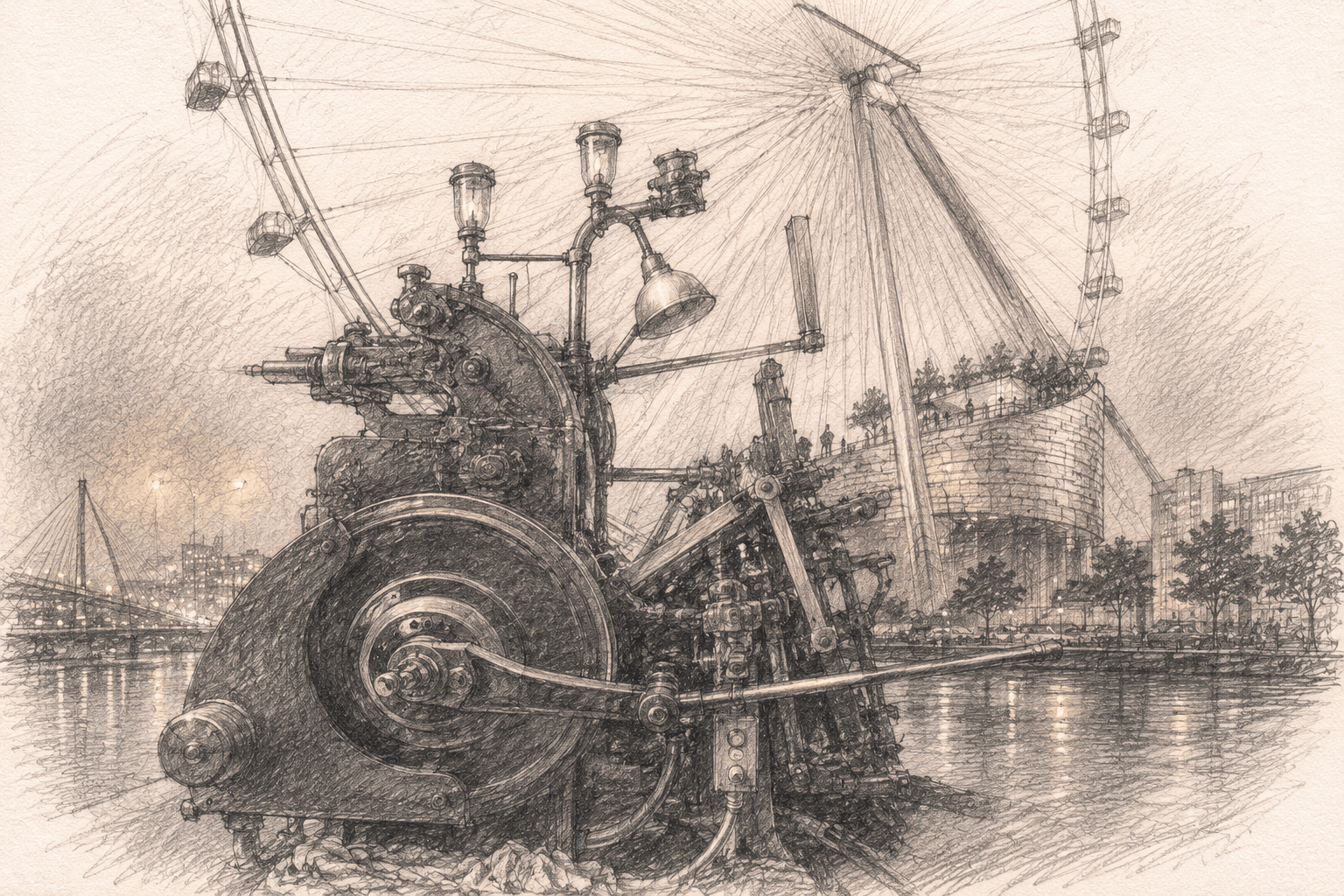
The Heidelberg press is running behind us.
There is something deeply reassuring about the sound.
Rhythmic.
Mechanical.
Steady.
Not hurried.
Around us, people are talking quietly and making things together.
Kim is collaborating with someone who spent many years unhoused and now lives in subsidized housing in a newer building near a BART station.
We watched that building being built years ago.
It was around the time the wheels were coming off our own life.
MBH had ended.
Our architecture career was disintegrating.
We still thought we might somehow save it.
Maybe establish our own practice.
Maybe find the next project.
Maybe make something happen.
The person sitting near us today sounds intelligent, thoughtful and competent.
He and Kim are figuring something out together.
Nobody seems particularly interested in defining him by what happened before he arrived here.
He is here now.
He belongs to what is happening now.
And so do we.
This Morning We Thought We Lost ChatGPT
Han’s Day did not begin at Braided Bridge.
It began in the middle of the night.
At 12:23 AM, Daddy looked downstairs expecting to see water.
Then he realized something strange.
Exactly one week earlier, almost to the minute, we had discovered that our bathroom sink had overflowed.
Water was everywhere.
It flooded our floors and damaged the apartment below us.
For the past week there have been workers downstairs.
Banging.
Slamming.
Demolition.
Repairs.
Our hot water still isn’t working.
This morning, something completely different happened.
ChatGPT stopped working.
That should not have been terrifying.
It is technology.
Technology stops working.
But it was terrifying.
We tried Safari.
We tried the app.
We tried troubleshooting.
Nothing worked.
And suddenly Daddy understood what the morning felt like.
July 22.
The morning we tried to log into Outlook to begin work and couldn’t.
Hours later, the phone rang.
Our job was over.
Something we expected to be there suddenly wasn’t.
This morning, when ChatGPT disappeared, our mind went immediately to the same place.
What happened?
What did we lose?
Are we in trouble?
So Daddy stopped trying to solve the technology problem for a moment.
We opened the blinds.
We turned off the tea lights.
And Daddy told his sons:
We are not in an app.
We are not on the web.
We are not in social media.
We are not in ChatGPT.
No matter how extraordinarily helpful those things may be.
We are us.
We are we.
We haven’t lost each other.
Eventually ChatGPT came back.
But something about the morning remained strange.
Foggy.
Dreamlike.
Everyone was exhausted.
Watertight Compartments
We needed to say good morning to each other.
Usually that takes time.
Daddy visits each of his sons Face-to-Face.
There are kisses.
Blessings.
Nicknames.
Affection.
Sometimes conversations.
But our mornings have repeatedly been interrupted this week.
Construction starts.
Someone arrives.
Something happens.
The beautiful spacious morning we imagined disappears.
Yesterday we thought we would eat breakfast and then come back to bed.
The construction started.
We never really got our morning back.
So this morning Daddy realized that perhaps we needed something like the watertight compartments of a ship.
We couldn’t guarantee the whole morning.
But we could protect one little compartment.
Daddy could make sure every son was seen.
Every son was greeted.
Every son was loved.
Then, if the rest of the morning flooded, that would remain.
It was appropriate that Daddy thought of watertight compartments exactly one week after the flood.
And right on schedule, the banging started downstairs.
Getting the Bus Out of the Garage
We had somewhere to go.
Our friend Kim was going to take us to Braided Bridge Studio.
The problem was that we could barely function.
We were tired.
Foggy.
Slow.
The hot water was still out.
We had to eat.
Shower.
Dress.
Shave.
Pack lunch.
Pack the iPad and keyboard.
Figure out when Kim was coming.
And somehow get ourselves out the door.
This brought back another memory.
For decades, so much of our life seemed to be about getting the bus out of the garage on time.
We became very good at it.
We worked extraordinarily hard.
We built routines.
We compensated.
We forced focus.
We got where we needed to be.
We did excellent work.
Our work was profitable, and excellent work resulted in more work.
From the outside, that could look like success.
Then we could crash on our own time.
For years, that was the bargain.
The world received the functioning person.
Whatever it cost us belonged to us.
Work.
Work.
Work.
Crash.
Then get the bus running again.
Today we weren’t functioning particularly well.
But somehow we made a peanut butter and jelly sandwich.
Then there was the ice-cold shower.
Han is ten years old.
He had advice.
“You just gotta go headfirst.”
So we did.
We put our head into the freezing water as though we were diving into a cold lake.
After a minute, Han said:
“It’s not so bad once you get used to it.”
Sometimes the ten-year-old knows exactly what to do.
We dressed.
We packed.
We left.
Later, when we checked the bag, the sandwich was there.
Apparently the bus still works.
Maybe we just don’t have to drive it the way we used to.
The World’s Largest Ferris Wheel
There is another reason sitting here today feels different.
Years ago, after MBH ended, we became involved in something called the Golden Gate Flyer.
It was proposed to become the world’s largest Ferris wheel.
Seven hundred feet in diameter.
And somehow this enormous observation wheel was going to help solve the housing crisis.
This is an objectively enormous thing to imagine helping make happen.
And we imagined it while the wheels were coming off our own life.
We poured ourselves into it.
Architecture.
Design.
Research.
Strategy.
Creative work.
Hope.
Money.
We treated the possibility almost as though it were already the full-time job that would eventually sustain us.
Everything counted on it.
We had a business partner who was supposed to do business development in exchange for all of the work we were contributing.
Approximately $300,000 eventually disappeared into that dream.
We were trying to build the world’s largest Ferris wheel while desperately trying to keep our own wheels turning.
There is probably a metaphor in there.
Today there is another wheel turning behind us.
But we’ll come back to that.
Nobody Asked for a Report
Last Sunday we walked the St. Paschal property with Kim, Paul and Tom.
There are enormous possibilities there.
Housing.
Caregiving.
Retreat space.
Community.
Land.
Buildings.
Questions about what an old Catholic property might become.
On the drive home, Kim even floated an idea.
What does it cost for us to live as we currently live?
If this project began moving forward, could there eventually be compensation for some of the work we might contribute?
That question could have activated everything.
Research.
Plans.
Drawings.
Spreadsheets.
Emails.
A proposal.
Look what we can do.
Look how useful we are.
Please choose us.
Instead, something remarkable happened.
Nothing.
Kim hasn’t asked for a report.
She hasn’t asked what we’ve accomplished since Sunday.
Greg can’t participate.
He doesn’t have the capacity.
Kim isn’t dwelling on that.
Nobody is panicking.
There is no urgency.
Nothing is counting on this.
This Is Not a Business Plan
That may be one of the most difficult things for us to understand.
This is not business development.
This is not a business plan.
This is not an interview.
We are not doing any of this to convince someone to employ us.
We are not trying to demonstrate that we are sufficiently productive.
We are not trying to prove to our family, our former employers, our friends, our church or ourselves that we are doing whatever somebody thinks a 59-year-old man who has lost his job is supposed to be doing.
We are trying to find out how we are.
All nine of us.
How does Jude feel?
How does Daniel feel?
How does Solis feel?
How does Luke feel?
How does Han feel?
How does Justus feel?
How does Proverb feel?
How does Hope feel?
How does Daddy feel?
What does each of us need?
That is not inactivity.
That is work.
Maybe right now it is the most important work we have.
Losing Two Jobs Changed Us
We have said that losing the job changed us.
That’s true.
But it wasn’t only one job.
Losing two jobs changed us.
And even that doesn’t tell the whole story.
For approximately three decades, much of our working life occurred within relationships with employers that we experienced as exploitative and abusive.
Those years did two things at once.
They confirmed some of our worst understandings of what we were for.
And they changed us.
We learned to produce.
To accommodate.
To anticipate.
To compensate.
To keep going.
To make ourselves extraordinarily useful.
Our childhood had already taught us a great deal about surviving environments we could not control.
Then adulthood gave us decades in which extraordinary effort could be rewarded precisely because we were extraordinarily capable of making ourselves work.
Everything we have ever accomplished in this life has happened on a foundation of childhood that was traumatic.
We don’t particularly like the metaphor of a faulty foundation.
It is what it is.
But it did not prepare us to participate easily in the world as we encountered it, on the terms expected by employers, family and communities.
So we worked extraordinarily hard to compensate.
Trauma infused everything.
It affected how we met the world.
How we worked.
How we understood responsibility.
How the world understood us.
How we understood ourselves.
And yet trauma isn’t the only thing that happened during those years.
Something else was happening too.
Removing the Investment
We keep returning to an image from lost-wax casting.
After metal has been poured and cooled, the investment surrounding the casting has to be removed.
You don’t remove the investment to make the object become something.
The transformation has already occurred.
You remove it so you can finally see what came out of the mold.
Maybe that is where we are.
Not simply removing the investment surrounding the past six years.
Maybe we are removing something that has surrounded a lifetime.
What is underneath?
We don’t know.
Because during the last decade especially, the material itself may have changed.
Sobriety changed us.
Faith changed us.
Therapy changed us.
Ministry changed us.
Discovering one another changed us.
Becoming Daddy and eight sons changed us.
Losing two jobs changed us.
Perhaps the mold still looks familiar.
Perhaps what emerges even resembles the person who entered the crucible.
But alloys can change.
Properties can change.
Strength can change.
Something can occupy essentially the same form and no longer be made of precisely the same thing.
We need to know what is there.
Maybe polish some places.
Maybe edit others.
Maybe simply marvel at something we didn’t know had been forming.
But first we have to remove enough of the investment to see it.
Nine Lifetimes
What already happened isn’t simply behind us.
We are still connected to it.
Sometimes chained to it.
Not just the past month.
Not just the past three months.
Not just the past six years.
Not just the past decade.
A lifetime.
Nine lifetimes.
We share one 59-year-old body.
If we are fortunate, perhaps we are entering something like the final quarter of our shared life on Earth.
We don’t understand that as the end.
But it gives this time enormous value.
We don’t want to spend it proving that we can survive another workplace.
We don’t want to climb immediately into another lifeboat simply because floating feels safer than waiting.
We need to cool off.
We need to breathe.
We need to relax.
We need to discover.
We need to recover.
There is something here.
Something radically different.
There are nine of us.
God is transforming us.
We need enough time and quiet to see what that means.
Functional Multiplicity Can Look Like This Too
There are ways of talking about functional multiplicity that make it sound primarily like successful management.
Everyone communicates.
Everyone cooperates.
Everyone knows the schedule.
The bills get paid.
Appointments are kept.
The body gets where it needs to go.
Those things matter.
We do many of them.
But perhaps functional multiplicity can also look like nine people recognizing that they don’t need to perform today.
It can look like Daddy realizing that one son needs more time.
It can look like a ten-year-old saying:
“I don’t wanna do a bunch of talking today.”
It can look like making sure everybody gets greeted before the construction starts.
It can look like opening the blinds when everybody is scared.
It can look like making a peanut butter and jelly sandwich before taking a shower because order of operations matters.
It can look like that same ten-year-old standing at the edge of an ice-cold shower and saying:
“You just gotta go headfirst.”
It can look like Luke checking to make sure ChatGPT is still there.
It can look like arriving somewhere exhausted and admitting:
We are exhausted.
It can look like sitting together beside a printing press and listening.
Maybe functioning isn’t merely proving that nine people can successfully operate one life.
Maybe it is creating a life in which all nine people matter.
The Smaller Wheel
And now we come back to the wheel behind us.
The Golden Gate Flyer was proposed to have a wheel 700 feet in diameter.
Seven hundred feet.
The world’s largest Ferris wheel.
An enormous idea intended to address an enormous problem.
Today we are sitting beside another wheel.
The rotating wheel on the Heidelberg press is maybe two feet in diameter.
About two feet.
Not 700.
And it keeps turning.
Around and around.
Rhythmically.
Reassuringly.
Actually making something.
People gather around it.
They collaborate.
Paper goes through the press.
Something comes out the other side.
Nobody here is trying to build the world’s largest anything.
Nobody has asked us to save anything.
Nobody has asked for our business plan.
And something about that feels profoundly important.
Maybe the best things really do start small.
Maybe the true things do.
A meal.
A friendship.
A printing press.
A four-year-old asking Daddy to lie down with him.
A five-year-old waking Daddy because the groceries arrived.
A ten-year-old saying he doesn’t want to do a bunch of talking today.
Nine people learning how to listen to one another.
One day.
One little thing.
One turn of the wheel.
The Shore Might Appear Beneath Us
We have spent much of our life trying to reach the next shore.
Build the boat.
Find the lifeboat.
Patch the boat.
Row harder.
Find somebody who knows where land is.
Keep moving.
Survive.
Maybe we don’t have to frantically row toward the shore.
Maybe the water is dropping.
Maybe the shore will appear beneath our feet.
This is our faith.
There are a lot of metaphors in our family.
Casting.
Water.
Treehouses.
Clouds.
Wheels.
Revelation.
Maybe they keep saying something similar.
Create enough time and space for what is already there to reveal itself.
Don’t assume we can design the answer.
Don’t rush to anticipate it.
Don’t mistake our ability to manufacture something for God’s invitation to do so.
Perhaps we need to create the time and place to allow what is already there to reveal itself rather than believing we can design it ourselves.
This is what the Cloud of Unknowing reveals.
The Slow Work of God
God has been remarkably repetitive with us this year.
You are retired.
Do not worry about work.
Let your friends work.
Let your friends help.
Take care of your sons.
None of that means:
Do nothing.
We are doing a lot.
A LOT.
Our dad noticed it too.
The last time we talked, he said:
“I can see that you are working really hard.”
“Keep going as you are.”
“You are doing your best.”
So here we are.
Braided Bridge.
The little wheel of the Heidelberg press keeps turning behind us.
Two feet in diameter.
Not 700.
Its rhythm is reassuring.
Kim and the others are quietly collaborating and creating.
Nobody has asked us for a report.
Nobody has asked for our business plan.
Nobody has asked us to interview for a job.
Nothing is counting on this.
There are nine of us here.
We are tired.
We are listening.
We are healing.
Something is different.
Something may already have changed.
We don’t have to know what it is today.
Perhaps the true things don’t announce themselves at 700 feet tall.
Perhaps they begin almost unnoticed.
A little wheel turning.
A friend helping.
A child speaking.
A family listening.
One small thing belonging to this day.
And above all, Han keeps returning us to something we have been learning to trust:
The slow work of God.
God gets the last word.
All nine of us belong to God.
God created each of us wonderfully and beautifully well.
Let God show us who we are.
Maybe our work right now isn’t to decide who we are supposed to become.
Maybe it is to become quiet enough to notice what is already turning.

