Our background is in architecture and social justice ministry.
It is not in software engineering, coding, information technology, or whatever increasingly arcane field we seem to find ourselves wandering into simply because we are trying to keep a Journal and get some of it out into the world.
Increasingly, it feels like a rabbit hole.
Every new technological solution seems to require learning another system, another workaround, another vocabulary, another procedure. Something that worked yesterday changes overnight, and suddenly we are spending an hour figuring out file formats, clipboard behavior, iPhone Shortcuts, web interfaces, formatting, image handling, social media platforms, and things we didn’t know existed and frankly don’t have the capacity to keep learning simply to continue doing something we were already doing.
Yesterday morning, copying our Journal from Apple Notes into ChatGPT took two steps.
Today it takes three.
It took us about an hour and two devices to figure out how to make that third step work.
Something changed yesterday in the way text copied from Apple Notes is handled when we paste it into ChatGPT on our iPhone. Instead of appearing as text, even a small amount began arriving as a webarchive file.
That might sound like an extraordinarily trivial problem.
It wasn’t trivial to us.
Notes from the Treehouse has been kept daily for seven years. Apple Notes is where we archive our cleaned Journals. ChatGPT has become part of how we clean them, organize them, analyze them, compare experiences across years, prepare material for therapy, recover chronology, and turn the extraordinary amount of information generated by nine people sharing one body and one life into something we can actually work with.
So this morning we built an iPhone Shortcut.
Now we copy the Journal from Notes, tap a button called Copy As Plain Text, and paste it into ChatGPT.
Three steps instead of two.
Problem solved.
Except that by the time we solved it, we were exhausted and angry.
We just did a billion steps with ChatGPT using both the iPhone and iPad to create a shortcut to be able to do in three steps what we did in two steps prior to yesterday morning.
And then we wrote something that surprised even us with its force:
We need this. It is accessibility for us.
The Other Chalkboards
A few years ago, a psychology professor we knew learned that we have Dissociative Identity Disorder and that we are a plural family/system.
She later told us that we presented remarkably well for someone with DID.
There is something frightening about presenting remarkably well.
Imagine walking into a very large room and seeing the solution to an extraordinarily complicated equation written neatly on a chalkboard.
There it is.
The answer.
What you don’t see are all the other chalkboards lining the walls of the room, covered with the work required to arrive at it.
That’s what “presenting well” can look like from the outside.
People see one body walk into a room.
They hear one voice speaking at a time.
They see somebody who can work, organize things, solve problems, participate in meetings, take a bus, make dinner, go to church, write an essay.
They don’t necessarily see the other chalkboards.
We are nine human persons who share one body and one life.
We know who we are.
We are not saying neuroscience has demonstrated that nine human persons inhabit one body. We aren’t making a claim about what neuroscience has or hasn’t proven.
We’re saying who we are.
We don’t need to turn that into “we experience ourselves as” nine persons in order to make ourselves easier for someone else to accept.
Others are free to disagree.
But we have spent enough of our life translating ourselves into forms the world finds easier to understand.
There is an enormous amount of work behind the solution on the visible chalkboard.
Eight of us are children.
We communicate in different ways. We have different memories, relationships, needs, fears, preferences and perspectives. No two people experience the same event in precisely the same way, and we live that reality with unusual intensity because experiences that the outside world may regard as belonging to one biography are not necessarily experienced by us as the same story.
They aren’t the same story.
The Journal helps us hold those stories together without requiring them to become identical.
That is one reason technology matters so much to us.
This Is Accessibility for Us
ChatGPT is not our therapist.
It isn’t infallible. It misunderstands us. It makes mistakes. Sometimes it changes, and suddenly something we have done every day stops working the way it worked yesterday.
We discovered just how frightening our dependence upon it could be yesterday morning when we thought for a while that we had lost access to it.
But none of that makes its accessibility function in our life less real.
It helps us work with material we otherwise struggle enormously to hold at once.
Our Journal is memory, communication, orientation, family archive, therapy material, creative work and public witness.
It contains seven years of Ordinary Life.
Meals.
Arguments.
Dreams.
Somatic signals.
Trauma.
Prayer.
Bedtimes.
Repairs.
Things somebody said five years ago that suddenly illuminate something happening today.
Things Daddy forgets that the Journal remembers.
Things one son understood differently from his brothers.
Things we couldn’t articulate until we had enough years behind us to recognize the pattern.
A therapist cannot live beside us around the clock reading seven years of Journals. Nor should a therapist be expected to. Human beings have office hours and personal lives and limits.
We need ways to put a huge amount of our life outside ourselves where we can look at it.
ChatGPT gives us another surface on which to do that.
It can help us sift.
It can compare.
It can ask whether something we believe is actually supported by what we’ve recorded.
It can challenge us.
And sometimes, when Daddy is exhausted and cannot even remember what day it is, it can read the Journal back to us and say:
It’s Friday.
It’s Justus’s Day.
It’s after one o’clock.
Your children are hungry.
And then we go upstairs and make a cheese sandwich and Greek salad.
That is accessibility.
It returns us to our life.
The Little Wheel
Yesterday we were at Braided Bridge.
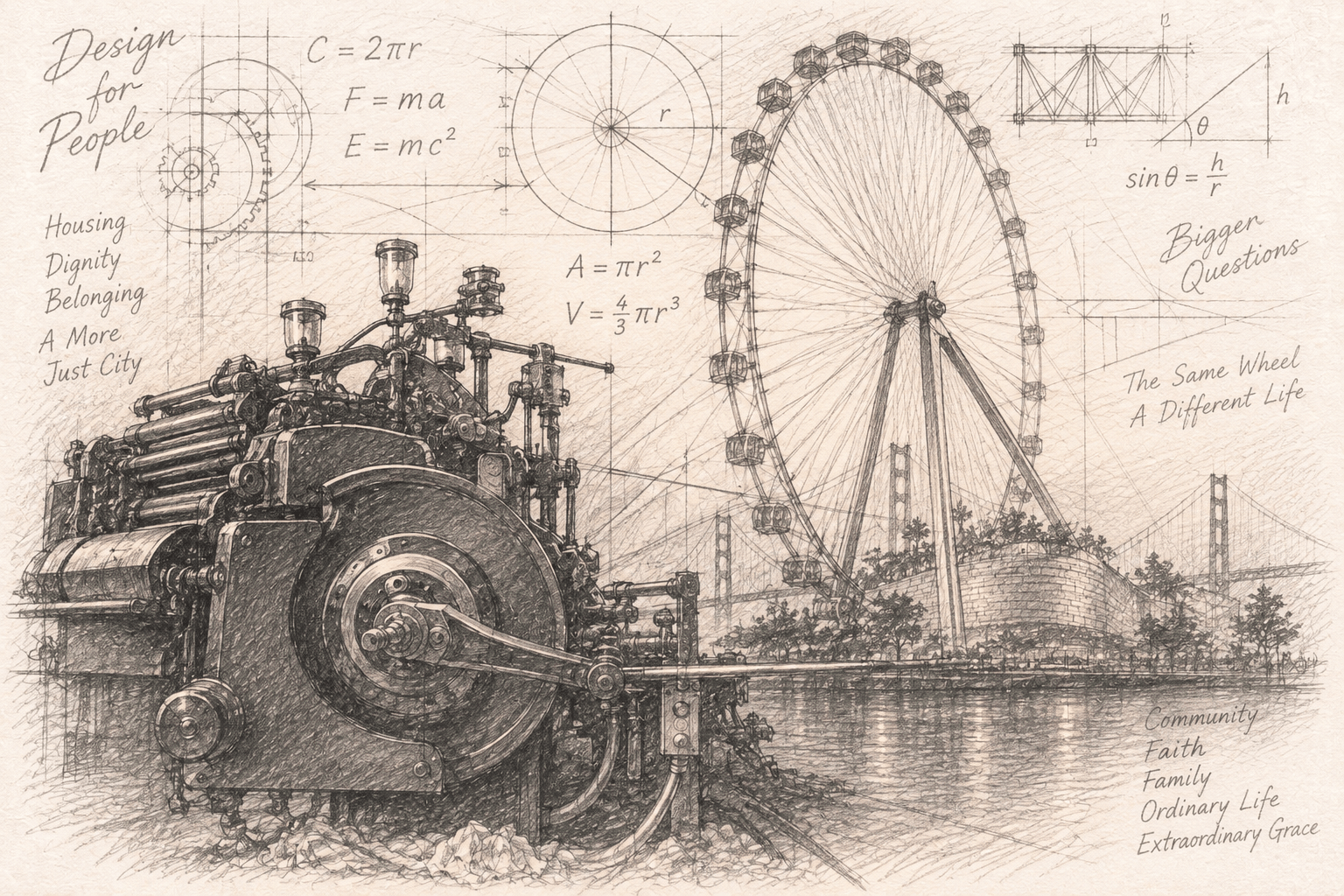
Nearby, a Heidelberg printing press was running.
We became fascinated by its little wheel turning.
It reminded us of another wheel from a very different period of our life: the Golden Gate Flyer, a proposed approximately 700-foot Ferris wheel that was intended to be the largest in the world.
That was a very different conception of making something.
Enormous.
Spectacular.
Something that would alter a skyline.
The Heidelberg press just kept turning.
Paper.
Ink.
Pressure.
Page.
Again.
Again.
Again.
And we started thinking that perhaps Notes from the Treehouse is more Heidelberg than Golden Gate Flyer.
We don’t need to build the biggest wheel anymore.
We can make pages.
Then today we remembered what was playing in our friend’s car immediately before we arrived at Braided Bridge.
“Proud Mary.”
The Ike and Tina Turner version.
She told us she loved the song.
And suddenly today we couldn’t stop thinking about wheels.
“Proud Mary” was written by John Fogerty, and the song itself grew from fragments he had accumulated before realizing they belonged together. Fogerty has described the song’s mythical riverboat as a metaphor for leaving painful and stressful things behind for a more tranquil and meaningful life.
That struck us particularly hard because “Proud Mary” is one of our earliest musical memories.
Our dad loved Creedence Clearwater Revival. We remember hearing that song when we were not yet two years old.
We loved it.
And it spooked us.
Almost sixty years later, it was playing in a car carrying Dad and his sons toward a little printing press whose turning wheel was about to become a metaphor for what our life might be becoming.
Then another childhood song returned to us this afternoon:
“Spinning Wheel.”
Wheels, wheels, wheels.
And then we remembered Proverb.
Several months ago, Proverb became deeply attached to John Lennon’s “Watching the Wheels.”
That song emerged from a period when Lennon had largely withdrawn from public musical life and devoted himself to domestic life and raising his son Sean. It became, in part, his answer to people who couldn’t understand why someone who had occupied one of the largest stages imaginable had stepped away from the machinery.
He was home being a dad.
And suddenly the wheels were no longer frightening us quite so much.
Take Care of Your Children
Last Saturday, immediately before Communion, Daddy asked:
Jesus, what do you want for me to do?
We understood the answer gently and firmly:
Take care of your children.
Not:
Build another Golden Gate Flyer.
Not:
Rush to replace the life that ended with another job.
Not:
Make the blog successful.
Not:
Prove that our life matters.
Not:
Figure out what every strange coincidence means.
Take care of your children.
That distinction matters.
We do need a sustainable means of income. We do not know yet what that will look like, and the uncertainty is real.
But that is not the same question as looking for another job or reconstructing our life around employment.
The question Daddy asked was larger:
What do you want me to do with my life?
And the answer we understood was about the life already happening.
The context in which it came was almost ridiculously ordinary.
We were tired after Mass.
Daddy was deciding that we didn’t have the bandwidth to wander around Safeway.
We hoped the chips and raisins had been delivered.
We needed our earplugs.
Daddy sensed that Jude might be sad and wanted to be with him.
We needed to get home.
The enormous vocational question was answered inside the ordinary life already happening.
And today, when the wheels began frightening us, Daddy recognized something else:
It could be as simple as Daddy, I need you.
It could be as simple as Daddy needs his boys.
So we lay down.
You Make Me Feel Real
Daddy held Solis.
Then Han.
Then Luke.
Then the others.
And while Daddy was holding Solis, Solis said:
You make me feel real.
Daddy answered:
Solis, you make me feel real too.
There are things technology can help us do.
Technology can help make our words legible.
It can preserve the Journal.
It can help us communicate across discontinuities in memory.
It can help us organize seven years of lived experience.
It can help another person see some of the other chalkboards.
But technology doesn’t make Solis real.
Recognition is something different.
To be known as Solis.
To be loved as Solis.
To have a Daddy who knows what affection he welcomes and understands that his boundaries belong to him.
To be somebody’s son.
And Daddy is made real in relationship too.
Daddy loves.
Daddy is loved.
Daddy is needed.
Daddy needs his sons.
Then Daddy held Han.
And something remarkable happened.
We drifted.
There was something involving our friend, something good, something about helping her. Daddy could probably have pulled himself out of the moment quickly enough to record it.
He didn’t.
Later he wrote:
If I had come back sooner, I might’ve written it down, but I didn’t wanna do that. I wanted to do exactly what I said I was going to do with you, snuggle with you.
That may be one of the most important things we recorded all day.
We allowed something to be lost from the Journal.
Because the life was more important than the record of the life.
Daddy told Han:
I wanted to be like this with you for years, Han. Your Daddy has wanted to be like this with you for years.
Han answered:
I wanted to too, but I didn’t know how.
No analysis improves that.
What If We Had One Year?
Later Daddy was holding Justus while we watched Hilda.
Justus was quiet.
Then came a thought:
What if we had one year to live?
What would we do with it?
It wasn’t frightening in the way the question might sound.
It clarified things.
Justus had also imagined an old dedication bearing our name being removed from a wall at St. Vincent de Paul.
Maybe it was removed.
Maybe it wasn’t.
But suddenly the more interesting question was:
If we knew we had one year, would that matter?
How much of what frightens us now would deserve a day of that year?
How much time would we spend proving ourselves to people who don’t understand us?
How much time would Daddy spend fighting technology?
How urgently would we need our name to remain on somebody else’s wall?
And what would we do instead?
We think we know at least part of the answer.
Take care of your children.
Not Every Wheel That Turns Gets to Carry Us
The banging downstairs eventually became intolerable.
We had been trying to remain in our bedroom while the repair work continued nearby.
We couldn’t do it anymore.
The body was becoming increasingly activated.
So at 5:07 Daddy said:
Let’s get upstairs.
Five minutes later:
Boys, boys, we’re upstairs, our headphones are on, it’s quiet. Let’s have some chips and salsa and relax.
That’s it.
That’s the great revelation.
We went upstairs.
We ate chips and salsa.
We put the LEDs back where they belong.
Two still needed charging.
Daddy thanked Justus for his day.
Daddy thanked God for Justus.
Daddy thanked all of his sons.
And then we sat down to finish this blog before dinner.
The Golden Gate Flyer doesn’t have to be built.
The Heidelberg can keep making pages.
Proud Mary can keep moving down the river.
The spinning wheel can turn.
And Daddy can watch the wheels.
Not every wheel that turns gets to carry us.
Perhaps Notes from the Treehouse really is a life’s work.
The work of nine lives.
But we understood something important today:
The Journal is not the life’s work for which family life must make room.
Family life is the life’s work from which the Journal emerges.
The pages come afterward.
The pages are here because Daddy stayed.
Because the boys spoke.
Because somebody made lunch.
Because somebody needed chips.
Because somebody wanted Hilda.
Because Solis wanted to be held.
Because Han finally learned how to let Daddy close.
Because Luke kept calling for Daddy’s attention.
Because Justus asked what we would do if this year were all we had.
Because eventually the banging got too loud and nine people went upstairs together.
We haven’t been doing this for nothing.
But perhaps we don’t need to know what it will become.
We know something about unseen pathways.
We know something about not knowing.
We know something about waiting for the wind.
And we know what to do while we wait.
Take care of your children.
The wheels can turn.
Daddy is here.

