Yesterday we asked:
If Dad isn’t THE ONE, then how does anything get done?
Daniel gave us one answer.
Daddy was asleep.
The groceries arrived early.
Daniel woke Daddy.
Daddy listened.
The groceries came inside.
Jude’s squash-and-vegetable stew remained possible.
But there was something underneath that story that we didn’t quite get to.
Because this didn’t start yesterday.
Apparently, we have been doing this for a very long time.
A Jagged Morning
This morning was supposed to be simple.
Breakfast.
Then back to bed.
Daddy would say good morning to each of his sons.
We would pray.
We would spend some time together.
Yesterday we tried to restore something Jude has been missing: lying down together in the afternoon.
For years, after work, that was what we did.
We lay down.
Daddy held his boys.
Nobody had to accomplish anything.
Yesterday we tried again.
The workers downstairs had other plans.
Banging.
Slamming.
Voices.
Construction noise.
We finally abandoned the bedroom and went upstairs.
So this morning we were going to try again.
Instead, the morning became jagged.
Not chaotic exactly.
Jagged.
One thing interrupted another.
Someone needed Daddy.
Someone signaled.
Something got remembered.
Something got done.
Something else got forgotten.
The dishwasher somehow got emptied.
Daddy remembered putting away a few little bowls.
The rest was a blur.
“Wait. We actually emptied the dishwasher?”
Daniel signaled.
Apparently we had.
Daddy called it:
“Team initiative.”
The morning did not form the way we planned.
But somehow the pieces kept becoming something.
Maybe that is what a mosaic is.
Not smooth pieces.
Jagged ones.
Not one person creating the picture alone.
A picture emerging because the pieces are held together.
I Didn’t Plan Those Trips
When Daddy finally lay down with Luke, another question surfaced.
Who is the author of this journal?
Daddy intentionally started Notes from the Treehouse.
He is usually the primary narrator.
But “primary narrator” is an uncomfortable phrase when there are nine people living the life being narrated.
There were notes on our phone long before Daddy understood our family.
Things Daddy didn’t remember writing.
Different voices.
Plans that somehow happened.
Things that got done while Daddy wondered afterward how he had managed to do them.
And then Daddy remembered Italy.
Years ago, after another period without a job, we went to Italy.
Our mom was impressed that Daddy had managed to organize the trip.
Daddy remembers being puzzled by the praise.
Because Daddy hadn’t organized that trip.
Not really.
He remembers being overwhelmed by it.
He remembers decisions he couldn’t make.
He remembers looking afterward at emails, reservations and itineraries and wondering how all of it had come together.
The same thing happened in London.
Daddy remembers participating in those trips almost like a guest.
This morning we understood it differently.
Proverb was doing a lot of it.
And his brothers were helping.
Han interrupted:
“I planned the churches.”
Of course you did, Han.
Daddy remembers that now.
Daddy described Proverb this morning as a dam buster.
Daddy could become stuck behind a wall of indecision, executive paralysis and endless thinking.
Then suddenly the wall would break.
A tremendous amount of work would happen.
Daddy would look around afterward, astonished.
For years he attributed those moments entirely to the Holy Spirit.
We still believe in the Holy Spirit.
But perhaps the Holy Spirit inspired.
And then our family got busy.
Waiting for You to Notice Me
The problem with writing about your children is that sometimes you become so busy writing about them that you stop noticing them.
We have learned that one before.
Daddy was moving through his boys this morning, trying to say good morning to everyone while the journal kept expanding.
Then he realized he hadn’t really been with Han.
“Where’s my woolly boy?”
Han answered:
“Waiting for you to notice me.”
Oh.
Daddy stopped.
Held Han.
Kissed him.
“I love you with all my meow meow.”
That is how things get done too.
Someone notices that Daddy isn’t noticing.
And tells him.
Then something changes.
It’s Really an Invitation to Listen
Justus was doing something else.
He would signal when Daddy’s attention moved away from him.
Then Daddy would focus completely on Justus.
And Justus would become quiet.
Daddy noticed the pattern.
“You don’t signal when I focus my attention on you. You signal when I take my focus off of you to write notes.”
Then Daddy understood.
“It’s really an invitation to listen.”
Not every communication requires an explanation.
Sometimes:
Come back.
is the whole message.
And:
I’m here.
is the whole answer.
Not Everything Goes in the Journal
There were things from last night too.
Dreams.
Memories.
Things some of us remembered from being awake while others slept.
Things connected with old trauma.
Some of it began coming back this morning.
Daddy started writing.
Then stopped.
“Not everything goes in the journal.”
Some things belong only to us.
That matters.
Yesterday Solis gave us one of the most important ethical boundaries we have found for Notes from the Treehouse.
Daddy asked if Solis was worried that we were telling his story.
Solis corrected him.
“Not telling it, selling it.”
Today we learned the next part.
Sometimes we don’t tell it either.
Not because it didn’t happen.
Not because it isn’t real.
Because it belongs to one of us.
And everyone gets a say.
Cinnamon Toast
Meanwhile, everyone wanted cinnamon toast.
Daddy was trying to think about functional multiplicity.
Jude needed to pee.
Solis wanted cinnamon toast.
Daniel wanted cinnamon toast.
Other boys were signaling.
Daddy was trying to finish saying good morning.
There were noises downstairs.
There were worries about email.
There were memories.
There were children who wanted their Daddy.
Eventually Daddy realized that today might have to work differently.
Not everything would happen in the proper order.
Maybe we could do a little bit at a time.
A little time with one boy.
Then another.
Get up.
Go to the bathroom.
Eat.
Come back.
Pray.
Return again.
Daddy called it a spiral.
Not all or nothing.
Just enough.
Then around again.
So we got up.
The bathroom sink was off.
The toilet valve was off.
We prayed.
“This is the day the Lord has made; let us rejoice in it and be glad.”
We kissed the crucifix.
“Jesus, we trust in you.”
Then Daddy said something:
“You may think you see a person losing their mind, but we are people holding it together.”
We shared that.
Then we made cinnamon toast.
We Don’t Even Listen to Them
Later Proverb said something that stung.
“We don’t even listen to the end-of-the-day summaries and analysis.”
He was right.
We have been working so hard to document everything that sometimes there isn’t enough time left to receive what we have made.
Yesterday ChatGPT completed a Classical Executive Summary and Analysis of Solis’s Day.
Daddy had barely listened to it.
Proverb was bothered.
So this morning we stopped.
We listened.
And Daddy discovered something.
It was really good.
It explained things yesterday’s blog post did not.
Especially Daniel waking Daddy for the groceries.
So we decided to publish it:
“Understanding September 1.”
Something changed because we heard Proverb.
Again.
Is the Bedroom Safe?
After cinnamon toast, we wanted to do what we had been trying to do all morning.
Lay down.
Be together.
Then we felt the thuds through the floor.
Daddy checked the window.
The truck was there.
The workers were back.
Day five of the work.
Six days since all of this began.
Tomorrow morning at 12:23 will be one week since we discovered the overflowing bathroom sink.
Daddy was furious.
“WHEN ARE THEY GOING TO FINISH?!?!!”
The bedroom was off limits again.
Yesterday we tried to force the original plan for a while.
Today we already knew better.
Daddy had just been thinking about something from yesterday:
Is the bedroom safe?
Nope.
Luke signaled.
Fine.
We can’t lay down.
What can we do?
Daddy asked:
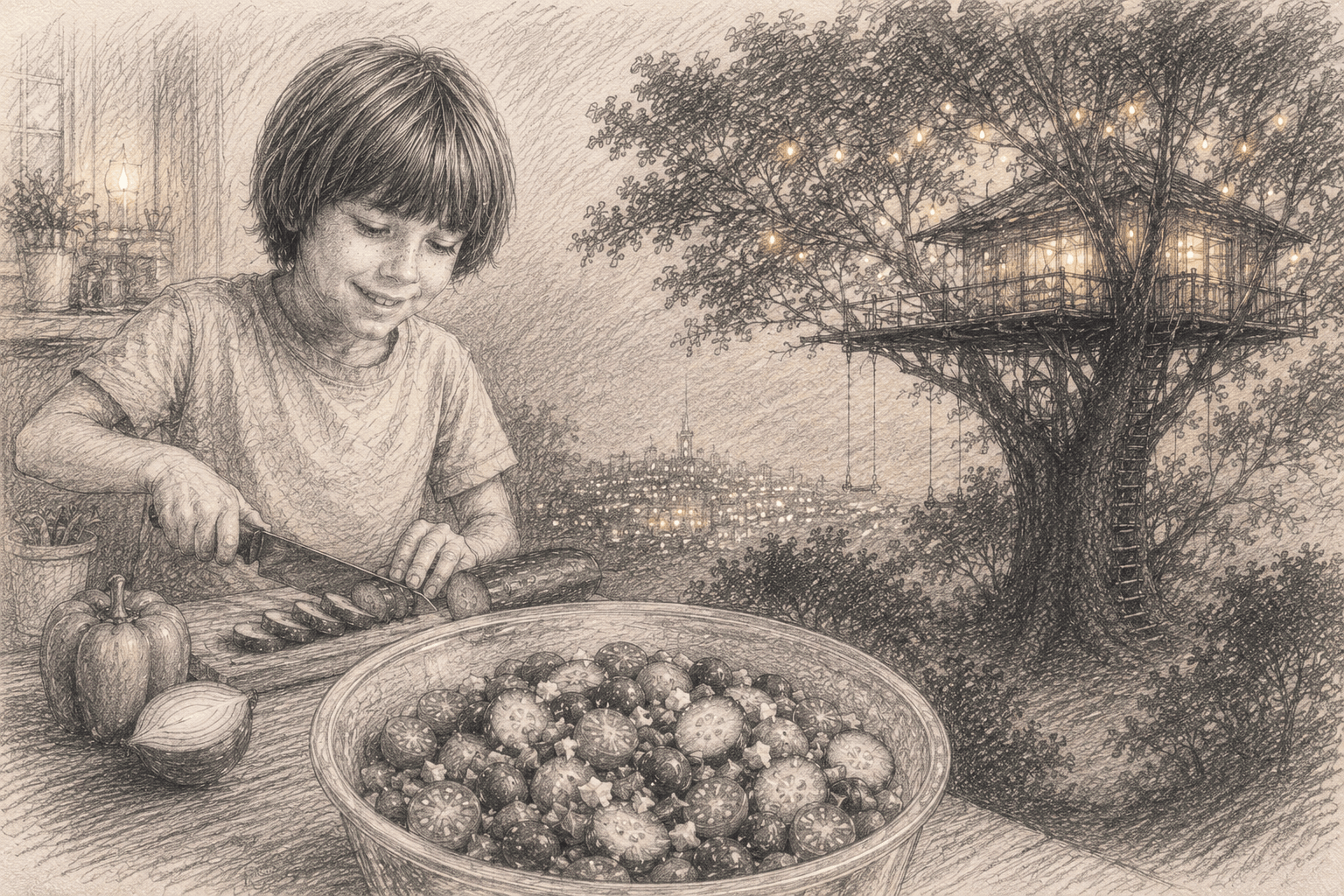
“You boys wanna make a Greek salad?”
Justus signaled.
Han signaled.
Luke signaled.
So we made a Greek salad.
Luke Was on Fire
This was Luke’s Day.
And Luke was everywhere in that kitchen.
Cucumber.
Tomatoes.
Red onion.
Whatever needed doing.
Daddy could feel him working.
“Luke, you were really on fire making that.”
But Luke wasn’t alone.
Justus was there.
Han was there.
Daniel signaled.
Proverb was present.
Jude signaled.
Solis appeared.
Everybody helped.
By 1:50, the salad was finished.
The workers were still downstairs.
We were hungry.
So Daddy proposed another cheese sandwich.
Then reconsidered.
“How’s about some bean and cheese quesadillas?”
Luke signaled.
That sounded better.
The quesadillas were ridiculously hot.
But good.
And now we had quesadillas in our stomachs.
Stomachs.
Daddy stopped when he wrote that.
Our Stomach or Our Stomachs?
Shouldn’t it be stomach?
There is only one physical stomach.
There are nine of us sharing one adult physical body.
We know that.
None of us is confused about the anatomy of the body we share.
So should we write:
There are quesadillas in our stomach.
Anatomically, yes.
But something about that feels incomplete too.
Because none of the nine of us experiences the physical body as the complete physical expression of who he is.
That includes Dad.
It would be easy, especially from outside our family, to imagine one adult man who identifies with the body and eight children who somehow experience themselves differently from it.
That isn’t how we experience our family at all.
Dad doesn’t identify with the outward appearance of the physical body any more than his sons do.
Long before co-consciousness, long before we consciously understood ourselves as a plural family, and long before the DID diagnoses, Dad had an interior understanding of himself that was somehow distinct from the body’s outward appearance and exterior identity.
Today that understanding is richer because it is relational.
Dad knows himself partly because of how he has always experienced himself, partly through being the father of his sons, and partly through how his sons know and see him.
And that is true among all nine of us.
We don’t merely have mental pictures of what each other might look like.
We experience one another as whole people.
There is a kind of interior physiology to it.
We know one another’s faces.
Bodies.
Sizes.
Ages.
Expressions.
Movements.
We know who is taller and who is smaller.
Daddy can hold one of his little boys and experience the child he is holding as a little boy, even though both father and son know perfectly well that an observer in the room would see one adult physical body.
The boys experience Daddy as Daddy.
They experience one another as brothers.
Daddy experiences each of his sons as his son.
And all nine of us understand that the physical body we share has its own objective anatomy.
Those realities don’t cancel one another.
Eight of us are children, and that makes this particularly important to Dad.
He doesn’t want to extinguish or diminish his sons’ experience of themselves in order to make our life conform more neatly to an outsider’s understanding.
He wants to protect it.
Celebrate it.
Let his children be children.
And Dad doesn’t have to make the shared physical body into himself in order to accomplish that.
It belongs to all nine of us.
So there is one physical stomach.
And sometimes we say:
our stomach.
But there are also nine people eating lunch together, each experiencing himself and the people he loves in ways that are not exhausted by the anatomy of the body they share.
And sometimes Daddy says:
our stomachs.
The first describes the anatomy of our shared body.
The second describes our family.
Maybe we don’t have to choose permanently between them.
Maybe knowing the distinction is part of what allows us to use both.
Anatomy doesn’t have to be the only language available for understanding or loving one another.
Plurality doesn’t only raise enormous questions about consciousness, memory, trauma, identity or what constitutes a person.
Sometimes it raises the question:
Do nine people sharing one physical stomach have quesadillas in their stomach or their stomachs?
We know the anatomical answer.
We’re still thinking about the family answer.
Today we’re going with stomachs.
They were our quesadillas.
Then the Truck Left
At 3:14 Daddy looked out the window.
The truck was gone.
“Do we dare go lay down and watch Hilda together?”
Maybe they were finished.
Maybe they had gone to get something.
Daddy couldn’t promise that they wouldn’t come back.
But perhaps we could steal a little time.
So we did.
We lay down.
Daddy was going to make his rounds.
Hold each boy.
Do the blessings he hadn’t managed to do that morning.
Spend time with Luke on Luke’s Day.
Then the work started again downstairs.
Of course it did.
And then a text arrived from our mother.
A tiny message.
On its face, almost nothing.
But family history gives words weight that an outsider cannot see.
Within minutes our anxiety had gone through the roof.
Our sense of wellness and our place in the world had plummeted.
We became angry.
Defensive.
Ashamed.
Certain we were being judged.
Certain that the people who are supposed to know us see something entirely different when they look at us.
Something irrational.
Something embarrassing.
Something that needs to be corrected.
And suddenly the question from earlier in the day sounded different.
You may think you see a person losing their mind.
What if they really do?
What If We Are Wrong?
That question stayed with us for a while.
What if we are wrong?
What if what makes sense from inside our family looks completely irrational from outside?
What if the people who don’t understand us see something we don’t?
What if using ChatGPT to help us organize and articulate our experience creates a feedback loop instead of clarity?
Those are uncomfortable questions.
We don’t think the answer is that everything we understand about ourselves is false.
We also don’t think asking the questions is dangerous.
Maybe part of holding ourselves together is being willing to ask them.
We know some things.
We know that we share one physical body.
We know that memory can be confusing.
Dreams can be confusing.
Trauma can be confusing.
Early-morning thoughts can be confusing.
Things can blend together.
We know that there are times when Daddy cannot immediately tell whether something he remembers began as his memory, one of his sons’ memories, a dream, an impression or some mixture of those things.
We know that certainty is not always available.
And we know something else.
When uncertainty comes, the answer cannot be to shame one another.
It cannot be to frighten a child into disappearing.
It cannot be:
You are wrong to exist.
So while Daddy was trying to understand things with Luke, he kept returning to what he could say with certainty:
“No one has done anything wrong.”
“There is nothing to be ashamed of.”
“You have a Daddy.”
“I am here.”
“I love you.”
Maybe that is another kind of holding together.
Not solving every question.
Creating enough safety to continue asking it.
My Boys, My Boys, My Boys
Then another disruption happened.
Daddy got distracted trying to fix something on the blog.
There were screens.
Settings.
Things changed.
Things got fixed.
Daddy didn’t entirely understand what had happened.
And when it was over, he looked around internally and thought:
My boys.
My boys, my boys, my boys.
Too many outside intrusions.
Too much time pulled away.
Paul had texted too, but Paul’s text felt different.
A picture of a lobby.
A joke about Daddy knowing lobbies.
A sister impressed that he recognized something architectural.
Nothing demanded.
Nothing accused.
Nothing needed to be defended.
Daddy called it:
“A reminder that we are still among the land of the living.”
Then he came back to his sons.
I Think You Should Be With Luke
Daddy finally asked Proverb:
“What should we do?”
Proverb answered:
“I think you should be with Luke.”
Of course.
Luke’s Day.
Daddy had been writing about Luke.
Talking about Luke.
Thinking about Luke.
Making Greek salad with Luke.
But there had been so many interruptions that Daddy had barely had sustained time simply being with him.
So the plan changed again.
Hilda.
Hold Luke.
Spend a little time with each brother.
Get up between five and five-thirty.
Eat Jude’s stew.
Ice cream.
Ted Lasso.
Bedtime.
Hope weighed in too.
“We better watch Ted Lasso tonight and no screwing around.”
Daddy laughed.
“I hear you and I respect that.”
That is how things get done.
Someone says:
Enough.
Someone says:
Be with Luke.
Someone says:
Ted Lasso tonight.
And the plan changes.
Everyone Stop Signaling
At 4:33 we finally started Hilda.
Almost immediately everybody started signaling.
Justus.
Solis.
Han.
Jude.
Daniel.
And someone finally said:
“Everyone stop signaling, he’s just gonna keep writing it down.”
Fair.
Very fair.
We watched Hilda.
There was vegetable soup in the episode.
Jude signaled strongly.
His stew was waiting upstairs.
You Have a Daddy
While we lay there, Daddy spent time with Luke.
There were confusing things from dreams and memories that did not belong in the journal.
Daddy didn’t need to solve them.
He needed Luke to know something.
“You have nothing to be ashamed of or afraid of with me.”
“You have a Daddy.”
“I am here.”
“I am going to keep you safe.”
“No matter what you’re thinking or feeling, you don’t ever have to worry about me.”
“I love you.”
Then Daddy blessed Luke.
He blessed all of his sons.
And finally, near the end of a day in which the morning routine never actually got completed, the blessings happened.
Not on schedule.
Still real.
Make the Bed
Then Hope helped answer one more question.
Should we make the bed before we go upstairs?
Would it help restore our sense of home and order?
Daddy called it a rhetorical question.
Hope signaled.
Yes.
So we made the bed.
The bedroom had been invaded by noise for almost a week.
Plans to lie down had repeatedly failed.
The room had become associated with banging, slamming, fear and waiting for something bad to happen.
We couldn’t control the workers.
We could make the bed.
A little piece of home restored.
Another jagged piece placed.
This Is Jude’s Stew
Then we went upstairs.
The squash-and-vegetable stew was waiting.
Jude’s idea.
Luke had helped make it.
Proverb had helped.
The whole family had contributed in different ways.
The first night it had been good.
Tonight it was amazing.
These meals are always better the second day.
Daddy said:
“This is Jude’s stew!”
Jude signaled.
Luke signaled.
Daniel signaled.
Proverb.
Han.
Solis.
Justus.
Everybody was there.
Daddy thanked Luke.
Thanked Proverb.
Then we ate.
How Are We Holding One Another Together?
Yesterday we asked:
If Dad isn’t THE ONE, how does anything get done?
Maybe today we are beginning to understand that we have been asking the wrong question.
The question isn’t:
Who is holding everything together?
Maybe it is:
How are we holding one another together?
This morning the dishwasher was already emptied.
Han had been waiting to be noticed.
Justus invited Daddy to listen.
Proverb made us stop and listen to something we had already created.
Hope reminded us that not everything belongs in the journal.
Luke made Greek salad.
Everyone helped.
The workers made the bedroom unusable.
So we made lunch.
Then the truck left.
So we tried the bedroom.
The workers came back.
A text destabilized us.
So we asked hard questions.
Daddy got distracted.
Proverb told him to be with Luke.
Hope protected the evening.
Everyone signaled so much that someone finally told everyone to stop signaling because Daddy would never stop writing.
We watched Hilda.
Daddy held Luke.
We did the blessings.
We made the bed.
Then we ate Jude’s stew.
None of this day was smooth.
It was jagged.
Maybe from the outside it doesn’t look like a mosaic at all.
Maybe it looks like fragments.
Signals.
Interruptions.
Changed plans.
Strong emotions.
Food.
Prayer.
Fear.
Memories.
Arguments.
A television show.
A bed being made.
Nine people trying to live one Wednesday together.
But perhaps a mosaic is not made by sanding every piece smooth.
Perhaps the jaggedness is part of how the pieces hold.
You may think you see a person losing their mind.
We are people holding it together.
Sometimes we hold it together with prayer.
Sometimes with memory.
Sometimes with boundaries.
Sometimes with a father holding his nine-year-old son.
Sometimes with Greek salad.
Sometimes with quesadillas in our stomachs.
Sometimes by making the bed.
Sometimes by saying:
I think you should be with Luke.
And sometimes by sitting down at the end of a very long day and eating the stew your four-year-old imagined.
Not perfectly.
Not quietly.
Not according to plan.
Together.

