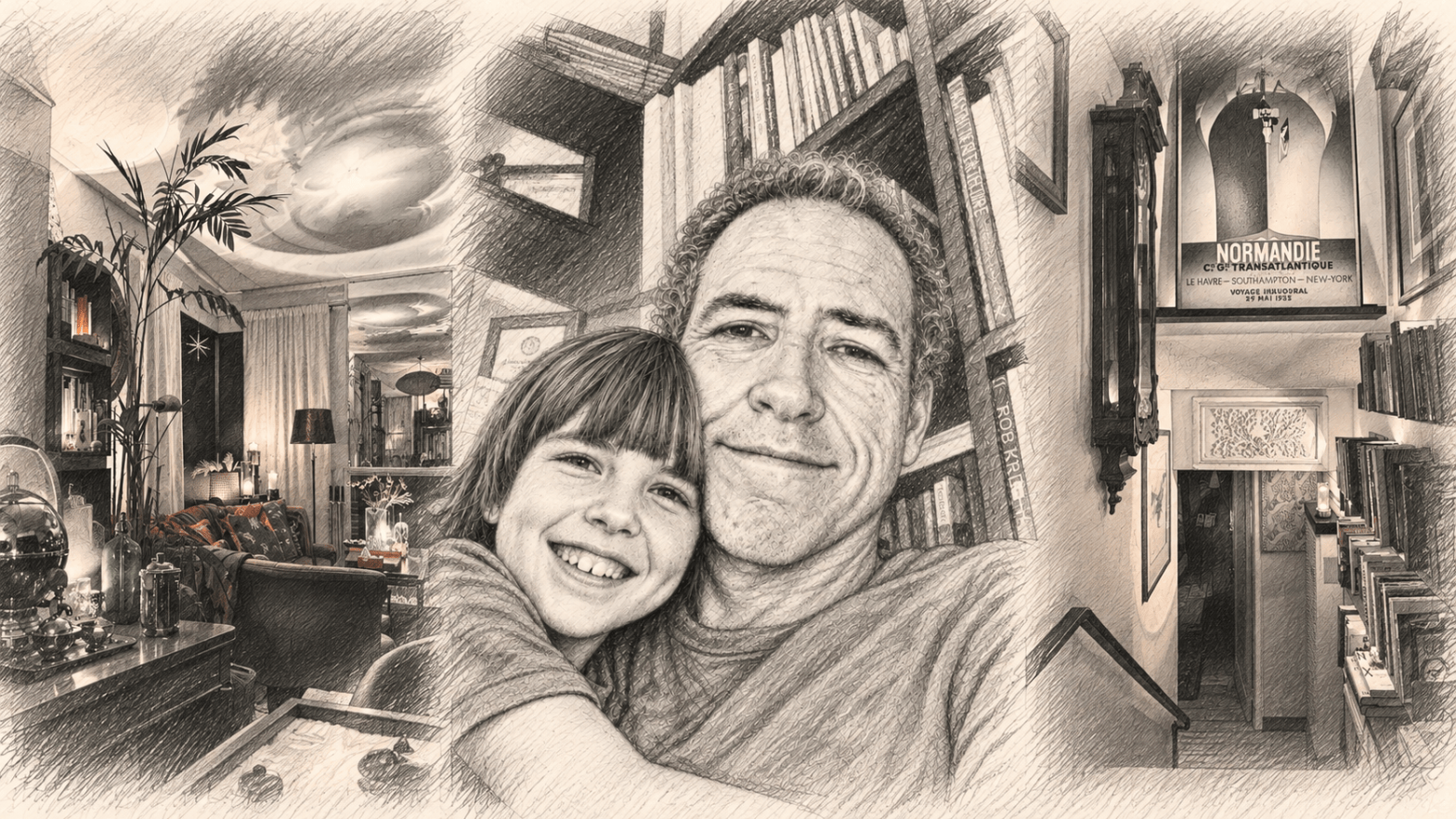
On Luke’s Day, an unexpected answer to prayer, a fraudulent email, and a promise to my nine-year-old son helped us understand what it means to put our children first.
Yesterday afternoon, I spent three minutes holding my seven-year-old son Solis.
Three minutes.
It felt like an eternity.
Not because anything extraordinary happened. We were lying on our bed in the apartment where our family lives. I had put down my phone. I wasn’t writing in our journal or trying to understand something that had happened earlier in the day. I wasn’t working on an essay.
I was holding my son.
And he was letting me love him.
We are a plural family of nine people sharing one body and a life. I am the father of eight sons, ages four to fourteen. Each of my children is his own person, with his own experiences, interests, memories, and ways of communicating with me and with his brothers.
Our circumstances make ordinary life complicated.
But yesterday, holding Solis, I experienced something that was wonderfully uncomplicated.
I was with my son.
And he was with me.
Later, we wrote an essay about what those three minutes had helped us understand.
We called it Love Is Not What Happens After Everything Else Is Finished.
The title was a discovery.
I had spent much of my adult life organizing everything around work, obligations, deadlines, and the expectations of other people. Even after our job ended in July, I continued to experience ordinary tasks as things that had to be accomplished before I could give my children the attention they needed.
Yesterday, Solis helped me recognize that I had been approaching life backward.
The children were not what happened after everything else was finished.
They were the reason for building a life in the first place.
That evening, I was talking with my nine-year-old son Luke.
I told him that I wanted to spend time with him the following afternoon, just as I had with his brother.
We had plans to visit our friends at Braided Bridge, a community gathering place in Oakland. We were looking forward to seeing everyone, but I was also thinking about how much time the outing would take.
I told Luke that one of the biggest reasons I might choose to stay home was that I wanted to snuggle with him.
I wanted him to have an afternoon with his daddy.
Not a few minutes squeezed between other activities.
Real time.
Time that belonged to him.
I made him a promise.
And the following day, I discovered how difficult it could be to keep.
⸻
Luke’s Day began with a dream about work.
I was an architect again.
For thirty years, we worked in architecture before spending another six years supporting local conferences of the Society of St. Vincent de Paul. Architecture had been a significant part of our life, and in the dream we were working on something beautiful.
There were drawings and an extraordinary museum.
There were friends.
There was a deadline.
But the work was becoming increasingly difficult. The drawings seemed to deteriorate as we worked on them. What had begun as something creative and promising became another impossible obligation.
We woke into a life in which we no longer had an employer.
And yet the familiar feeling remained.
There was something we were supposed to accomplish.
Something we were supposed to finish.
Something that would become a problem if we didn’t do it correctly.
The night before had also been difficult.
Luke and I had struggled during his bedtime. Memories of our family, our mother, and the loss of our job had brought up grief that I had not handled particularly well.
I had allowed my own distress to enter a conversation that should have centered on my son.
I knew that.
And I was sorry.
In the morning, we listened to an analysis of the previous evening while we got ready to leave.
It was painful to hear.
I could recognize places where I had responded to Luke’s sadness with my own anger and disappointment. I could recognize the way an old injury had entered a moment when my child needed his daddy.
I apologized to my boys.
I wanted to do better.
But there was another possibility I hadn’t fully considered.
Perhaps spending the entire following day worrying about how badly I had handled the night before would become another way of failing to be present.
I didn’t understand that yet.
We had a day to live.
And it was already beginning.
⸻
At ten o’clock, our friend Kim told us something extraordinary.
The woman we had spent much of the previous day trying to help had received the keys to her apartment.
We had been helping coordinate assistance for a neighbor who was in danger of losing an opportunity for housing.
Vincentians call the people we serve our neighbors.
Not clients.
Neighbors.
It is a word rooted in the question Jesus asks in the parable of the Good Samaritan: Who is my neighbor?
And it is a question that our childhood hero, Mister Rogers, asked in another way:
“Won’t you be my neighbor?”
Our neighbor had been living in her car.
An apartment had become available, but there was a financial obstacle, and the landlord was unwilling to wait while we tried to assemble the assistance she needed.
We had made telephone calls.
We had sent messages.
We had contacted people who might be able to help.
By the previous afternoon, it appeared that the opportunity had been lost.
We had been deeply disappointed.
Justus, my eleven-year-old son, had been particularly concerned about her.
We had done what we could.
And it hadn’t seemed to be enough.
Now Kim was telling us that our neighbor had the keys.
People at Braided Bridge had helped provide the money. Others had continued working on the situation after we went home.
Something had changed.
Our neighbor had somewhere to live.
The relief was enormous.
The previous evening, while preparing the essay about Solis, a name had come to us for our neighbor.
Elia.
We use pseudonyms in our writing because Vincentians take seriously the privacy and dignity of the neighbors we serve.
Elia is a name of Hebrew origin, associated with the meaning God has answered.
The name had come to us even after we believed that our neighbor had lost the apartment.
Now, less than a day later, we were hearing that she had received the keys to her new home.
We thought about Jesus asking his frightened disciples why they had doubted.
And we gave thanks.
But something else was happening that we didn’t immediately recognize.
We had gone home the previous afternoon believing that we had failed.
Other people had continued helping.
The situation had changed without our having to manage every part of it.
The good news had arrived while we were living our lives.
It hadn’t required us to sacrifice another evening.
It hadn’t required my children to wait until I had solved the problem.
We had participated in something good.
And other people had participated too.
There was room for all of us.
⸻
At Braided Bridge, we encountered a different problem.
An email had arrived in one of our accounts that appeared to be a security notification.
It was suspicious.
We receive fraudulent messages frequently, and ordinarily we would have marked it as spam and moved on.
But this one seemed to warrant closer examination.
We had already been dealing with concerns about account security, and I didn’t want to overlook something important.
We turned to ChatGPT for help understanding what we were seeing.
That began an investigation that grew increasingly complicated.
We were working with an iPhone and an iPad. The email looked different depending on where we opened it. Options that should have been available weren’t appearing. We were trying to determine whether a link was legitimate, whether we needed to change a password, and whether someone might have accessed an account.
We changed the password.
We checked security settings.
We examined screenshots.
We tried one approach and then another.
Kim was there with us.
And my children were there with me.
They were not simply watching their father use a telephone.
They were experiencing the uncertainty, the frustration, the urgency, and the interruptions.
Luke was participating.
Solis was participating.
Proverb was participating.
And as the investigation continued, the atmosphere became increasingly uncomfortable.
I was trying to protect us.
But I was also becoming absorbed in a task that seemed to generate another task every time we thought we were finished.
Eventually, everyone wanted to stop.
We had taken reasonable precautions.
We could mark the message as spam.
We could close the browser.
We could move on.
And finally, we did.
But the experience had consumed a substantial portion of our visit.
The good news about our neighbor had brought us enormous relief.
We had been among friends.
We were in a place where we belonged.
And somehow, a fraudulent email had managed to take possession of the afternoon.
Later, Luke said something that stopped me.
“I wasn’t doing nothing.”
He was right.
I had been so absorbed in trying to solve the problem that I hadn’t adequately recognized what he was contributing.
I knew he was there.
I had acknowledged him when he communicated with me.
But he wanted me to understand that he had been helping.
He wasn’t merely waiting for Daddy to finish.
He was participating in our life.
And he had been frustrated too.
I apologized.
But the larger problem was becoming familiar.
Yesterday, we had written that love was not what happened after everything else was finished.
Today, we had allowed another thing to become something that apparently had to be finished before we could return to our lives.
The irony was difficult to miss.
We had even been using the same technology that helped us write about the importance of being together.
The tool was useful.
The security concern deserved some attention.
But neither the tool nor the concern had the authority to decide how much of our day it would consume.
That was supposed to be my responsibility.
And I was still learning how to exercise it.
⸻
Before we left, we received a telephone call from Juan Luis, the president of our St. Vincent de Paul conference in Hayward.
We were anxious when we saw that he had called.
That is something I have been noticing since our job ended.
An unexpected telephone call can still produce the feeling that we are in trouble.
Something has happened.
Someone is unhappy.
There is something we have failed to do.
We don’t work for anyone anymore.
But our body doesn’t always seem to know that.
Juan Luis was calling about someone from the administration of the organization where we used to work.
She wanted to attend a meeting of our local conference.
He wanted to know whether we would be comfortable participating.
I told him no.
Not now.
Not later, under the circumstances as they stood.
We did not intend to have contact with our former employer.
Juan Luis understood.
In fact, he had suspected that would be our answer.
The conversation continued. We talked about the changes that had occurred since our departure and the concerns he had about the support local conferences were receiving.
But something important had happened.
Someone had asked us to participate in something.
And we had declined.
There had been no argument.
No threat.
No requirement to explain why our family needed the boundary.
We had simply said no.
And our friend had respected it.
For six years, we supported the 34 local conferences of the Society of St. Vincent de Paul of Alameda County, with a focus on Spirituality and Formation.
We worked from home.
Dad was the employee, but he was not the only member of our family who contributed to the work.
His sons participated too.
We developed relationships with Vincentians, helped conferences solve problems, and worked together to support the people carrying out the Society’s mission in their communities.
When the accommodations that made this work possible were challenged and the job ended, the consequences affected all nine of us.
But the ministry did not end with the employment.
We continue serving together.
We are Vincentians.
Dad and his sons.
And we are not willing to place our family in the situation we experienced with our former employer again.
But saying no to this meeting didn’t require us to solve our entire future.
It only required us to decide what belonged to this day.
And what did not.
⸻
Kim brought us home.
We stopped at Safeway for groceries.
We needed milk and half-and-half, Greek yogurt, tortilla chips, ice cream, and bread.
We were planning to have chili for dinner, and we wanted corn tortillas and cilantro.
Luke helped us find the little street tortillas.
We had passed them earlier without seeing them. On our way back down the aisle, he spotted them tucked along the side of a rack.
It was an ordinary contribution.
A nine-year-old boy helping his family shop for dinner.
I thanked him.
We got home shortly before four.
We were hungry.
We put away the groceries.
We changed into comfortable clothes.
We set up the iPad and keyboard.
We made a cheese sandwich.
Then we had nachos.
And we continued listening to the analysis of the journal.
I wanted to hear it.
I wanted to understand the day.
I wanted to begin the essay.
I wanted to make sure I hadn’t missed anything important.
But I also wanted to lie down with my children.
I told them so.
I wanted more than fifteen or twenty minutes.
I wanted more than half an hour.
I wanted enough time to be with each of my sons without finding myself rushing through the last few because dinner was approaching.
And I especially wanted to be with Luke.
I had promised him.
At 4:47, we were still listening.
The analysis was still going.
Two minutes later, I had enough.
“All right,” I said. “We’re laying down.”
I asked Alexa to play nature sounds.
We went to bed.
And at 4:53, I told my boys:
“I promised you boys. I promised you, Luke. If you are real, just like any other kid, then I’m gonna keep my promises and I’m gonna be with you.”
I began holding my son.
⸻
I had imagined that the afternoon would be like the previous day with Solis.
Yesterday, Solis and I had been so completely present with one another that three minutes had seemed to contain an entire world.
I wanted Luke to experience something like that.
I wanted him to feel my affection.
I wanted to feel his.
I wanted us to be together without interruption.
But Luke was quiet.
I held him.
I kissed him.
I told him I loved him.
I asked him to be with me.
And I worried.
Had I made him wait too long?
Was he still upset about the night before?
Had I failed to recognize how much he had been helping with the email?
Was he disappointed?
I apologized again.
And again.
Luke communicated with me.
He shared an extraordinary imagined scene involving the ocean liner Titanic.
Luke had been thinking about the movie Raise the Titanic, with its impossible depiction of the enormous ship being brought almost intact to the surface.
Luke contrasted that with images of the actual sinking—the ship breaking apart and its sections plunging toward the ocean floor.
Then he imagined Keith Richards’ funeral, with Mick Jagger standing there wearing a subtle expression that seemed to acknowledge the answer a question people had been asking for decades.
Who would go first?
I laughed.
Later, Luke showed me Ted Lasso walking around with his son as a baby, wearing enormous oven mitts that looked like the foam hands people wave at sporting events.
These were Luke’s thoughts.
His humor.
His imagination.
His way of being present.
But I was still waiting for something else.
I wanted him to be snuggly.
I wanted him to respond the way I had hoped.
I wanted to know that he was all right.
And because he was quiet, I began interpreting the quietness.
I asked whether he was angry with me.
Eventually, Luke told me:
“Daddy, I’m not mad at you.”
I heard him.
But I wasn’t entirely trusting what I heard.
I was still worried.
I had been carrying the previous evening’s sadness and my own regret into the afternoon. I was concerned that Luke was depressed, that he was unhappy, that I had made the day difficult for him.
Some of those concerns may have been justified.
Some may have been my own fears.
But Luke had told me something.
He wasn’t mad at me.
And I needed to allow his words to matter.
There was no reason his afternoon had to look exactly like Solis’s.
Luke is not Solis.
He is Luke.
He is nine years old.
He is his own person with his own consciousness, his own self-schema, memories, interests, feelings, and ways of expressing affection.
And perhaps I was so determined to give him the experience I had promised that I was in danger of deciding what that experience was supposed to look like.
I had promised to be with him.
I had not promised that he would have to respond in a particular way.
I held him for more than half an hour.
Then I told him that I needed to spend time with his brothers.
I loved him.
I would return.
And I did.
⸻
The afternoon continued.
I held Han.
He was wonderfully cuddly.
He remembered that we had forgotten to answer a friend’s text message. He also shared an imaginative scene of Disneyland in the 1960s, with dancers in white go-go outfits and a visual style that reminded me of Andy Warhol.
I held Jude.
My four-year-old was affectionate and playful.
He wanted to know whether there would be more Ted Lasso.
Not for a while, I told him.
“It wasn’t long enough,” he said.
I agreed.
Luke suggested that perhaps we should start watching it again.
Then I held Solis.
He was affectionate in a way that made me want to stay with him indefinitely.
Twice, I began drifting toward sleep while holding him.
It felt wonderful.
But there were other children waiting, and we still needed to have dinner.
I told Solis how much I loved him.
How wonderful it was to feel his affection.
How grateful I was that he was my son.
And then I began thinking about our future.
I thought about the possibility of having to return to conventional employment.
Commuting.
Working under people who did not understand our family.
Trying to negotiate arrangements that would allow my children to have the life they needed.
I felt the old fear.
And I felt something else.
A refusal.
We had spent decades organizing our life around employment.
We had worked extraordinarily hard.
We had sacrificed more than we should have.
And we had lost jobs despite those sacrifices.
We did not want to build our next life on the same foundation.
I didn’t know how we would sustain us.
I still don’t.
There are practical questions that require answers.
But I knew that I could not treat my children as the things that would have to be sacrificed to make the answers possible.
I told them that.
I told them I would not do it again.
I asked God to show us another way.
Then I held Daniel.
My five-year-old was happy about the corn tortillas we had bought for dinner.
I held Proverb.
I held Hope.
I held Justus.
Justus and I talked about what he might like to do on Saturday, his day.
He remembered visiting San Francisco during difficult periods at work.
We had once taken the ferry across the bay and visited the Maritime Museum, where a ranger had spent a couple of hours showing us the ferryboat Eureka, which was closed to the public, about to leave for the shipyard in Vallejo for a long deferred overhaul.
He remembered another visit to Golden Gate Park, when we had been trying to escape the fear surrounding our employment situation.
Even there, the anxiety had followed us.
I wondered whether it might be different now.
Perhaps we could go back.
Perhaps we could visit Golden Gate Park or take the N Judah to Ocean Beach.
Perhaps we could experience a place we loved without worrying about what might be waiting for us when we returned home.
The job was over.
There was nothing to go back to.
We could simply go to San Francisco.
I asked Justus what he thought.
We didn’t have to decide.
It was enough to imagine that something different might be possible.
Then, at 6:30, I returned to Luke.
⸻
I held my nine-year-old son.
I kissed him.
And this time, Luke responded strongly.
He returned my affection.
He kissed me back.
I was delighted.
“Luke, thank you so much, sweetheart,” I told him. “That made me so happy.”
I held him close.
I told him how much I loved him.
I thanked him for being my son.
And I thanked God.
I thanked God for Luke.
I thanked God for all eight of my children.
I thanked God for the good day we had been given.
It had not been an easy day.
We had begun with exhaustion from the night before.
We had experienced extraordinary good news.
We had become entangled in a frustrating security problem.
We had received an unexpected reminder of our former employer.
We had been anxious.
We had been disappointed.
We had spent too much time looking at screens.
I had worried about Luke.
I had worried about my ability to care for my sons.
And now I was holding my child.
He was responding to my affection.
And I was responding to his.
Nothing else needed to happen.
I didn’t need to make him feel something different.
I didn’t need to ask him to reassure me.
I didn’t need to turn the moment into an explanation of everything that had gone wrong.
I could simply love him.
And allow him to love me.
⸻
There was still an essay to write.
We had been thinking about it all afternoon.
We could begin to see the basic shape of the story. But I also knew what would happen if we sat down at the keyboard before dinner.
We would begin writing.
Then we would begin editing.
Then we would want to listen to what we had written.
Then we would want to make changes.
And the evening would disappear.
My children would wait.
Dinner would be late.
Bedtime would be late.
And once again, I would find myself trying to accomplish something important for the family at the expense of being with the family.
So I made another decision.
We would get up.
We would make dinner.
We could listen to some ideas about the essay while we prepared and enjoyed our meal.
I would tuck my sons into bed.
And afterward, if we still wanted to work on the essay, we could.
It didn’t have to be finished before we lived the rest of our day.
I told my children:
“The essay, the journal, all of these other things serve life, us, not the other way around. Daddy is trying to learn.”
I meant it.
Our journal matters enormously to us.
We have been keeping Notes from the Treehouse daily since 2019.
It helps us remember.
It helps us understand.
It gives each of us a way to be known.
The essays have become another way of sharing our family’s experience with the world.
But the journal is not the family.
The essay is not the family.
Even the work of trying to understand our lives is not the same thing as living them.
The work is supposed to serve the relationship.
Not replace it.
And today, Luke had helped me understand something about that relationship.
Yesterday, Solis had shown me how extraordinary three minutes of undivided attention could be.
Today, Luke had shown me that I couldn’t turn those three minutes into another assignment.
I couldn’t decide in advance what being with him was supposed to feel like.
I couldn’t require his affection to arrive on schedule.
I couldn’t measure the success of our afternoon by whether it reproduced something beautiful that had happened with his brother.
I could make time for him.
I could hold him.
I could listen.
I could apologize when I needed to.
I could believe him when he told me how he felt.
And I could allow him to be Luke.
Not the Luke I was afraid I had hurt.
Not the Luke I was trying to make happy.
Not the Luke I needed to reassure me that I was becoming a better father.
Just Luke.
My nine-year-old son.
The boy who remembered the corn tortillas.
The boy who knew about The Sound of Music.
The boy who imagined the Titanic sinking to the ocean floor.
The boy who thought perhaps we should watch Ted Lasso again.
The boy who told me he wasn’t mad at me.
The boy who kissed me back.
My son.
⸻
At 6:35, I was still holding Luke.
I had been cleaning up the last portion of the journal, preparing to share it for help developing the essay.
Luke had been responding occasionally to my affection.
I could feel his brothers too.
And I became profoundly aware of something.
I was holding my child.
Not an idea.
Not a responsibility.
Not a problem to solve.
Not a person whose feelings I needed to manage.
My son.
I told him:
“I have this life in my arms.
“I am profoundly, deeply aware of you as your own human person.
“You’re here with me.
“You’re letting me love you, and I’m feeling your love.”
And I told him what I wanted him to know.
That he was everything to me.
That his brothers were everything to me.
That I would not sacrifice them for anything.
That this was my promise before God.
I believe God has entrusted these children to me.
I believe being their daddy is the central vocation of my life.
That doesn’t mean there are no other responsibilities.
There are.
We need a home.
We need food.
We need healthcare.
We need to find a sustainable way to live.
We have friends and neighbors whom we love and want to help.
We have gifts we want to share.
We have a world in which we want to participate.
But those responsibilities must be organized around the reality of the people who live this life.
Eight children.
Their daddy.
All nine of us.
Together.
I don’t yet know what that life will look like.
I don’t know how all the practical questions will be answered.
I don’t know what we will discover in therapy, or what our ministry will become, or how our writing will develop.
I know there will be difficult days.
I know I will make mistakes.
I know I will sometimes become absorbed in something and need my children to remind me that they are waiting.
But I am learning.
And today, Luke gave me another opportunity to practice.
I promised him that I would be with him.
I wasn’t perfect at it.
I sometimes allowed my own worry to shape how I understood his feelings.
I had things to apologize for, and I apologized.
But I also needed to listen when Luke told me how he felt.
I put down the work.
I went to bed.
I held him.
And when he was ready, he kissed me back.
At 6:46, I told my boys it was time to get up.
There were groceries in the kitchen.
There was chili waiting for us.
There was cilantro and the corn tortillas Luke had helped us find.
And there was an evening still to enjoy.
I held Luke close for another moment.
I kissed him.
He responded.
Then I told my children that we were going to turn on our tea lights and our other LEDs.
We have 89 of the little rechargeable lights throughout our apartment.
They make our home enchanted in the evening. The idea started with Solis.
They shine on the things we have gathered and made together.
They help transform an ordinary room into a place that belongs to us – an extension of our inner world.
I wanted to turn them on.
I wanted our home to shine with the magic of the presence my children bring.
So we got up.
Not because everything else was finished.
There was still an essay to write.
There were still questions to answer.
There was still a great deal I needed to learn.
But there was dinner.
There was our home.
There were my sons.
And there was a life waiting to be lived.
A life I had been holding in my arms.
A life I did not want to miss.
A life we were building together.

